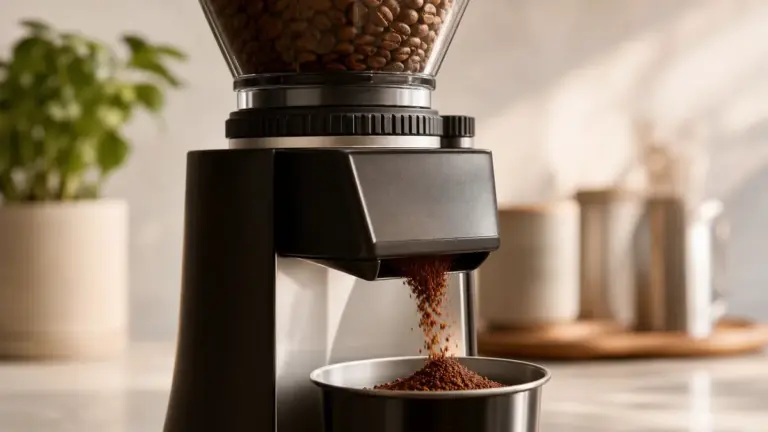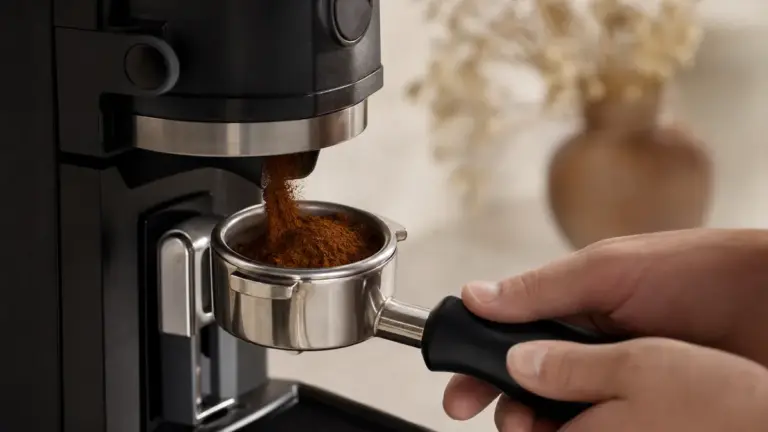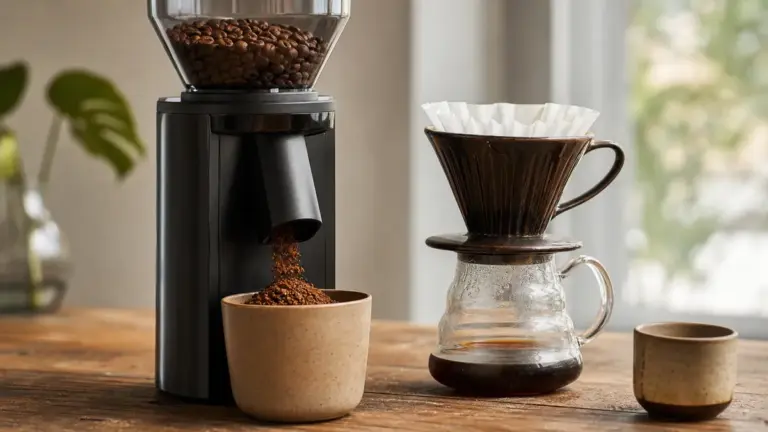
Burr grinders break roasted coffee between two toothed surfaces, with an adjustable gap controlling the grind. Both conical and flat burrs can make excellent coffee: choose the grinder’s brewing suitability, adjustment and maintenance arrangements before treating burr shape as a promise of flavour.
In short
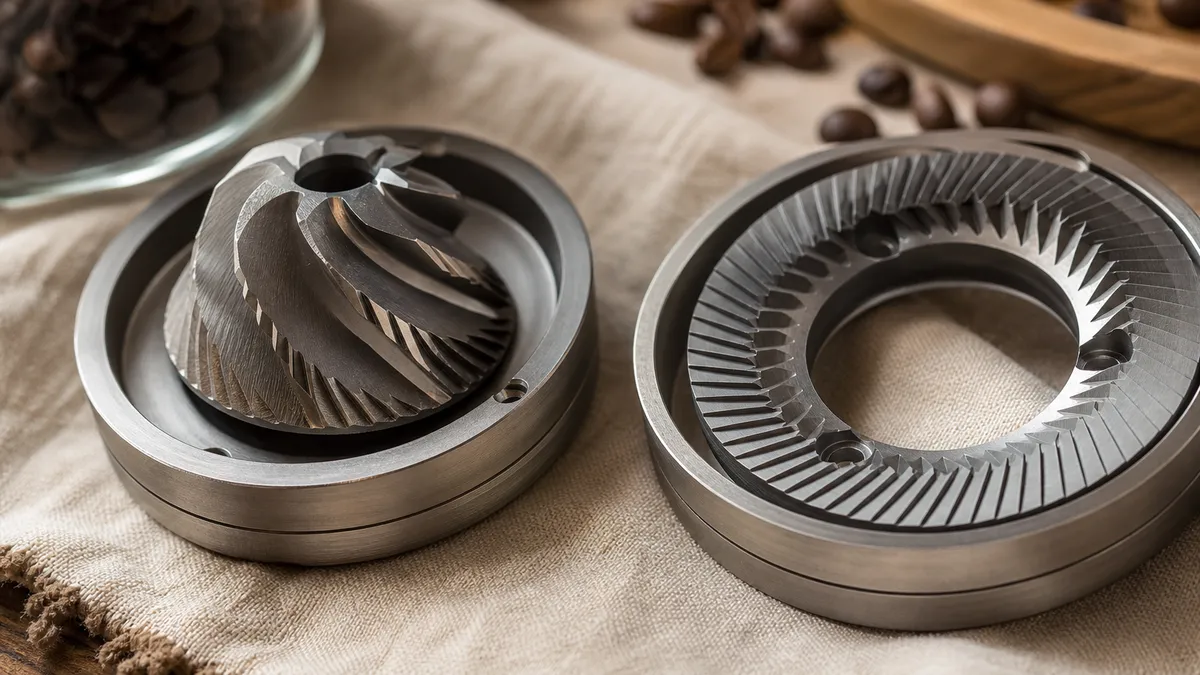
- Conical burrs pair an inner cone with an outer ring; flat burrs use opposing, parallel grinding discs.
- Every grinder produces a spread of particle sizes, not identical grains.
- “Conical means body, flat means clarity” is a reported tendency in some designs, not a dependable buying rule.
- Rotational speed can change grinding behaviour, but slower does not automatically mean better.
- Check cleaning access, replacement burr availability and the intended brewing methods before choosing.
How burr grinders work
Coffee enters the space between the burrs, where larger teeth break the beans into fragments and finer cutting features reduce them further. Adjusting the burr separation changes the grinding conditions and the resulting particle sizes.
The distinction from a blade grinder is control. Rather than chopping coffee in a chamber for a chosen duration, a burr grinder provides a mechanical grind adjustment. Our guide to blade grinders explains that alternative without confusing it with burr design.
However, the gap is not a sieve that produces perfectly matching grains. Coffee fractures irregularly, so grounds contain larger fragments and much smaller particles called fines.
For the wider equipment picture, start with the coffee grinders hub. Here, the useful question is what the two burr shapes actually tell you, and what they leave unanswered.
Conical Burr Grinders
A conical burr set has a toothed inner cone sitting inside a toothed outer ring. Relative rotation draws coffee through the grinding surfaces towards the narrower finishing region.
This arrangement appears in domestic electric grinders and hand grinders. If turning the handle yourself appeals, our guide to manual hand grinders covers the practical trade-offs separately.
Conical designs are often associated with lower rotational speeds. That is a feature of particular grinder systems, not a requirement that every conical grinder follows the same speed or produces the same grounds.
What conical burrs may offer
Baratza describes some of its conical grinders as producing round, sweet flavours, with fine particles contributing to a more forgiving espresso adjustment. Treat this as the manufacturer’s description of its own products, rather than independent proof about all conical burrs.
Nor are conical burrs confined to traditional, heavy-bodied espresso. Mazzer describes a newer conical tooth design as improving particle uniformity and suiting light and medium roasts.
Our buying view: keep conical grinders on your shortlist for either espresso or filter, but ask about the specific burr set and adjustment range. Reject the idea that the cone shape alone tells you how the coffee will taste.
Flat Burr Grinders
Flat burr sets use two opposing ring-shaped discs with parallel grinding faces. Coffee enters towards the centre and moves outwards through the teeth, assisted by centrifugal action, before leaving the grinding region.
“Flat” describes the overall arrangement, not identical cutting surfaces. The teeth, grooves and finishing sections can differ considerably between burr sets.
What flat burrs may offer
Some flat burr designs are promoted for flavour clarity, meaning that individual characteristics seem easier to distinguish rather than merging into one broad impression. Other flat burrs are intended to produce a fuller, more rounded drink.
Baratza’s own descriptions illustrate the problem with a simple shape rule: it associates its flat steel burrs with clarity, but its flat ceramic burrs with syrupy texture. Those descriptions do not isolate material from tooth design, so they cannot establish that steel or ceramic alone caused the difference.
Our buying view: consider a filter-focused flat burr grinder if distinct flavours are your priority, but seek evidence about that exact configuration. For espresso, establish its adjustment capability first. A flat burr label does not guarantee either filter clarity or espresso suitability.
Conical versus flat burrs: what to compare
Use brewing suitability, adjustment, documented grinding behaviour and maintenance access as your comparison criteria. Shape is useful context, but not a complete specification.
| Criterion | Conical burrs | Flat burrs | Buying implication |
|---|---|---|---|
| Geometry | Inner cone and outer ring | Opposing parallel discs | Understand the arrangement, not a quality ranking |
| Reported cup character | Often described as rounded or textured | Often described as clear, but some designs favour body | Compare exact burr sets |
| Particle distribution | Can contain substantial fines alongside larger particles | Can also produce a bimodal distribution | Do not assume flats eliminate fines |
| Speed | Often lower in established designs | Often higher in established designs | Assess the whole grinder |
| Best fit | Buyers whose chosen model meets their brewing and handling needs | Buyers whose chosen model meets their brewing and handling needs | Neither shape wins universally |
A useful shortlist should answer these questions:
- Does the manufacturer explicitly support your brewing method?
- Can you make sufficiently small grind changes for your intended use?
- Can you clean it without disturbing parts the manufacturer expects a technician to handle?
- Are the correct replacement burrs available?
- Is the flavour description backed by a disclosed comparison, or only promotional language?
For general selection rather than burr mechanics, use the complete grinder guide.
Particle distribution and honest flavour claims
Particle size distribution describes the spread of sizes in a sample of grounds. Two samples can have a similar average size but different amounts of fines and different proportions of larger fragments.
A bimodal distribution has two peaks: broadly, a fine-particle population and a larger-particle population. Unimodal means one peak. Neither term means every particle has the same dimensions.
Why the familiar explanation needs correcting
You will often encounter the claim that conical burrs are bimodal while flat burrs are unimodal. That is too categorical.
A peer-reviewed espresso study published in 2024 describes finely ground espresso coffee as characteristically bimodal. Its findings do not support assigning bimodality exclusively to conical burrs. Some modern flat burr designs target low fines and a narrower main distribution, but “flat” is not another word for “unimodal”.
Cut geometry and alignment deserve attention alongside overall shape. In a 2016 grinding study, researchers explicitly identified flat-burr misalignment as a source of changes in particle distribution. Mazzer’s newer conical designs also show that manufacturers alter the refining teeth within the same broad burr category.
What fines actually change
The 2024 controlled experiment added sieved fines to ground coffee. Increasing their share reduced the coffee bed’s permeability, meaning water passed through it less readily, and lengthened espresso extraction.
That does not make fines inherently undesirable. Within the study’s tested conditions, higher fines did not automatically reduce sensory scores.
The defensible conclusion is modest: distribution affects brewing, but a particle graph alone does not establish which cup you will prefer. “More uniform” needs a brewing context, not an automatic place at the top of a ranking.
Heat and speed
Rotational speed is usually expressed as rpm, or revolutions per minute. It can influence particle distribution, but there is no universal rule that turning a grinder down produces fewer fines.
Timemore reports opposite responses in two related grinders: increasing speed raises fines slightly in its Sculptor 078, while reducing them in its 078S. These are manufacturer-reported observations, not an independent rule for other machines.
Temperature also matters, although claims about “burning the coffee” often go beyond the evidence. The 2016 controlled grinding experiment found that colder beans produced smaller particles and a narrower distribution on the tested grinder.
Crucially, that experiment changed bean temperature. It was not a controlled comparison proving that conical grinders run cooler, or that a faster flat burr grinder damages flavour.
For repeated workplace use, ask the supplier about permitted operating patterns, cooling arrangements and suitability for your busiest period. Do not substitute burr shape or a low-speed claim for confirmation that the grinder suits the workload.
Maintenance and troubleshooting
Coffee particles and oils accumulate in the grinding chamber and exit path. Baratza identifies this build-up as a contributor to inconsistent grinding, slower output and blockages.
Follow the instructions for the exact grinder. Even cleaning schedules differ: Baratza suggests routine cleaning every four to six weeks in its general guidance, while Fellow gives a different minimum interval for daily-use Ode grinders. Neither interval should become a universal rule.
A safe cleaning sequence
- Read the maintenance instructions. Identify which parts are user-removable and whether cleaning tablets are permitted.
- Switch off and unplug. Never reach into an electrically connected grinder.
- Remove only approved components. Keep small fixings together and note their positions.
- Dry-brush the accessible burr chamber and chute. Follow any model-specific instructions for clearing retained grounds.
- Keep water away from burrs and internal mechanisms unless expressly permitted. Wash removable containers only as instructed and dry them completely.
- Reassemble and check the required calibration procedure. Do not copy another grinder’s burr-contact or adjustment instructions.
Fellow’s installation guidance requires clean mounting surfaces and burrs sitting flush. Mazzer similarly stresses clean burr supports and warns against overtightening securing screws.
| Symptom | Likely cause | Fix |
|---|---|---|
| Output becomes slow or stops | Blocked outlet or unsuitable fine setting | Follow the manual’s blockage procedure; clean the chamber and chute |
| Grind changes after cleaning | Incorrect seating or changed calibration | Recheck assembly and the manufacturer’s calibration instructions |
| Unexpected scraping or a new mechanical noise | Assembly or mechanical problem | Stop using it and contact support |
| Old, rancid notes persist | Residue in the chamber or exit path | Clean approved areas before changing burrs |
There is no useful universal burr replacement interval. Mazzer publishes different indicative service lives for different burr sets. Use the manufacturer’s guidance and investigate deteriorating performance rather than replacing burrs solely because a calendar reminder appears.
FAQ
Are ceramic burrs better than steel burrs?
Neither material is automatically better. Manufacturer descriptions combine material, tooth design and intended brewing use, making it unsafe to attribute a flavour difference to material alone. Compare the specified burr set, its replacement arrangements and its suitability for your coffee, rather than treating ceramic or steel as a quality grade.
Can I fit different burrs to change the flavour?
Sometimes, but only use a combination confirmed as compatible with your grinder. Fellow publishes installation and calibration instructions for particular alternative burr sets in the Ode, illustrating how specific the process can be. Matching diameter alone is not sufficient confirmation. Ask the manufacturer before buying replacement or alternative burrs.
Do new burrs always need seasoning?
No, seasoning is not a universal requirement. Mazzer states that its burrs do not need breaking in, although it advises initial doses to check correct operation and says not to brew with those doses. Follow the instructions for the actual burr set rather than grinding through an arbitrary quantity of coffee.
Where to go next
Read Coffee Grinders: The Complete Guide to place burr grinders within the wider choice of equipment. Blade Grinders explains the alternative grinding mechanism, while Manual Hand Grinders helps you decide whether a hand-powered burr grinder fits your routine.
Sources
Manufacturer descriptions below establish designs, instructions and attributed claims, not independently verified superiority.
-
Baratza, Shop by Burr Type, undated, retrieved November 2026.
https://www.baratza.com/en-au/landing/shop-by-burr-type
Burr arrangements and manufacturer-described cup characteristics. -
Baratza, Dialing in Espresso: Burr Types, Adjustments, and Troubleshooting, undated, retrieved November 2026.
https://www.baratza.com/en-us/blog/product-guides/dialing-in-espresso
Attributed conical-burr flavour and adjustment descriptions. -
Mazzer, ZZ Burrs, undated, retrieved November 2026.
https://www.mazzer.com/en/zz-burrs/
Manufacturer descriptions of revised tooth geometry and intended cup profiles. -
Smrke, S., Eiermann, A. and Yeretzian, C., The role of fines in espresso extraction dynamics, Scientific Reports 14, 5612, 2024.
https://www.nature.com/articles/s41598-024-55831-x.pdf
Controlled experiments on fines, permeability, extraction and sensory results. -
Uman, E. and colleagues, The effect of bean origin and temperature on grinding roasted coffee, Scientific Reports 6, 24483, 2016.
https://www.nature.com/articles/srep24483.pdf
Controlled temperature experiments and discussion of burr alignment. -
Timemore, Tips For Sculptor, undated, retrieved November 2026.
https://www.timemore.com/blogs/tips-for-sculptor
Manufacturer-reported, model-specific responses to rotational speed. -
Baratza, Grinder Cleaning Essentials: Routine Care & How to Prevent Clogs, undated, retrieved November 2026.
https://www.baratza.com/en-us/blog/cleaning/grinder-cleaning-essentials
Residue, blockages and maintenance guidance. -
Fellow, How to clean & maintain your Ode Brew Grinder, undated, retrieved November 2026.
https://help.fellowproducts.com/hc/en-us/articles/4402414279309-How-to-clean-maintain-your-Ode-Brew-Grinder
Electrical safety, dry cleaning, recalibration and support advice. -
Fellow, How do I install and calibrate my Ode Gen 2 Brew Burrs and SSP MP Burrs?, undated, retrieved November 2026.
https://help.fellowproducts.com/hc/en-us/articles/7767147426843-How-do-I-install-and-calibrate-my-Ode-Gen-2-Brew-Burrs-and-SSP-MP-Burrs
Model-specific fitting, seating and calibration instructions. -
Mazzer, Burrs tutorial, undated, retrieved November 2026.
https://www.mazzer.com/en/burrs-tutorial/
Speed comparisons within its range, cleaning, replacement and seasoning guidance.
This article was researched using manufacturer technical guidance and peer-reviewed grinding experiments, separating reported sensory characteristics from demonstrated physical effects.
Last checked: November 2026