A coffee grinder determines the size and spread of the particles you brew, giving you control over extraction, flow and flavour. Choose an adjustable burr grinder that suits your main brewing method: espresso needs particularly fine adjustment, while filter coffee needs repeatable settings across a useful medium-to-coarse range.
In short
- Choose by brewing method and adjustment precision, not simply the number of settings.
- Burr grinders offer controlled adjustment; blade grinders chop coffee without an adjustable burr gap.
- Conical and flat describe burr shapes, not a universal quality ranking.
- Low retention is useful when changing beans or brewing methods, but matching input and output weights does not prove that no old grounds remain.
- Check cleaning access, replacement parts, permitted use and UK support before choosing extra features.
Why the grinder deserves your attention
Grinding exposes more of the bean to water. Particle size affects how quickly soluble material leaves the coffee and, in a bed of grounds, how readily water passes through it. Extraction means dissolving material from the coffee into the brewing water.
The grinder therefore deserves attention before another brewer upgrade. Our editorial view is that, once your brewer works properly, improving grind control is often the more useful next step. It lets you change a brewing variable deliberately rather than compensate for grounds you cannot reproduce.
That does not mean every disappointing cup needs new equipment. Keep the coffee, dose and brewing method consistent first. The wider coffee grinder hub provides the route into more specialised equipment guidance.
Burr versus blade: the essential choice
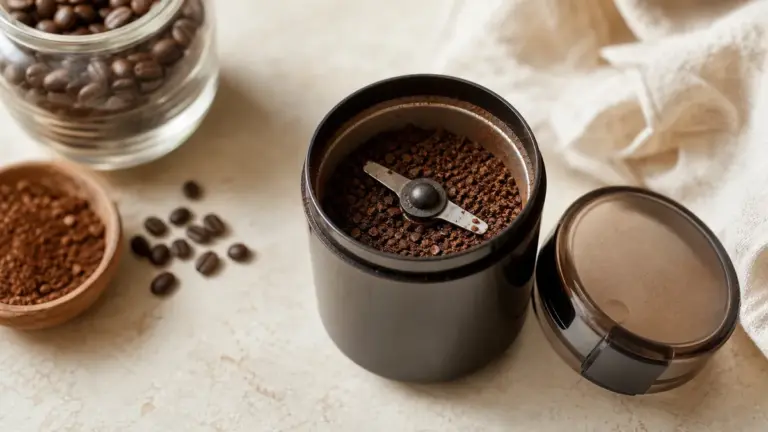
A burr grinder passes beans between two cutting surfaces. Adjusting their separation changes the grind. A blade grinder uses a spinning blade in a chamber, with the result controlled mainly by how long it runs.
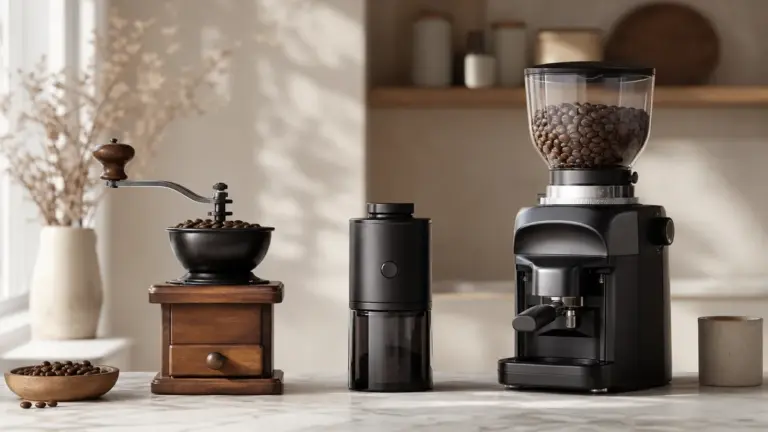
| Type | How adjustment works | Who it suits | Main limitation |
|---|---|---|---|
| Blade | Pulsing or longer running chops the coffee further | Someone using an existing grinder for straightforward brewing | Difficult to reproduce a particular particle distribution |
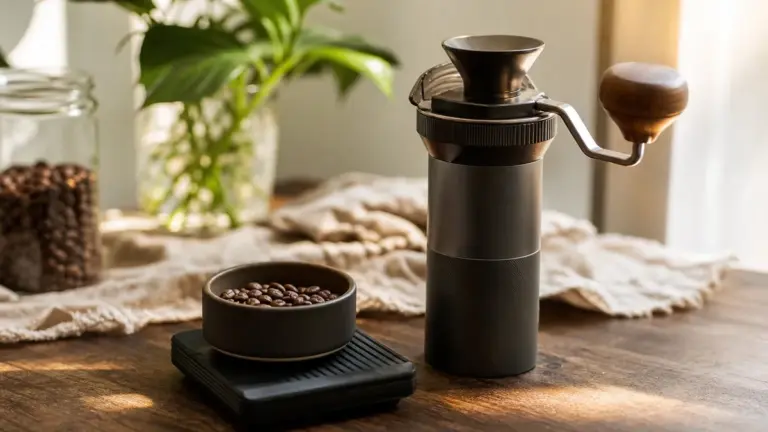
| Manual burr | An adjustable burr gap, powered by a handle | Someone happy to grind each dose by hand | Requires physical effort for every batch |
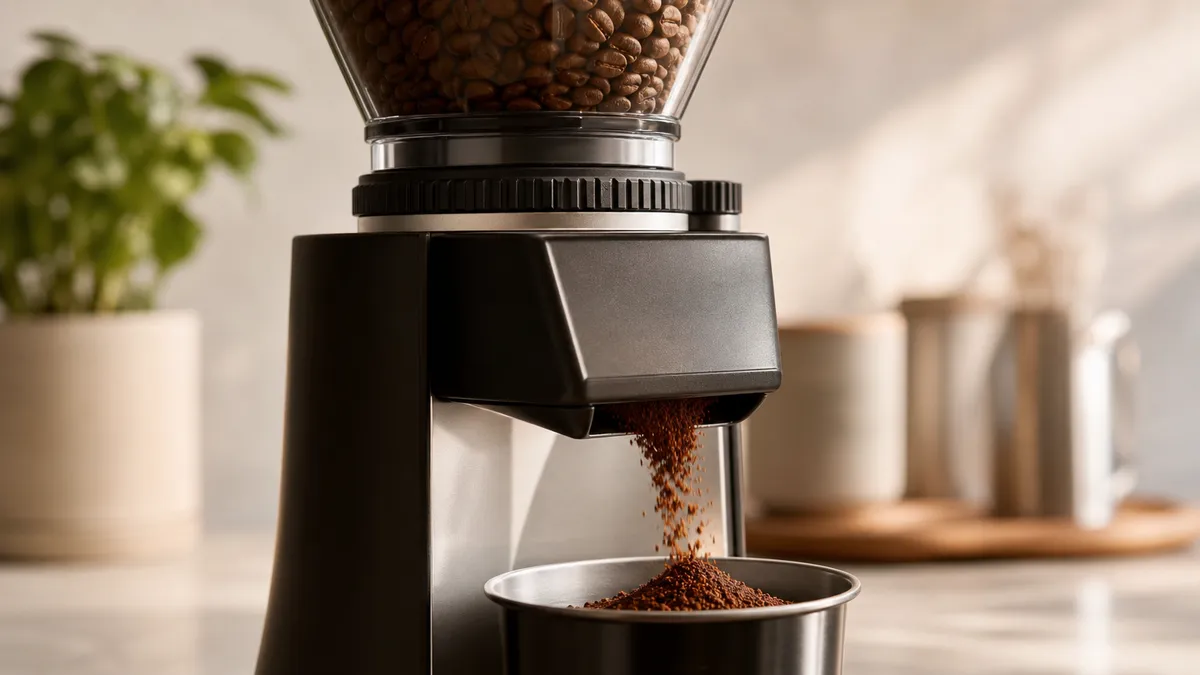
| Electric burr | An adjustable burr gap, powered by a motor | Regular brewing or several drinks in succession | Needs power and suitable space |
An adjustable burr grinder is our recommended starting point for repeatable brewing. Blade grinders can make usable coffee, but running them longer is not equivalent to selecting a finer burr setting: already-small fragments remain in the chamber while larger pieces are chopped.
For the mechanisms and their limitations, see burr grinders and blade grinders. The distinction matters more at this stage than screens, timers or the appearance of the housing.
Conical versus flat burrs
Conical burrs have a cone-shaped inner component and a surrounding ring. Flat burrs use opposed circular cutting faces. Both arrangements can provide adjustable grinding.
Avoid treating the shape as a flavour guarantee. Baratza, for example, describes different sensory aims for its flat steel and flat ceramic burrs, despite both being flat. Those are manufacturer descriptions of particular burr sets, not independent proof that every grinder with that shape tastes alike.
For a shortlist, ask more useful questions:
- Is the burr set intended for your brewing method?
- Does the adjustment offer enough control?
- Can you clean the grinding chamber without disturbing parts the manual says to leave alone?
- Are replacement burrs and other service parts available?
If possible, compare coffee brewed under the same conditions. A shape label alone is not a tasting result.
Stepped and stepless adjustment
A stepped grinder has fixed positions, usually felt as clicks. A stepless grinder allows adjustment without fixed stops. Some designs combine larger stepped movements with a finer secondary adjustment.
Stepped settings are convenient for recording recipes and returning to them. Their usefulness depends on the distance between steps, however. A grinder can have a broad overall range yet leave too large a jump between adjacent espresso settings.
Stepless adjustment allows very small changes, but check how easily you can record and recover a position. A clear reference scale can be more useful than an impressive-sounding total number of settings.
There is no need to reject stepped adjustment for espresso automatically. The relevant question is whether its fine-range steps are small enough for the coffee and basket you use.
Espresso versus filter: match the job first
Espresso
With a conventional, non-pressurised espresso basket, grind adjustment is a central tool for controlling flow. Look for an explicitly espresso-capable grinder with fine adjustment, not merely a product description saying it grinds “fine”.
Check the receiving arrangement too. Will it hold your portafilter securely, or will you grind into a dosing cup and transfer the grounds? Choose the arrangement you can use neatly and consistently.
Filter and immersion brewing
For pour-over, automatic filter brewing and cafetière coffee, prioritise repeatable settings in the appropriate range. You do not need espresso adjustment simply to make filter coffee.
The Specialty Coffee Association’s SCA-320:2021 home grinder standard concerns atmospheric-pressure brewing and explicitly excludes espresso grinders. Its particle-distribution requirements are test conditions for that purpose, not a universal ideal grind for every recipe.
One grinder for both
A dual-purpose grinder can be practical, but check the changeover process. Can you move between methods easily, recover the previous position and clear grounds left at the old setting?
Do not compare setting numbers between different machines. Use the manufacturer’s suggested setting as a starting point, then adjust for your recipe and taste.
Choosing a coffee grinder: a decision path
Work through these decisions in order:
- Name your main brewing method. If espresso is essential, establish fine-adjustment suitability before considering convenience features.
- Choose manual or electric operation. Be realistic about how often you want to turn a handle and how many consecutive doses you prepare.
- Choose a bean-feeding routine. A hopper holds beans ready for grinding; single-dosing means weighing each portion before adding it.
- Check method switching. Ask how settings are recorded and what the manual recommends after a large adjustment.
- Inspect cleaning and support. Read the manual before ordering. Check removable parts, replacement components and repair arrangements.
- Confirm the intended environment. For workplace use, ask the supplier to confirm suitability in writing. A domestic grinder is not automatically intended for shared commercial use.
Compare feature tiers, not monetary bands
Use these capability tiers rather than assuming every higher-tier machine is a necessary improvement:
- Essentials: adjustable burrs, a suitable grind range and accessible cleaning.
- Workflow additions: convenient dosing controls, a useful receiving cup or portafilter holder, and easy-to-read adjustment.
- Specialist requirements: particularly fine espresso control, straightforward single-dosing or declared suitability for repeated workplace use.
Make the shortlist against those requirements first. For a workplace purchase, obtain itemised written quotations covering the grinder, accessories, replacement burrs, servicing and delivery, with VAT treatment identified. Compare what is included and which ongoing items your own usage will require.
Retention: what stays behind matters
Retention is coffee that remains inside the grinding chamber or outlet instead of reaching the receiving cup. After changing settings, some grounds leaving the grinder may still have been produced at the previous setting.
Distinguish two questions:
- How much coffee appears to be missing when you compare input and output?
- How much previously ground coffee is being exchanged for newly ground coffee?
These are not identical. Equal weights in and out cannot establish freshness: some old grounds could leave while an equal mass of new grounds remains.
For a practical check, weigh the beans and collected grounds over repeated doses under the same conditions. Treat this as a workflow check, not a complete measurement of internal retention. Ask what a manufacturer’s “low retention” claim actually measures.
Follow the manual’s guidance on purging, meaning grinding some coffee through to clear transitional grounds. There is no single purge quantity that should be imposed on every grinder.
Using the grinder consistently
Use this routine when establishing a setting:
- Start with the manual’s recommendation. Select the range for your brewing method rather than copying another grinder’s dial number.
- Weigh and record the dose. Use grams, and keep it unchanged while investigating the grind.
- Keep the brewing recipe fixed. Record water quantity, temperature and timing from the recipe you already use. They are controls here, not additional variables to change.
- Brew and taste. Note the flavour and, where relevant, how readily water passed through the grounds.
- Change only the grind. Make a small adjustment, then repeat. Follow model-specific instructions about whether the motor must run during adjustment.
- Record the useful setting. Include the coffee and recipe so the number has context.
A timer controls running time, not directly the mass delivered. Check the collected dose by weighing it rather than assuming a previously useful timer setting still delivers exactly what you need.
| Symptom | Likely cause to investigate | First action |
|---|---|---|
| Espresso reaches the intended yield unusually quickly | Grind too coarse, with other variables unchanged | Try a small finer adjustment |
| Espresso barely flows after an adjustment | Grind too fine or a brewing obstruction | Check preparation and try slightly coarser |
| Results remain mixed immediately after switching methods | Grounds retained from the previous setting | Follow the manufacturer’s purge guidance |
| Grinding slows or the outlet blocks | Accumulated grounds or an overfilled receiver | Stop and follow the cleaning procedure |
| Grinder will not start after cleaning | A removable part is not seated or locked correctly | Unplug and check assembly instructions |
These are starting points, not diagnoses. A flow problem can have causes outside the grinder.
Cleaning without damaging the grinder
Follow the model’s manual rather than a universal cleaning calendar. Baratza’s general guidance suggests routine cleaning every four to six weeks, but usage and the manufacturer’s instructions should determine your own schedule.
For a typical removable-burr electric grinder:
- Remove beans and run out remaining coffee only as instructed, with the grinder assembled.
- Switch off and unplug before opening the grinding chamber.
- Remove only user-serviceable components.
- Brush accessible burrs, the chamber and outlet using the approved method.
- Wash only components the manual identifies as washable, then dry them thoroughly.
- Reassemble carefully before reconnecting power.
Do not assume burrs are washable because the hopper is. Sage’s Smart Grinder Pro manual specifies brushing its burrs while separately allowing washing of certain containers and hopper parts.
Use cleaning tablets only where the manufacturer permits them. Do not improvise with foodstuffs or liquids as a substitute for an approved procedure.
FAQ
Can a timed grinder replace a coffee scale?
No, a timer measures running time rather than the mass of coffee delivered. Sage’s manual notes that grind amount varies with the setting and beans used. A scale therefore remains useful for checking the result, even when a timer makes the daily routine more convenient.
Can I use a grinder intended for home use in an office?
Only if its manufacturer or supplier confirms that the intended use is suitable. Check consecutive grinding requirements, cleaning responsibilities and warranty conditions rather than relying on hopper size. Sage’s Smart Grinder Pro manual, for example, identifies that appliance as being for household use.
Does a manufacturer’s warranty replace my UK consumer rights?
No, a warranty does not replace statutory consumer rights. GOV.UK explains that rights concerning faulty goods apply independently of a warranty or guarantee. Keep proof of purchase and contact the seller about faults. For a workplace purchase, check the business contract rather than assuming consumer-purchase protections apply.
Where to go next
Return to Coffee Grinders, the parent hub, to choose a more specialised route through the subject. Read Burr Grinders for adjustable grinding mechanisms, or Blade Grinders to understand the limitations of a grinder you already own.
Sources
-
Specialty Coffee Association, Home Coffee Grinders: Specifications and Test Methods, SCA-320:2021, 2021. Scope, particle-distribution testing, retention and documentation requirements.
https://sca.coffee/research/coffee-standards -
Baratza, Shop by Burr Type, undated. Conical and flat burr construction, with manufacturer descriptions of particular burr sets.
https://www.baratza.com/en-us/landing/shop-by-burr-type -
Baratza, Stepped vs. Stepless: Which is Right for Your Grind?, undated. Adjustment mechanisms and differences in adjustment resolution.
https://www.baratza.com/en-us/blog/product-guides/stepped-vs-stepless -
Baratza, Encore ESP Operations Manual, version 1.0, January 2023. Espresso and filter adjustment, initial settings, operation and cleaning.
https://assets.breville.com/ZCG495/manual-encoreesp-v1-0-en-010923.pdf -
Baratza, Switching Grind Settings with Confidence, undated. Grind adjustment, retained transitional grounds and purging.
https://www.baratza.com/en-us/blog/product-guides/switching-grind-settings-with-confidence -
Baratza, Grinder Cleaning Essentials: Routine Care & How to Prevent Clogs, undated. Accumulation, cleaning intervals and approved cleaning methods.
https://www.baratza.com/en-us/blog/cleaning/grinder-cleaning-essentials -
Sage, The Smart Grinder Pro Instruction Book, BCG820, undated retrieved edition. Dosing, household-use restriction, assembly and cleaning instructions.
https://assets.sageappliances.com/BCG820/SCG820_EU_UG8_F23_LR.pdf -
Bodum, BISTRO Electric Coffee Grinder, undated product and care page. Blade operation, pulse control and cleaning.
https://www.bodum.com/us/en/11160-911us-3-bistro -
Breville, Dialing In Espresso, undated. Holding brewing variables constant while adjusting one at a time.
https://www.breville.com/us/en/coffee-journey/tutorials/espresso-tutorials/dialing-in-espresso.html -
GOV.UK, Accepting returns and giving refunds: the law, undated current guidance. Faulty goods, proof of purchase and warranties.
https://www.gov.uk/accepting-returns-and-giving-refunds
This guide was researched using retrieved SCA documentation, manufacturer manuals and technical guidance, and GOV.UK consumer guidance; it does not report first-hand equipment testing.
Last checked: November 2026