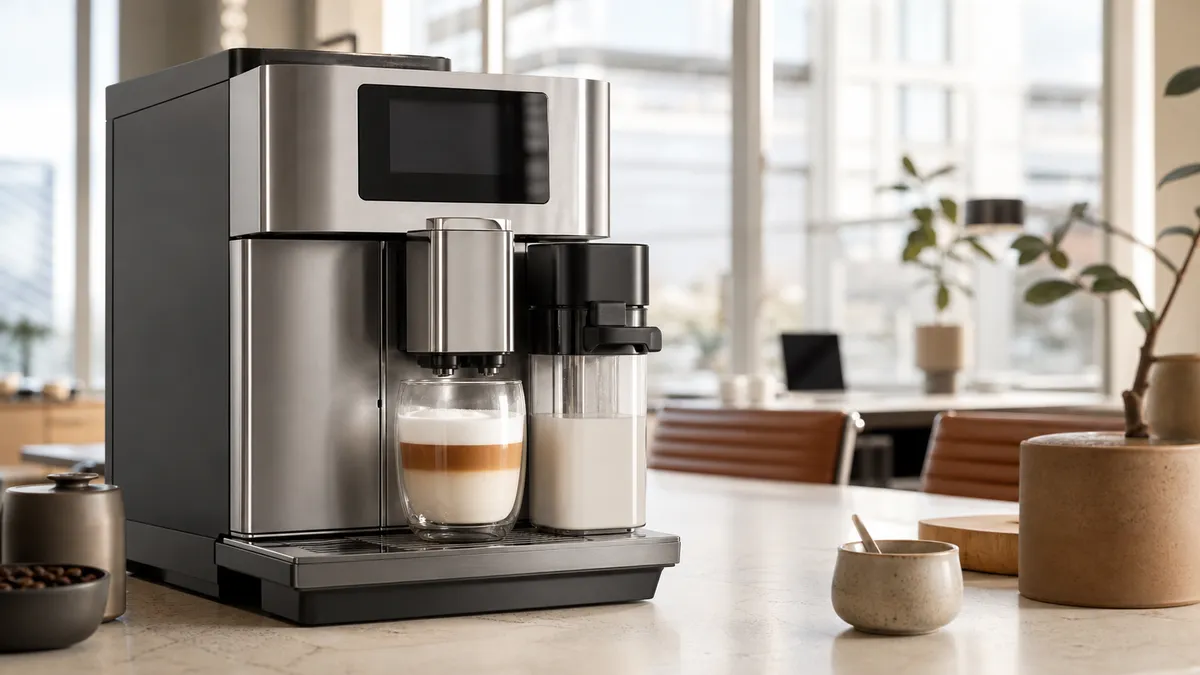
Cimbali office coffee machines cover two different jobs: automated bean-to-cup drinks for workplace self-service, and traditional espresso preparation for staffed coffee bars. LaCimbali’s published daily capacities range from up to 150 cups for the S15 to up to 600 for the S60, but the right choice depends on peak demand, milk arrangements and UK support, not simply the largest headline figure.
In short
- LaCimbali is a machine brand within Cimbali Group, alongside Faema, Casadio, Slayer and grinding specialist Keber.
- Start with the S15 or S20 for office self-service, then assess larger models against your actual drink menu and busiest periods.
- Supera specifications differ substantially between Senso and Dolcevita, particularly for grinders, milk circuits and cold foam.
- M26, M40 and M200 are traditional espresso machines, better considered for a staffed workplace coffee bar than an unattended kitchen.
- Ask for a demonstration of cleaning and servicing arrangements, as well as drink preparation, before choosing a configuration.
Who makes Cimbali office coffee machines?
LaCimbali, also written La Cimbali, is an Italian professional coffee-machine brand. Its parent uses the corporate name Cimbali Group, which replaced Gruppo Cimbali in its corporate identity in 2023.
Company fact panel
- Machine brand: LaCimbali.
- Parent group: Cimbali Group.
- Country: Italy.
- Main machine classes: super-automatic espresso machines, traditional espresso machines and grinder-dosers.
- UK support route: Cimbali Group UK, the manufacturer’s dealer network and model-specific service providers. The UK contact page lists offices in Elstree, Coventry and East Kilbride.
The group’s history began in 1912, when Giuseppe Cimbali opened a copper-working business in Milan. It acquired Faema in 1995, Casadio in 2005, Slayer in 2017 and Keber in 2019.
These names are not interchangeable. Faema, Casadio and Seattle-origin Slayer have their own products and identities. Keber’s involvement is principally in grinding technology, including burrs, the cutting components inside a grinder, rather than a separate range of office drinks machines.
Mazzer is a strategic partner, not another name on the group’s published brand list. Cimbali Group announced their long-term grinding partnership on 27 March 2026.
For the broader market, start with our guide to UK office coffee machine brands.
LaCimbali bean-to-cup machines: the main choices
A super-automatic machine handles grinding, dosing and brewing internally. Milk preparation varies by configuration, so “fully automatic” does not establish whether a particular machine delivers a complete cappuccino into the cup without further handling.
The following comparison uses manufacturer-published capacity and equipment claims, checked in November 2026. Suggested workplace applications are editorial judgements, not independently tested performance findings.
| Model | Claimed daily capacity | Distinguishing published feature | Workplace application to assess |
|---|---|---|---|
| S15 | Up to 150 cups | Fresh-milk and soluble-ingredient configurations; automatic washing | Office tea points with moderate demand |
| S20 | Up to 200 cups | Preheated metal brewing unit; fresh-milk or powder solutions | Busier self-service social spaces |
| S30 | Up to 300 cups | Independent coffee boiler; hot and cold milk foam | Larger workplaces wanting a broader menu |
| Supera | Up to 350 cups | Senso and Dolcevita configurations with different grinding and milk capabilities | High-demand, varied-menu installations |
| S60 | Up to 600 cups | Claimed output up to 260 espressos per hour | High-volume workplace hospitality |
These are not identical drinks produced under a single published comparison protocol. In particular, the S60’s espresso-per-hour figure is not a promise of the same number of large milk drinks.
The global catalogue also includes S-Lite and S20 Fresh Brew. Ask the UK supplier which models and configurations it currently supplies rather than treating the international catalogue as a UK stock list.
Why the exact configuration matters
Supera illustrates the problem with buying by family name alone. Its published technical sheet lists up to two grinders for Senso and four for Dolcevita. Cold milk foam and completely separated milk circuits are listed for Dolcevita, not Senso.
Get the full model designation and fitted options in writing. A demonstration of one configuration should not be accepted as proof that another has the same capabilities.
Traditional machines: M26, M40 and M200
LaCimbali’s traditional machines belong on a different shortlist. The operator prepares coffee in a portafilter, the removable handle holding the coffee basket, rather than relying on an enclosed bean-to-cup brewing process.
M26 is the conventional option to investigate for a staffed workplace bar. Its published range includes a single-group machine, a compact two-group machine and larger versions. The technical sheet lists a 5 litre boiler for the compact two-group version, compared with 10 litres for the full-size two-group version.
M40 introduces the manufacturer’s Eco-Smart thermal system, using centralised heating with selectable dispensing temperature. Published technologies include telemetry and Turbosteam Milk4. Confirm which features are fitted to the quoted machine.
M200 offers independent coffee boilers. The GT1 version provides boiler-temperature control, while PROFILE adds control over how brewing pressure changes during extraction.
Our judgement is that these machines suit a workplace café or hospitality team with trained operators. They are not the natural substitute for push-button self-service. For another Italian commercial-machine comparison, see Gaggia Milano’s workplace range.
Capacity: size for the queue, not just the headcount
Headcount is only a starting point. Count people actually present, visitors, drinks per person and the concentration of orders around meetings and breaks.
This matrix is illustrative arithmetic, not a manufacturer sizing standard. It assumes every person shown drinks two machine-made coffees during the working day.
| People using the machine | Assumed coffees each | Calculated daily coffees |
|---|---|---|
| 25 | 2 | 50 |
| 50 | 2 | 100 |
| 100 | 2 | 200 |
| 150 | 2 | 300 |
Do not select a machine solely because its claimed daily maximum matches the final column. Instead, ask the supplier to reproduce your busiest period using your cup sizes and expected mixture of espresso, longer coffee and milk drinks.
Include bean replenishment, milk replacement and grounds disposal in that demonstration. Decide what queue is acceptable before the test, rather than deciding afterwards that the result will probably do.
For competing automated systems, our Rex-Royal and Eversys profile provides another useful comparison.
Milk systems: decide how drinks will be served
The key distinction is between milk delivered through the machine’s dispensing system and milk prepared separately in a jug.
LaCimbali describes Turbosteam as automatic milk frothing through a steam wand. It assists preparation, but it should not be confused with a complete one-touch drink delivered through a central outlet. The S30’s published specification includes hot and cold foamed milk through its milk system.
For Supera, distinguish the advertised family capabilities from the chosen version’s technical sheet. Dolcevita’s additional milk features may matter if your workplace wants cold foam or separate milk circuits.
Before ordering, request a demonstration using the dairy milk and plant-based products you actually intend to serve. Ask the supplier to document:
- The required refrigerator and its placement.
- How users select each milk.
- Which components and outlets are shared.
- The cleaning procedure when switching products.
Do not infer a complete milk-handling arrangement from a photograph of the machine alone.
Telemetry and cleaning
Telemetry means remote reporting of machine information. LaCimbali describes drink-count analysis, fault reporting, dispensing-parameter monitoring and wash monitoring. Its S-range documentation also describes two-way communication that can allow remote parameter changes.
Ask who receives alerts, who acts on them and what access your facilities team receives. Remote information is useful only when responsibility for responding is clear.
Automatic cleaning is also a feature, not an absence of work. LaCimbali specifies automatic washing for the S15 and S30; Supera documentation describes automatic cleaning with a built-in detergent tank.
Require a complete cleaning demonstration for the exact configuration. Have the supplier identify what staff must remove, wipe, refill or replace, and obtain the operating instructions before installation. Allocate responsibility for the refrigerator and surrounding tea point as well as the machine.
For connected installations, involve your IT team before approving network access. Obtain the connectivity requirements and remote-access arrangements in writing.
UK supply, servicing and installation
Cimbali Group UK is the starting point for confirming current UK distribution and the appropriate sales or service contact. The manufacturer also provides a branch-office and dealer finder.
Independent service provision needs equally careful checking. FreshGround states that it fully supports the S15, while other Cimbali machines are considered case by case. That is a useful illustration of why experience with the brand does not establish support for every model.
Ask the proposed provider to confirm:
- Coverage for your postcode and exact machine configuration.
- Engineer availability, escalation arrangements and parts provision.
- Planned maintenance, water-treatment responsibilities and exclusions.
- Who supports the refrigerator, telemetry and any separate grinder.
Check the physical installation too. LaCimbali lists the S15 CP10 and CS10 at 350 mm wide, 605 mm deep and 715 mm high, before allowing for surrounding equipment or service access. Have the supplier assess counter loading, electrical supply, drainage, ventilation and refill clearance.
For plumbed installations in England and Wales, the Water Supply (Water Fittings) Regulations 1999 include backflow-prevention requirements. Ask the installer to identify the rules applicable to the site rather than treating this as one UK-wide installation regime.
In Great Britain, steam-boiler equipment can fall under the Pressure Systems Safety Regulations 2000. Check the machine with the supplier and HSE guidance. Where required, a written scheme and examination by a competent person are separate from routine servicing.
Pros, cons and who Cimbali suits
Our assessment prioritises operating style, peak demand, milk workflow, cleaning responsibility and local support.
Advantages
- Different service styles: automated machines and traditional espresso equipment can serve different parts of one workplace.
- A substantial capacity spread: the published range supports shortlisting beyond a single office-machine category.
- Milk-menu flexibility: selected configurations offer cold foam, soluble ingredients or separate milk circuits.
- Operational visibility: telemetry can provide drink and maintenance information where properly configured.
Limitations
- Configuration complexity: a family name alone does not establish the supplied equipment.
- Ongoing housekeeping: automatic washing still needs an accountable operator.
- Support is model-specific: confirm capability rather than accepting a general brand-service claim.
- Traditional machines need a staffed workflow: their controls are not a substitute for operator training.
Cimbali merits consideration for a workplace seeking commercial espresso equipment with a clearly defined service arrangement. For a lightly used kitchen, start by questioning the required machine class rather than assuming a larger commercial model is preferable.
What to request before choosing
Obtain itemised written quotations covering the machine, milk equipment, installation, water treatment, commissioning, training, cleaning supplies, servicing, connectivity and contractual exclusions.
To calculate your workplace’s own cost per cup, total the applicable ownership and operating items over a defined period, then divide by the expected drinks served during that period. Include beans, milk, cleaning materials, filters, energy, maintenance and staff cleaning time, and keep the VAT treatment consistent.
The decisive next step for Cimbali office coffee machines is a demonstration of the quoted configuration, using your drinks and your busiest expected service pattern.
FAQ
Can a Cimbali machine offer decaf alongside regular coffee?
Yes, configurations with separate grinders can provide a route to offering different coffees. For example, the S15 CP10 and CS10 technical sheet lists two grinders and two bean hoppers. Ask the supplier to demonstrate how each recipe selects its coffee and how staff avoid mixing beans during refilling.
What should we establish about operation during an internet outage?
Ask the supplier to document what remains available without a connection. Separate drink preparation, remote diagnostics, reporting and remote configuration in that discussion. Do not accept “connected machine” as a sufficient explanation of dependencies, and have your IT team review the proposed arrangement before installation.
What should we check before buying a used Cimbali machine?
Obtain the exact model, serial number, configuration and maintenance records before committing. Ask a prospective service provider to inspect it and confirm parts support, installation requirements and any pressure-system documentation needed. Assess the condition of the milk equipment and water-treatment arrangement separately rather than judging the installation by its exterior.
Where to go next
Read UK Office Coffee Machine Brands for the wider shortlist, then Comparing UK Office Bean-to-Cup Brands for a structured selection process. Rex-Royal and Eversys Office Coffee Machines is the useful next profile when comparing alternative commercial automated systems.
Sources
Manufacturer specifications below are published claims, not independently measured results. Undated webpages and technical sheets are identified as such.
-
Cimbali Group, “Organization”, undated; “Sustainability Reporting 2024”, published 2025. Company history, group identity and brands.
https://www.cimbaligroup.com/en/the-group/organization/
https://www.cimbaligroup.com/wp-content/uploads/2025/09/Sustainability-Report-2024_DEF.pdf -
Cimbali Group, “2023 Sustainability Report”, published 2024. Adoption of the Cimbali Group corporate identity in 2023.
https://www.cimbaligroup.com/wp-content/uploads/2024/10/INT_EN_CIMBALI_GROUP_240927.pdf -
Cimbali Group, strategic partnership announcement with Mazzer, 27 March 2026; LaCimbali, “G50” brochure, undated. Partnership status and Keber grinding-component involvement.
https://www.cimbaligroup.com/il-gruppo/partnership/
https://www.cimbali.com/sites/default/files/documenti/brochure_g50_en.pdf -
LaCimbali, “Fully Automatic Machines”, “S15” and “S20”, undated product webpages. Catalogue, capacities and configurations.
https://www.cimbali.com/products/fully-automatic-machines
https://www.cimbali.com/products/fully-automatic-machines/s15
https://www.cimbali.com/products/fully-automatic-machines/s20 -
LaCimbali, “S30”, “Supera” and “S60”, undated product webpages. Capacity, brewing, milk and cleaning claims.
https://www.cimbali.com/products/fully-automatic-machines/s30
https://www.cimbali.com/products/fully-automatic-machines/supera
https://www.cimbali.com/products/fully-automatic-machines/s60 -
LaCimbali, “S15 CP10 / CS10” and “Supera Technical Specifications”, undated technical sheets. Dimensions, grinders and version-specific milk equipment; PDF tables visually checked.
https://www.cimbali.com/sites/default/files/cp10_-_cs10.pdf
https://www.cimbali.com/sites/default/files/technical-specifications_compressed.pdf -
LaCimbali, “M26”, “M26 Technical Data”, “M40” and “M200”, undated manufacturer documents. Traditional-machine configurations and thermal systems.
https://www.cimbali.com/products/traditional-machines/m26
https://www.cimbali.com/sites/default/files/dati_tecnici_m26.pdf
https://www.cimbali.com/products/traditional-machines/m40
https://www.cimbali.com/products/traditional-machines/m200 -
LaCimbali, “Telemetry” and “Turbosteam”, undated technology webpages. Monitoring, remote changes and automatic wand frothing.
https://www.cimbali.com/innovation/connectivity/telemetry
https://www.cimbali.us/innovation/milk/turbosteam -
LaCimbali UK, “Contacts”; LaCimbali, “Branch offices and dealers”, undated webpages. UK offices and manufacturer contact routes.
https://www.cimbaliuk.com/contacts
https://www.cimbali.com/find -
FreshGround, “La Cimbali service and support”, undated supplier webpage. Its stated model-specific support scope.
https://freshground.co.uk/cimbali-service/ -
UK legislation, “The Water Supply (Water Fittings) Regulations 1999”, Schedule 2, paragraph 15. England and Wales backflow requirements.
https://www.legislation.gov.uk/uksi/1999/1148/pdfs/uksi_19991148_en.pdf -
HSE, “Introduction to pressure equipment”, undated current guidance. Pressure-system responsibilities, examination and maintenance.
https://www.hse.gov.uk/pressure-systems/about.htm
Researched from manufacturer catalogues and technical sheets, corporate publications, a service provider’s stated scope and official UK safety sources; no hands-on machine testing was undertaken.
Last checked: November 2026