Caffeine-free hot drinks include pure rooibos, many herbal infusions, roasted grain and root drinks, and golden milk made without coffee, tea or cocoa. Decaf coffee and tea belong in a separate, very-low-caffeine category, while ordinary hot chocolate contains caffeine and theobromine, a related compound.
In short
- Choose by ingredients, not colour: a dark roasted drink can be caffeine-free, while a pale green tea contains caffeine.
- Pure rooibos is a useful starting point if you want something you can drink with milk.
- Check herbal blends for tea leaves, guarana or other caffeine-containing ingredients.
- Grain drinks may contain barley, rye or wheat, so caffeine-free does not mean gluten-free.
- For strict caffeine avoidance, check the whole blend and ask the manufacturer when the label is unclear.
Comparing caffeine-free hot drinks
Start with the part of your usual drink you most enjoy: a refreshing aroma, roasted bitterness, something fruity, or the texture of warm milk. There is little point replacing coffee with peppermint if what you really miss is a dark, milky drink.
The comparison below uses three criteria: caffeine status, flavour style and the main ingredient check. Flavour descriptions are starting points rather than promises about every blend.
| Drink | Caffeine status | Flavour and texture | Best fit and main check |
|---|---|---|---|
| Pure peppermint or chamomile infusion | Naturally caffeine-free | Minty and refreshing, or soft and floral | A light drink without milk; check mixed blends |
| Pure rooibos | Naturally caffeine-free | Slightly sweet, fruity and amber-coloured | A tea-style drink, including with milk |
| Grain and chicory drink without coffee | Caffeine-free formulations available | Roasted cereal character | A darker coffee substitute; check gluten-containing grains |
| Dandelion infusion or root drink | Caffeine-free formulations available | Varies with the plant material and preparation | Another non-coffee option; check the complete blend |
| Golden milk without tea, coffee or cocoa | Caffeine-free | Creamy and warmly spiced | A milk-based drink; check premixed powders |
| Decaf coffee or tea | Very low caffeine, not necessarily caffeine-free | Retains the character of coffee or tea | Cutting down rather than eliminating caffeine |
| Ordinary hot chocolate | Contains caffeine and theobromine | Chocolatey, with sweetness depending on the recipe | Not a caffeine-free choice |
For the wider family of roasted replacements, our coffee substitutes guide explains how the main options differ.

Herbal teas: read beyond the name
A herbal infusion, sometimes called a tisane, is a drink made by steeping plant material in water. “Herbal tea” is the familiar name, but it should not be treated as a guarantee that every ingredient is caffeine-free.
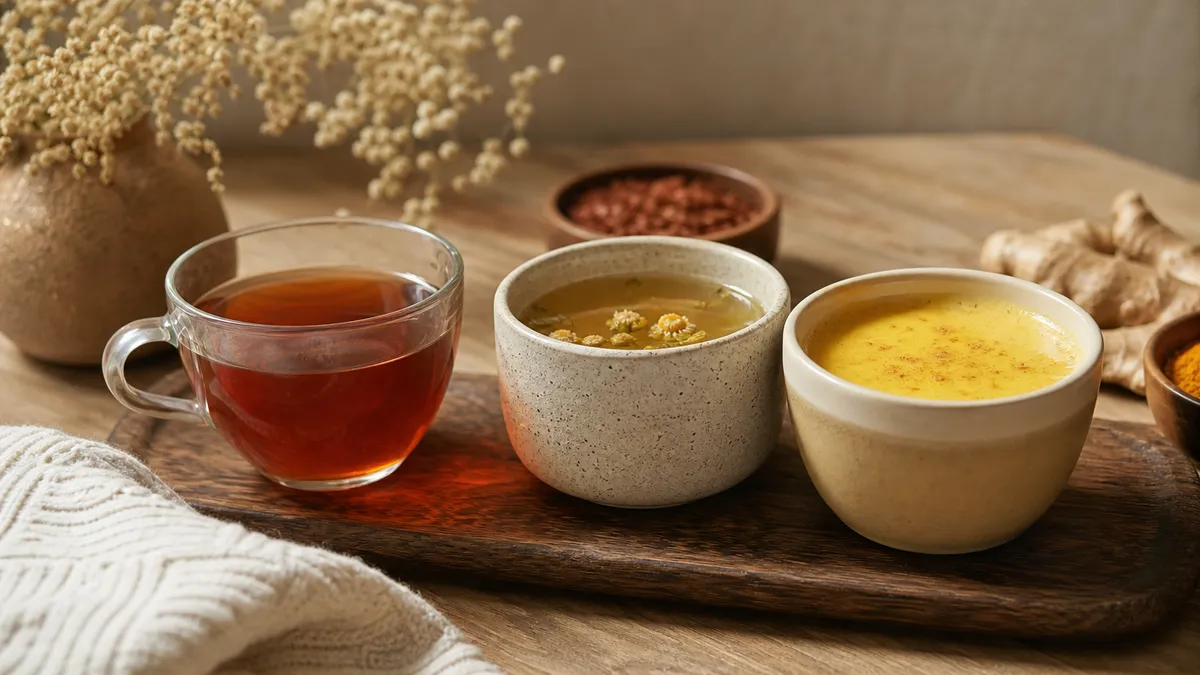
Pure peppermint and chamomile are straightforward examples. Lemon and ginger blends offer another flavour direction, while fruit infusions provide alternatives for readers who do not want either mint or flowers.
A useful way to explore them is to choose one uncomplicated flavour first:
- Peppermint: try it when you want a clearly minty aroma rather than roasted flavour.
- Chamomile: consider it if a mellow, floral drink appeals.
- Lemon and ginger: choose this direction for citrus character and spice.
- Fruit infusion: try one when you want a fruit-led drink rather than a tea-like substitute.
Check the full ingredients of anything described as “energy”, “chai”, “green” or simply “herbal”. Black and green tea contain caffeine, and a blend can combine herbal ingredients with tea leaves. Guarana is another caffeine source.
Follow the packet’s brewing instructions rather than assuming every infusion needs the same treatment. Judge the first mug before adding sweetener, and change one thing at a time if you dislike it. That makes it easier to tell whether the problem is the flavour itself or how you prepared it.
Rooibos: a tea-style option without caffeine
Rooibos, also called redbush, is naturally caffeine-free. It is a herbal infusion rather than conventional tea, although its familiar mug-and-kettle preparation makes it an easy place to start.
The South African Rooibos Council describes its flavour as slightly sweet and fruity. Its amber colour and suitability for drinking with milk make it particularly useful if peppermint feels too light and a roasted grain drink feels too far from tea.
Try a plain rooibos before choosing a flavoured version. This gives you a clear reference point for deciding whether you prefer it black, with milk or with added flavourings.
Rooibos itself does not need decaffeination. However, that does not establish the caffeine status of every product containing it: a mixed blend still needs an ingredients check.
For a shared kitchen, keep the original packaging beside the tea bags. People should be able to check the ingredients themselves rather than relying on an unlabelled jar or somebody else’s recollection.
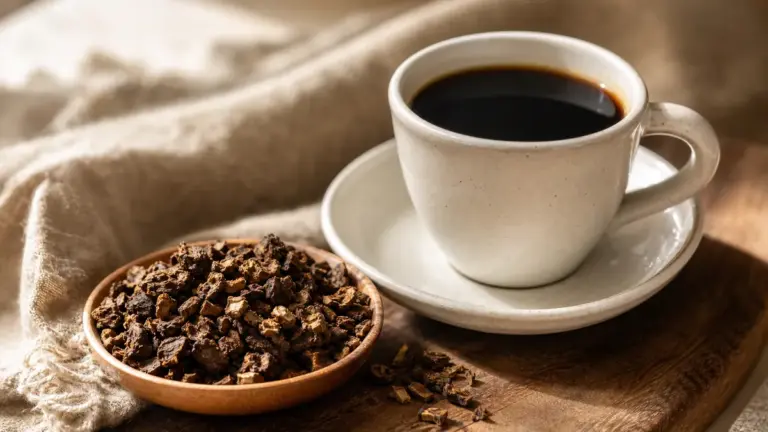
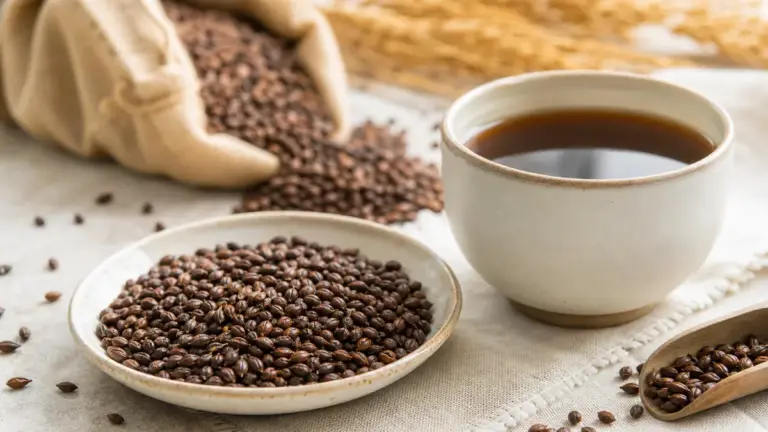
Grain and root drinks: for a darker mug
Grain and root drinks are worth considering when the appeal of coffee is its roasted character rather than caffeine. They are substitutes for coffee, not necessarily coffee with the caffeine removed.
Commercial caffeine-free formulations include roasted barley, rye and chicory. Dandelion drinks are another option, although a light dandelion infusion and a roasted root preparation should not be assumed to taste alike.
Product names can be confusing here. “Chicory coffee” may describe a coffee substitute, but a product containing both chicory and actual coffee needs a different caffeine assessment. Read the ingredients before deciding which category it belongs in.
Choose between these drinks by asking:
- Do you want a soluble powder or a drink that needs brewing and straining?
- Will you drink it black or add milk?
- Does the ingredient list contain coffee?
- Does it contain grains you need to avoid?
Barley, rye and wheat are gluten-containing cereals. If you have coeliac disease, do not assume a cereal drink is suitable merely because it contains no coffee. Look for appropriate gluten-free information and seek advice from your dietitian when uncertain.
Our barley coffee guide covers that particular substitute in more detail.
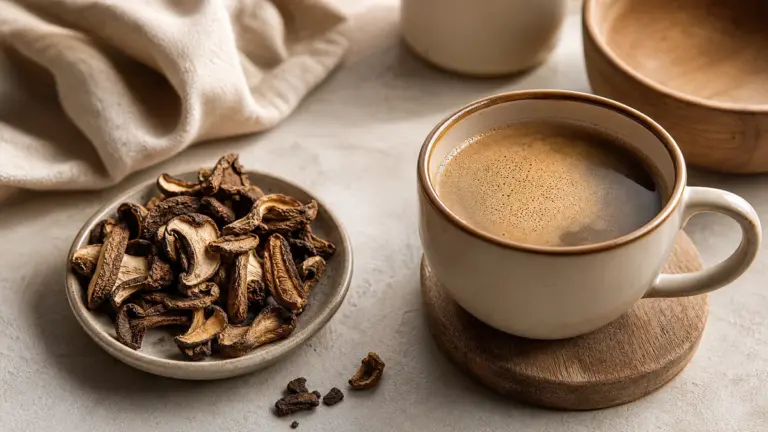
Mushroom drinks need their own check
“Mushroom coffee” does not automatically mean coffee-free or caffeine-free. Some products contain actual coffee alongside mushroom ingredients.
Adding mushrooms does not remove caffeine from the coffee component. Check the declared ingredients and caffeine information rather than judging by the product’s wellness wording. Our mushroom coffee guide examines this category separately.
Golden milk and other warm milk drinks
Golden milk is a turmeric-based milk drink, often made with cinnamon and ginger. A version containing milk or a plant-based drink, culinary spices and no tea, coffee or cocoa is a caffeine-free option.
It suits a different craving from herbal tea: think creamy texture and spice rather than a clear infusion. You can also choose plain warm milk or an unsweetened plant-based drink if you would rather leave the spices out.
For a simple approach, use a published food recipe, whisk the ingredients together and warm them gently. Check ready-made “golden latte” powders separately, especially if the name does not make the complete formulation clear.
Treat golden milk as a drink, not a treatment. NCCIH’s review of turmeric research says the evidence is not sufficient to reach definite conclusions about its benefits for health conditions. Findings from concentrated turmeric or curcumin products cannot simply be transferred to a mug made with kitchen spices.
Concentrated supplements also have different safety considerations. NCCIH reports liver injury with some enhanced-absorption curcumin formulations, so there is no reason to turn an ordinary warm drink into a high-dose supplement experiment.
Very low caffeine, not necessarily caffeine-free: decaf
Decaf coffee and tea contain less caffeine than their regular equivalents, but they can still contain some. They are useful choices for reducing intake, not a dependable way to eliminate it.
This distinction matters most when your reason for switching is a strong reaction to caffeine or advice to avoid it. In that situation, ask your GP or pharmacist whether decaf is appropriate rather than assuming “decaffeinated” means zero.
If you simply want less caffeine while keeping the taste of coffee, decaf may fit your aim better than a substitute. If you want a naturally caffeine-free drink, choose from the other categories and check the complete formulation.
There is also a difference between removing caffeine and diluting a drink. Adding more water or milk changes the concentration, but it does not remove the caffeine already present in the portion you drink.
Hot chocolate: separate from caffeine-free drinks
Ordinary cocoa-based hot chocolate contains caffeine and theobromine. Theobromine is a related compound found in cocoa, but it is not another name for caffeine.
The amount in a particular mug depends on the product and how much you use. A general figure for “hot chocolate” would therefore be less useful than information for your actual powder, chocolate and serving size.
A milky drink is not necessarily caffeine-free, and a dark drink is not necessarily caffeinated. Ingredients are the better guide: cocoa puts ordinary hot chocolate outside the caffeine-free group, while a coffee-free roasted cereal drink can belong inside it.
If caffeine avoidance is your priority, choose a cocoa-free warm milk drink instead. If you are only reducing caffeine, hot chocolate is still something to count rather than ignore.
Choosing for evenings, pregnancy or sensitivity
For an evening drink, distinguish avoiding caffeine from treating sleeplessness. EFSA’s 2015 scientific assessment found that 100 mg of caffeine close to bedtime can affect sleep in some adults, but choosing a caffeine-free drink does not guarantee sleep.
Chamomile illustrates the difference. NCCIH’s evidence summary reports very limited information on insomnia, including a study in a 2019 review that found no benefit for that condition. Enjoying chamomile as part of your evening routine is different from claiming it treats insomnia.
Pregnancy needs a separate check. Current NHS guidance advises no more than 200 mg of caffeine a day from all sources. It also advises avoiding more than four cups of herbal tea a day and avoiding herbal teas containing liquorice root, because evidence on herbal teas in pregnancy is limited.
That is not a blanket approval for every herbal blend. Speak to your midwife about products you are unsure of, particularly concentrated preparations or drinks marketed for medicinal effects.
If you take medicines, ask a pharmacist about herbal ingredients before making them a regular habit. “Natural” and “caffeine-free” answer neither the interaction question nor the allergy question.
A final packet check
Before adding a drink to your routine:
- Define the aim: less caffeine, or strict avoidance?
- Read every ingredient: look for tea, coffee, cocoa and guarana.
- Check suitability separately: consider allergens, gluten and personal medical advice.
- Look at added sugar: caffeine-free does not mean unsweetened.
- Keep preparation consistent: follow the packet so you can judge the drink fairly.
The most useful caffeine-free hot drink is one you enjoy enough to choose again, with ingredients that suit your needs.
FAQ
Do caffeine-free hot drinks count towards hydration?
Yes, drinks other than water can contribute to your fluid intake. NHS guidance includes milk and lower-sugar drinks among everyday choices, so a caffeine-free infusion or suitable milk drink need not be treated as separate from hydration. Keep added sugar in view, and follow any individual fluid advice you have been given by your healthcare team.
Should I stop caffeine suddenly when switching drinks?
A gradual reduction is generally more comfortable if you regularly consume caffeine. The FDA advises cutting down gradually because withdrawal can be unpleasant, even though it is not considered dangerous. Try replacing part of your usual routine with a caffeine-free drink first, rather than changing everything at once. Seek medical advice if symptoms concern you.
Can children have any drink labelled caffeine-free?
No, caffeine-free is not a complete suitability check for children. Herbal ingredients, allergens and added sugar still matter, and adult supplements should not be treated as ordinary drinks. NHS guidance identifies water and milk as the best drinks for children. Ask a pharmacist or other appropriate healthcare professional before using medicinal herbal preparations.
Where to go next
Read Coffee Substitutes for a broader route through non-coffee drinks, then Barley Coffee if roasted cereal flavours appeal. Mushroom Coffee is the useful next read if you want to understand why a coffee alternative’s name does not establish its caffeine content.
Sources
-
NHS, “Foods to avoid in pregnancy”, current online guidance, checked November 2026. Supports the pregnancy caffeine limit, herbal tea advice and caffeine-source checks.
https://www.nhs.uk/pregnancy/keeping-well/foods-to-avoid/ -
European Food Safety Authority, “Caffeine”, summary of the 2015 scientific opinion, checked November 2026. Supports the sleep-related caffeine statement.
https://www.efsa.europa.eu/en/topics/topic/caffeine -
US Food and Drug Administration, “Spilling the Beans: How Much Caffeine is Too Much?”, current online guidance, checked November 2026. Explains residual caffeine in decaf and gradual reduction.
https://www.fda.gov/consumers/consumer-updates/spilling-beans-how-much-caffeine-too-much -
Clipper Teas, “Frequently Asked Questions”, undated, checked November 2026. Manufacturer information on herbal blends, caffeine and rooibos with milk.
https://www.clipper-teas.com/faq/ -
South African Rooibos Council, “Frequently Asked Questions”, page titled 2024, checked November 2026. Industry-body information on rooibos, caffeine status and flavour.
https://sarooibos.co.za/frequently-asked-questions/ -
Barleycup, “Barleycup Organic”, undated, checked November 2026. Manufacturer ingredient list and caffeine-free claim for a roasted grain and chicory formulation.
https://barleycup.com/products/barleycup-organic/ -
Clipper Teas, “Organic Dandelion Infusion”, undated, checked November 2026. Manufacturer ingredients and caffeine-free claim.
https://www.clipper-teas.com/product/organic-dandelion-infusion -
University of California, Berkeley, University Health Services, “Turmeric Tea Latte”, undated, checked November 2026. Food preparation example for caffeine-free golden milk.
https://uhs.berkeley.edu/sites/default/files/now-turmericlatte.pdf -
National Center for Complementary and Integrative Health, “Turmeric: Usefulness and Safety”, updated April 2025. Evidence summary and supplement safety information.
https://www.nccih.nih.gov/health/turmeric -
National Center for Complementary and Integrative Health, “Chamomile: Usefulness and Safety”, updated November 2024. Evidence summary, including the limitations of insomnia research.
https://www.nccih.nih.gov/health/chamomile -
Kreiser and Martin, “High pressure liquid chromatographic determination of theobromine and caffeine in cocoa and chocolate products: collaborative study”, Journal of the Association of Official Analytical Chemists, 1980. Primary analytical research identifying both compounds in cocoa-containing materials.
https://pubmed.ncbi.nlm.nih.gov/7430044/ -
NHS, “Water, drinks and hydration”, current online guidance, checked November 2026. Supports hydration, lower-sugar choices and advice on children’s drinks.
https://www.nhs.uk/live-well/eat-well/food-guidelines-and-food-labels/water-drinks-nutrition/ -
Cambridge University Hospitals NHS Foundation Trust, “Gluten-free labelling for coeliac disease”, version 6, approved May 2023. Supports checking gluten suitability separately from caffeine status.
https://www.cuh.nhs.uk/patient-information/gluten-free-labelling-for-coeliac-disease/ -
Four Sigmatic, “Original Mushroom Coffee”, current manufacturer product page, checked November 2026. Confirms that a mushroom coffee formulation contains actual coffee and caffeine; health marketing claims were not used.
https://us.foursigmatic.com/products/original-mushroom-coffee
This article was researched using live NHS and regulatory guidance, institutional evidence summaries, primary analytical research and manufacturers’ ingredient information; no first-hand testing was undertaken.
Last checked: November 2026