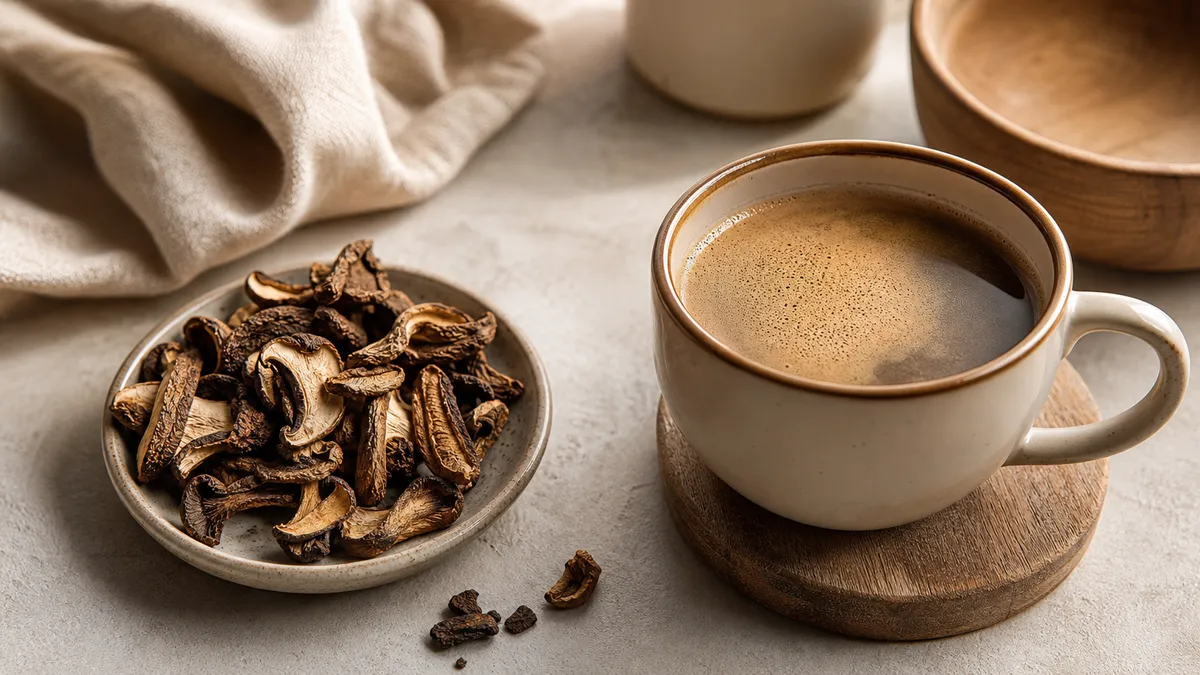
Mushroom coffee combines coffee with mushroom powders or extracts, usually sold with promises about focus, energy, stress or immunity. Some mushroom ingredients have been studied in people, but that does not establish that the finished drinks deliver the advertised benefits: judge the caffeine content, ingredient quantities and evidence for the actual formulation separately.
In short
- “Mushroom coffee” does not mean caffeine-free. Check the caffeine per prepared serving.
- Lion’s mane research includes small human trials with mixed findings, not convincing proof of better everyday concentration.
- A study of a particular mushroom preparation cannot automatically support a coffee containing a different extract or an undisclosed blend.
- Chaga deserves particular caution because kidney injury has been reported after substantial or prolonged powder consumption.
- UK availability is not proof of regulatory approval. Health claims and novel-food status are separate questions.
What is mushroom coffee?
The name describes a product category rather than a fixed recipe. One example, Four Sigmatic’s Original Mushroom Coffee, combines instant Arabica coffee with lion’s mane, chaga, reishi, cordyceps and turkey tail extracts, alongside other ingredients. Different formulations therefore need separate assessment.
The mushroom names also need unpacking:
| Label ingredient | What the name identifies | What to check |
|---|---|---|
| Lion’s mane | Hericium erinaceus | Powder or extract, quantity and preparation studied |
| Chaga | Inonotus obliquus | Quantity, kidney-related cautions and suitability for use in drinks |
| Reishi | Commonly labelled Ganoderma lucidum | Exact identity, extract details and medication warnings |
| Cordyceps | A name used across different fungal species and preparations | Full species name and relevant novel-food status |
Powder and extract are not interchangeable descriptions. Powder is milled material; extraction produces a preparation whose composition depends on the process. The fruiting body is the reproductive structure, while mycelium is the fungus’s growing network. Neither term, by itself, proves that a product works.
For the wider choice between coffee-containing blends and genuinely different drinks, start with coffee substitutes.
How much caffeine is in mushroom coffee?
There is no reliable category-wide caffeine figure. Four Sigmatic, for example, declares approximately 50 mg per serving for its Original Mushroom Coffee. That is a manufacturer’s specification for that formulation, checked in November 2026, not an independently measured average for mushroom coffee.
Descriptions such as “half-caf” also need care. They describe a caffeine comparison, not necessarily a mixture containing equal weights of coffee and mushrooms. This research did not establish that most products are half-coffee blends or contain a standard caffeine range.
Read the serving instructions alongside the caffeine figure. Using more powder than the stated serving changes your intake; adding water changes the drink’s concentration, not the caffeine already present.
EFSA’s 2015 assessment found that, for healthy non-pregnant adults:
- Single doses up to 200 mg generally raise no safety concerns.
- Habitual intake up to 400 mg a day, spread across the day, generally raises no safety concerns.
- Even 100 mg near bedtime can affect sleep in some people.
These are population benchmarks, not targets or guarantees of comfort. Sensitivity, medicines and medical conditions matter. If avoiding caffeine is your main aim, compare products with caffeine-free hot drinks, rather than assuming a mushroom label settles the question.
Does mushroom coffee work?
The answer depends on what “work” means. A caffeinated formulation can increase alertness because caffeine stimulates the central nervous system. Establishing an additional mushroom benefit requires evidence that separates the mushroom’s effect from caffeine, expectations and other ingredients.
Lion’s mane: interesting findings, limited certainty
A 2023 randomised, placebo-controlled pilot trial studied 41 healthy adults, using 1.8 g of a lion’s mane preparation daily for 28 days. Participants performed faster on one attention task after an acute dose. However, other findings were null or negative, and the reported reduction in subjective stress did not meet the conventional threshold for statistical significance.
A separate 2025 randomised crossover trial involved 18 healthy adults. It found no significant overall improvement in cognition or mood after a single dose of lion’s mane extract, although performance improved on one individual task.
These results are not simply contradictory. The preparations, tests and study designs differed, and an improvement on one test is not the same as a broad improvement in memory or workplace concentration. Both were small studies.
A 2026 proof-of-concept study also reported no statistically significant changes in cognitive outcomes after supplementation. Its uncontrolled design could not establish that the preparation caused any numerical changes.
The reasonable verdict is preliminary and mixed, not “proven brain support”.
Chaga, reishi and cordyceps: do not turn mechanisms into promises
Chaga research includes laboratory and animal findings involving antioxidant activity, inflammation and blood glucose. Those findings do not demonstrate that drinking chaga coffee prevents illness or improves human health.
Cordyceps studies on exercise performance have produced mixed results. Reishi has also been investigated in particular preparations and clinical settings, but those studies cannot establish that an everyday coffee blend improves immunity or relieves stress.
“Antioxidant” describes chemical activity, not a demonstrated outcome such as fewer infections. Likewise, “adaptogen” on a packet should prompt a question: what human outcome improved, using which preparation, compared with what?
The finished drink is the missing link
The ingredient studies discussed here did not test the mushroom coffees being sold. This research did not identify a convincing randomised trial establishing the advertised benefits of a finished mushroom-coffee drink.
That is an evidence gap, not proof that every formulation is ineffective. A useful trial would test the actual product against an appropriate control, accounting for caffeine and other active ingredients. Until then, a long bibliography about individual mushrooms is not equivalent to evidence for the drink.
Ingredient quantities and quality: a label checklist
Use this checklist before deciding whether a formulation is transparent enough to assess.
- Find the amount of each mushroom per serving. A combined blend total does not reveal the contribution of each ingredient. Do not assume equal shares.
- Separate actual extract weight from “equivalent” mushroom weight. These describe different things. An extraction ratio does not establish clinical effectiveness.
- Look for the species and material used. “Mushroom complex” is less informative than an identified species with a clear description of powder, extract, fruiting body or mycelium.
- Compare like with like in research. Match the preparation, daily quantity, duration and participants, not merely the mushroom name.
- Ask what testing covers. A useful batch certificate should identify the product, batch, laboratory, methods and measured results. Ask about identity, microbiological quality and relevant contaminants.
- Read the complete ingredient list. Added vitamins, sweeteners, plant extracts or other supplements change what you are assessing.
These are purchasing criteria, not a certification scheme. Testing can help establish identity and quality; it cannot prove a health benefit.
There is also no justification for increasing servings to imitate a trial dose. You may simultaneously increase caffeine and several other ingredients, without recreating the studied preparation.
Safety and potential medication interactions
Concentrated mushroom preparations should not be treated as automatically harmless because mushrooms can be foods.
Chaga and kidneys: published case reports describe oxalate-related kidney injury after substantial or prolonged chaga powder consumption. Oxalate is a compound that can contribute to crystal deposition in the kidneys. These reports do not establish the risk from every coffee serving, but they make blanket safety assurances inappropriate, especially for someone with kidney disease.
Blood-thinning medicines: chaga, reishi and cordyceps raise potential bleeding concerns with anticoagulant or antiplatelet medicines. Evidence varies between laboratory research, clinical observations and case reports; the risk at mushroom-coffee quantities is not well quantified.
Diabetes treatment and immunosuppression: laboratory evidence suggests chaga and cordyceps could add to the effects of blood-glucose-lowering medicines. Reishi also warrants caution with immunosuppressants. These are reasons for an individual medication check, not instructions to change treatment.
Ask a pharmacist or GP to review the complete formulation if you take regular medicines or have a medical condition. Stop using a supplement and seek professional advice if it makes you unwell.
During pregnancy, the NHS advises no more than 200 mg caffeine daily from all sources. Meeting that limit does not establish the safety of added mushroom extracts. Speak to your midwife, pharmacist or GP before using these products during pregnancy or breastfeeding.
What UK rules allow brands to claim
In Great Britain, commercial nutrition and health claims fall under assimilated Regulation (EC) No 1924/2006 and the Great Britain Nutrition and Health Claims Register. The ASA’s CAP Code, Section 15, also governs relevant advertising. Northern Ireland uses the applicable EU framework and register, so “UK rules” should not be treated as one identical system.
The ASA’s functional-mushroom guidance states that mushrooms themselves have no authorised health claims. Specific cognitive claims for lion’s mane, or health claims for chaga itself, should therefore not be presented as authorised mushroom benefits.
Added nutrients are a separate matter. Zinc, for example, has an authorised claim concerning normal cognitive function, subject to its conditions of use. That does not authorise a promise that the mushrooms improve focus. Claims attached to B vitamins likewise concern the named nutrient and its permitted wording.
Foods cannot be advertised as preventing, treating or curing disease. Testimonials and references to studies do not provide a workaround.
Novel-food status is a separate check. The species, preparation and intended use matter; acceptability in a supplement does not automatically establish acceptability in an ordinary drink. Sellers should establish the relevant status with the FSA or Food Standards Scotland. An online listing is not evidence that this has happened.
Assessing cost without buying a health promise
Compare products by their stated serving, disclosed ingredients, caffeine information and supporting evidence, rather than by the size of the mushroom list.
To work out your own cost per serving, divide the amount you pay by the number of servings you will actually prepare, following the instructions. Include delivery, milk or other additions and any recurring-order commitment. For workplace supply, request itemised written quotations and clear cancellation terms.
My view: enjoyment and transparent ingredients are defensible reasons to choose mushroom coffee. An unverified promise of sharper thinking is not a sound basis for judging its value.
FAQ
Does mushroom coffee taste like mushrooms?
It depends on the formulation, so do not assume it will taste like mushroom broth. Four Sigmatic describes its example as coffee-led, with caramel notes and no mushroom flavour, but that is the manufacturer’s sensory description, not this site’s tasting result. Check the ingredients and preparation instructions rather than expecting every blend to taste alike.
Can I put mushroom coffee in an office bean-to-cup machine?
Do not put a powdered mushroom blend in a bean hopper. Follow the machine manufacturer’s instructions about permitted ingredients and powder systems. If a product is intended for preparation directly in a mug, make it separately unless the equipment supplier explicitly confirms compatibility. A product being called “coffee” does not make it interchangeable with whole beans.
How long should I drink it before expecting benefits?
There is no established waiting period for benefits from finished mushroom-coffee drinks. An ingredient trial lasting several weeks does not create a recommended course for a different commercial blend. Follow the label, do not increase servings to pursue an effect, and seek medical advice for persistent fatigue, concentration problems or other symptoms rather than relying on the drink.
Where to go next
Read Coffee Substitutes to compare the broader categories, then Caffeine-Free Hot Drinks if removing caffeine is your main goal. Dandelion Root Coffee and Barley Coffee explain two different approaches to a roasted hot drink, without treating mushroom coffee as a necessary route to better health.
Sources
-
Four Sigmatic, Original Mushroom Coffee product information, undated, retrieved November 2026. Manufacturer information used for composition, declared caffeine and sensory description, not efficacy.
https://us.foursigmatic.com/pages/mushroom-coffee-fb4 -
EFSA, Caffeine, summarising the Scientific Opinion on the safety of caffeine, 2015.
https://www.efsa.europa.eu/en/topics/topic/caffeine -
Docherty and colleagues, Northumbria University, The Acute and Chronic Effects of Lion’s Mane Mushroom Supplementation on Cognitive Function, Stress and Mood in Young Adults: A Double-Blind, Parallel Groups, Pilot Study, 2023.
https://researchportal.northumbria.ac.uk/en/publications/the-acute-and-chronic-effects-of-lions-mane-mushroom-supplementat/ -
Surendran and colleagues, Frontiers in Nutrition, Acute effects of a standardised extract of Hericium erinaceus (Lion’s Mane mushroom) on cognition and mood in healthy younger adults: a double-blind randomised placebo-controlled study, 2025.
https://pubmed.ncbi.nlm.nih.gov/40276537/ -
Nutrients, A Pilot Proof-of-Concept Study to Evaluate the Physiological and Cognitive Impacts of Hericium erinaceus on Healthy Adults, 2026.
https://pmc.ncbi.nlm.nih.gov/articles/PMC13666732/ -
Memorial Sloan Kettering Cancer Center, Chaga Mushroom, current online clinical monograph, retrieved November 2026.
https://www.mskcc.org/cancer-care/integrative-medicine/herbs/chaga-mushroom -
Memorial Sloan Kettering Cancer Center, Reishi Mushroom, updated 2026.
https://www.mskcc.org/cancer-care/integrative-medicine/herbs/reishi-mushroom -
Memorial Sloan Kettering Cancer Center, Cordyceps, current online clinical monograph, retrieved November 2026.
https://www.mskcc.org/cancer-care/integrative-medicine/herbs/cordyceps -
NHS, Foods to avoid in pregnancy, current online guidance, retrieved November 2026.
https://www.nhs.uk/pregnancy/keeping-well/foods-to-avoid/ -
Department of Health and Social Care, Food supplements guidance, 2026.
https://www.gov.uk/government/publications/food-supplements-guidance-for-consumers/food-supplements-guidance -
Department of Health and Social Care, Great Britain nutrition and health claims register, updated 19 May 2026, and Nutrition legislation information sheet, current online edition.
https://www.gov.uk/government/publications/great-britain-nutrition-and-health-claims-nhc-register
https://www.gov.uk/government/publications/nutrition-legislation-information-sources/nutrition-legislation-information-sheet–2 -
ASA and CAP, 15: Food, food supplements and associated health or nutrition claims, current online Code; Shroom for improvement? Navigating the advertising rules for functional mushrooms, current online guidance.
https://www.asa.org.uk/type/non_broadcast/code_section/15.html
https://www.asa.org.uk/news/shroom-for-improvement-navigating-the-advertising-rules-for-functional-mushrooms.html -
ASA, Ruling on Birling Shore Ltd t/a ShroomIQ, 22 April 2026.
https://www.asa.org.uk/rulings/birling-shore-ltd-g25-1323444-birling-shore-ltd.html -
FSA, Novel foods authorisation guidance, current GOV.UK publication, and Outcomes on novel food consultations, current online edition.
https://www.gov.uk/government/publications/novel-foods-authorisation-guidance
https://www.gov.uk/government/publications/outcomes-on-novel-food-consultations/outcomes-on-novel-food-consultations
This piece was researched using retrieved official guidance, original human studies, clinical safety monographs and clearly identified manufacturer information; no first-hand product testing was undertaken.
Last checked: November 2026