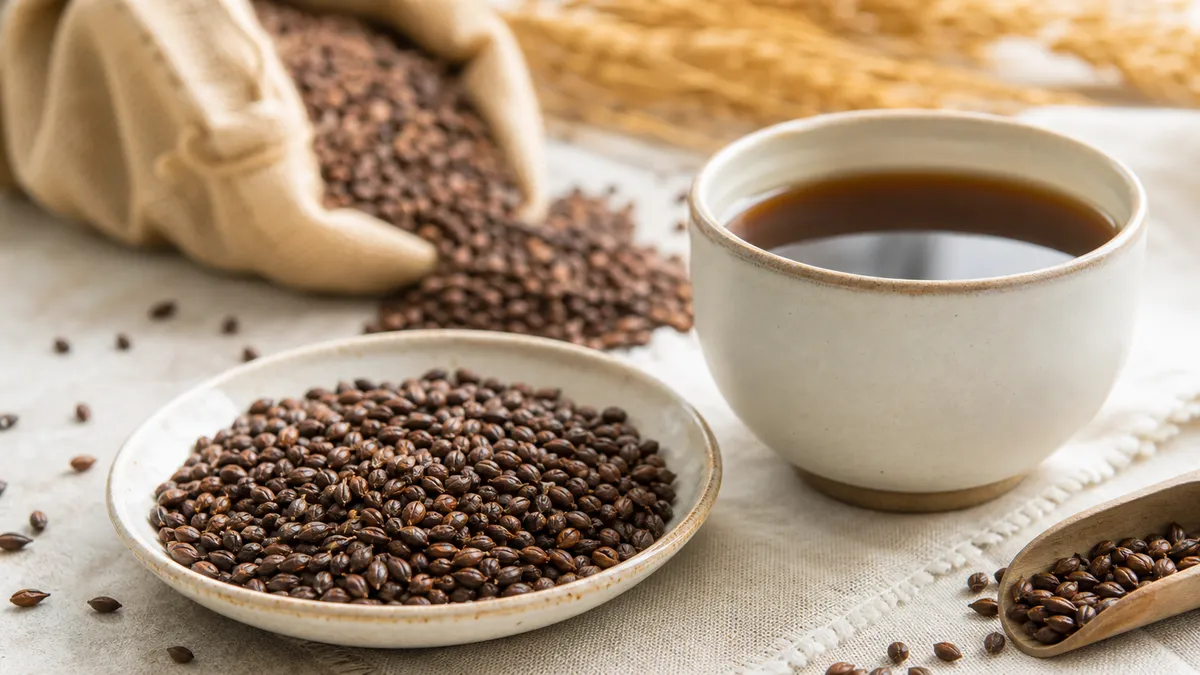
Barley coffee is a roasted-grain drink made from barley rather than coffee beans, with a toasted, malty flavour and no caffeine when barley is the only ingredient. The Italian version is called caffè d’orzo, and it can be prepared as an instant drink or brewed from roasted, ground barley. Barley contains gluten, so ordinary barley coffee is not suitable for people with coeliac disease.
In short
- Choose the right format: soluble barley dissolves in water, while roasted, ground barley needs brewing and filtering.
- An orziera is a brewer adapted for barley, often using moka-style technology, not another name for an espresso machine.
- Japanese mugicha and Korean boricha are roasted-barley teas, related to barley coffee but usually prepared as infusions.
- Removing the grains does not make a barley drink suitable for a gluten-free diet.
- Check blends carefully: a product containing barley may also contain actual coffee.
What is barley coffee?
Barley coffee starts with barley grain that has been roasted to develop its brown colour and roasted aroma. Depending on the product, the grain is sold whole, ground for brewing, or as a soluble preparation that can be stirred straight into hot water or milk.
“Coffee” describes its role as a replacement drink, not its botanical identity. A packet containing only roasted barley contains no coffee beans. It belongs among the coffee substitutes, but deserves to be understood as a drink in its own right rather than judged solely on how convincingly it imitates espresso.
The preparation instructions matter as much as the name. Ground barley and instant barley can look superficially similar in a packet, yet they behave differently in the cup: ground grain leaves material to filter out, whereas a soluble product is intended to dissolve.
Italian caffè d’orzo, mugicha and boricha
In Italy, caffè d’orzo is the familiar name for barley coffee. Manufacturers supply roasted, ground barley for moka preparation, alongside espresso-compatible products and instant versions.
An orziera is equipment designed for preparing barley drinks. Bialetti, for example, describes its barley brewer as using traditional moka technology with an additional separator to retain barley residue. Espresso preparation is a separate option, requiring a suitable barley product and compatible equipment.
Japanese mugicha and Korean boricha belong to the roasted-barley tea tradition. Here, the emphasis is on an infusion made from roasted grain, including products packed into large brewing bags, rather than necessarily a concentrated coffee-style serving.
These categories overlap in their ingredient, but they are not interchangeable brewing instructions.
| Format | What you do with it | Best suited to |
|---|---|---|
| Soluble barley | Dissolve according to the packet | A straightforward mug without filtering |
| Ground barley for moka or orziera | Brew in compatible equipment | An Italian coffee-style preparation |
| Espresso-compatible barley | Use the specified pod, capsule or brewing arrangement | Equipment explicitly approved for that product |
| Roasted-barley tea | Steep or boil as directed, then remove the grain or bag | A tea-style drink, served hot or chilled |

What does barley coffee taste like?
Expect toasted cereal, malt and a rounded roasted aroma rather than an exact copy of coffee. Producers describe barley drinks using terms such as roasted grain and malty character. The useful expectation is a drink that recalls the browned crust of bread more readily than the bright fruit of some coffees.
Preparation changes that impression. A concentrated serving puts the roasted character at the front; a longer infusion makes a different drinking experience. Milk is an established serving option, including cappuccino-style preparations made with suitable barley products.
Taste the drink plain before adding anything. That gives you a clearer basis for deciding whether you want more concentration, a longer serving or milk, rather than immediately covering an unfamiliar flavour with sweetness.
Why roasting makes barley smell coffee-like
Roasting is not simply a way of darkening the grain. Heat drives chemical changes, including the Maillard reaction, a group of reactions involving sugars and amino compounds that helps create browned-food aromas.
Research on roasted barley has identified compounds associated with roasted and caramel-like characteristics. This helps explain the resemblance to coffee, without making the two ingredients chemically or sensorially identical.
The grain and its processing also matter. Laboratory research has found that changing barley’s composition and treatment changes the aroma compounds formed during roasting. “Barley coffee” therefore describes a category, not one fixed flavour.
Gluten: who should avoid barley coffee?
Ordinary barley coffee is not gluten free and should not be offered to someone with coeliac disease. Coeliac UK lists barley among the grains to avoid, and NHS guidance includes foods and drinks made from gluten-containing grains.
Barley’s relevant gluten proteins are called hordeins. Immunological research has examined their ability to provoke responses in people with coeliac disease. The concern is the barley itself, not merely accidental contact with wheat.
Brewing does not provide a reliable way round this. The National Celiac Association specifically identifies barley-seed tea, including Korean boricha, as not gluten free. A clear-looking infusion is not evidence that a drink is safe, and straining out the visible grain is not a validated gluten-removal process.
For someone avoiding gluten, choose an appropriate product with suitable gluten-free labelling instead. Our guide to caffeine-free hot drinks provides a broader starting point, but each product still needs checking.
Reading the label in the UK
Look for barley, not just the word “gluten”. Food Standards Agency guidance for England, Wales and Northern Ireland requires gluten-containing cereals to be identified by their specific cereal name and emphasised in ingredients lists where required. Food Standards Scotland gives corresponding guidance for Scotland.
Also check added ingredients and precautionary allergen statements. A caffeine-free claim says nothing about gluten suitability, and “coffee substitute” is not an allergen guarantee.
If you have a diagnosed barley allergy or a prescribed gluten-free diet, follow your clinician’s or dietitian’s advice rather than trying a small serving to judge your reaction.
How to make barley coffee
Start by reading the packet and checking that the product matches your brewing method. There is no single recipe that sensibly covers soluble powder, ground barley, espresso pods and barley tea bags.
For a first attempt, use an established food product sold for making drinks. This removes the extra uncertainty of selecting and roasting grain yourself.
A simple cafetière method
Caffè Pazzini publishes a press-filter method using approximately 4 g of ground roasted barley per serving, water at approximately 80°C, and 5 to 10 minutes of infusion. The method below adopts those instructions, with 200 ml chosen as an editorial serving size because the manufacturer does not specify the water volume.
You need: ground roasted barley suitable for infusion, scales, a measuring jug, thermometer and cafetière.
- Check the product. Use ground roasted barley, not soluble powder.
- Measure the ingredients. Put 4 g of barley into the cafetière and measure 200 ml of drinking water.
- Add the water at about 80°C. Stir to wet the grounds.
- Infuse for 5 minutes initially. The manufacturer’s stated range extends to 10 minutes, so record the time that gives your preferred concentration.
- Separate the drink from the grounds. Lower the plunger gently and pour into your cup.
- Taste before adjusting. On the next brew, change the dose or infusion time separately so you can identify which adjustment helped.
This is a manufacturer-based starting method, not a universal barley standard or a first-hand tested recipe. Follow your own product’s directions if they differ.
Soluble barley
Soluble barley needs dissolving, not extraction. Crastan’s published preparation method starts by mixing the product with a little hot water or milk, then adding the remaining liquid.
Use the dose on your packet. Stirring a small amount of liquid into the powder first is a useful way to make the drink evenly before filling the mug.
Moka pots, orziere and espresso equipment
Use barley labelled for the equipment concerned and follow both sets of instructions. Do not assume that the basket should be filled as it would be for coffee.
For example, Nestlé’s Orzoro Moka directions specify filling the filter only halfway, without pressing the barley down, and using a low flame. That is a product-specific instruction, not a rule to transfer automatically to every barley brewer.
Espresso-compatible barley products also exist. Hausbrandt’s instructions, for example, specify a dedicated filter for its barley pod. Do not put barley into a bean-to-cup machine’s hopper or ground-coffee chute unless the machine manufacturer explicitly permits it.
Barley tea
For a tea-style preparation, follow the bag or loose-grain instructions. Ippodo’s published hot-brew method uses one of its mugicha brewing bags with 1 litre of freshly boiled water at 100°C, infused for 10 minutes.
That quantity applies to its particular bag. Smaller bags and other products may require different water volumes.
| Symptom | Likely cause | Fix |
|---|---|---|
| Grainy drink with material at the bottom | Ground barley was treated as instant powder | Brew and filter it, or choose a soluble product |
| Soluble powder mixes unevenly | The powder was not fully dispersed | Mix with a little hot liquid before topping up |
| Drink is weaker than you want | The preparation is too dilute for your preference | Check the packet, then adjust one variable at a time |
| Moka preparation differs from expectations | Coffee instructions were used for barley | Follow the barley product and brewer instructions instead |
Is barley coffee a healthy alternative?
The clearest practical distinction is caffeine: a pure barley drink is naturally caffeine free. That can make it an option when you want a roasted hot drink without caffeine, provided gluten is not a problem.
Check the ingredients rather than relying on the product name. Barley-and-coffee blends are sold, so “contains barley” does not necessarily mean “contains no coffee”. Blends may also include other cereals or roots.
Avoid transferring the nutritional reputation of whole barley directly to the drink. A 2024 laboratory study, not a clinical trial, examined roasted-barley teas made from three barley varieties and found that the prepared teas were not a source of dietary fibre or antioxidants under the conditions tested.
That does not establish the composition of every instant barley product or every brewing method. It does show why claims about the grain need separate verification before being applied to the beverage.
Likewise, measuring antioxidant activity in a laboratory does not establish that drinking a product prevents disease. Treat barley coffee primarily as a food choice, not a treatment for digestive symptoms or other medical conditions. Speak to a GP, pharmacist or dietitian about individual health concerns.
Choosing a barley drink you will actually enjoy
Choose by ingredients, preparation and serving style, in that order. First establish whether you can eat barley, then decide whether you want an instant mug, a brewed coffee-style drink or a lighter tea-style preparation.
For a plain starting point, look for barley as the sole ingredient. If you prefer a blend, read the complete list so you know what you are comparing. A drink containing chicory, coffee or several cereals should not be treated as representative of pure barley.
For a root-based comparison, read about chicory coffee. If you are comparing products promoted for additional functional ingredients, mushroom coffee needs separate consideration rather than being assumed equivalent.
The useful test for barley coffee is simple: does its roasted-grain character suit the drink you want? It need not impersonate espresso to earn a place in your cupboard.
FAQ
Can you make barley coffee with milk?
Yes, soluble barley can be prepared with hot milk when the packet permits it, and brewed barley can be served with milk. Manufacturers also describe cappuccino-style uses for suitable barley preparations. Check the ingredients of ready-made mixes separately, particularly if you need to avoid milk or another allergen.
How should you store barley coffee?
Keep it according to the packet instructions, typically in a cool, dry place away from heat. Close the container after use and follow its best-before and after-opening guidance. Do not assume that storage instructions for dry barley also describe how to keep a prepared drink.
Is pure barley coffee vegan?
A product containing only barley is plant-based, but the finished drink depends on what else is included. Milk, milk powder or other additions can change its suitability. Check the full ingredients list on instant mixes and flavoured products, and ask about preparation if ordering a drink rather than making it yourself.
Where to go next
Read Coffee Substitutes to place barley coffee alongside the wider range of replacement drinks, and Chicory Coffee for a focused comparison with a roasted-root option. Dandelion Root Coffee introduces another root-based preparation, while Caffeine-Free Hot Drinks helps you explore beyond coffee-style substitutes.
Sources
Manufacturer pages below were used for ingredients, equipment compatibility and preparation instructions, not as evidence for health benefits. Undated pages are identified as such rather than assigned an assumed publication year.
-
Coeliac UK, “Grains”, undated, current page retrieved November 2026. Lists barley as unsuitable for a gluten-free diet.
URL: https://www.coeliac.org.uk/grains/. -
NHS inform, “Gluten-free diet”, undated in retrieved text, current page retrieved November 2026. Covers gluten-containing grains and foods and drinks made from them.
URL: https://www.nhsinform.scot/healthy-living/food-and-nutrition/special-diets/gluten-free-diet. -
National Celiac Association, “Is tea gluten free?”, reviewed 11 August 2025. Explicitly identifies barley-seed tea and boricha as not gluten free. Its US labelling discussion was not applied to UK products.
URL: https://nationalceliac.org/celiac-disease-questions/is-tea-gluten-free/. -
Food Standards Agency, “Food allergen labelling and information requirements technical guidance”, updated 29 October 2026, applying to England, Northern Ireland and Wales.
URL: https://www.gov.uk/government/publications/food-allergen-labelling-and-information-requirements-technical-guidance/food-allergen-labelling-and-information-requirements-technical-guidance. -
Food Standards Scotland, “Food Allergen Labelling and Information Requirements Technical Guidance”, 4 May 2023 version, paragraphs 28 to 31.
URL: https://www.foodstandards.gov.scot/sites/default/files/migration/downloads/Food_Allergen_Labelling_and_Information_Technical_Guidance_-_04_May_2023.pdf. -
Martínez-Subirà and colleagues, “Effects of roasting and steeping on nutrients and physiochemical compounds in organically grown naked barley teas”, Food Chemistry: X, volume 22, article 101385, 2024. Laboratory research on roasting, steeping and beverage composition.
URL: https://repositori.udl.cat/server/api/core/bitstreams/7053f085-d3e9-4679-babf-8fba254929ee/content. -
Tanner and colleagues, “Dissecting the T-cell response to hordeins in coeliac disease can develop barley with reduced immunotoxicity”, 2010. Primary immunological research.
URL: https://pubmed.ncbi.nlm.nih.gov/21039679/. -
Bialetti, “Orzo Express”, undated manufacturer page, retrieved November 2026. Describes its orziera and moka-based operation.
URL: https://www.bialetti.com/it_it/orzo-express.html. -
Nestlé Italiana, “Orzoro Moka”, undated manufacturer page, retrieved November 2026. Roasted, ground barley ingredients and moka instructions.
URL: https://www.buonalavita.it/prodotti/nestle-orzoro/moka. -
Caffè Pazzini, “Orzo tostato e macinato da 250g”, undated manufacturer page, retrieved November 2026. Used for roasted-cereal flavour descriptions and press-filter preparation, not its health claims.
URL: https://www.caffepazzini.it/prodotto/orzo-tostato-e-macinato-da-250g/. -
Crastan, “Orzo Italiano Solubile” and “Orzo & Caffè Solubile”, undated manufacturer pages, retrieved November 2026. Soluble preparation, ingredients and the existence of barley-and-coffee blends.
URLs: https://shop.crastan.it/products/orzo-italiano-solubile and https://crastanitalia.it/prodotto/orzo-e-caffe-solubile/. -
Hausbrandt, “Orzespresso”, undated manufacturer page, retrieved November 2026. Espresso-compatible barley pods, dedicated-filter instructions and milk-based serving suggestions.
URL: https://shop.hausbrandt.it/orzespresso.html. -
Ippodo Tea, “Mugicha Teabags: Hot Brew”, undated producer recipe, retrieved November 2026. Malty roasted character and product-specific brewing instructions.
URL: https://ippodotea.com/blogs/recipes-to-brew-japanese-tea/mugicha-teabags-hot-brew. -
ITO EN, “Mugicha Barley Tea Bags”, undated manufacturer page, retrieved November 2026. Barley-only ingredients, caffeine-free description and dry-storage instructions.
URL: https://itoen.com/products/mugicha-barley-tea-bags.
This article was researched using UK clinical and food-labelling guidance, primary research and manufacturers’ published preparation instructions; no first-hand brewing tests were supplied or claimed.
Last checked: November 2026