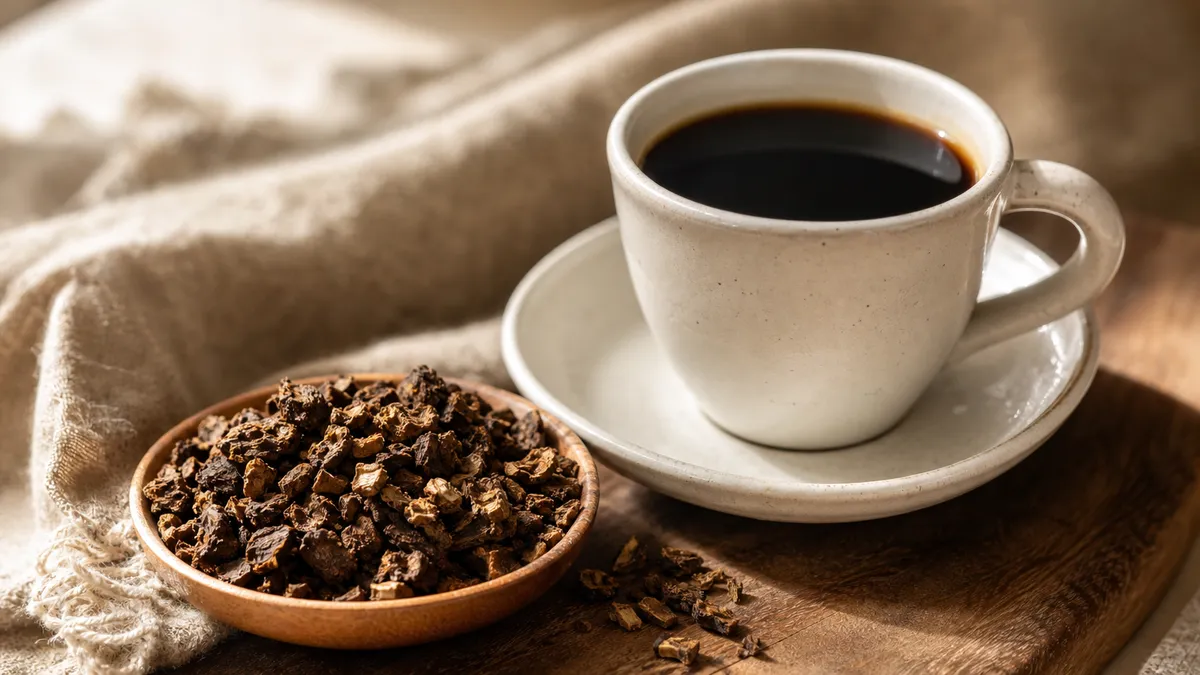
Chicory coffee is a dark, roasted drink made from the root of Cichorium intybus, either brewed on its own or blended with coffee. Pure chicory is naturally caffeine-free, but chicory-and-coffee blends can contain caffeine, so the ingredients matter more than the name on the front.
In short
- Choose pure roasted chicory if you want the root drink without coffee.
- Expect a nutty, bittersweet flavour, often with caramel-like or chocolate-like notes, rather than an exact coffee replacement.
- Instant chicory dissolves in the mug; roasted root pieces need infusing and straining.
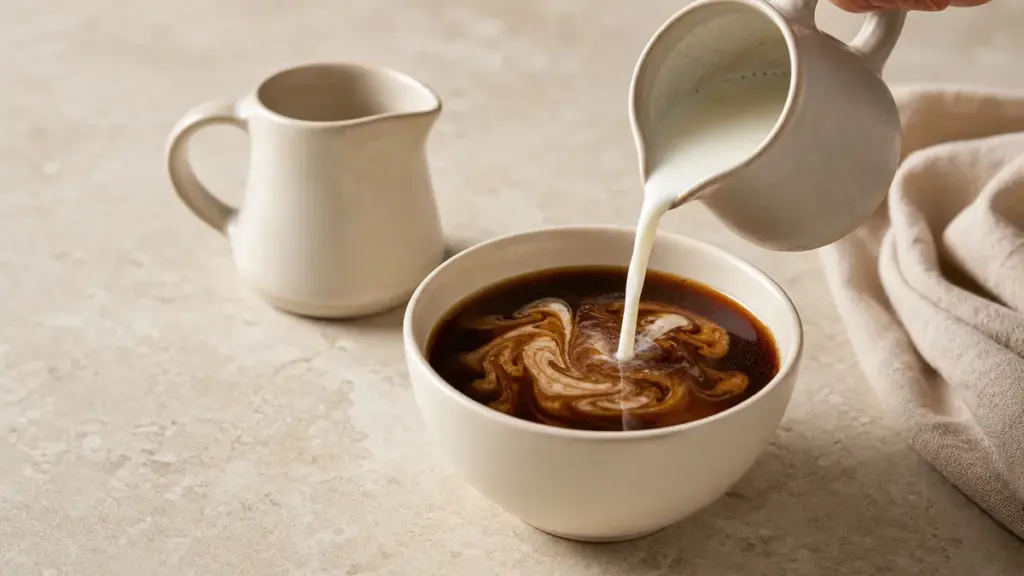
- New Orleans café au lait commonly combines coffee and chicory with hot milk.
- Chicory root contains inulin, a prebiotic soluble fibre, but roasting changes it substantially. Do not assume every mug provides a meaningful fibre dose.
What is chicory coffee made from?
Chicory coffee starts with the root of Cichorium intybus. The root is dried, roasted and prepared for brewing, or processed into a soluble extract. It is not a coffee bean, and pure chicory contains no coffee.
The word “coffee” describes its role at the breakfast table rather than its botanical identity. Like other coffee substitutes, it offers a roasted hot drink without necessarily reproducing coffee’s flavour or stimulant effect.
Three formats deserve distinguishing:
| Format | What it contains | How to prepare it | Caffeine |
|---|---|---|---|
| Roasted root pieces or grounds | Chicory root, if labelled pure | Infuse or brew, then strain | Naturally caffeine-free |
| Pure instant chicory | Soluble roasted chicory extract | Dissolve in water or milk | Naturally caffeine-free |
| Coffee-and-chicory blend | Both ingredients | Follow the product’s brewing instructions | Can contain caffeine |
Read the full ingredients list, especially on products described as a coffee alternative or coffee essence. Those descriptions do not establish that a product is pure chicory.
For a wider comparison of ingredients and drink styles, see alternatives to coffee.
What does chicory coffee taste like?
Roasted chicory is generally nutty and bittersweet, with a roasted sweetness that can suggest caramel. Café Du Monde describes an almost chocolate-like contribution from chicory in its coffee-and-milk drink.
Those descriptions are useful expectations, not guaranteed tasting notes. Roast, concentration and the other ingredients all affect the result. A strong preparation may emphasise bitterness; a lighter one gives you more room to decide whether the root’s distinctive flavour suits you.
The best approach is to treat chicory as its own drink. If you expect an exact copy of your usual coffee, the difference can feel disappointing. If you want a dark, roasted alternative, that difference is part of the appeal.
Milk is a traditional accompaniment, not a requirement. Try the first mouthful black, then add milk or a plant-based alternative if you prefer a softer drink.
From wartime substitute to New Orleans tradition
Chicory has served two related purposes: replacing unavailable coffee and stretching the coffee people already had. Its history connects European trade restrictions, American wartime shortages and drinks that remained popular after the shortages passed.
A short timeline
- 1806: Napoleon’s Berlin Decree established the Continental System against British trade. Chicory producer Leroux links the resulting restrictions on coffee supplies with the expansion of chicory drinking in France. This is a story of increased adoption, not proof that chicory coffee was invented that year.
- American Civil War: Chicory was used when coffee supplies were scarce. The Smithsonian records Confederate soldiers adding or substituting chicory and other roasted ingredients because Union blockades restricted supplies.
- 1862: Café Du Monde opened in New Orleans. Its own history identifies coffee and chicory as its characteristic coffee offering, served black or with hot milk.
- 1876: Camp Coffee’s brand history dates its beginnings to the Paterson Company of Glasgow, Scotland. Camp is a coffee-and-chicory essence, not pure chicory.
- 1942: During American Second World War coffee rationing, contemporary advice recommended adding chicory to stretch supplies. The US National Park Service documents that advice.
These examples should not be collapsed into a single invention story. Chicory drinking in Europe predates the New Orleans café tradition, while wartime shortages help explain why substitutes and blends spread.
Nor should American coffee rationing be presented as a UK rule. The Second World War example above specifically concerns the United States.
What makes the New Orleans version different?
New Orleans-style coffee and chicory is a blend, not a mug of pure root infusion. Café Du Monde describes its café au lait as prepared coffee and chicory mixed half and half with hot milk.
To reproduce that serving style, combine equal volumes of brewed coffee-and-chicory blend and hot milk. The equal-parts instruction concerns the finished brew and milk, not equal weights of dry coffee and chicory. It also does not make the drink caffeine-free.
How to make chicory coffee
First establish whether your product is soluble or needs filtering. Confusing those formats is an easy way to end up with either unnecessary brewing equipment or a gritty mug.
A simple instant method
For plain soluble chicory, Leroux gives a starting dose of 2.5 g per 125 ml of liquid. The method below doubles that manufacturer’s proportion.
Equipment: mug, scales, kettle and spoon.
Ingredients: 5 g pure soluble chicory and 250 ml hot water, or hot milk if the packet permits it.
- Check that the ingredients specify pure soluble chicory.
- Weigh 5 g into the mug.
- Add a little of the 250 ml hot liquid and stir until dissolved.
- Add the remaining liquid, stir and taste.
- Use less powder next time if you find the drink too concentrated.
This is a manufacturer-based starting point, not a universal chicory standard or a first-hand tested recipe. Follow your own product’s directions where they differ.
Brewing roasted root pieces
Root pieces need contact with hot water followed by separation from the drink. Leroux’s published infusion guidance uses 250 ml hot water and a five-minute steep, with its specified packet dose.
Put the measured root into an infuser or heatproof brewing vessel, add the water, leave it to infuse, then strain. Because pieces vary in size and density, use the product’s stated dose rather than converting a spoon measure into an invented gram weight.
The manufacturer specifies hot water rather than a precise temperature in degrees Celsius. There is no reason to give that instruction a false laboratory precision.
Preparing coffee-and-chicory blends
Use the brewing method and dose stated on the blend. Do not automatically substitute chicory for coffee gram for gram and assume the same result.
If you want to experiment with your own mixture, make a small batch and record the weights of each ingredient. Change one thing at a time so that you can distinguish the effect of the blend from the effect of brewing strength.
For workplace use, the simplest trial is a separately prepared drink. Do not assume a commercial bean-to-cup machine accepts chicory merely because another brewing device does; check its manufacturer’s instructions before introducing a substitute.
Troubleshooting your first mug
These are practical adjustments rather than claims from comparative brewing trials.
| Symptom | Likely cause | Fix |
|---|---|---|
| Overwhelmingly strong or bitter | Too much product for your preference | Reduce the dose while keeping the liquid volume unchanged |
| Weak, watery drink | Too little product or an unsuitable method | Check the packet directions before increasing the dose |
| Root pieces in the mug | A non-soluble product was not strained | Use an infuser or filter |
| Flavour remains unfamiliar | Expecting chicory to duplicate coffee | Try it as a separate drink rather than judging it as identical coffee |
Inulin, roasting and digestive tolerance
Chicory root is rich in inulin, a soluble fibre made from linked sugar units. It is described as prebiotic because gut microorganisms can use it, with potential benefits to the host.
However, raw root, extracted inulin and roasted chicory drink are not nutritionally interchangeable.
Roasting changes the fibre
Saying that inulin simply “caramelises” is an oversimplification. Laboratory research on chicory roasting found substantial breakdown of inulin, alongside changes in sugars and amino acids. Sugar degradation and browning reactions help explain how a root develops roasted flavours.
That chemistry also explains why a raw-root fibre figure cannot be copied onto a finished mug. The roast, processing and amount used matter. Unless the product provides relevant analytical information, do not promise a particular inulin intake.
What the health evidence actually supports
EFSA’s 2015 assessment supported increased stool frequency from 12 g daily of a specified native chicory inulin ingredient. That finding concerns a characterised fibre ingredient and dose, not ordinary chicory coffee as a category.
Digestive effects can also be unwelcome. Controlled trials of chicory inulin products have reported wind and bloating, with tolerance depending on the ingredient and dose. A controlled study of an inulin-rich roasted chicory extract found slight increased abdominal discomfort at its higher tested intake.
These results are not contradictory: an ingredient can affect bowel function and still cause symptoms in some people. They do not establish a universal number of mugs that everyone will tolerate.
Start with a modest serving if chicory is new to you. If it repeatedly causes discomfort, reduce it or stop rather than assuming the symptoms prove it is helping. Persistent bloating warrants advice from a GP.
FAQ
Does a darker chicory drink contain more caffeine?
No, darkness alone does not tell you whether a drink contains caffeine. Pure chicory is naturally caffeine-free, while a dark coffee-and-chicory blend can contain caffeine from its coffee component. Check the ingredients and any product-specific caffeine information rather than using colour, bitterness or the word “roasted” as a guide.
Is Camp Coffee the same as pure chicory?
No, Camp Coffee is a coffee-and-chicory essence rather than pure roasted chicory. Its brand history dates the product to Glasgow in 1876. It belongs in the history of convenient coffee-and-chicory preparations, but it should not be treated as interchangeable with either soluble pure chicory or root pieces intended for infusion.
Is chicory automatically a suitable replacement during pregnancy?
No, caffeine-free status alone does not establish suitability during pregnancy. Coffee-containing blends also need to be distinguished from pure chicory. The NHS advises no more than 200 mg caffeine daily from all sources during pregnancy. Ask a midwife, pharmacist or GP about the particular product rather than treating every herbal substitute as automatically appropriate.
Where to go next
Read Alternatives to Coffee to decide whether chicory coffee fits the kind of replacement you want. Dandelion Root Coffee is the next read for another roasted-root drink, while Barley Coffee explores a grain-based alternative.
Sources
-
Wei and colleagues, University of Tokyo, “Use of NMR-Based Metabolomics To Chemically Characterize the Roasting Process of Chicory Root”, Journal of Agricultural and Food Chemistry, 2016.
https://pubmed.ncbi.nlm.nih.gov/27504711/ -
Chicorée Leroux, “How to eat chicory”, undated, current preparation guidance retrieved November 2026.
https://www.leroux.com/en/questions-frequentes/how-should-chicory-be-used/ -
Fondation Napoléon, “A close-up on: the ‘Continental system or Blockade’”, undated; and Chicorée Leroux, “Histoire de l’entreprise Chicorée Leroux”, undated.
https://www.napoleon.org/en/history-of-the-two-empires/close-up/a-close-up-on-the-continental-system-or-blockade
https://www.leroux.com/notre-entreprise-chicoree-leroux/ -
Smithsonian National Museum of American History, “Coffee sack”, collection record, undated.
https://americanhistory.si.edu/ne/collections/object/nmah_1429643 -
Café Du Monde, “About Cafe Du Monde” and “Coffee Black or Au Lait”, undated, retrieved November 2026.
https://shop.cafedumonde.com/history/
https://shop.cafedumonde.com/coffee/ -
Camp Coffee, hosted by RH Amar, “Camp Coffee Fact Sheet”, undated, retrieved November 2026.
https://rhamaronline.com/netalogue/documents/Camp/CM001/Camp%20Coffee%20Fact%20Sheet.pdf -
US National Park Service, “Coffee Rationing on the World War II Home Front”, undated, including references to Life, 30 November 1942.
https://www.nps.gov/articles/000/coffee-rationing-on-the-world-war-ii-home-front.htm -
EFSA, “Scientific Opinion on the substantiation of a health claim related to ‘native chicory inulin’ and maintenance of normal defecation by increasing stool frequency”, EFSA Journal, 2015, 13(1):3951, assessment abstract retrieved through DTU Research Database.
https://orbit.dtu.dk/en/publications/scientific-opinion-on-the-substantiation-of-a-health-claim-relate/ -
Bonnema and colleagues, University of Minnesota, “Gastrointestinal tolerance of chicory inulin products”, Journal of the American Dietetic Association, 2010.
https://pubmed.ncbi.nlm.nih.gov/20497775/ -
Ripoll and colleagues, “Gastrointestinal tolerance to an inulin-rich soluble roasted chicory extract after consumption in healthy subjects”, Nutrition, 2010.
https://pubmed.ncbi.nlm.nih.gov/19931416/ -
NHS, “Bloating” and “Foods to avoid in pregnancy”, current guidance retrieved November 2026.
https://www.nhs.uk/symptoms/bloating/
https://www.nhs.uk/pregnancy/keeping-well/foods-to-avoid/
This piece was researched using retrieved laboratory studies, controlled human trials, an EFSA assessment, NHS guidance, museum histories and manufacturers’ preparation instructions; no first-hand brewing tests were conducted.
Last checked: November 2026