The best alternatives to coffee depend on what you want to replace: choose chicory or roasted grain drinks for a caffeine-free, coffee-style cup, rooibos for a different daily brew, or decaf if keeping actual coffee matters most. Tea, matcha and many mushroom-coffee blends still contain caffeine, so switching drinks does not necessarily mean cutting it out.
In short
- Check ingredients: pure roasted roots and grains differ from blends containing coffee, tea or added caffeine.
- Decaf is not caffeine-free: it removes most caffeine, not all of it.
- Match your reason: evening drinking, different flavours and complete caffeine avoidance call for different choices.
- Question health promises: research on an ingredient does not establish benefits for a finished drink.
- Check dietary suitability: barley and rye contain gluten, while herbal ingredients have safety considerations of their own.
Start with your reason for switching
Decide whether you want less caffeine, no coffee, an evening drink or simply a different flavour. These are separate aims: a product can meet one while missing another.
For caffeine reduction, consider the amount per serving and your total intake. The European Food Safety Authority’s assessment found that up to 400 mg daily, spread across the day, raises no safety concerns for healthy non-pregnant adults; single doses up to 200 mg raise no concerns for most healthy adults. These are population benchmarks, not targets or guarantees of individual comfort.
Sleep can be a reason to switch even below those amounts. EFSA found that 100 mg close to bedtime can affect sleep in some adults. You might therefore replace afternoon coffee rather than abandon it altogether.
If coffee seems to trigger symptoms, do not assume every roasted substitute will solve them. Discuss persistent symptoms with a GP and medicine or herbal-product questions with a pharmacist. Our coffee substitutes guide provides the wider starting point.
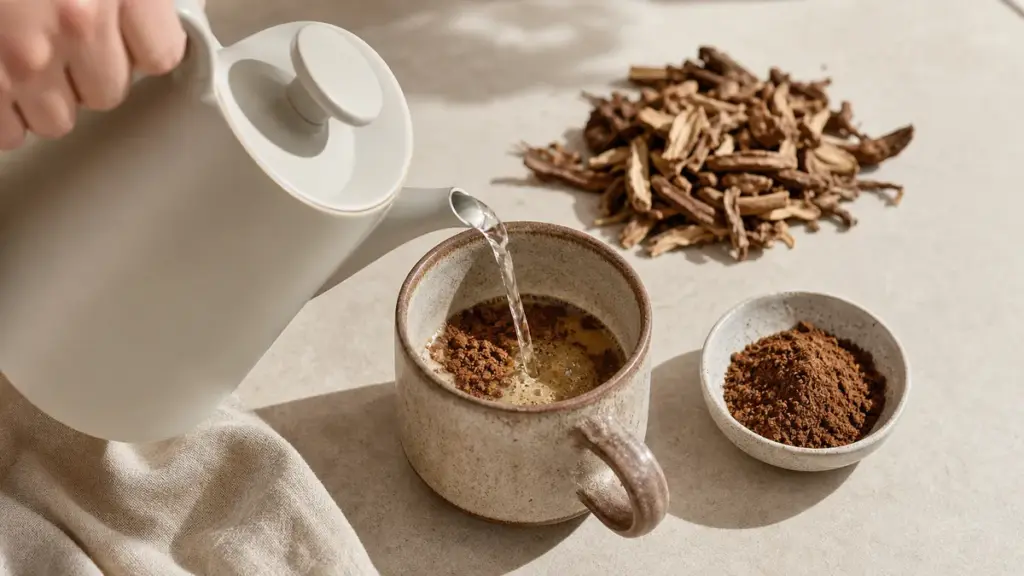
Alternatives to coffee compared
This comparison prioritises flavour, caffeine status and practical suitability, not wellness promises. Taste descriptions are broad expectations drawn from published product descriptions, not first-hand testing.
“Caffeine-free” refers here to plain products without added coffee, tea, cocoa or another caffeine source. Check the actual pack, especially with mixed powders.
| Option | Expected taste | Caffeine status | Who it suits and main limitation |
|---|---|---|---|
| Pure roasted chicory | Roasted and coffee-like, with a distinctive root character | Naturally caffeine-free | A coffee-style replacement; check it is not blended with coffee |
| Roasted dandelion root | Roasted, slightly nutty and bitter | Naturally caffeine-free | Those who enjoy bitter roasted drinks; health claims need caution |
| Barley or mixed cereal drink | Mild roasted flavour | Caffeine-free without caffeinated additions | A gentler roasted option; barley and rye contain gluten |
| Pure rooibos | Subtle caramel character | Naturally caffeine-free | An everyday infusion, including with milk; not a coffee imitation |
| Decaffeinated coffee | Actual coffee flavour | Reduced caffeine, not zero | Those wanting to keep coffee; not guaranteed caffeine avoidance |
| Black or green tea, including matcha | Different from coffee; matcha has savoury umami notes | Contains caffeine unless specifically decaffeinated | Variety rather than necessarily caffeine elimination |
| Mushroom drink or mushroom coffee | Depends on its base | Product-dependent | Needs close label reading; the name alone tells you little |
There is no universal caffeine figure for “a coffee alternative”. The NHS currently estimates about 75 mg in a cup of black or green tea, but preparation and serving size vary. Use a product’s declared caffeine per serving where available.
Which caffeine-free substitutes are worth trying?
Chicory and roasted grain drinks
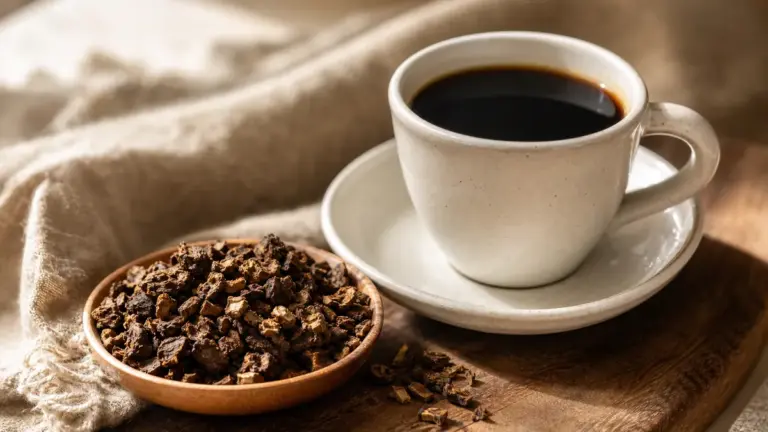
Pure roasted chicory is a sensible first trial for coffee-style flavour without coffee. Try it plain initially, then add milk if you prefer: this helps you distinguish the drink’s underlying character from its additions.
Check the ingredients. Roasted chicory root alone is different from coffee blended with chicory; the latter still contains coffee, however prominent chicory appears on the packaging. Our guide to chicory coffee covers this distinction in more detail.
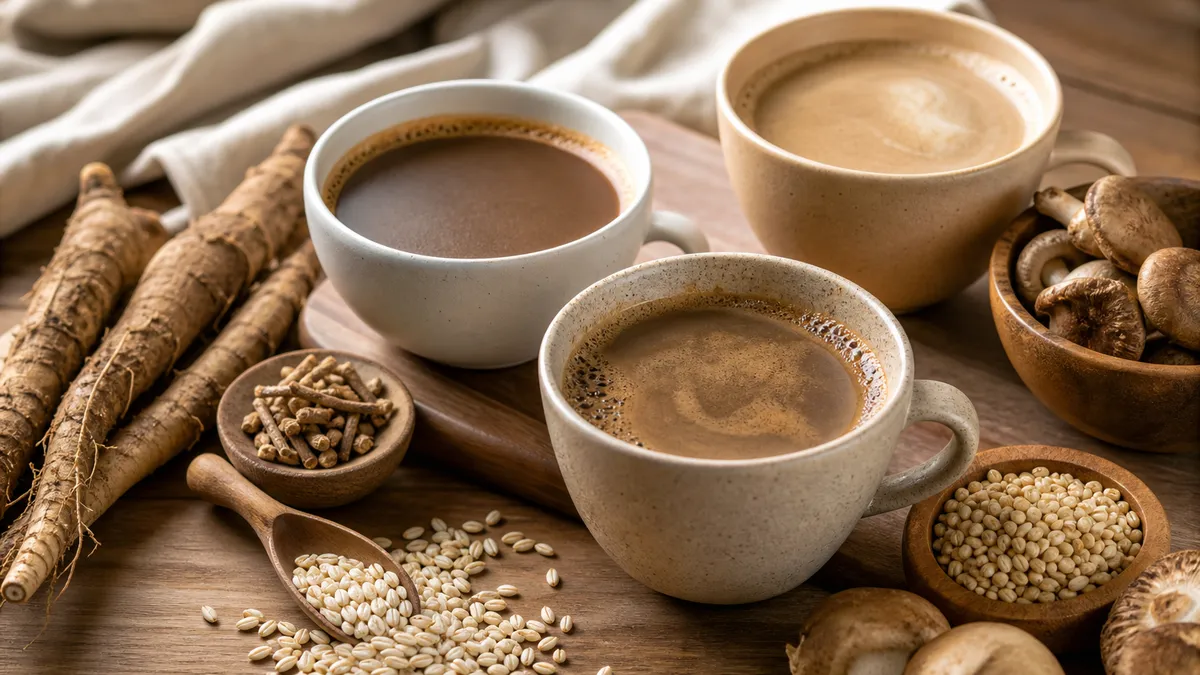
Barley and mixed cereal drinks offer a milder roasted option. Some combine barley, rye and chicory, so the contents may be a blend rather than a single ingredient.
Barley and rye contain gluten. Do not assume suitability for coeliac disease because a drink is caffeine-free or plant-based. Check its allergen information and appropriate gluten-free labelling.
Dandelion root
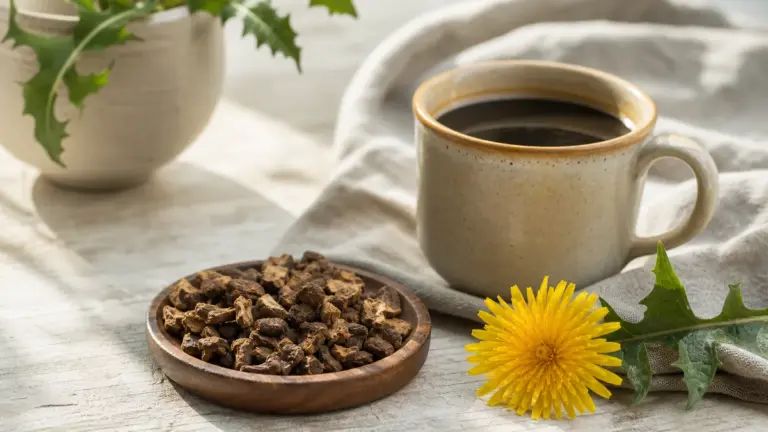
Roasted dandelion root offers bitter, roasted notes without coffee. Choose a product intended for drinking and distinguish roasted root from leaf-and-root blends, which are not necessarily designed for the same flavour.
Flavour is a valid reason to try it; “detox” promises are not. The US National Center for Complementary and Integrative Health says there is no compelling scientific evidence supporting dandelion for any health condition. See dandelion root coffee for the focused guide.
Rooibos
Pure rooibos is naturally caffeine-free, with a subtle caramel character that works with or without milk. It suits someone seeking a satisfying new habit rather than a close coffee imitation.
Set expectations accordingly. A substitute need not reproduce coffee to be enjoyable, and choosing an entirely different flavour may be more satisfying than searching for an exact match.
Coffee-free does not always mean caffeine-free
Tea and matcha replace coffee, but they are not naturally caffeine-free. Matcha comes from the tea plant and contains caffeine; its savoury flavour and preparation ritual do not change that.
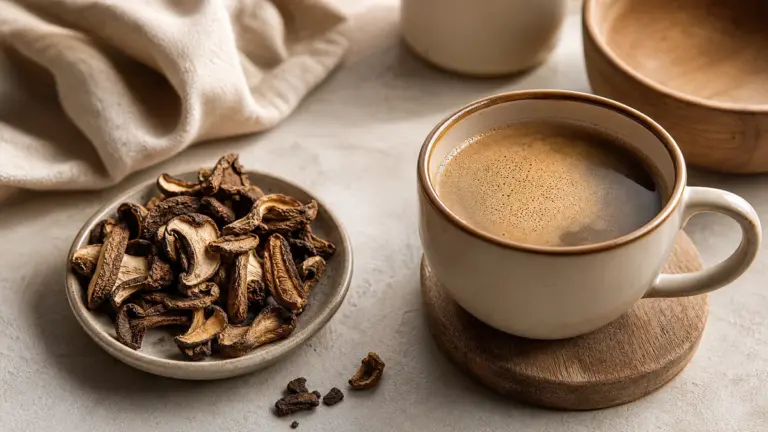
“Mushroom coffee” also needs scrutiny. It can mean actual coffee with mushroom ingredients added. Four Sigmatic, for example, declares 50 mg of caffeine per serving in its instant mushroom coffees. That is a manufacturer’s figure for those products, not a category-wide average or an independently verified measurement.
Establish the base ingredients before comparing mushroom drinks. The mushroom name or picture does not tell you whether the product contains coffee or caffeine. Nor does adding mushroom ingredients establish that caffeine will affect you differently.
Decaf is a separate compromise: still coffee, with some caffeine remaining. It can suit someone who enjoys coffee and wants less caffeine rather than none. For strict avoidance, do not treat “decaffeinated” and “caffeine-free” as interchangeable.
How strong is the evidence for health claims?
Chicory fibre: a specific finding
Inulin is a type of fibre associated with chicory. EFSA’s assessment found that at least 12 g daily of a specified native chicory inulin increased stool frequency, based on human intervention studies.
That does not establish the same effect for an ordinary mug of roasted chicory. The preparation, quantity and measured inulin content matter. Mentioning chicory or “prebiotics” on a pack does not show that its serving matches the material and intake studied.
“Prebiotic” does not guarantee comfortable digestion either. Monash University explains that fermentation of ingredients such as inulin can cause gas, bloating and abdominal distension in some people with irritable bowel syndrome. Judge tolerance rather than assuming a digestive-health claim applies equally to everyone.
Mushroom ingredients: preliminary findings
Controlled human research on lion’s mane supports further investigation, not a general endorsement of mushroom coffee. A small randomised pilot trial published in 2023 found improvement on one cognitive task, alongside null and limited negative findings elsewhere.
A separate randomised crossover trial published in 2025 found no significant improvement in overall cognitive function or mood, although one individual task improved. These results are not simply contradictory: the preparations, testing schedules and outcomes differed.
Neither trial establishes that an unspecified retail mushroom-coffee blend improves focus or prevents caffeine-related discomfort. Evidence for a named ingredient is not automatically evidence for the finished drink. Look for research matching the actual formulation and serving before accepting such claims.
Judge what ends up in your cup
Separate three questions: does it taste good, does it meet your caffeine goal, and is its health claim supported? A drink can satisfy the first two without offering a special medical benefit.
Consider additions too. NHS guidance favours lower-sugar drinks and advises against frequent high-sugar drinks. Replacing plain coffee with a heavily sweetened substitute is not automatically a healthier swap.
A practical checklist for switching
- Define your aim: less caffeine, no caffeine, no coffee or more variety.
- Choose a flavour direction: roasted roots or grains for coffee-style character; rooibos for something different.
- Read the ingredients: check for coffee, tea, other caffeine sources, allergens and added sweeteners.
- Follow the preparation instructions: instant powders and ingredients requiring brewing are not interchangeable.
- Reduce caffeine gradually if appropriate: the FDA advises gradual reduction because withdrawal can be unpleasant.
- Review the result: keep the option you enjoy and tolerate, rather than the one making the boldest promises.
Compare substitutes under similar conditions, using the same mug and your usual milk or sweetener. Change one thing at a time so you can identify what you actually like.
The useful test for alternatives to coffee is whether they fit your routine and reason for switching. A good replacement needs no extraordinary health promise to earn its place.
FAQ
Which alternative tastes most like coffee?
Pure roasted chicory is a sensible first choice for coffee-style flavour without coffee. Dandelion root and cereal drinks offer other roasted profiles, but none should be expected to reproduce every coffee. If keeping actual coffee flavour matters more than excluding coffee itself, decaf is the more direct compromise.
Are coffee alternatives safe during pregnancy?
Caffeine-free does not automatically mean suitable during pregnancy. The NHS advises no more than 200 mg of caffeine daily from all sources and currently recommends limiting herbal tea to four cups a day, avoiding liquorice-root teas. Check unusual herbal blends and concentrated extracts with your midwife or pharmacist rather than assuming “natural” guarantees safety.
Will a herbal drink still help me stay hydrated?
Yes, a suitable caffeine-free drink can contribute to fluid intake, but coffee and tea already count too. NHS guidance includes both among drinks that help with hydration. You do not need to stop coffee solely to make your fluids “count”; consider caffeine tolerance, added sugar and personal preference instead.
Where to go next
Start with Coffee Substitutes for the wider category guide. Read Chicory Coffee if roasted, coffee-like flavour is your priority, or Dandelion Root Coffee to explore another bitter roasted-root option.
Sources
Guidance and research
-
European Food Safety Authority. Caffeine, topic guidance summarising its 2015 scientific assessment. Current page retrieved November 2026.
https://www.efsa.europa.eu/en/topics/topic/caffeine -
NHS. Foods to avoid in pregnancy. Current guidance retrieved November 2026.
https://www.nhs.uk/pregnancy/keeping-well/foods-to-avoid/ -
US Food and Drug Administration. Spilling the Beans: How Much Caffeine is Too Much? Current guidance retrieved November 2026.
https://www.fda.gov/consumers/consumer-updates/spilling-beans-how-much-caffeine-too-much -
Food Standards Agency. Food Standards Agency Codes: Barley. Current allergen entry retrieved November 2026.
https://data.food.gov.uk/codes/alerts/def/allergen/barley
GOV.UK. Food labelling and packaging: Ingredients list. Current guidance retrieved November 2026.
https://www.gov.uk/food-labelling-and-packaging/ingredients-list -
National Center for Complementary and Integrative Health. Dandelion. Current evidence and safety summary retrieved November 2026.
https://www.nccih.nih.gov/health/dandelion -
EFSA NDA Panel. Scientific Opinion on the substantiation of a health claim related to “native chicory inulin” and maintenance of normal defecation by increasing stool frequency. 2015, EFSA Journal, 13(1):3951.
https://efsa.onlinelibrary.wiley.com/doi/10.2903/j.efsa.2015.3951 -
Monash University. Update: Label reading and FODMAPs. 2021.
https://www.monashfodmap.com/blog/update-label-reading/ -
Docherty, Doughty and Smith. The Acute and Chronic Effects of Lion’s Mane Mushroom Supplementation on Cognitive Function, Stress and Mood in Young Adults: A Double-Blind, Parallel Groups, Pilot Study. 2023, Nutrients, 15(22):4842.
https://pubmed.ncbi.nlm.nih.gov/38004235/ -
Surendran and colleagues. Acute effects of a standardised extract of Hericium erinaceus (Lion’s Mane mushroom) on cognition and mood in healthy younger adults: a double-blind randomised placebo-controlled study. 2025, Frontiers in Nutrition, 12:1405796.
https://www.frontiersin.org/journals/nutrition/articles/10.3389/fnut.2025.1405796/pdf -
NHS. Water, drinks and hydration. Current guidance retrieved November 2026.
https://www.nhs.uk/Live-well/eat-well/food-guidelines-and-food-labels/water-drinks-nutrition/
Product composition and published flavour descriptions
-
Grana. Chicorycup and Barleycup Organic. Undated manufacturer pages, retrieved November 2026.
https://www.chicorycup.com/
https://barleycup.com/products/barleycup-organic/ -
Traditional Medicinals. Roasted Dandelion Root Tea. Undated manufacturer page, retrieved November 2026.
https://www.traditionalmedicinals.com/products/roasted-dandelion-root-tea/ -
Clipper. Organic Rooibos. Undated manufacturer page, retrieved November 2026.
https://www.clipper-teas.com/product/organic-redbush/ -
Four Sigmatic. How do your coffees compare to regular coffee? Current manufacturer information retrieved November 2026.
https://foursigmatic.gorgias.help/en-US/how-do-your-coffees-compare-to-regular-coffee-41507 -
Twinings. The Many Uses of Matcha. Undated manufacturer article, retrieved November 2026.
https://twinings.co.uk/blogs/news/the-many-uses-of-matcha
This article was researched using public-health guidance, an EFSA evidence assessment, controlled human studies and manufacturers’ ingredient information; no first-hand product testing was undertaken.
Last checked: November 2026