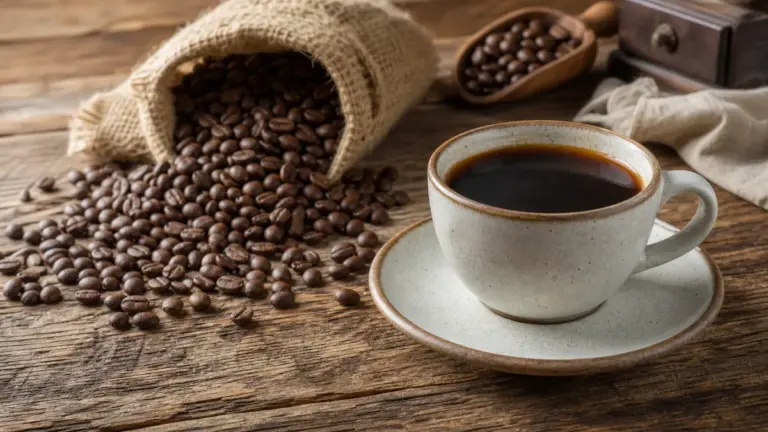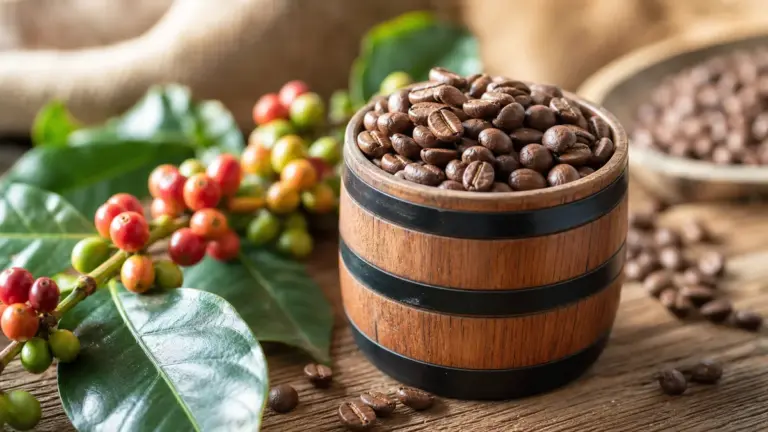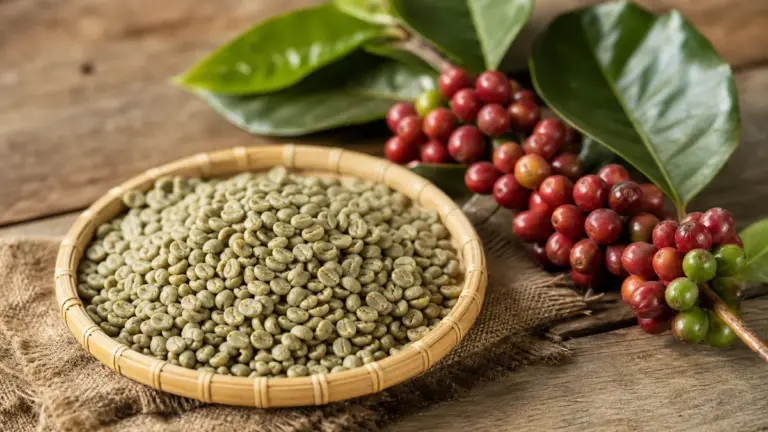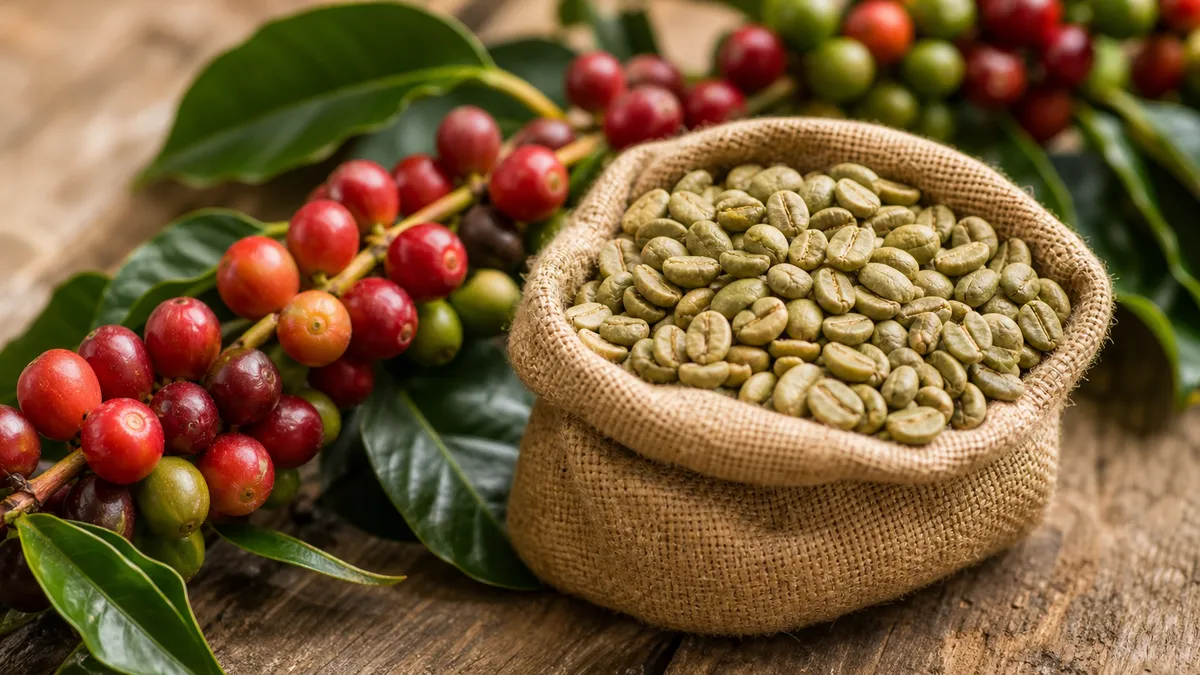
Puerto Rican coffee is often rounded and sweet, with chocolate, caramel and nut-like flavours, a creamy texture and moderate acidity, although individual farms produce distinctly different cups. Its story combines a long-established mountain-growing tradition with repeated hurricane damage and a revival built on replanting, farmer training and more traceable coffees.
In short
- Look for the place where the beans were grown, not simply where they were roasted or packed.
- The central and western mountains are the main growing area, including Yauco, Adjuntas, Jayuya, Lares and Maricao.
- Arabica dominates, with varieties including Typica, Bourbon, Caturra, Catuaí and Limaní.
- University extension guidance gives August to January as the usual picking season, with timing varying by elevation.
- Recovery programmes show substantial replanting, but their achievements should not be mistaken for proof that the whole industry has recovered.
What does Puerto Rican coffee taste like?
A useful starting expectation is chocolate and caramel, supported by nut-like aromas and a rounded mouthfeel. The University of Puerto Rico’s production and export manual describes a carefully harvested and processed highland coffee as creamy or buttery, with chocolate and nut notes, caramel and almond-like fragrance, and moderate acidity.
That is a description of a well-prepared style, not a promise attached to every bag. The manual itself cautions against giving one definitive profile for the island because its growing areas differ.
Producer descriptions help illustrate the variation. Cuatro Sombras describes its Yauco coffee as medium-bodied, with vibrant acidity, semi-sweet chocolate, caramel and spices; Baraka describes its washed Yauco offering around a classic chocolate character. These are the sellers’ tasting descriptions, not independent tasting results.
For a beginner, acidity means the bright, lively sensation in the cup, rather than simply an unpleasant sour taste. Do not assume that Puerto Rican coffee must be flat or almost acid-free: the contrast between the university’s moderate-acidity description and Cuatro Sombras’ brighter profile is a good reason to read the individual lot information.
Treat origin as the starting point, then ask about the farm, processing and roast. The wider Caribbean coffee guide provides the regional context without treating neighbouring islands as interchangeable.
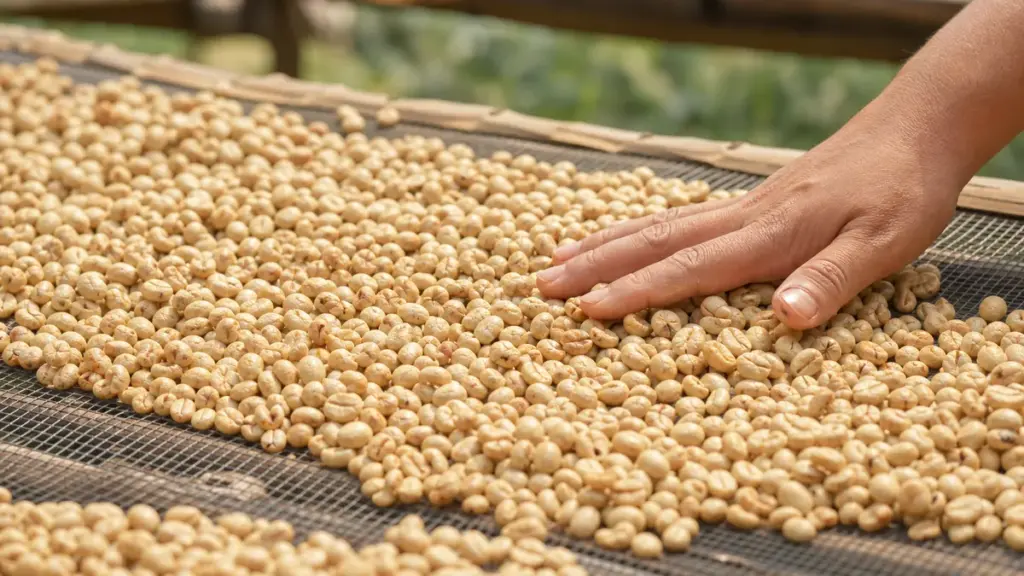
Puerto Rican coffee: origin fact panel
The altitude figure below is deliberately qualified. It records a verified range from contemporary research rather than presenting study boundaries as the limits of coffee cultivation across Puerto Rico.
| Feature | Verified guide | Evidence |
|---|---|---|
| Growing area | Mainly the humid central and western mountains, within the Cordillera Central | USDA NRCS, source 2 |
| Altitude range | 403 to 951 metres above sea level across sites in a study published in 2026; not an island-wide minimum and maximum | Mariño and colleagues, source 3 |
| Species and varieties | Predominantly Coffea arabica. Documented varieties include Typica, Bourbon, Caturra, Catuaí, Mundo Novo, Limaní, Marsellesa and Obatã | USDA ERS and Mariño and colleagues, sources 3 and 8 |
| Main processing | Washed coffee is an established commercial style; university guidance also describes dry processing | USDA ERS and UPR extension, sources 6 and 8 |
| Harvest months | Usually August to January in university extension guidance; a local specialist reports some picking from July through February | UPR extension and Cuela, sources 5 and 7 |
| Typical cup profile | Chocolate, caramel and nuts, creamy texture and moderate acidity in the university’s description of well-prepared highland coffee | UPR production manual, source 1 |
Where coffee grows in Puerto Rico
Puerto Rico’s coffee country is mountainous rather than coastal. USDA conservation guidance places most plantations on the humid slopes of the central and western interior, where steep ground and cooler conditions shape farming.
Names worth recognising include Yauco, Adjuntas, Jayuya, Utuado, Lares, Maricao and Ciales. These are growing municipalities, not varieties or processing methods. A bag marked Yauco tells you something about geographical origin, but not which arabica variety it contains.
Nor does a municipality represent one uniform elevation. Cuela’s account of the harvest describes lower-growing areas around Las Marías and Mayagüez, alongside later-picking highland areas in places such as Jayuya and Yauco. It also emphasises local conditions: exposure and microclimate can change the timing within a district.
For buying purposes, a named farm or clearly identified group of growers is more useful than an attractive mountain name alone. Ask whether the stated elevation describes the actual lot, a farm’s full extent or simply the wider district.
Shade is another detail worth checking rather than assuming. Puerto Rico has both sun-grown and shade-grown coffee. USDA’s conservation work supports the return of managed shade trees to help regulate growing conditions and provide wildlife habitat, but “Puerto Rican” does not automatically mean “shade-grown”.
A history of expansion, decline and repeated rebuilding
Coffee’s importance to Puerto Rico predates its modern specialty market. Historian Fernando Picó dates its introduction to 1736 and identifies renewed expansion into the central mountains after 1855.
The precise arrival date is less secure than a simple anniversary suggests. Ayala and Bergad’s Agrarian Puerto Rico places introduction more broadly in the 1720s or 1730s. The safe conclusion is that coffee became established during the early eighteenth century, with 1736 a frequently cited date.
A short timeline
- 1736: Picó’s date for the introduction of arabica coffee.
- After 1855: Coffee cultivation expanded again in the central mountains.
- Mid-1890s: Coffee accounted for about 70% of Puerto Rico’s export trade by value, according to Ayala and Bergad.
- 1998: Hurricane Georges severely damaged the coffee sector.
- September 2017: Hurricanes Irma and María caused another major collapse in trees and the expected harvest.
- December 2025: TechnoServe reported the completion of its seven-year Revivamos Nuestro Café programme.
Decline was not one uninterrupted slide from a nineteenth-century peak. USDA’s agricultural history records renewed expansion between 1978 and 1992, followed by hurricane damage and difficulties rebuilding during the island’s economic recession and fiscal crisis.
This matters when reading revival stories. Puerto Rican growers are not restarting an industry that disappeared completely; they are maintaining and rebuilding one that has repeatedly contracted, adapted and expanded.
For another island history, read Dominican coffee separately rather than assuming that Caribbean producers followed the same economic path.
How hurricanes changed the industry
Hurricanes can destroy the crop being picked and the trees needed for future harvests. USDA’s 2023 review reports that the September 2017 hurricanes destroyed approximately 80% of coffee trees and 85% of the production expected that year. Those are retrospective estimates for that disaster, not figures for today’s industry.
Replanting therefore cannot be judged like replacing a warehouse’s stock. A seedling is a future producing tree, not an immediate replacement harvest. Recovery figures need to distinguish planting, survival, productive maturity and coffee actually harvested.
The effects of shade also deserve care. It is tempting to imagine that a canopy of larger trees provides straightforward hurricane protection. An observational study of 28 farms, published in Scientific Reports in 2019, found that management style had only a small effect on resistance and recovery following María, probably because the disturbance was so severe.
The researchers found the farms’ social and political circumstances more useful in explaining recovery. The practical lesson is not that shade has no value, but that canopy management alone cannot explain how a farming community survives an extreme storm.
A useful revival story should therefore explain who is doing the farming, what support remains available and whether processing capacity has returned, not simply count new plants.
Varieties and processing: what sits behind the flavour
Puerto Rican coffee is not a botanical variety. It is an origin containing different cultivated varieties, principally of arabica.
Recent field research documents familiar names such as Bourbon, Caturra, Catuaí and Mundo Novo, alongside Variedad Puerto Rico, identified as a type of Typica. It also records Limaní, Marsellesa and Obatã.
Limaní has a particularly local connection. World Coffee Research identifies it as a Sarchimor-related arabica, selected in Puerto Rico from material combining Timor Hybrid and Villa Sarchi ancestry, and released to farmers in 1994.
There is an important qualification for enthusiasts: World Coffee Research warns that plants sold or grown under the Limaní name frequently do not match the original genetic reference. A variety name is useful information, but it is not always proof of genetic identity or predictable disease resistance.
Processing is a separate question. In washed processing, the fruit skin and pulp are removed, the sticky mucilage surrounding the seeds is removed through fermentation or mechanical treatment, and the coffee is dried. Dry processing follows a different route, drying the harvested fruit before the dried layers are removed.
Ask about these details rather than interpreting “sun-dried” as a complete processing description. Baraka, for example, explicitly describes its Yauco offering as washed and then sun-dried. Drying in sunshine does not, by itself, make a coffee a natural-process coffee.
What the revival means, and how to buy it
There is concrete evidence of rebuilding. In December 2025, TechnoServe reported that Revivamos Nuestro Café had trained more than 1,200 coffee-farming households since 2018, while project partners had supported the planting of approximately 11 million coffee trees over seven years.
These are programme-reported achievements. They demonstrate substantial activity, but do not establish that every planted tree survived or that island-wide production has returned to an earlier level.
For UK readers, availability needs checking lot by lot. Puerto Rican roasters currently advertise identifiable coffees, including Yauco offerings from Cuatro Sombras and Baraka, but an online product page does not establish UK delivery or continuing stock.
Use this buying checklist:
- Confirm bean origin. Ask whether all the coffee was grown in Puerto Rico.
- Request traceability. Look for a farm, municipality or named grower group.
- Separate processing from drying. “Washed, sun-dried” is more informative than “sun-dried” alone.
- Check the roast date and intended use. Ask the seller which brewing method suits that particular roast.
- Confirm UK fulfilment before ordering. Establish whether the seller currently dispatches to your address and can provide the promised lot.
Puerto Rico has historically imported coffee to meet demand, as the university’s export manual documents. That makes it especially sensible to distinguish grown in Puerto Rico from roasted, blended or packed there, without assuming that every local brand uses the same sourcing approach.
For further comparison, coffee from Cuba and Haiti belongs in its own context. Judge Puerto Rican coffee by the identifiable beans in the bag, not by a general Caribbean reputation.
FAQ
Is Puerto Rican coffee always low in acidity?
No, low acidity is not a reliable description of every Puerto Rican coffee. The university’s account of well-prepared highland coffee describes moderate acidity, while Cuatro Sombras describes its own Yauco coffee as having vibrant acidity. Use the specific producer’s tasting notes as a guide rather than treating the island’s name as a fixed flavour specification.
Does “100% arabica” mean it was grown in Puerto Rico?
No, “100% arabica” identifies the coffee species, not its geographical origin. If you want island-grown beans, ask for an explicit statement that all the coffee was grown in Puerto Rico, ideally supported by a named farm or growing municipality. Keep that separate from statements about where the coffee was roasted or packaged.
Has Puerto Rico’s coffee industry fully recovered from María?
The recovery programme evidence cited here does not establish full island-wide recovery. TechnoServe reports extensive planting and training, but those measures are not the same as a complete production census. A claim of full recovery would need a clearly defined benchmark and comparable harvest data, not simply the number of seedlings planted.
Where to go next
Start with Caribbean for the regional overview, then read The Dominican Republic for another island’s growing areas, coffee history and buying considerations. Cuba and Haiti provides a further comparison of Caribbean coffee origins and their distinct histories.
Sources
-
University of Puerto Rico, Agricultural Experiment Station: Manual para la Producción y Exportación de Café de Puerto Rico, undated retrieved edition, particularly the sections on cup characteristics and historical imports.
URL: https://www.uprm.edu/wp-content/uploads/sites/292/2019/05/Manual-para-la-Produccion-y-Exportacion-de-Cafe-de-Puerto-Rico-en-Informe-Proyecto-Potential-Markets-for-PR-Coffee-1-pages-17-169.pdf -
USDA Natural Resources Conservation Service: Shade-Grown Coffee Yields a Better Product and Top-Notch Wildlife Habitat, 2016, current retrieved page.
URL: https://www.nrcs.usda.gov/state-offices/caribbean-area/news/shade-grown-coffee-yields-a-better -
Mariño, Y. A., and colleagues, Frontiers in Plant Science: Dynamics of coffee leaf rust (Hemileia vastatrix) in Puerto Rico: associations with season, cultivar, altitude, and hyperparasites, 2026, volume 17, article 1768440.
URL: https://www.frontiersin.org/journals/plant-science/articles/10.3389/fpls.2026.1768440/full -
World Coffee Research: Arabica Coffee Varieties: Limani, undated live catalogue entry.
URL: https://varieties.worldcoffeeresearch.org/varieties/limani -
University of Puerto Rico, Agricultural Extension Service: Recolección del Café, Miguel F. Monroig Inglés, undated extension leaflet.
URL: https://www.uprm.edu/ecosdelcafe/wp-content/uploads/sites/133/2018/11/Recoleccion_Cafe.pdf -
University of Puerto Rico: Beneficiado del Café, Miguel F. Monroig Inglés, undated extension notes.
URL: https://www.uprm.edu/ecosdelcafe/wp-content/uploads/sites/133/2018/11/Beneficiado_de_Caf_1.pdf -
Cuela: Harvest Season in Puerto Rico, Enio A. Suasnávar Torres, 21 September 2026. Local coffee specialist’s account, used for variation in harvest timing.
URL: https://cuela.coffee/blogs/news/harvest-season-in-puerto-rico -
USDA Economic Research Service: Puerto Rico’s Agricultural Economy in the Aftermath of Hurricanes Irma and Maria: A Brief Overview, Administrative Publication 114, April 2023.
URL: https://ers.usda.gov/sites/default/files/_laserfiche/publications/106261/AP-114.pdf?v=33551 -
Picó, Fernando, Caravelle: El café y el despegue de la agricultura comercial en la montaña puertorriqueña (1855-1928), 1993, issue 61.
URL: https://www.persee.fr/doc/carav_1147-6753_1993_num_61_1_2552 -
Ayala, César J., and Bergad, Laird W., Cambridge University Press: “The Coffee Economy”, in Agrarian Puerto Rico, 2020. Retrieved publisher’s chapter summary.
URL: https://www.cambridge.org/core/books/abs/agrarian-puerto-rico/coffee-economy/DA5932EEC4C8AE3A007CC7FCE6C6A401 -
Perfecto, Ivette, and colleagues, Scientific Reports: Response of Coffee Farms to Hurricane Maria: Resistance and Resilience from an Extreme Climatic Event, 2019, volume 9, article 15668.
URL: https://www.nature.com/articles/s41598-019-51416-1 -
TechnoServe: Revivamos Nuestro Café Marks Success in Reviving Puerto Rico’s Coffee Sector, 3 December 2025. Programme implementer’s reported results.
URL: https://www.technoserve.org/news/revivamos-nuestro-cafe-coffee-revival-puerto-rico/ -
Cuatro Sombras: Cuatro Sombras Coffee, undated producer website. Used for its own origin and tasting descriptions.
URL: https://cuatrosombras.com/ -
Baraka Coffee Co.: Yauco, Puerto Rico Coffee, undated product page. Used for its own sourcing, processing and tasting descriptions.
URL: https://barakacoffee.com/products/yauco-puerto-rico-coffee-bag-2lbs
Research combined university extension material, historical scholarship, USDA publications, peer-reviewed field studies and attributed producer and programme descriptions; no first-hand tasting or farm inspection is claimed.
Last checked: November 2026