Coffee from the Dominican Republic is worth exploring if you enjoy sweetness, a rounded body and chocolate or nut-like aromas rather than an aggressively bright cup. That is a useful starting expectation, not a national flavour guarantee: the growing area, variety, processing and roast all deserve attention.
In short
- Start with traceability: look for a named growing area, producer and processing method rather than “Caribbean coffee” alone.
- Typica and Caturra are the traditional main varieties, with newer plantings including selections introduced to help manage coffee leaf rust.
- Washed processing is the main reference point, although the country’s technical guidance also covers honey and natural methods.
- Harvest timing varies considerably: October to June is a broad origin calendar, not the picking season of every farm.
- Exports need careful definitions: recorded exports of unroasted, non-decaffeinated coffee were 631,212 kg in calendar year 2025, excluding roasted and soluble products.
Dominican coffee at a glance
The Dominican Republic borders Haiti on Hispaniola. For its place among neighbouring origins, start with our Caribbean coffee guide, but judge Dominican coffee on its own growing areas and individual lots.
| Feature | Useful reference |
|---|---|
| Altitude | The Dominican production manual describes an adaptation range of 500 to 1,400 metres above sea level. This is agronomic guidance, not an exhaustive census of farm elevations. |
| Main varieties | Typica and Caturra, according to INDOCAFE, the national coffee institute. Its guidance also identifies newer plantings including T-8667, Lempira, Costa Rica 95 and Obatá. |
| Processing | Washed is the principal method identified in the Starbucks Coffee Academy origin reference. Honey and natural processing are also explained in the Dominican technical manual. |
| Harvest | October to June as a broad country reference. INDOCAFE describes a traditional high-zone season from December into June, while reporting earlier picking in 2023. |
| Cup profile | A useful documented benchmark is Café de Valdesia: medium body, mild acidity, sweetness and a clean finish, sometimes with nutty or chocolatey aromas. This is not a specification for every Dominican coffee. |
The distinction between a country reference and a lot description matters. Use the panel to orient yourself, then ask the seller for the particulars of the coffee actually in the bag.
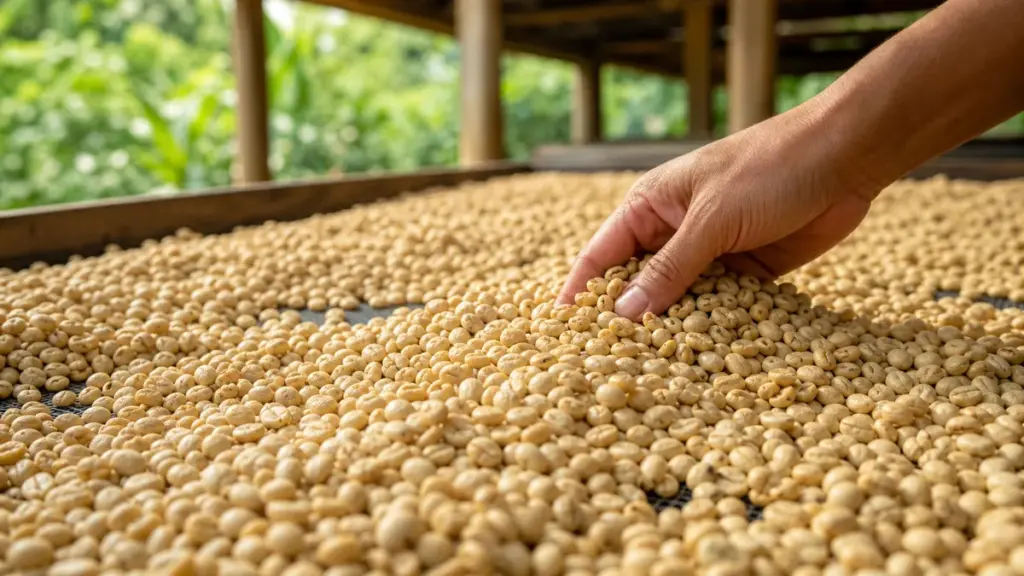
What does coffee from the Dominican Republic taste like?
The most defensible starting point is balance rather than a dramatic flavour claim. Café de Valdesia’s published specification describes a sweet, clean cup with mild acidity and medium body, with occasional chocolate and nut aromas.
In plain language, body is the drink’s weight and texture in the mouth. Acidity is its bright, lively sensation, not simply sourness. If you dislike sharp-tasting coffee, that Valdesia description gives you a sensible direction to investigate, but it does not promise that every Dominican lot will suit you.
Roast level deserves equal attention. The Valdesia specification distinguishes the milder acidity of its medium roast from the fuller body, lower acidity and bitter-chocolate notes described for its dark roast. A dark-roasted bag and a medium-roasted bag can therefore offer quite different introductions to the same origin.
My recommendation is to begin with a clearly described washed lot whose tasting notes appeal to you. Read “chocolate” and “nuts” as sensory comparisons, then assess the cup yourself. Do not let the country name persuade you that a coffee ought to taste a particular way.
Growing regions and the names on the bag
INDOCAFE identifies Barahona, Neyba, Cibao, Cibao altura, Juncalito and Valdesia among the country’s commercial coffee types. The Starbucks origin map also marks Jarabacoa, Constanza and Azua. These names are useful leads, but they should not be treated as interchangeable grades.
Valdesia
Valdesia provides the clearest documented example of a tightly defined Dominican origin. Its published designation covers coffee-growing areas in San Cristóbal, Peravia and San José de Ocoa, on the southern side of the Cordillera Central, with eligible growing land at 600 to 1,300 metres.
Café de Valdesia was registered as an EU protected designation of origin in 2016. That designation concerns specified origin and production requirements, not merely an attractive regional name. If certification matters to your purchase, ask whether the actual product is certified rather than assuming that any mention of Valdesia means the same thing.
Barahona and Neyba
Barahona and Neyba are useful names to recognise when exploring Dominican coffee. However, neither name alone supplies the farm’s elevation, varieties, harvest or processing details.
Treat them as the beginning of a conversation with the roaster. Ask whether the bag represents a single producer, a co-operative collection or a regional blend, and request tasting notes for that particular lot rather than accepting a fixed regional stereotype.
Cibao, Juncalito and Jarabacoa
Cibao, Cibao altura and Juncalito appear in INDOCAFE’s commercial classification, while Jarabacoa is another growing location marked in the origin reference. Ask sellers to clarify the relationship between their broad regional description and the producer’s location.
For comparison, imagine receiving a bag labelled only “British apples”. It tells you something, but not enough to choose confidently. Coffee deserves the next layer of detail too.
Varieties: traditional trees and changing plantings
Arabica is a species, Coffea arabica. Typica and Caturra are varieties within that species, not separate species and not processing methods.
INDOCAFE names Typica and Caturra as the country’s principal varieties. World Coffee Research describes Typica as a tall plant with very good quality potential at high altitude and Caturra as a compact variety originating through a natural mutation of Bourbon. Both are highly susceptible to coffee leaf rust.
Coffee leaf rust is a fungal disease affecting leaves. World Coffee Research explains that it can cause defoliation and severe crop losses, which helps explain why planting decisions cannot be based on cup reputation alone.
INDOCAFE lists newer plantings introduced with rust resistance in mind, including T-8667, Lempira, Costa Rica 95, Tupí, Obatá, Acauá, Cuscatleco and Parainema. This is evidence of a changing sector, not grounds for assigning current national percentages to each variety.
For a buyer, the useful question is simply: which varieties are in this lot? Record the answer alongside processing and roast level. Avoid treating an old variety name as a guarantee of excellence, or a newer selection as a reason to dismiss a coffee without tasting it.
Processing: why washed coffee is the starting point
Washed processing is the main method identified in the Starbucks Dominican origin reference. The Dominican production manual explains the process alongside honey and natural alternatives.
In a washed process, the fruit is depulped and the sticky coating around the seed, called mucilage, is removed before drying is completed. In honey processing, depulped coffee dries with mucilage still attached. In natural processing, the whole cherry is dried before its outer layers are removed.
Those distinctions are more useful than an unexplained processing label. Ask what was removed, when the coffee was dried and who managed the work.
The joint CEPAL and INDOCAFE sector study identifies inconsistent post-harvest handling as a quality constraint. That supports a practical buying rule: give attention to the mill and producer, not only the growing region.
Do not interpret mustiness or an unpleasant fermented character as an unavoidable feature of Dominican coffee. Equally, do not assume an unusual process is automatically better. My preference for a first purchase would be a traceable washed lot, followed by a different process once you have a reference point.
Domestic consumption: an origin with its own audience
Dominican coffee is not simply an export crop waiting for overseas recognition. The joint CEPAL, INDOCAFE and climate council study describes coffee drinking as a deeply rooted national tradition and says a substantial part of production goes to domestic consumption.
The same 2020 study reports that domestic demand was not covered by national production. This is an essential qualification: coffee consumed in the Dominican Republic and coffee grown there are not identical statistical categories.
It also makes statements such as “Dominicans drink almost the entire harvest” less useful than they initially sound. Without a stated year, production estimate, import allowance and treatment of stocks, a precise percentage can mislead.
For UK readers, the practical lesson is to distinguish Dominican-grown coffee from coffee merely roasted or packaged in the country. Ask for the origin of the beans when the packaging does not make it clear.
Export volumes: separate green coffee from finished products
For a clearly defined measure, World Bank WITS presents the following reported trade quantities from UN Comtrade. These figures cover HS 090111: coffee, not roasted or decaffeinated.
| Calendar year | Reported export quantity |
|---|---|
| 2024 | 618,934 kg |
| 2025 | 631,212 kg |
These are product-weight figures for that customs category, checked in November 2026. They are not total exports of every coffee product, a production estimate or a measure of how much Dominican coffee people drink.
Roasted coffee, decaffeinated coffee and soluble preparations require other categories. Nor should these calendar-year quantities be compared casually with figures expressed for a coffee year or in green-bean equivalent.
This narrower measure is useful because its boundaries are clear. When another source gives a different export total, check the product coverage, reporting period and units before deciding that either number is wrong.
How to choose a Dominican coffee in the UK
My buying criteria would be traceability first, followed by processing detail, a clear roast description and tasting notes relevant to the way you drink coffee.
Before ordering, look for:
- A named producer or producer group, with more detail than the country alone.
- A growing location, with farm elevation where available.
- The varieties and processing method, or an honest explanation that these are mixed.
- Harvest information and a roast date, rather than an undated freshness claim.
- A clear statement of origin, especially for coffee roasted in the Dominican Republic.
For an initial comparison, choose two coffees with similar roast descriptions and use the same brewing method for both. Make notes on sweetness, brightness, texture and the finish, then decide which you would actually like to drink again. This is a more useful exercise than trying to confirm an origin’s reputation.
If you are exploring neighbouring origins, compare the information on the bag as carefully as the cup. Our guides to Puerto Rican coffee and Cuban and Haitian coffee keep those distinct stories separate.
The Dominican Republic deserves that same attention. Choose a well-documented lot, not a generic promise of island flavour.
FAQ
Is Dominican coffee the same as Santo Domingo coffee?
Not necessarily: check whether “Santo Domingo” is being used as a brand, place reference or product description. It does not replace the need for a growing origin. If your aim is to explore Dominican-grown beans, ask the seller to identify the producer or growing area and confirm the beans’ country of origin.
Which Dominican region should I try first?
Valdesia is a useful starting point if you want a documented origin specification, but it is not automatically the best choice for every palate. My recommendation is to prioritise a roaster who provides clear lot information. A well-described coffee from another growing area is a better learning purchase than an unexplained regional label.
Should I buy coffee roasted in the Dominican Republic or in the UK?
Either can be worth considering; compare the information supplied rather than choosing by roasting country alone. Ask where the beans were grown, when they were roasted and what the seller says about the roast style. For an origin comparison, choose the product that makes those details clearest and best matches how you intend to brew it.
Where to go next
Read Caribbean for the regional overview and a framework for comparing island origins. Puerto Rico and Cuba and Haiti provide the next comparisons for understanding how distinct Caribbean origins should be assessed.
Sources
-
INDOCAFE. Preguntas frecuentes. Undated, retrieved November 2026. National reference for principal varieties, newer plantings and commercial coffee types.
URL: https://www.indocafe.gob.do/index.php/en/preguntas-frecuentes -
IICA, PROCAGICA-RD and INDOCAFE. Manual de producción sostenible de café en la República Dominicana. Undated PDF, filed in INDOCAFE’s 2020 publications collection. Used for altitude guidance and processing definitions.
URL: https://www.indocafe.gob.do/transparencia/index.php/publicaciones-t/category/618-2020?download=1676%3Amanual-del-cafe -
Starbucks Coffee Academy. Dominican Republic origin map. Undated, retrieved from a September 2023 upload directory. Used for growing locations, principal processing and the broad harvest calendar.
URL: -
European Commission. Café de Valdesia: single document, 2016/C 91/11, published 8 March 2016, Official Journal C 91, pages 15 to 19. Used for origin boundaries, altitude, varieties and sensory requirements.
URL: https://eur-lex.europa.eu/legal-content/EN/TXT/PDF/?uri=OJ%3AC%3A2016%3A091%3AFULL -
European Commission, reproduced by Spain’s BOE. Commission Implementing Regulation (EU) 2016/1043 of 15 June 2016. Used for the EU registration of Café de Valdesia.
URL: https://www.boe.es/buscar/doc.php?id=DOUE-L-2016-81127&lang=es -
World Coffee Research. Arabica Coffee Varieties: Typica; Caturra. Live catalogue entries, undated, retrieved November 2026.
URLs: https://varieties.worldcoffeeresearch.org/varieties/typica and https://varieties.worldcoffeeresearch.org/varieties/caturra -
CEPAL, INDOCAFE and CNCCMDL. Fortalecimiento de la cadena de valor de café en la República Dominicana: en respuesta al cambio climático. LC/MEX/TS.2020/39, November 2020. Used for domestic consumption and post-harvest constraints.
URL: https://repositorio.cepal.org/bitstream/handle/11362/46433/1/S2000894_es.pdf -
INDOCAFE. Cambio climático adelanta cosechas de café en las zonas altas y bajas del país. 9 November 2023. Used for reported variation in harvest timing.
URL: https://www.indocafe.gob.do/index.php/en/noticias/item/562-cambio-climatico-adelanta-cosechas-de-cafe-en-las-zonas-altas-y-bajas-del-pais -
World Bank WITS, presenting UN Comtrade data. Dominican Republic: Coffee, not roasted or decaffeinated exports by country, calendar years 2024 and 2025, HS 090111. Retrieved November 2026.
URLs: https://wits.worldbank.org/trade/comtrade/en/country/DOM/year/2024/tradeflow/Exports/partner/ALL/product/090111 and https://wits.worldbank.org/trade/comtrade/en/country/DOM/year/2025/tradeflow/Exports/partner/ALL/product/090111
This article was researched using national technical guidance, published origin specifications, World Coffee Research and defined customs trade data; buying recommendations are editorial judgements, not first-hand tasting results.
Last checked: November 2026