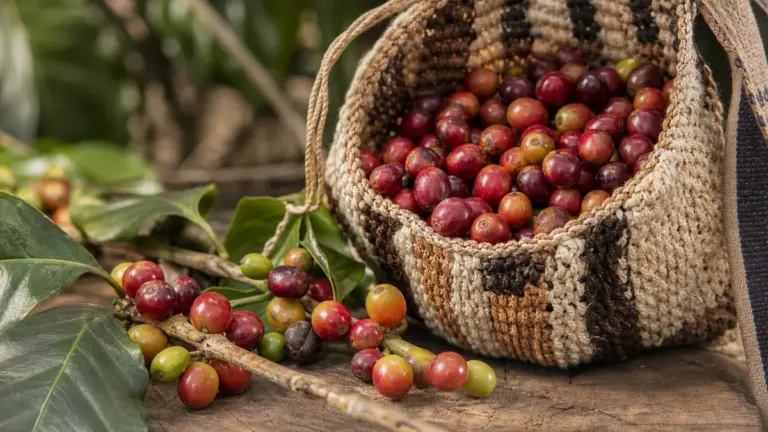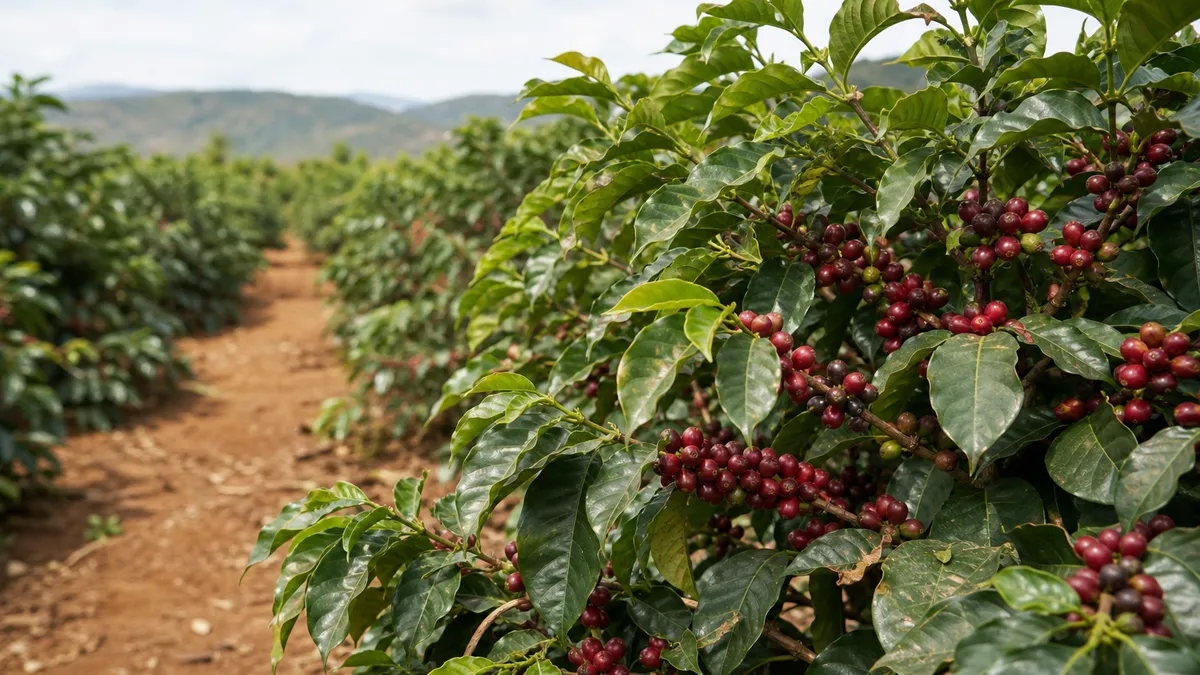
Australian-grown coffee is a small arabica origin, commonly described in terms of sweetness, chocolate, nuts and gentle to moderate acidity. Its distinctive story is agricultural: growers in Queensland and northern New South Wales combine suitable local climates with mechanised harvesting, rather than relying on the high mountain farms often associated with quality arabica.
In short
- Look for grown in Australia, not simply roasted there. The 2024 Australian Coffee Growers’ Manual reported that locally grown coffee supplied less than 0.5% of domestic consumption.
- The main growing areas are tropical Far North Queensland and the subtropical belt of northern New South Wales and south-east Queensland.
- K7 and Catuai are established leading varieties, with replacements being assessed for Australian conditions.
- Regional peak harvests differ: June and July in tropical conditions, September to November in the subtropics. Individual farms can fall outside those peaks.
- Treat the country’s flavour description as a starting point. Ask for the farm, variety, processing method and tasting notes of the actual lot.
Australian coffee at a glance
These are regional pointers, not a specification that every Australian coffee must meet. In particular, the documented elevations below describe identified growing sites, not verified national minimum and maximum elevations.
| Feature | Australian-grown coffee |
|---|---|
| Growing regions | Far North Queensland, especially the Atherton Tablelands; northern New South Wales and south-east Queensland |
| Documented altitude range | Research sites at 100 to 300 m in northern New South Wales; Queensland sites include 400 m in the same study and plantations above 550 m reported by Howe Farming |
| Main established varieties | Arabica varieties K7 and Catuai |
| Processing | Washed, natural and pulped natural methods are documented in Australian production |
| Peak harvest months | Tropical areas: June and July. Subtropical areas: September to November |
| Typical cup profile | Subtropical descriptions emphasise sweet fruit and chocolate, with medium to low acidity; Far North Queensland descriptions include nuts and biscuit |
Sources: growing regions and acidity, Australian Grown Coffee Association; elevations and processing, Drinnan’s Australian processing research and Howe Farming; varieties, AgriFutures Australia; harvest peaks, the 2024 growers’ manual; flavour descriptions, the association’s resources page.
Where coffee grows in Australia
Australian coffee production is concentrated along the eastern side of the country, but it does not occupy one uniform growing environment. The useful distinction is between the tropical north and the cooler subtropical production belt farther south.
Northern New South Wales and south-east Queensland
The Australian Grown Coffee Association describes the subtropical growing belt as extending from Noosa south to Coffs Harbour. Northern New South Wales and south-east Queensland therefore belong together in a growing-climate discussion, even though the state boundary divides them.
Here, distance from the equator helps provide comparatively cool conditions at modest elevations. Fruit can ripen slowly through winter, with multiple flowerings and an extended harvest pattern. This is why an Australian farm’s elevation should not be judged against an equatorial farm’s elevation without considering latitude and temperature as well.
Far North Queensland
The tropical production area includes the Atherton Tablelands. The growers’ manual identifies relatively flat land, irrigation water and suitable climatic conditions there as a combination favourable to efficient machine harvesting.
Farm calendars still differ. Although the manual gives June and July as the tropical peak, Howe Farming reports mechanically harvesting its coffee in August and September. A regional calendar is useful orientation, not a promise about when a particular estate’s crop will be ready.
For the wider geographical context, start with Oceania. Keep the Australian growing regions distinct rather than assuming a shared regional label means identical farming conditions.
What Australian-grown coffee tastes like
The Australian Grown Coffee Association describes subtropical coffee through sweet fruit, chocolate and medium to low acidity. Its descriptions of Far North Queensland include nutty and biscuity notes. These are industry descriptions of regional tendencies, not results from a single representative national tasting.
For a buyer, that suggests a useful direction rather than a guaranteed flavour. If you enjoy sweetness and cocoa-like or toasted-nut descriptions, Australian coffee is worth investigating. If you specifically want a sharply citrus-led cup, ask the seller for evidence in the individual lot’s tasting notes rather than assuming the country name will deliver it.
Read those notes concretely. “Chocolate and biscuit” should help you imagine the intended cup, while “smooth” on its own tells you rather little. Ask whether the seller means restrained acidity, a rounded texture, little bitterness, or simply a darker roast.
Processing also matters. Australian research has examined washed, natural and pulped natural treatments, so “Australian coffee” does not identify a single route from cherry to green bean. The processing description belongs beside the origin and variety when comparing bags.
A sensible first tasting is the coffee on its own, followed by your usual preparation. Record what you actually notice before reading the full flavour description again. You are looking for a coffee you enjoy, not trying to reproduce somebody else’s vocabulary.
Why mechanised harvesting matters
Mechanisation is central to understanding Australian coffee production. The Australian Grown Coffee Association links the revival of plantations during the 1980s and 1990s partly to developments in mechanical harvesting.
A mechanical harvester moves through a managed row and dislodges coffee cherries, the fruits containing the seeds we roast. The system favours aligned rows and a canopy maintained within the machine’s working dimensions. Australian production research documents relatively level sites planted as hedgerows to accommodate this equipment.
That explains the neat, accessible rows associated with many Australian plantations. Their appearance is not merely decorative: planting layout and tree management serve the harvesting system.
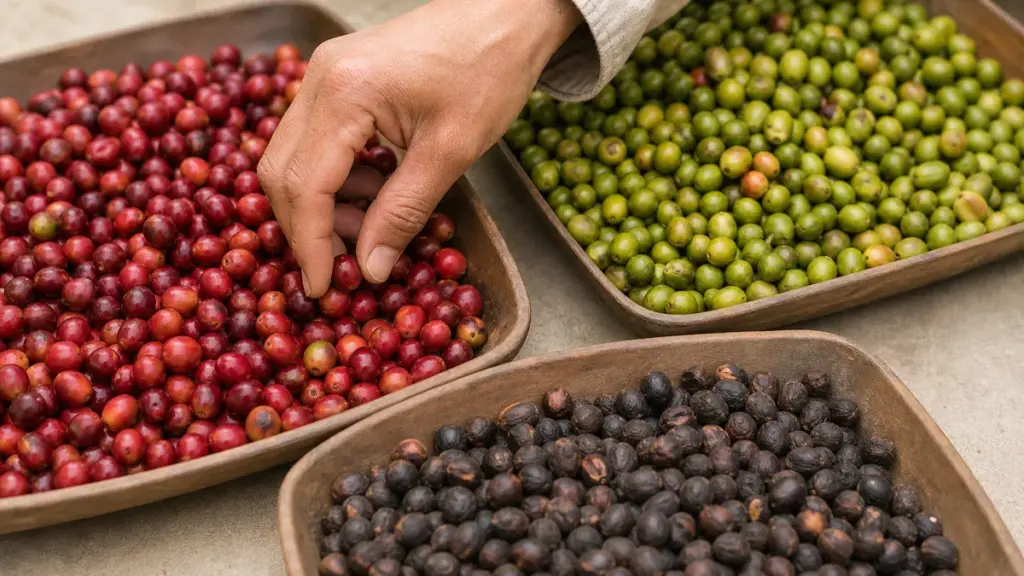
The challenge is fruit maturity. A machine-harvested load can contain ripe, unripe and over-mature cherries, so separation during processing is important. Australian research documents equipment designed to separate these fractions rather than treating the whole load as one uniform raw material.
Do not use “machine harvested” as shorthand for inferior coffee. Equally, do not assume machinery guarantees consistency. The useful questions are how the grower manages ripening, how the harvested fruit is sorted, and how the resulting lot tastes.
For buyers, the practical conclusion is straightforward: judge the complete production system. An account of harvesting is more informative when it also explains selection and processing.
Varieties: established plants and replacement candidates
A variety is a named type within a coffee species. K7 and Catuai are arabica varieties, not separate species and not Australian regions.
AgriFutures Australia identifies them as the industry’s currently dominant varieties in its 2025 cultivar assessment overview. They represent an established production base, but also different challenges that researchers are trying to address.
K7
World Coffee Research describes K7 as a tall variety selected in Kenya from French Mission material, with a Bourbon-like genetic background. Its Kenyan origin does not make coffee grown from it in Australia Kenyan coffee: variety describes the plant’s identity, while origin describes where the crop was grown.
In Australian subtropical conditions, excessive vigour has been a practical difficulty. AgriFutures research priorities have therefore included finding plants that retain desirable production and quality characteristics while reaching a size suitable for mechanical harvesting without repeated height-control pruning.
Catuai
Catuai was bred in Brazil from Mundo Novo and Caturra. World Coffee Research describes it as compact and highly susceptible to coffee leaf rust, a fungal disease affecting leaves. Plant stature and disease susceptibility are separate considerations: a conveniently sized tree is not automatically the best long-term planting choice.
What the trials are investigating
AgriFutures reports that 25 varieties were planted at Alstonville in northern New South Wales in 2019. Sixteen varieties in full production were assessed during 2022 and 2023 for agronomic performance, yield, quality and cupping performance.
Parth Patel’s 2025 Southern Cross University doctoral research identified Parainema, Marsellesa, IPR107 and Paraiso as promising alternatives in its northern New South Wales evaluation. That is a research finding from particular conditions, not proof that every Australian farm should replace its existing trees with the same variety.
A small industry, not a miniature mass producer
Australia’s coffee-growing industry remains small beside its domestic appetite for coffee. The 2024 growers’ manual put locally grown supply at less than 0.5% of domestic consumption, making the distinction between Australian-grown and Australian-roasted especially important.
For historical scale, the 2021 Australian Coffee Strategic RD&E Plan estimated approximately 600 tonnes of green beans annually and about 50 commercial growers. These are dated industry estimates, not a verified production total or grower count for 2026.
The industry’s development is not simply a matter of planting more trees. The strategic plan identifies suitable cultivars, processing infrastructure and coordination among growers as important development needs.
For the reader, small scale is a reason to seek traceability, not to assume automatic excellence. A named farm and a clearly described lot tell you more than rarity alone.
How to choose Australian coffee in the UK
Start by deciding what you want to learn: the character of a particular Australian estate, the effect of a processing method, or simply whether the coffee suits your regular drink.
Then ask for:
- Growing provenance: the farm and region, with explicit confirmation that the beans were grown in Australia.
- Composition: whether the bag contains only Australian-grown coffee or includes other origins.
- Variety and processing: the named variety where known, and whether the lot is washed, natural or pulped natural.
- Harvest information: the crop year and, ideally, the farm’s actual harvest period.
- Roast information: the roast date, intended brewing method and the roaster’s description of the finished coffee.
These are buying criteria, not a certification checklist. If a seller cannot supply a detail, distinguish “unknown” from “not applicable”, and avoid filling the gap with a national stereotype.
When comparing Australian coffee with Papua New Guinea, keep the farm, processing and roast information alongside the country names. For your first Australian-grown coffee, choose the clearest provenance and most useful lot description, then let the cup decide whether you return.
FAQ
Does Australian-roasted coffee mean the beans were grown there?
No, roasting location does not establish growing origin. The Australian growers’ manual reported that locally grown coffee supplied less than 0.5% of domestic consumption in 2024. Look for explicit Australian-grown wording and a named farm or growing region, rather than relying on a roaster’s address or Australian branding.
Are Australian coffee varieties native Australian plants?
No, the established varieties discussed here have overseas origins. World Coffee Research traces K7 to Kenyan selection and Catuai to Brazilian breeding. Their names identify cultivated plant material, not native Australian species. Beans harvested from those plants on an Australian farm are nevertheless Australian-grown coffee.
What should I try if the seller offers several Australian lots?
Choose according to the comparison you want to make. To explore processing, ask for differently processed lots from the same farm where available. To explore regional character, ask for comparable roasts from different growing regions. Neither approach is a controlled experiment, but it gives your tasting a clearer question than choosing by country name alone.
Where to go next
Read Oceania to place Australia within the wider regional guide. Continue with Papua New Guinea for a separate origin profile, keeping its growing conditions and production story distinct from Australian coffee.
Sources
- Australian Grown Coffee Association, About Us, undated. Regional geography, climate and mechanisation history.
URL: https://www.agca.au/about - AgriFutures Australia and Australian Grown Coffee Association, David Peasley and Jos Webber, Australian Coffee Growers’ Manual, 2024 edition, publication 24-130. Indexed manual passages retrieved for regional harvest peaks and domestic supply share.
URL: https://www.agca.au/_files/ugd/61d322_7a404588343048399dab74decb62d82c.pdf - Australian Grown Coffee Association, Resources, undated. Regional sensory descriptions.
URL: https://www.agca.au/resources - Rural Industries Research and Development Corporation, James Drinnan, Influence of Processing on the Flavour of Australian Coffee, April 2007, publication 07/065. Documented growing sites, harvesting systems and processing methods.
URL: https://era.dpi.qld.gov.au/id/eprint/7385/1/07-065.pdf - Howe Farming, Coffee with Altitude, undated. Producer-reported elevation, harvest months and wet processing.
URL: https://www.howefarms.com/coffee-with-altitude/ - AgriFutures Australia, Assessing the Performance of International Coffee Cultivars in Australia, 2025, publication 25-038, and New Coffee Varieties for the Australian Subtropics, project summary, completed 2019. Retrieved project pages used for established varieties, trial design and selection priorities.
URLs: https://agrifutures.com.au/product/assessing-the-performance-of-international-coffee-cultivars-in-australia/
https://agrifutures.com.au/related-projects/new-coffee-varieties-for-the-australian-subtropics/ - World Coffee Research, Arabica Varieties Catalog: K7; Catuai, living catalogue, undated entries.
URLs: https://varieties.worldcoffeeresearch.org/varieties/k7
https://varieties.worldcoffeeresearch.org/varieties/catuai - AgriFutures Australia, Stuart Orr and Gustavo Escudero, Australian Coffee Strategic RD&E Plan, November 2021, publication 21-128.
URL: https://www.agca.au/_files/ugd/1e9215_a60ce73bd4e04260b966f0961aeaa522.pdf - Southern Cross University, Parth Patel, From Crop to Cup: Integrated Evaluation of Agronomic, Chemical and Sensory Traits of Arabica Coffee Varieties under Australian Conditions, doctoral thesis, 2025. Repository abstract retrieved.
URL: https://researchportal.scu.edu.au/esploro/outputs/doctoral/From-Crop-to-Cup-Integrated-evaluation/991013330226802368
This article was researched through live retrieval of Australian agricultural research, grower-association material, World Coffee Research entries and a producer’s published farming information; it does not report first-hand tasting or farm visits.
Last checked: November 2026