The caffeine content of coffee drinks depends on the coffee dose, beans, brewing method and serving size, not simply the drink’s name. Useful reference figures include 80 mg for a 60 ml espresso and 90 mg for 200 ml of filter coffee, but some UK coffee-shop drinks contain more than 300 mg per serving.
In short
- Count milligrams per whole drink, not just the number of cups: published figures refer to different serving sizes.
- Milk and added water dilute coffee, rather than removing its caffeine. For espresso-based drinks, check the coffee recipe and shot count.
- Pod intensity is not a caffeine scale. Capsule size, coffee dose and blend matter.
- Decaf is not caffeine-free: the FDA gives a typical range of 2 to 15 mg for approximately 237 ml of decaffeinated coffee.
- During pregnancy, the NHS advises no more than 200 mg daily from all sources. A single coffee-shop drink can exceed that amount.
Caffeine content by coffee drink and size
The table below deliberately distinguishes published ranges from reference figures. A reference figure is a useful example, not a promise about every drink of that size. Manufacturer ranges apply to the named product family, not to every compatible capsule.
All amounts are milligrams of caffeine per complete serving. The American serving volumes have been converted to millilitres and rounded.
| Drink | Clearly defined serving | Caffeine per serving | What the figure represents |
|---|---|---|---|
| Instant coffee | 2 g dissolved in 125 ml water | 48 to 88 mg | Measured range across eight products in a 2014 study |
| Regular brewed coffee | Approximately 355 ml (12 US fl oz) | 113 to 247 mg | FDA typical range, based on US beverage data |
| Filter coffee | 200 ml | About 90 mg | EFSA reference figure |
| Espresso | 60 ml | About 80 mg | EFSA reference figure, not a universal shot value |
| Nespresso Original espresso | One capsule, 40 ml preparation | 50 to 130 mg | Manufacturer’s regional published range |
| Nespresso Original lungo | One capsule, 110 ml preparation | 70 to 110 mg | Manufacturer’s regional published range |
| Nespresso Vertuo mug coffee | One capsule, 230 ml preparation | 130 to 200 mg | Manufacturer’s regional published range |
| Decaffeinated coffee | Approximately 237 ml (8 US fl oz) | 2 to 15 mg | FDA typical range |
| Black tea | 220 ml | About 50 mg | EFSA reference figure |
| Cola | 355 ml | About 40 mg | EFSA reference figure |
Sources: laboratory measurements for instant coffee; FDA guidance for brewed coffee and decaf; EFSA reference servings; and Nespresso’s Hong Kong English-language FAQ for the specified capsule preparations. These are not minimum and maximum limits for the entire market.
The distinction matters particularly for espresso. EFSA’s example is explicitly 60 ml: it should not be silently relabelled as “one shot”, because cafés use different doses and serving recipes. Laboratory analysis of commercial espressos has also found substantial variation between outlets.
For a wider introduction to the subject, start with caffeine and decaf.
What the NHS figures mean
The NHS gives estimated amounts of 100 mg in a cup of instant coffee, 75 mg in a cup of tea and 40 mg in a can of cola on its pregnancy advice page. It specifically warns that filter coffee and coffee bought from coffee shops can contain more caffeine than its instant-coffee example.
The familiar 140 mg for a mug of filter coffee remains on the NHS breastfeeding page, alongside 100 mg for instant coffee and 75 mg for tea. Those coffee and tea examples do not specify a volume in millilitres, so assigning them an invented mug size would make the comparison look more exact than it is.
There is therefore no simple contradiction between the NHS’s 140 mg filter-coffee mug and EFSA’s 90 mg filter-coffee serving. They are approximate examples with different serving definitions, not matched measurements of the same brew. Use the figure for your actual product when available.
Espresso, americano, latte, cappuccino and flat white
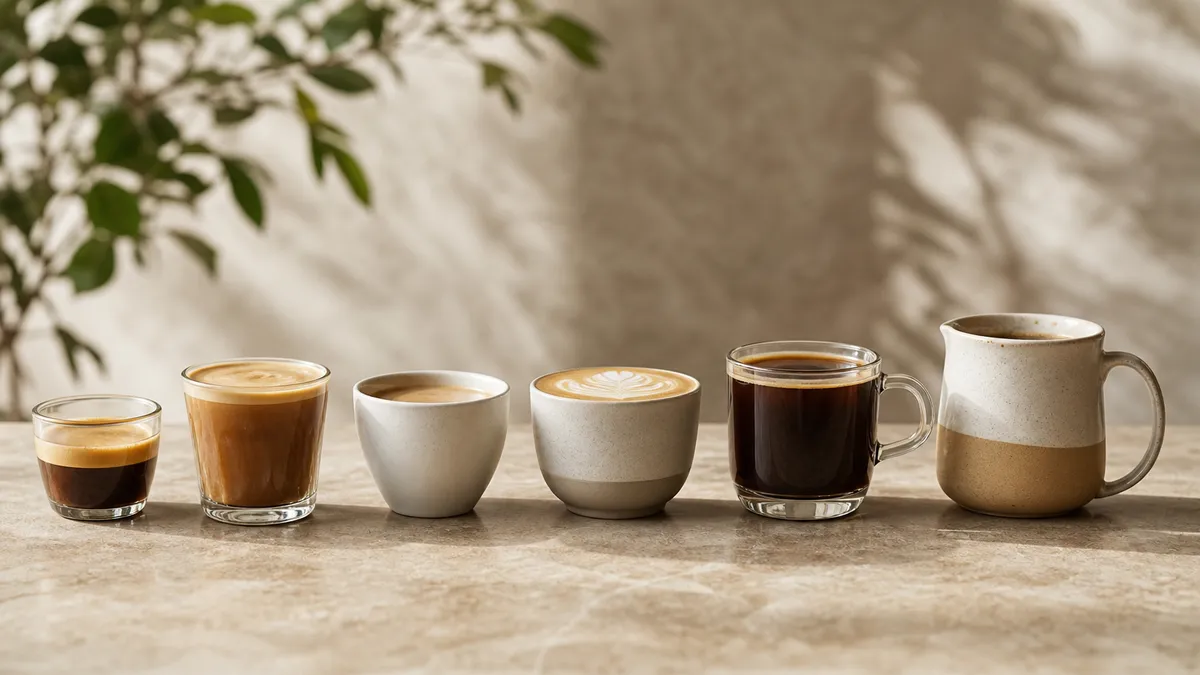
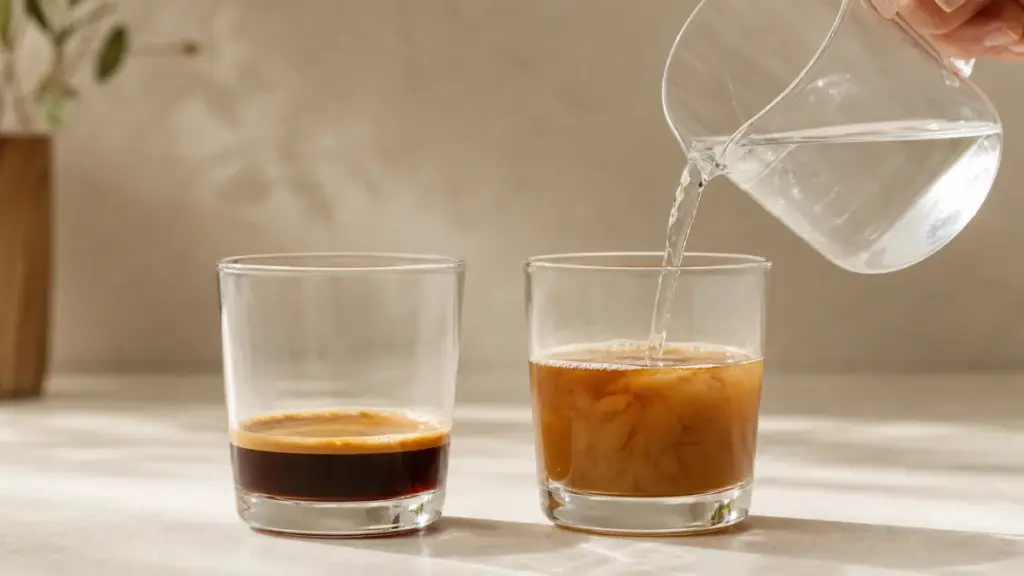
For espresso-based drinks, the useful starting question is: how much coffee went into this drink? Milk texture and the amount of added water explain much of the difference in appearance, but do not tell you the caffeine dose. The same coffee preparation can be diluted into different drinks without removing its caffeine.
An americano is not automatically more caffeinated because it looks darker than a latte. Equally, a compact flat white is not necessarily lower in caffeine because its cup is smaller. Check the particular drink recipe rather than judging by colour, foam or cup height.
How changing size changes caffeine
Starbucks UK’s autumn guide, version dated 18 September 2026, illustrates why drink name and size both matter. These are the company’s published standard-recipe figures for hot Signature Espresso drinks, checked in November 2026, rounded to the nearest milligram.
| Starbucks named size | Cappuccino with semi-skimmed milk | Americano |
|---|---|---|
| Short | 45 mg | 45 mg |
| Tall | 89 mg | 89 mg |
| Grande | 89 mg | 134 mg |
| Venti | 134 mg | 178 mg |
Source: Starbucks UK Nutrition & Allergen Guide, autumn 2026, individual drink entries. These are declared values, not independent measurements of every drink served.
Notice that moving from Tall to Grande does not increase the cappuccino’s declared caffeine, but does increase the americano’s. A larger drink can mean more milk or water, more coffee, or both. Never assume that caffeine rises in direct proportion to the size of the cup.
Why older high-street comparisons need dates
Which?’s 2023 comparison reported 66 mg in a Starbucks cappuccino and 325 mg in Costa’s medium cappuccino. Those figures demonstrate the potential difference between similarly named drinks, but the Starbucks number should not be presented as current.
Which? revisited the comparison on 25 August 2026, using information requested from chains and their published nutrition guides. It reported continuing large differences and said Starbucks attributed changed values to improved testing protocols. This was a comparison of declared information, not a fresh laboratory test of every drink.
Why caffeine ranges are so wide
Several separate variables determine what reaches the cup:
- Beans: robusta generally contains more caffeine than arabica, so changing the blend can change caffeine without changing the drink’s name.
- Dry coffee dose: using more coffee supplies more caffeine for extraction.
- Brewing recipe: extraction, meaning the transfer of soluble substances from coffee into water, depends on preparation conditions.
- Serving size: a concentrated small drink and a less concentrated large drink can deliver very different totals.
A 2014 laboratory study analysed 104 commercial espressos from Scotland, Italy and Spain and reported 48 to 317 mg per serving. This is evidence of real-world variability, not a prediction that your next espresso will fall neatly within those endpoints.
Roast colour is also an unreliable shortcut. In that study’s controlled roasting experiment, caffeine was relatively stable across the roast conditions examined. A dark, bitter flavour should not be treated as a caffeine measurement.
For what happens after caffeine enters the body, see how caffeine works.
Pods, capsules and decaf
A pod is a portion of coffee, not a standard caffeine unit. Nespresso’s regional published ranges in the first table show that espresso, lungo and mug capsules can deliver different amounts, even within one manufacturer’s systems. Its intensity rating describes sensory characteristics rather than milligrams of caffeine.
Check the exact capsule and market. Manufacturer FAQs can differ between countries and product families. The regional figures above are identified accordingly; they should not replace current UK information for a specific capsule.
Decaf needs the same care. The FDA’s 2 to 15 mg range is a general guide for approximately 237 ml of decaffeinated coffee, not a universal value for decaf espresso, instant coffee or every capsule. If you need very strict restriction, ask the manufacturer for the particular product’s caffeine information.
How to estimate your daily caffeine
Use this short method rather than counting “coffees”:
- Identify the serving: brand, drink, size and any extra coffee.
- Find the closest applicable figure: prefer current product information over a generic average.
- Record the whole serving: distinguish milligrams per drink from milligrams per 100 ml.
- Add other sources: tea, cola, chocolate, supplements and some medicines can contribute caffeine.
- Keep uncertainty visible: an unknown café coffee remains unknown, even if a calculator supplies a precise-looking answer.
For example, using EFSA reference servings, a 60 ml espresso, 200 ml filter coffee, 220 ml black tea and 355 ml cola total 80 + 90 + 50 + 40 = 260 mg. That arithmetic illustrates the method; it does not establish the content of drinks brewed differently.
Putting the numbers in context
EFSA’s 2015 scientific risk assessment, which evaluated the available evidence rather than reporting a single trial, found no safety concerns for healthy non-pregnant adults from habitual intakes up to 400 mg daily, spread through the day. Its single-dose benchmark is 200 mg, approximately 3 mg per kg body weight.
These are population benchmarks, not consumption targets or guarantees for everyone. EFSA also found that 100 mg near bedtime may affect sleep in some adults. Medicines, health conditions and individual sensitivity can change what is appropriate; caffeine sensitivity explores that distinction.
During pregnancy, follow the NHS advice of no more than 200 mg daily from all sources. For breastfeeding, the NHS currently suggests cutting caffeine out or, if drinking it, trying not to exceed 300 mg daily; EFSA’s assessment identifies 200 mg daily as raising no concerns for breastfed infants. These are different recommendations, so discuss personal circumstances with a midwife, health visitor, pharmacist or GP.
FAQ
Is cold brew always higher in caffeine?
No, “cold brew” alone does not establish the caffeine content. What matters is the particular product, serving size and whether you are drinking a concentrate or a diluted preparation. Use the manufacturer’s figure for the finished serving where available, rather than borrowing an espresso or filter-coffee average.
Can I calculate caffeine from grams of coffee alone?
Not accurately from weight alone. The beans’ caffeine content and the preparation also matter, so identical coffee doses need not produce identical caffeine amounts. Recording the dose helps make a home recipe consistent, but it does not turn that recipe into a laboratory measurement. Product-specific data remain more useful than a universal conversion factor.
Is tea always lower in caffeine than coffee?
No, although many reference servings of tea contain less caffeine than coffee. EFSA gives 50 mg for 220 ml black tea, while the NHS uses 75 mg for its cup example. Neither is a ceiling, and comparing either with an unspecified “coffee” can be misleading. Compare defined servings and actual products wherever possible.
Where to go next
Read What Is Caffeine and How It Works for the underlying science, and Caffeine Sensitivity to understand why the same amount can affect people differently. Caffeine Withdrawal is the next read if you are reducing your intake; Caffeine and Decaf brings the wider subject together.
Sources
- S1. NHS. Foods to avoid in pregnancy, current online version, retrieved November 2026. https://www.nhs.uk/pregnancy/keeping-well/foods-to-avoid/
- S2. NHS. Food and drinks to avoid when breastfeeding, current online version, retrieved November 2026. https://www.nhs.uk/best-start-in-life/baby/feeding-your-baby/breastfeeding/healthy-diet-when-breastfeeding/food-and-drinks-to-avoid-when-breastfeeding/
- S3. European Food Safety Authority. Caffeine, topic page and reference-serving table, current online version, retrieved November 2026. https://www.efsa.europa.eu/en/topics/topic/caffeine
- S4. EFSA Panel on Dietetic Products, Nutrition and Allergies. Scientific Opinion on the safety of caffeine, 2015, EFSA Journal, 13(5):4102. https://efsa.onlinelibrary.wiley.com/doi/10.2903/j.efsa.2015.4102
- S5. European Food Safety Authority. EFSA explains risk assessment: Caffeine, 2015. https://www.efsa.europa.eu/sites/default/files/corporate_publications/files/efsaexplainscaffeine150527.pdf
- S6. US Food and Drug Administration. Spilling the Beans: How Much Caffeine is Too Much?, current online version, retrieved November 2026. https://www.fda.gov/consumers/consumer-updates/spilling-beans-how-much-caffeine-too-much
- S7. Ludwig, I. A., and colleagues, Royal Society of Chemistry. Variations in caffeine and chlorogenic acid contents of coffees: what are we drinking?, 2014, Food & Function, 5:1718 to 1726. https://pubs.rsc.org/en/content/articlepdf/2014/fo/c4fo00290c
- S8. Nespresso. Frequently asked questions, Hong Kong English-language version, caffeine content and intensity sections, undated, retrieved November 2026. Regional manufacturer declarations, not independent testing. https://www.contact.nespresso.com/faq-3/hk/en
- S9. Starbucks UK. Nutrition & Allergen Guide: Autumn beverages, version 18 September 2026, individual drink entries. https://www.starbucks.co.uk/sites/starbucks-uk-pwa/files/2026-09/AUT_26_UK_AllergenBook_CORE_BEVERAGE_v04.pdf
- S10. Which? A little or a latte? Which? finds huge differences in high-street coffee caffeine levels, 4 March 2023. https://www.which.co.uk/policy-and-insight/article/a-little-or-a-latte-which-finds-huge-differences-in-high-street-coffee-caffeine-levels-athmJ0F9z1yS
- S11. Which? Caffeine levels in high street coffees still vary significantly, Which? finds, 25 August 2026. https://www.which.co.uk/news/article/caffeine-levels-in-high-street-coffees-vary-significantly-which-finds-ay7cA4G1zh1S
This article was researched using NHS and EFSA guidance, published laboratory analysis, manufacturer declarations and Which?’s dated comparisons, keeping reference estimates separate from product-specific information.
Last checked: November 2026