Living income and labour rights in coffee concern two connected questions: can farming households earn enough for a decent life, and are the people doing the work treated safely and fairly? Evidence documents substantial income shortfalls in particular farming communities, alongside child labour and forced labour risks, but neither a country name nor a certification label tells you what happens on every farm.
In short
- Living income measures a household’s income from all sources; living wage concerns an employee’s pay for normal working hours.
- A living income gap must be tied to a place, household benchmark and reporting period, not presented as one worldwide coffee figure.
- Seasonal and migrant workers need specific attention, including recruitment, accommodation, payment and freedom to leave.
- UK modern slavery reporting, EU corporate due diligence and the EU forced labour product ban are different legal mechanisms.
- Buyers should ask for evidence of prevention, worker participation and remedy, not simply a policy promising no exploitation.
What living income means in coffee
A living income is the net annual household income needed for a decent standard of living in a particular place. It includes nutritious food, adequate housing, education, healthcare and provision for unexpected events, rather than merely staying above a poverty line.
For a farming household, the assessment includes coffee, other crops, employment and other income sources. Coffee sales alone are not household income: production expenses must be accounted for, and the treatment of food grown for home consumption should be explained.
The calculation is:
Living income gap = relevant living income benchmark minus actual net household income.
Both sides must cover the same period and use compatible household assumptions. Researchers should explain household size, location, data collection and any adjustments to the benchmark.
A living wage, by contrast, concerns what a worker should earn during normal working hours to support a decent standard of living for their family. A farmer may need a living income while the people harvesting that farmer’s coffee need living wages. Improving one does not automatically establish the other.
What a sourced income gap looks like
An October 2024 working paper by Wageningen University & Research and coffee supplier ofi analysed complete data from 340 Kenyan arabica-farming households, covering July 2020 to June 2021. Only 9% met the study’s household-specific living income benchmark, leaving 91% below it.
That is evidence about a defined sample and historical season, not a current estimate for every Kenyan grower. It is also a survey-based working paper co-authored with a commercial supplier, not a controlled trial showing that a particular intervention closes the gap.
The distinction matters when reading corporate claims. Ask whether “income improved” means higher coffee receipts, higher net household income, or more households actually reaching a living income benchmark. These are different outcomes.
Labour rights extend beyond farm owners
The International Labour Organization’s fundamental rights framework covers freedom of association and collective bargaining, the elimination of forced labour, child labour and employment discrimination, and a safe and healthy working environment.
For coffee buyers, this means looking beyond the producer whose name appears on a bag. Hired harvesters, processing workers and people recruited through intermediaries must also be visible in the assessment.
Why seasonal workers need particular attention
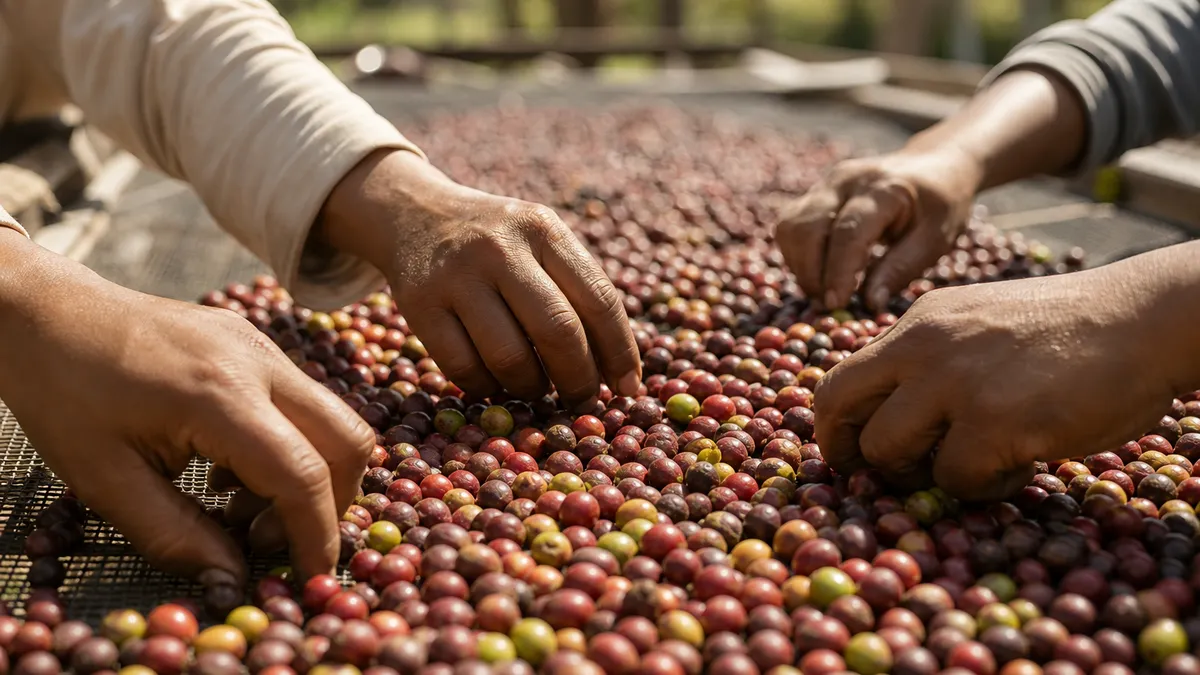
Coffee harvesting creates periods of concentrated labour demand. The ILO identifies seasonality, temporary work, unpaid family work, long hours, dangerous substances and tools, and limited social protection among agricultural labour risks.
A useful supplier assessment should therefore ask:
- Who recruits harvest workers, and are employment terms explained in a language they understand?
- How are hours, quantities harvested, deductions and payments recorded?
- Are drinking water, sanitation, suitable accommodation and protective equipment available?
- Can workers retain their identity documents, leave employment and raise concerns safely?
- Can seasonal workers join or speak to independent worker representatives?
These are practical checks, not an assumption that seasonal employment is inherently abusive. Their purpose is to make workers visible during the harvest, rather than assessing only permanent staff outside the busiest period.
What child labour and forced labour reports establish
Child labour is not synonymous with every task a child undertakes. The ILO distinguishes permissible activities from work that is harmful, performed below the relevant minimum age, or interferes with schooling. Hazardous work can be prohibited even where a young person is old enough for some other employment.
Forced labour involves work that is not genuinely voluntary and is extracted under threat of a penalty. Low pay or poor conditions alone do not establish forced labour, although coercion, restricted movement and debt bondage can turn employment into forced labour.
Dated evidence from coffee-producing countries
The US Department of Labor’s List of Goods Produced by Child Labor or Forced Labor, dated 5 September 2024, lists coffee associated with child labour in countries including Colombia, Guatemala, Honduras, Uganda and Vietnam. Its coffee entries for Brazil and Côte d’Ivoire identify both child labour and forced labour.
The Brazil entry describes reported recruitment deception, debts connected with transport and necessities, withheld identity papers and fear of punishment. These are accounts of mechanisms of exploitation, not simply statements that wages were inadequate.
Read the list carefully. It is a government risk resource based on evidence assessed against international standards, not a finding against every farm, exporter or coffee lot from a listed country. Some underlying surveys are considerably older than the publication date. A country missing from the list should not be treated as proven free of exploitation either.
The appropriate response is targeted investigation and protection, not replacing evidence about suppliers with assumptions about national origin.
What certification and traceability can establish
Certification can provide standards, inspections and corrective-action systems. It should not be treated as proof that every worker receives a living wage or that every farming household reaches a living income.
Rainforest Alliance, for example, describes an “assess-and-address” approach involving risk assessment, monitoring, prevention and remediation of labour abuses. Finding a case and addressing it is different from claiming that no case could exist.
Our guide to coffee certification explains the wider system. Here, the useful questions are narrower: who was covered, what was checked, what problems were identified, and what changed afterwards?
Likewise, supply-chain traceability helps establish where coffee came from, but an identified farm still needs a labour-rights assessment. Traceability provides a route for investigation and follow-up; it does not itself demonstrate decent working conditions.
UK and EU rules: reporting is not the same as due diligence
The following distinctions were checked in November 2026. Businesses should obtain advice on their own scope, group structure and markets rather than assume that buying coffee creates identical duties everywhere.
UK: Modern Slavery Act reporting and proposed reforms
Section 54 of the Modern Slavery Act 2015 is a UK-wide transparency requirement for qualifying commercial organisations carrying on business in the UK and meeting the statutory turnover threshold. It requires an annual slavery and human trafficking statement, appropriate approval and signature, and website publication.
This is not a general legal requirement for every UK coffee business to conduct comprehensive human rights due diligence. Publishing a statement is also not a certificate that a supply chain is free from exploitation.
Reforms introduced in the Immigration and Asylum Bill on 30 June 2026 remained proposals at this article’s checking date. They would strengthen reporting content, registry requirements and enforcement, including powers to introduce financial penalties.
Describing these proposals as an already operative mandatory due diligence regime would be misleading. The proposed framework still distinguishes reporting on due diligence from a substantive duty to carry it out.
EU: revised corporate due diligence rules
The Corporate Sustainability Due Diligence Directive, Directive (EU) 2024/1760, establishes corporate human rights and environmental due diligence duties for companies within its scope.
The timetable and scope have changed. Following the 2025 postponement and Directive (EU) 2026/470, the main national implementing measures are due to apply from 26 July 2029. The revised framework targets very large companies, using employee and turnover tests for EU companies and separate scope rules for non-EU companies.
It is therefore wrong to describe the revised directive as already applying to coffee businesses generally. Smaller suppliers may nevertheless receive information requests from customers preparing their own systems.
EU: a separate forced labour product ban
The Forced Labour Regulation, Regulation (EU) 2024/3015, has a different function. From 14 December 2027, its product prohibition applies to goods made with forced labour that are placed or made available on the EU market, or exported from it.
Unlike the corporate directive’s large-company scope, the product rules cover companies of all sizes involved in the relevant market activities. Coffee is not exempt, and certification does not replace compliance. This is a product prohibition, not another annual sustainability-reporting scheme.
What coffee buyers can do
For a household buyer, start with a roaster’s published sourcing evidence and ask questions where claims are vague. For a workplace buyer, make those questions part of supplier selection and contract review.
The following checklist adapts OECD due diligence principles to coffee purchasing.
| Ask the supplier | Useful evidence | What it helps establish |
|---|---|---|
| Where does this coffee come from? | Supply-chain mapping and identified producer organisations | Where investigation and follow-up are possible |
| How are incomes assessed? | Benchmark, reporting period, sample and net-income method | Whether a living income claim is meaningful |
| Are seasonal workers included? | Harvest-period assessment and worker consultation | Whether temporary labour is visible |
| What happens when abuse is found? | Safeguarding, corrective actions and follow-up | Whether a policy leads to remedy |
| What outcomes are reported? | Progress against identified harms and income gaps | Whether conditions change over time |
Then take five practical steps:
- Assign responsibility. Name the person who will review evidence and follow up concerns.
- Prioritise serious risks. Investigate credible indicators of coercion or hazardous child labour promptly.
- Include worker voices. Ask how workers and their representatives contribute without management controlling their answers.
- Agree a response. Require a clear process for protection, investigation, remedy and checking that harm has stopped.
- Review outcomes. Revisit evidence rather than renewing approval solely because a certificate remains valid.
Avoid demanding that a supplier merely sign a “zero child labour” declaration. The stronger question is how children are protected when a problem is discovered, including safe withdrawal from harmful work and support for schooling.
Compare schemes through certification labels, but assess suppliers on their actions as well as their labels. That is the practical connection between living income and labour rights in coffee: investigate both household livelihoods and the conditions of the people doing the work.
FAQ
Should I stop buying coffee from a country named in a labour report?
Not automatically. A country-level listing identifies a reason for investigation, not misconduct by every producer. OECD guidance supports continued engagement where there is a realistic prospect of improvement, while recognising that disengagement may be appropriate when mitigation fails, is not feasible, or the harm is sufficiently severe. Ask what protects affected people during either course.
Does a supplier reporting no labour cases have the strongest system?
Not necessarily. An absence of reported cases could reflect good conditions, but it could also reflect weak detection or inaccessible complaints channels. Assess how monitoring works, whether workers can speak safely, and what happens to complaints. Evidence of problems being identified and remedied can be more informative than an unexplained claim of zero cases.
Can a small office assess these issues without inspecting farms itself?
Yes, through proportionate supplier scrutiny rather than pretending to certify conditions independently. Ask your roaster or distributor for sourcing information, its labour-risk assessment, and evidence of follow-up. Record gaps and request clarification. A small buyer’s questionnaire is not a substitute for specialist investigation, but it can make responsible sourcing evidence part of the purchasing decision.
Where to go next
Read Coffee Certification for the wider framework, then Certification Labels Compared to understand differences between schemes. Traceability explains the evidence connecting coffee to its source, while UTZ provides background on that certification name.
Sources
-
Living Income Community of Practice, Living income benchmarks: frequently asked questions, version 1, May 2020.
URL: https://www.living-income.com/fileadmin/living_income/Publications/Living_Income_Benchmark_Definition_and_Calculation/FAQ_Living_income_benchmarks_LiCoP_v1_May_26_2020_final.pdf -
Wageningen University & Research, Waarts, Suter and van Asten, Return on household labour: a means to accelerate the path to a living income for smallholder coffee farming households, working paper, October 2024.
URL: https://edepot.wur.nl/675187 -
International Labour Organization, What is child labour; What is forced labour?; Fundamental Principles and Rights at Work, current web resources, checked 2026; and CoffeePeople webinar 1, 2023.
URLs:
https://www.ilo.org/topics/child-labour/what-child-labour
https://www.ilo.org/topics-and-sectors/forced-labour-modern-slavery-and-trafficking-persons/what-forced-labour
https://www.ilo.org/topics-and-sectors/fundamental-principles-and-rights-work
https://coffeepeople.vzf.ilo.org/wp-content/uploads/2023/10/Webinar1_final.pdf -
US Department of Labor, List of Goods Produced by Child Labor or Forced Labor, 5 September 2024 edition, coffee entries.
URL: https://www.dol.gov/agencies/ilab/reports/child-labor/list-of-goods-print -
Home Office, Transparency in supply chains: a practical guide, updated statutory guidance, March 2025.
URL: https://www.gov.uk/government/publications/transparency-in-supply-chains-a-practical-guide/transparency-in-supply-chains-a-practical-guide-accessible -
UK Parliament, Immigration and Asylum Bill, Bill 105, introduced 30 June 2026, clauses 44 to 49 and Schedule 5; parliamentary progress record; and committee debate, 27 October 2026.
URLs:
https://publications.parliament.uk/pa/bills/cbill/59-02/0105/260105.pdf
https://bills.parliament.uk/bills/4254
https://hansard.parliament.uk/Commons/2026-10-27/debates/a8a0cedb-124d-420b-b283-58562008074c/ImmigrationAndAsylumBill%28TwelfthSitting%29 -
European Commission and Council of the European Union, Corporate sustainability due diligence, current explanation incorporating Directive (EU) 2026/470, 2026; and Council signs off simplification of sustainability reporting and due diligence requirements to boost EU competitiveness, 24 February 2026.
URLs:
https://commission.europa.eu/topics/business-and-industry/company-law-and-corporate-governance/corporate-sustainability-due-diligence_en
https://www.consilium.europa.eu/en/press/press-releases/2026/02/24/council-signs-off-simplification-of-sustainability-reporting-and-due-diligence-requirements-to-boost-eu-competitiveness/ -
European Commission, What is the Forced Labour Regulation and how does it work?, current explanation of Regulation (EU) 2024/3015, checked 2026.
URL: https://single-market-economy.ec.europa.eu/single-market/goods/forced-labour-regulation/what-forced-labour-regulation-and-how-does-it-work_en -
OECD, Due Diligence Guidance for Responsible Business Conduct, 2018; and OECD Responsible Business Outlook 2026, chapter on company implementation.
URLs:
https://www.oecd.org/content/dam/oecd/en/publications/reports/2018/02/oecd-due-diligence-guidance-for-responsible-business-conduct_c669bd57/15f5f4b3-en.pdf
https://www.oecd.org/en/publications/oecd-responsible-business-outlook-2026_2b15370f-en/full-report/how-are-companies-implementing-due-diligence-for-responsible-business-conduct_52523408.html -
Rainforest Alliance, Rainforest Alliance Tools for Company Due Diligence, current programme explanation, checked 2026.
URL: https://www.rainforest-alliance.org/business/the-rainforest-alliance-certification-program-a-useful-tool-for-due-diligence/
This article was researched using income-methodology guidance, a primary household study, government labour-risk reporting, official legislative sources and published due diligence guidance; it does not claim first-hand farm inspections.
Last checked: November 2026