Rainforest Alliance certification is a voluntary scheme that sets environmental, social and farm-management requirements for coffee production and its supply chain. The frog seal identifies qualifying certified coffee, but it is not an organic label or a guarantee that farmers earn a living income or that biodiversity always improves.
In short
- The Sustainable Agriculture Standard’s current farm requirements are version 1.4, binding since 1 October 2025.
- A separate Regenerative Agriculture Standard, version 1.0, and shared Supply Chain Requirements, version 1.5, became binding on 1 March 2026.
- Under the ordinary labelling rule, single-ingredient coffee carrying the seal must physically contain at least 90% certified coffee. Coffee does not use the scheme’s mass-balance option.
- Rainforest Alliance and UTZ merged organisationally in 2018. Their certification programmes were consolidated later.
- Independent coffee research reports mixed results: improvements in some farming practices do not automatically translate into higher household incomes or successful forest protection.
Rainforest Alliance Certification
Rainforest Alliance is an international non-profit organisation. Its coffee certification programme combines requirements for farms with requirements governing how certified coffee is handled, recorded and traded.
For someone choosing beans, the useful distinction is between a defined standard with verification and a broad statement such as “responsibly sourced”. Certification provides requirements against which compliance can be assessed. It does not remove the need to ask what those requirements cover, how they are checked and what results have been measured.
Our coffee certification guide explains the wider category. Here, the focus is what the frog means on a coffee packet.
Which standard applies now?
As checked in November 2026, the programme has distinct farm standards rather than a single document covering everything:
| Document | Current version | Binding from | What it covers |
|---|---|---|---|
| Sustainable Agriculture Standard, Farm Requirements | 1.4 | 1 October 2025 | The established farm certification route |
| Regenerative Agriculture Standard, Farm Requirements | 1.0 | 1 March 2026 | A separate route, also available as an add-on, with deeper regenerative requirements |
| Supply Chain Requirements | 1.5 | 1 March 2026 | Shared requirements for both routes, including traceability and premiums |
| Labelling and Claims Policy | 1.2 | 14 October 2026 | Eligibility and conditions for using certification seals and claims |
The Sustainable Agriculture Standard update was published in March 2025. The later introduction of the regenerative route did not make its version 1.4 farm requirements obsolete.
The Regenerative Agriculture Standard adds depth in soil health and fertility, biodiversity and climate resilience while retaining social requirements. Its dedicated regenerative seal is available for qualifying certified coffee. Do not assume that an ordinary frog seal means the coffee meets this separate standard.
Binding annexes and applicable policies also matter. A supplier citing only “the 2020 standard” should be able to identify the current documents governing its certification.
What is checked?
Farm certification involves assessments by authorised certification bodies, supported by internal management and inspection systems. Supply-chain requirements address the handling and documentation of certified volumes.
This is verification of compliance within a defined scope, not continuous observation of every activity. It is therefore better to describe coffee as meeting certification requirements than as “guaranteed sustainable”.
Rainforest Alliance certification does not require organic farming. Its approach includes integrated pest management, meaning the planned use of different methods to control pests while reducing reliance on pesticides. Permitted pesticide use remains possible under the scheme’s conditions, so look for a separate organic certification if that is your requirement.
How the UTZ merger changed the programme
The organisational merger and the replacement of certification programmes happened at different times:
- 6 June 2017: Rainforest Alliance and UTZ announced their intention to merge.
- January 2018: the organisations merged. The organisation’s financial reporting records the business combination from 1 January 2018.
- July 2020: the combined Rainforest Alliance certification programme launched.
- September 2020: the new Rainforest Alliance seal was introduced, with the UTZ programme and label being phased out.
- 2022: the organisation’s annual financial report records certificate holders transitioning to the unified standard and the former standards no longer being in force.
It is therefore misleading to say that the UTZ label was replaced immediately in 2018. For a period, the programmes operated alongside each other while the unified programme was developed and introduced.
Our UTZ explainer covers the older scheme. When checking a supplier today, ask for current certification evidence rather than relying on an old UTZ logo in a brochure.
Biodiversity Conservation
Biodiversity means the variety of living organisms and the ecosystems they form. Rainforest Alliance’s environmental requirements address natural forests, other natural ecosystems, vegetation, wildlife and water.
The Environment Annex sets 1 January 2014 as the cut-off date after which deforestation or conversion of natural ecosystems makes the affected area or production unit non-compliant. It also describes geolocation-based risk assessment, using mapped farm locations to flag possible deforestation or encroachment into protected areas.
These are compliance requirements and checking tools. They are not proof that every certified farm has avoided every environmental breach.
What conservation looks like on a coffee farm
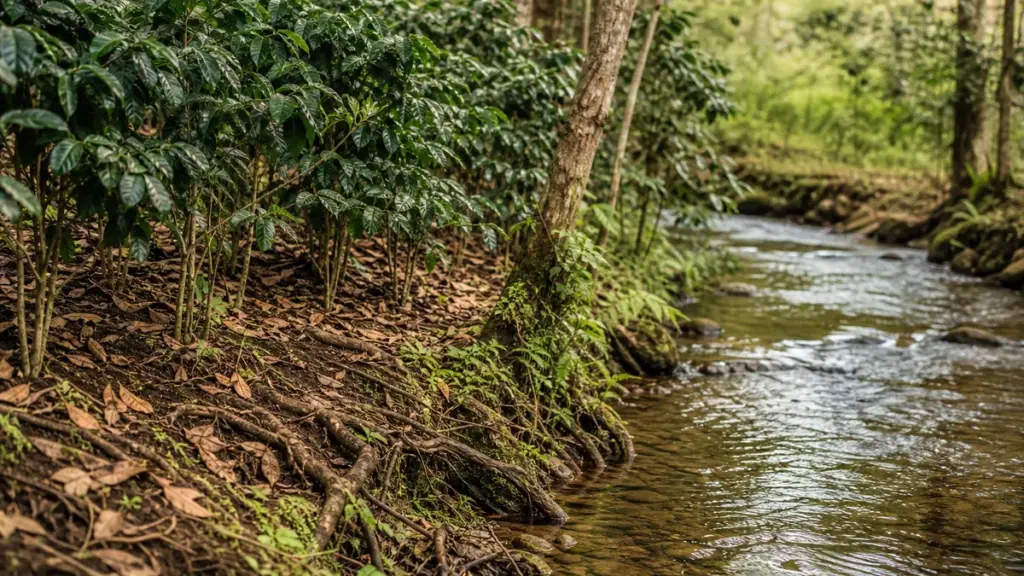
Relevant measures include conserving natural ecosystems, retaining remnant forest trees except where they present hazards, maintaining vegetation and protecting strips beside waterways. Those waterside strips are called riparian buffers.
The practical purpose is to make conservation part of farm management rather than something confined to a distant protected forest. Existing trees, patches of vegetation and watercourses all become features to identify and manage.
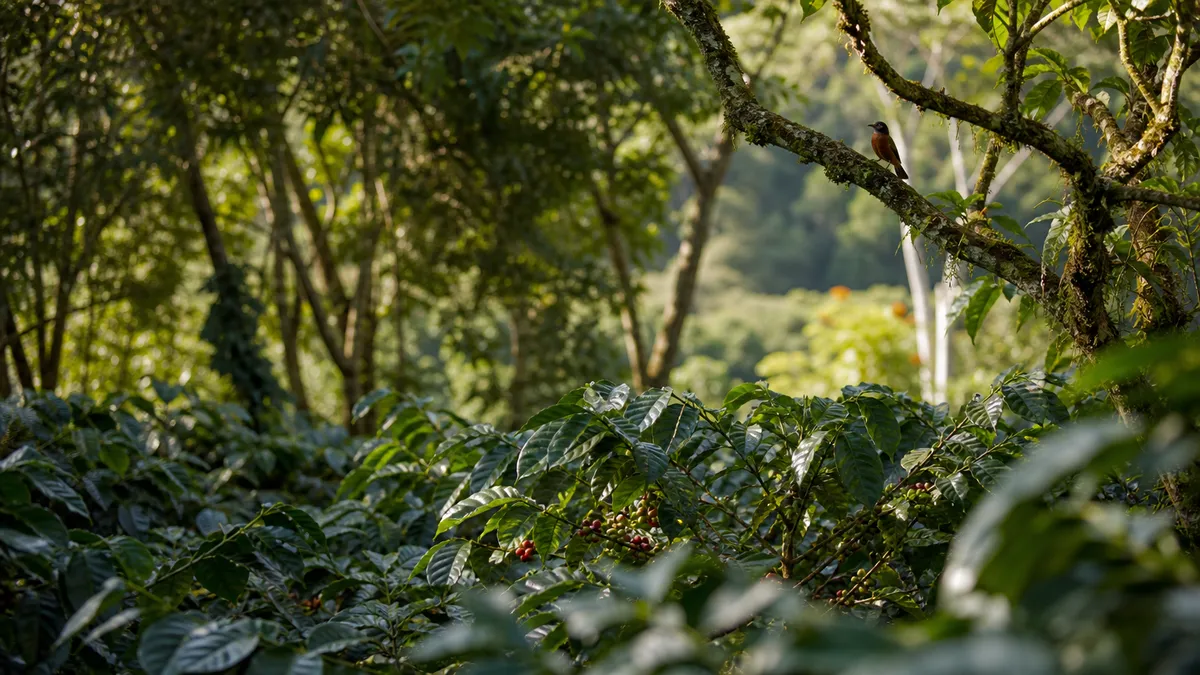
However, the seal should not be translated into “grown beneath an intact rainforest canopy”. The standard’s conservation requirements do not justify that description for every certified coffee. A photograph of shaded coffee plants illustrates one possible farming system, not a universal certification condition.
Requirements are not the same as outcomes
To assess biodiversity results, ask what was measured. Tree cover, adoption of recommended practices and changes in bird populations are different indicators.
A farm can improve its management records without demonstrating a measured increase in species diversity. Equally, maintaining existing habitat may be valuable even when a study does not record an increase. The useful question is whether certification helped conserve or improve conditions compared with what would otherwise have happened.
Community Engagement
The social side of the programme extends beyond farmers receiving training. It addresses workers and people whose land, resources or livelihoods may be affected by farm operations.
The Social Annex explains requirements for free, prior and informed consent, usually shortened to FPIC. Within its stated scope, this means affected Indigenous peoples and local communities must be able to make an informed decision before activities affecting their rights or collective interests proceed, without coercion.
The annex explicitly connects this process to large and individually certified farms. It should not be presented as an identical procedure applying to every smallholder in every situation.
Identifying and remedying abuse
Rainforest Alliance uses an assess-and-address approach to child labour, forced labour, discrimination, workplace violence and harassment. The approach requires identifying risks, taking preventive action, monitoring and remedying confirmed cases.
The organisation’s stated reasoning is that automatic exclusion whenever an incident is found can encourage concealment rather than help affected people. That does not mean abuses are permitted: its published explanation says severe abuses or failure to improve can lead to suspension or decertification.
Community engagement also needs to reach beyond a committee existing on paper. For a buyer, useful questions include whether workers know how to raise concerns, whether affected communities can participate and whether corrective action reaches the people harmed.
Does certification guarantee better incomes?
No. Rainforest Alliance coffee certification does not guarantee a minimum crop price or a living income.
Older programme material describes the Sustainability Differential, an additional payment, and Sustainability Investments, support for improvements. From October 2025, version 1.4 brought these mechanisms together under the term premium. It would be inaccurate to describe this as a move away from a previous guaranteed minimum coffee price.
Under the current Premium Annex, the first buyer has responsibility for agreeing premium terms and paying for volumes bought as certified. The coffee premium is negotiated rather than set at a scheme-wide minimum.
A required premium is not proof that a household has enough income to meet its needs. Keep that distinction in mind when reading supplier claims, and use Fair Trade Coffee for the separate scheme rather than treating the labels as interchangeable.
Evidence and criticism
Independent research gives reasons both to recognise certification’s potential and to resist sweeping claims.
A 2022 observational study in Rwanda, by Gather and Wollni, found a significant association between certification and good agricultural and biodiversity-related practices, but no significant association with the socio-economic indicators examined. These were associations, not results from a randomised controlled trial. Biodiversity-related practices were also not equivalent to a complete ecological survey.
A 2023 case study in south-western Ethiopia, by Arai, Hundera and Yoshikura, used interviews, field observations and secondary information. It reported deforestation or ecological degradation in some certified coffee forest areas and uneven application of programme requirements. The authors identified interacting pressures, including policy, population growth, conservation incentives and auditing weaknesses.
These findings are not necessarily contradictory. They examine different places, methods and outcomes. They also concern earlier certification settings, not a direct evaluation of the standards introduced in 2025 and 2026.
The defensible interpretation is that certification can support better practices, while results depend on implementation and local conditions. It cannot substitute for effective enforcement, workable livelihoods or convincing outcome evidence.
How to read the frog seal on coffee
Use this short check when choosing beans or reviewing an office coffee supplier:
- Identify the product and ingredient. On a mixed drink or food, establish whether the claim refers to coffee, cocoa or another ingredient.
- Check the certification route. Do not treat the ordinary and regenerative seals as identical.
- Check the certified content. The ordinary rule for single-ingredient coffee requires at least 90% physically certified content, not necessarily 100%.
- Ask for current evidence. Request certification details relevant to the product and its supply chain.
- Separate compliance from impact. Ask what evidence supports additional claims about income, forests or biodiversity.
Coffee is not included among the crops permitted to use mass balance, where certified and non-certified material can be mixed while equivalent certified purchases are accounted for. Its certified content must follow physical traceability through segregated or identity-preserved supply chains.
Segregation can combine coffee from different certified farms while keeping it separate from non-certified coffee. Identity preservation retains the link to an identifiable certified source. Our traceability guide explains the distinction.
For workplace purchasing, use Rainforest Alliance certification as a defined sourcing criterion, then ask suppliers to substantiate anything they claim beyond it.
FAQ
Why does Rainforest Alliance use a frog?
Rainforest Alliance says its frog symbol represents ecosystem health, drawing on frogs’ role as indicator species. It is a symbol for the organisation’s aims, not a statement that frogs have been counted on the farm supplying your coffee. Read it alongside the certification requirements rather than as a wildlife survey result.
Does one certified coffee mean a brand’s whole range is certified?
No. Certification claims need to be checked for the particular product or specified ingredient. A brand selling one qualifying coffee does not establish that all its other coffees qualify. For an office contract, identify the exact blend being supplied and ask how substitutions will be handled if that blend changes.
Does the seal tell me how the coffee will taste?
No. The seal communicates certification status rather than a particular flavour or quality grade. It cannot tell you whether you will prefer the coffee’s acidity, bitterness or body. Assess flavour separately, ideally using a sample prepared in the machine and drink style you actually intend to use.
Where to go next
Read Coffee Certification for the wider framework, then Organic to understand a separate production standard. UTZ explains the predecessor programme, while Traceability shows how sourcing claims follow coffee through a supply chain.
Sources
- S1. Rainforest Alliance, Sustainable Agriculture Standard, Farm Requirements, version 1.4, 2025, and current document status. Document page.
- S2. Rainforest Alliance, Regenerative Agriculture Standard, Farm Requirements, version 1.0, 2025, with subsequent corrections; binding from March 2026. Document page.
- S3. Rainforest Alliance, Supply Chain Requirements, version 1.5, 2025; binding from March 2026. Document page.
- S4. Rainforest Alliance, Policy: Labelling and Claims, version 1.2, October 2026. Policy.
- S5. Rainforest Alliance, The Rainforest Alliance and UTZ to Merge, Forming New, Stronger Organization, press release, 6 June 2017. Release distributed through PRWeb.
- S6. Stichting Rainforest Alliance, Consolidated Annual Financial Report 2022, 2023, legal structure section. Report.
- S7. Rainforest Alliance, UTZ Certification, Now Part of the Rainforest Alliance, undated. Programme history.
- S8. Rainforest Alliance, Environment Annex, version 1.3, 2025; binding from March 2026. Annex.
- S9. Rainforest Alliance, Social Annex, version 1.3, 2025; binding from March 2026. Annex.
- S10. Rainforest Alliance, Does Rainforest Alliance Certification Require a Farm to Be Organic?, updated March 2026. Explanation.
- S11. Rainforest Alliance, How We Promote Farmer’s Rights, 2023. Human-rights explanation.
- S12. Rainforest Alliance, Race to the Top: Our New Approach to Shared Responsibility, 2025, and Premium Annex, version 1.4, binding from March 2026. Transition explanation; current annex.
- S13. Rainforest Alliance, Does Rainforest Alliance Certification Guarantee a Minimum Price for Certified Crops?, 2021. Used for the historical distinction, not current premium terminology. Explanation.
- S14. Gather, J. and Wollni, M., Setting the standard: Does Rainforest Alliance Certification increase environmental and socio-economic outcomes for small-scale coffee producers in Rwanda?, Applied Economic Perspectives and Policy, 44(4), 2022. Research paper.
- S15. Arai, Y., Hundera, K. and Yoshikura, T., Challenges in conserving forest ecosystems through coffee certification: a case study from southwestern Ethiopia, Frontiers in Environmental Science, 2023. Research paper.
- S16. Rainforest Alliance, What is Mass Balance Sourcing?, updated July 2026, and Follow the Frog Toolkit, 2024. Sourcing explanation; toolkit.
Research combined current binding programme documents and organisational records with independent, peer-reviewed coffee studies, distinguishing certification requirements from measured outcomes.
Last checked: November 2026