Fairtrade coffee is coffee certified against standards covering how small-scale farmers organise, how coffee is traded, and how people and the environment are protected. Its central features are a minimum-price safety net and a separate Fairtrade Premium, which producer organisations decide democratically how to use.
In short
- Look for the FAIRTRADE Mark, rather than relying on an unsupported “fair trade” claim.
- The Minimum Price, Fairtrade Premium and organic differential are separate parts of the system.
- Updated coffee minimum prices take effect on 1 December 2026, not immediately following their July announcement.
- Certification does not automatically mean organic production or guarantee a living income.
- Benefits depend partly on how much coffee a co-operative actually sells on Fairtrade terms.
What does Fairtrade coffee mean?
“Fair trade” describes a wider movement towards fairer trading relationships. Fairtrade, written as one word, identifies the certification system discussed here. For shoppers, the practical distinction is between a general statement about ethical sourcing and a product carrying the FAIRTRADE Mark.
Coffee certification brings several organisations into the picture. Fairtrade International sets standards; independent certification providers, principally FLOCERT, check compliance; and businesses need permission to use the mark on finished products. Certification and permission to display the mark are related but separate processes.
For an introduction to how labels work more broadly, start with our coffee certification hub. Here, the question is narrower: what does the Fairtrade system require, and what can its label reasonably tell you?
It is best understood as a set of trading and production rules, not a promise that every certified farm has identical conditions or that every household receives the same benefit.
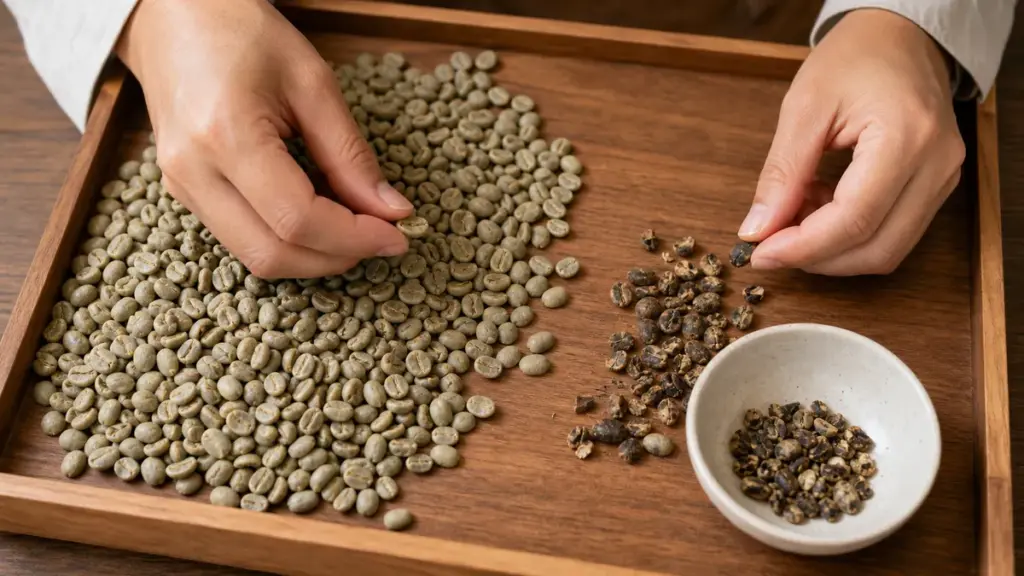
Fair Trade Certification Criteria
Fairtrade coffee certification combines the standard for small-scale producer organisations with a coffee-specific standard and relevant trading requirements. It covers both arabica and robusta green coffee, meaning unroasted beans.
Small-scale farmers and democratic organisations
Fairtrade coffee works through small-scale producer organisations, commonly co-operatives. The underlying model is collective organisation: farmers participate in a business that can market coffee and provide services to its members.
The majority of members must be smallholders whose farms rely mainly on their own and their families’ labour rather than permanent dependence on hired workers. Members must have a voice and vote in organisational decisions, including decisions about the Fairtrade Premium.
This matters because the Premium is not simply a payment that a buyer assigns to its preferred charity project. Decisions belong within the producer organisation’s democratic processes.
Labour rights and environmental requirements
The standards prohibit forced labour and child labour as defined through International Labour Organization conventions. They also include human-rights risk management, reporting and remediation requirements. A prohibition establishes the rule; monitoring and remediation address what happens when risks or violations are identified.
Environmental requirements cover matters including agrochemical use, water protection, soil health, biodiversity and forest protection. Fairtrade does not require organic certification. A coffee can carry both certifications, but each has its own requirements, as explained in organic coffee.
These are standards for production and trade, not a tasting assessment. When choosing coffee, treat certification evidence and flavour suitability as different questions.
Auditing and traceability
Independent auditors check producers and trading businesses against applicable requirements. The assurance system includes regular audits, corrective action for non-compliance, unannounced inspections and channels for reporting suspected violations.
For coffee, the FAIRTRADE Mark identifies a physically traceable product. This is more specific than a claim that a company purchases an equivalent quantity of certified ingredients somewhere in its supply chain.
Nevertheless, an audit is a checking mechanism, not continuous observation of every farm and transaction. The useful questions are what the standard requires, how compliance is checked and how problems are addressed.
How the Minimum Price and Premium work
Three terms need separating. They describe different obligations, and none is a retail price for a bag of roasted coffee.
| Mechanism | What it does | What it does not mean |
|---|---|---|
| Fairtrade Minimum Price | Establishes a floor for eligible coffee traded on Fairtrade terms | Every farmer receives an identical farm-gate payment |
| Fairtrade Premium | Provides a separate payment for producer-controlled investment | An optional donation or part of the minimum-price floor |
| Organic differential | Adds a separate requirement for qualifying organic coffee | All Fairtrade coffee is organic |
The basic rule is that the applicable market price or negotiated contract price applies when it is higher than the Fairtrade Minimum Price. The Premium is additional, rather than something a buyer can absorb into the floor.
Coffee minimum prices are expressed at FOB, or “free on board”, level. That refers to coffee prepared for export and loaded aboard the ship, not the amount handed directly to an individual grower. Processing, transport, export functions and the co-operative’s arrangements therefore matter when interpreting what reaches members.
The organic differential recognises qualifying organic production separately. Likewise, the Premium should not be confused with an additional payment negotiated for a particularly desirable coffee.
What changes on 1 December 2026?
Fairtrade announced revised arabica and robusta minimum prices on 30 July 2026, with implementation on 1 December 2026. As of this article’s check on 2 November 2026, that implementation date is still ahead.
The previous schedule therefore remains relevant until the new requirements take effect. Both washed and natural coffees are covered by the announced changes. The Fairtrade Premium and organic differential remain unchanged.
This timing resolves an apparent disagreement between references describing the earlier schedule as current and those describing the December schedule. They concern different effective dates, not necessarily different systems.
The current standard also earmarks part of the coffee Premium for improving productivity, quality or sustainable agricultural practices. Producer organisations must record its use and explain how the selected activities contribute to those purposes.
Impact on Coffee Communities
Fairtrade has plausible mechanisms for supporting coffee communities: protection against severe market downturns, collective investment and stronger producer organisations. Whether those mechanisms produce higher household incomes is an empirical question, and the evidence is mixed.
What research has found
A peer-reviewed study published in 2016 followed 183 coffee-growing households in India’s Araku valley. Using panel data and statistical methods intended to address differences between participating and non-participating farmers, it estimated higher incomes among certified producers, with relatively poorer farmers benefiting proportionally more.
This was an observational study, not a randomised trial. Its findings support a benefit in that setting, but they do not establish that certification produces the same result in every origin.
A 2017 Campbell systematic review examined agricultural certification across crops and schemes, rather than Fairtrade coffee alone. It found higher returns from certified produce in the evidence it pooled, but no clear overall improvement in total household income. Study quality, differences between settings and limited comparable evidence restricted the conclusions.
These findings need not contradict each other. A programme can work well in one place while producing smaller or uncertain benefits elsewhere. Household income also includes activities beyond coffee, so an improvement in coffee trading does not automatically transform the whole household economy.
Where the Premium goes
Fairtrade’s own 2025 coffee impact summary, reporting 2023 data, identifies production improvements, business development, direct financial benefits for farmers and social investment among the uses of coffee Premium funds.
That is useful monitoring evidence about reported activity. It is not, by itself, proof that a project caused a particular improvement in health, schooling or income.
When evaluating a co-operative’s impact story, look for the decision-making process, the activity funded, the people reached and the outcome measured. “A training programme took place” and “farmers’ net incomes improved because of it” are different claims requiring different evidence.
Criticisms and limits of Fairtrade coffee
The strongest criticisms concern the gap between certification’s rules and its eventual reach.
Not all eligible coffee sells on Fairtrade terms. Fairtrade’s 2025 summary reports that coffee co-operatives sold, on average, 35% of their coffee on Fairtrade terms in 2023. Certification does not create a guaranteed buyer for the entire harvest. The share sold through the system therefore affects the benefits available.
Compliance requires resources. Record-keeping, organisational administration, training and audits take time and effort. These demands should be considered alongside the benefits of certification, particularly where certified sales remain limited.
A price floor is not a living-income guarantee. Fairtrade itself distinguishes its mandatory mechanisms from additional, voluntary approaches intended to support living incomes. A household’s outcome also depends on production, farm size, labour requirements and other income sources.
Benefits may differ between farmers and workers. Evidence about co-operative members should not automatically be treated as evidence about seasonal or hired workers. The Campbell review found that worker outcomes did not simply mirror improvements in returns from certified produce.
The reasonable conclusion is neither that the label solves coffee’s problems nor that imperfect results make it worthless. Assess the rules, the organisation and the evidence together. Our complete certification guide provides the wider context without treating different schemes as interchangeable.
Fairtrade in the UK: checking your coffee
For UK buyers, the clearest starting point is the FAIRTRADE Mark on the specific coffee supplied. The Fairtrade Foundation’s UK guidance explains how the mark is used, while certification and licensing requirements distinguish verified products from general ethical claims.
Use this short purchasing check at home or at work:
- Identify the exact product. Ask for the coffee’s name and current packaging or product documentation.
- Check the certification claim. Confirm that the supplied product carries the relevant mark, rather than relying on a supplier’s general sustainability statement.
- Ask about origin. Request the producing country and co-operative where available, together with an explanation of any changing blend.
- Request evidence of outcomes. Ask for a dated Premium-use report or producer account that distinguishes activities from measured results.
- Specify substitutions. In workplace supply arrangements, state whether replacements must also be Fairtrade certified.
Other labels need separate interpretation. Read about Rainforest Alliance certification rather than assuming it makes the same commitments.
For Fair Trade Coffee purchasing, the most useful combination is a verifiable product claim, clear sourcing information and proportionate expectations about what certification can achieve.
FAQ
Does Fairtrade coffee taste better?
The Fairtrade Mark does not establish that a coffee will taste better to you. It addresses production and trading requirements, while the coffee standard allows Premium investment in quality improvement. Choose certification for the commitments it verifies, then assess the actual coffee’s flavour separately rather than treating an ethical label as a tasting score.
Is the Premium paid directly to every farmer?
Not necessarily: producer organisations decide democratically how to use the Premium within the applicable rules. Uses can include production improvements, organisational development, financial benefits for farmers and social investment. Ask how a particular co-operative allocated its funds rather than assuming every member received an identical individual payment.
Can a business display the FAIRTRADE Mark simply because it buys certified coffee?
Buying certified coffee does not automatically grant unrestricted permission to use the FAIRTRADE Mark. FLOCERT explicitly distinguishes certification from trademark licensing. A business planning to use the mark on packaging, promotional materials or its own products should check the relevant UK permissions rather than copying the symbol from a supplier’s materials.
Where to go next
Read Coffee Certification: The Complete Guide for the broader framework, then Organic to understand the separate requirements behind organic claims. Rainforest Alliance explains another major scheme, while UTZ helps interpret that name when you encounter it in certification information.
Sources
-
Fairtrade International, “Standards for small-scale producers”, undated, current online overview. Producer eligibility and democratic organisation.
https://www.fairtrade.net/ie-en/why-fairtrade/how-we-do-it/standards/who-we-have-standards-for/standards-for-small-scale-producer-organisations.html -
Fairtrade International, “Objectives of the standards”, undated, current online overview. Social and environmental requirements, organic distinction and living-income pathways.
https://www.fairtrade.net/en/why-fairtrade/how-we-do-it/standards/objectives-of-the-standards.html -
Fairtrade International, Fairtrade Standard for Coffee, version 15.07.2021_v.2.9. Coffee scope, trading requirements, FOB guidance and Premium earmarking.
https://www.fairtrade.net/content/dam/fairtrade/fairtrade-international/standards/small-scale-producer/coffee/Coffee_SPO_EN.pdf -
Fairtrade International, “How Fairtrade certification works”, undated, current online guidance. Independent certification, audits, corrective measures and complaints.
https://www.fairtrade.net/en/why-fairtrade/how-we-do-it/how-does-the-label-work/how-fairtrade-certification-works.html -
Fairtrade International, “Fairtrade Minimum Prices and Premiums”, current online database. Relationship between the minimum and higher market or negotiated prices.
https://www.fairtrade.net/en/why-fairtrade/how-we-do-it/standards/fairtrade-minimum-price-and-premium-information.html -
Fairtrade International, “Fairtrade strengthens safety net for coffee farmers”, 30 July 2026. December implementation date, affected coffee categories, unchanged Premium and organic differential.
https://www.fairtrade.net/us-en/for-media/Fairtrade-strengthens-safety-net-for-coffee-farmers.html -
Fairtrade Foundation, “How to use the FAIRTRADE Mark”, undated, current UK guidance. Single-ingredient coffee and physical traceability.
https://www.fairtrade.net/uk-en/for-business/partner-resources/how-to-use-mark.html -
FLOCERT, “Get certified”, undated, current online guidance. Distinction between certification and permission to use the mark.
https://www.flocert.net/get-certified/ -
Cambridge University Press, “Fair Trade Certification and Livelihoods: A Panel Data Analysis of Coffee-growing Households in India”, Agricultural and Resource Economics Review, volume 45, issue 3, December 2016. Observational household study.
https://www.cambridge.org/core/journals/agricultural-and-resource-economics-review/article/fair-trade-certification-and-livelihoods-a-panel-data-analysis-of-coffeegrowing-households-in-india/CCB64D912C7291D6F8E3D33C252C9597 -
Oya and colleagues, “Effects of certification schemes for agricultural production on socio-economic outcomes in low- and middle-income countries: a systematic review”, Campbell Systematic Reviews, 2017. Evidence synthesis, uncertainty and worker outcomes.
https://onlinelibrary.wiley.com/doi/full/10.4073/csr.2017.3 -
Fairtrade International, Fairtrade Coffee: Impact at a Glance, 2025. Reported Premium uses and proportion of coffee sold on Fairtrade terms in 2023.
https://www.fairtrade.net/content/dam/fairtrade/global/for-business/world-of-coffee-2025/Fairtrade%20Coffee%20-%20Impact%20at%20a%20glance%202025%20A4%20v4.pdf
Research combined retrieved Fairtrade standards and UK labelling guidance with peer-reviewed impact research, distinguishing scheme monitoring from evidence of causal effects.
Last checked: November 2026