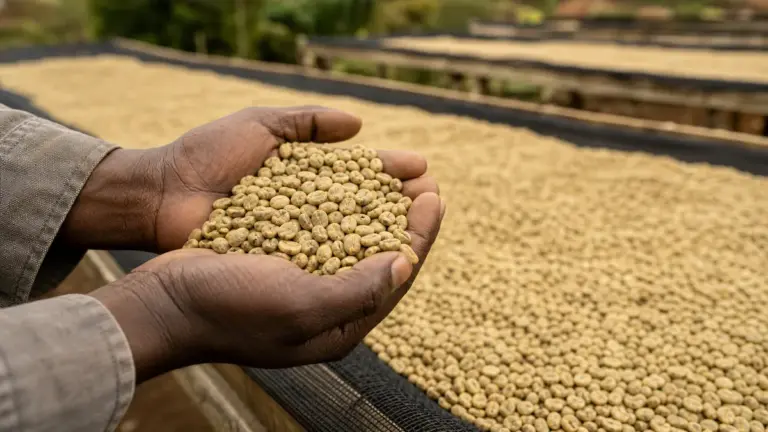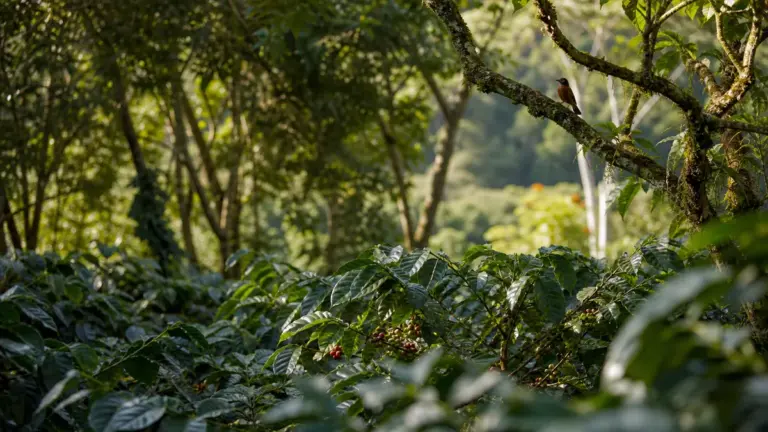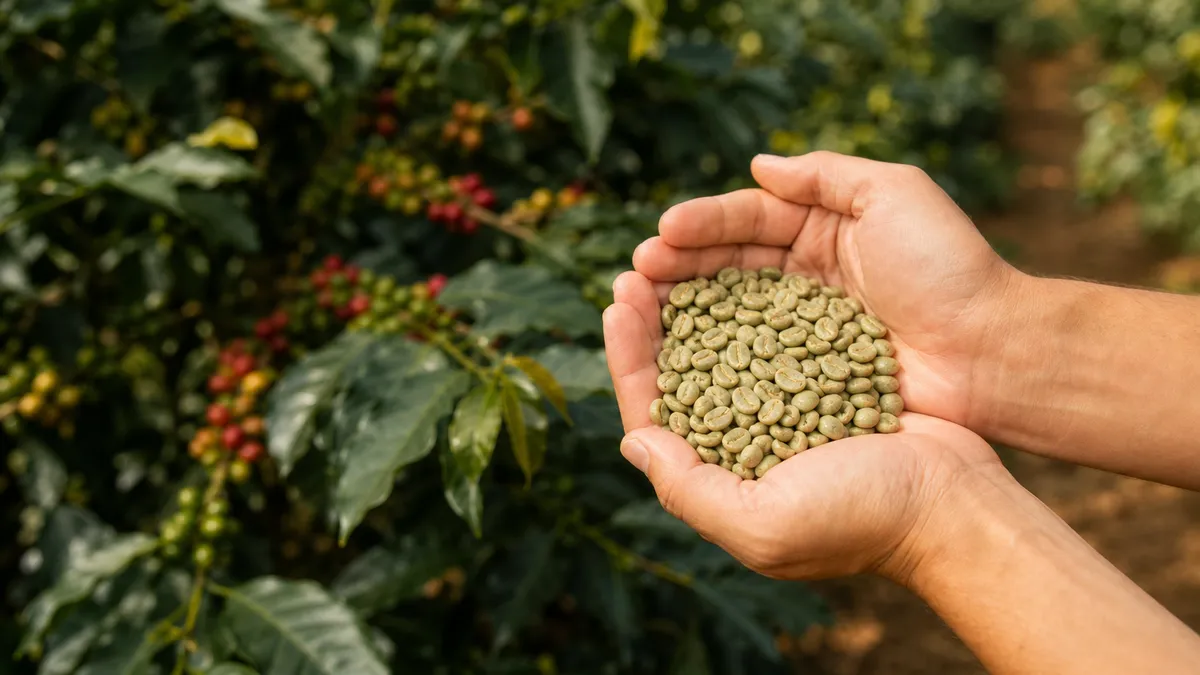
Coffee certification means that farms, producer groups or supply-chain businesses are assessed against a defined set of requirements, such as farming practices, trading conditions or labour protections. Different labels address different questions: none can guarantee the absence of every environmental or labour problem, and certification is not a tasting score.
In short
- Fairtrade combines producer-organisation requirements with trading rules, including a minimum-price mechanism and a separately managed Premium.
- Organic certification regulates production methods and permitted inputs; it does not mean that no pesticides can ever be used.
- Rainforest Alliance covers environmental, social and farm-management requirements, but is not the same as organic.
- Smithsonian Bird Friendly combines organic certification with requirements for wildlife habitat.
- Look beyond the logo: check the scheme, certificate scope, product coverage and evidence of outcomes.
What coffee certification actually means
A certification scheme starts with a standard, a written set of requirements. A certification body assesses compliance through activities such as inspections, interviews and checks of records. Depending on the scheme, certification also involves follow-up assessments and corrective action when requirements are not met.
Three things need separating:
- The standard: what participants must do.
- The audit: how compliance is checked.
- The impact: what changes for farmers, workers or the environment.
A requirement to protect waterways is not, by itself, evidence that water quality has improved. Equally, finding a problem does not automatically mean that a scheme has achieved nothing: the response, remedy and follow-up matter.
Certification can also cover the supply chain. Chain of custody means the controls used to follow certified material through trading, processing and packaging. A farm certificate and permission to put a logo on a finished product are related, but not interchangeable.
The coffee certification hub provides the wider route through individual labels and their supporting concepts.
Main coffee certification schemes
These schemes overlap, but their requirements are not interchangeable. The table compares their principal focus, what is assessed and the assumption a reader should avoid.
| Scheme | Principal focus | What it requires or assesses | Do not assume |
|---|---|---|---|
| Fairtrade | Producer organisation and trading conditions | Democratic organisation, social and environmental requirements, minimum-price rules and Premium arrangements | Every farmer receives a living income |
| Organic | Production and handling methods | Restricted inputs, soil-management practices, records and controls protecting organic integrity | Pesticide-free, shade-grown or fairly traded |
| Rainforest Alliance | Environmental, social and farm-management practices | Requirements addressing ecosystems, working conditions, agricultural practices and supply-chain controls | Organic production or a Fairtrade-style minimum price |
| Smithsonian Bird Friendly | Wildlife habitat alongside organic production | Organic certification and habitat criteria assessed by third-party inspectors | Certification replaces natural forest conservation |
| 4C | Environmental, social and economic practices | Production and processing requirements, audits and continuous improvement | Every sustainability outcome has been achieved |
Fairtrade
Fairtrade coffee operates through certified small-scale producer organisations and traders. Its distinctive features include a minimum-price mechanism for qualifying sales and the Fairtrade Premium, an additional payment whose use is governed through producer decision-making.
These are trading arrangements, not a promise that every household earns enough for a decent standard of living. Certified production also does not automatically secure a buyer willing to purchase the entire harvest on Fairtrade terms.
Fairtrade includes environmental and labour requirements, but organic certification is separate. Read how Fairtrade coffee works for the detailed explanation of producer organisations, payments and limitations.
Organic
Organic certification concerns how coffee is produced and handled. It restricts fertilisers and crop-protection substances, requires specified farming practices and relies on records and inspections.
“Organic” does not mean “nothing was sprayed”. Approved substances may be permitted under the applicable organic rules. Nor does organic certification, by itself, establish a minimum trading payment or require a particular shade canopy.
For UK buyers, organic is a regulated food claim rather than simply a voluntary marketing description. GOV.UK distinguishes labelling requirements for Great Britain and Northern Ireland, including control-body identification. The organic guide explains the production rules in more detail.
Rainforest Alliance and the former UTZ label
Rainforest Alliance combines environmental, social and economic requirements. Its programme addresses farming practices, ecosystem protection and working conditions, with independent certification bodies assessing compliance.
For coffee, current premium rules require the first buyer to specify the premium and payment terms in contracts or signed agreements. This should not be confused with Fairtrade’s minimum-price mechanism.
UTZ is now part of Rainforest Alliance, with its former programme and label being phased out. It should not be presented as an additional, independent contemporary choice.
There is also a newer distinction to recognise. From 1 March 2026, coffee farmers certified under Rainforest Alliance’s Sustainable Agriculture Standard could be audited against its Regenerative Agriculture Standard add-on. A general Rainforest Alliance claim should not automatically be read as this additional certification.
Smithsonian Bird Friendly
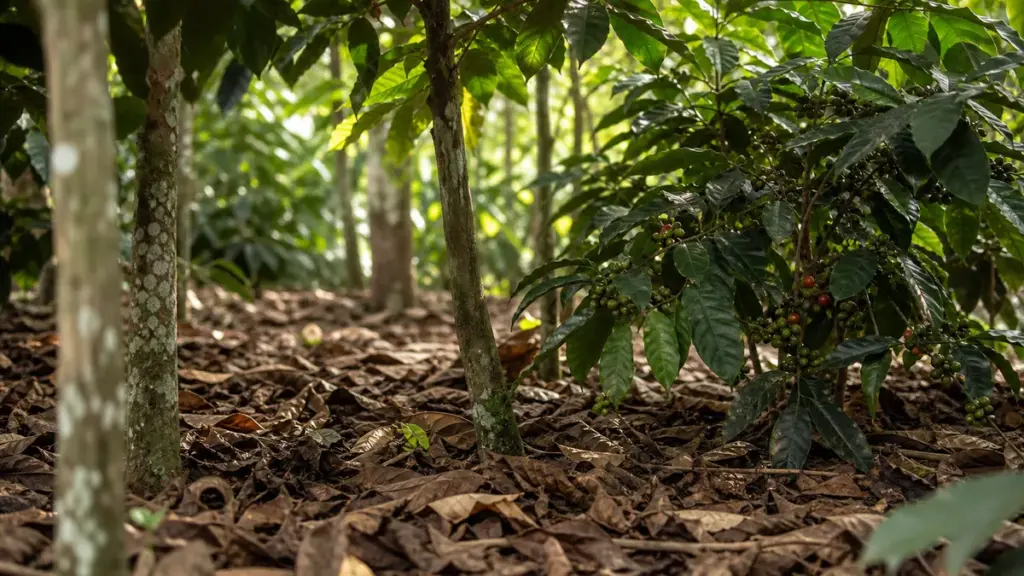
Bird Friendly adds habitat requirements to organic certification. Its criteria concern the vegetation supporting coffee production, rather than relying on an undefined “shade-grown” description.
The Smithsonian requires third-party inspection and specifies that coffee carrying its Bird Friendly label comes entirely from qualifying production. This makes it particularly relevant when your question is about wildlife habitat. It is not, however, a substitute for protecting intact natural forest.
4C
4C covers environmental, social and economic practices in coffee production and processing. Its system includes certification audits, surveillance and requirements for continuous improvement.
It is useful to recognise 4C when examining suppliers’ sourcing policies, even if it is not the label that first catches your eye on a retail bag. Ask which product, producer group and supply-chain activities the supplier’s claim actually covers.
What certification asks of farmers
Certification involves more than an inspector’s visit. Farmers and producer organisations may need to maintain records, train members, monitor compliance, change agricultural practices and correct problems.
There are direct certification expenses as well as indirect burdens. FLOCERT’s published system, for example, varies certification fees according to the organisation’s structure and activities. An independent systematic review also identifies the time and resources needed for compliance as potential barriers to participation.
Group organisation can help distribute administration, but it does not make the work disappear. Someone still needs to manage documents, organise training and check participating farms.
The crucial commercial question is how much certified production is actually bought on certified terms. Maintaining compliance across a harvest brings limited additional trading benefit if only part of that harvest finds a certified buyer.
A useful supplier question is therefore: “Who supports the producer organisation with certification, training and corrective action?” Ask for a specific explanation, not simply a statement that certification helps farmers.
What does the evidence show?
Certification has credible mechanisms for improvement, but the evidence does not justify saying that every certified purchase produces the same benefit.
Farmer livelihoods: benefits can be uneven
A peer-reviewed study by Raluca Dragusanu, Eduardo Montero and Nathan Nunn, published in 2022, examined Costa Rican coffee production from 1999 to 2014. Fairtrade certification was associated with better sales outcomes when the minimum-price mechanism was binding, and with higher incomes for farm owners. The study did not find an income benefit for unskilled coffee workers in its main results.
This was an econometric analysis of observational data, not a randomised trial. Its methods address important differences between participants, but its findings should not be treated as a universal result for every country or scheme.
A broader 2017 Campbell systematic review found mixed socioeconomic results across agricultural certification schemes. Some producer outcomes improved, but the pooled evidence did not establish a statistically significant improvement in total household income. Evidence about workers was particularly limited.
These findings are compatible: certification can benefit particular producers under particular conditions without reliably improving every household’s circumstances.
Environmental requirements and measured outcomes
The ecological case for maintaining diverse shade vegetation is supported by research summarised by the Smithsonian, including findings on habitat structure, biodiversity and soil protection. That helps explain why habitat requirements matter.
However, evidence that a farming practice is beneficial is different from evidence that certification caused farmers to adopt it. Farms entering a scheme may already have suitable vegetation or stronger management.
When reading an impact report, ask:
- What outcome was measured, rather than merely required?
- Was there a credible comparison group?
- Were conditions measured before and after certification?
- Does the report distinguish farmers, hired workers and their households?
Where certification reaches its limits
Audits are not continuous surveillance. They can miss concealed or intermittent problems. Rainforest Alliance itself explains that audits assess systems and controls, rather than proving that violations never occur.
Compliance is not the same as a living income. Trading rules and better farming practices may help, but household circumstances and the volume sold on certified terms still matter.
A production label is not a complete environmental assessment. Organic or habitat requirements should not be expanded into an unsupported claim that a finished drink has the lowest overall environmental impact.
A certificate is not a flavour guarantee. These schemes address production, trade or environmental and social practices. Use them to answer sourcing questions, not as substitutes for choosing coffee you enjoy.
A practical checklist for reading a coffee label
- Name the scheme. Identify the certification organisation rather than relying on words such as “responsible” or “ethical”.
- Check the specific product. Ask whether the coffee you are buying is covered, not merely whether its supplier handles certified coffee.
- Check scope and validity. Request the relevant certificate or scheme-verification details and confirm which activities they cover.
- Read the accompanying qualification. Establish which ingredient or sourcing claim the logo supports.
- Match the scheme to your priority. Look for the relevant requirements, whether your concern is producer trading conditions, permitted inputs or habitat.
- Ask about outcomes and remedies. A useful answer explains measured progress, unresolved difficulties and what happens when problems are found.
For workplace purchasing, include these questions in the written specification and ask suppliers to confirm the certification status of substitutions. Coffee certification is most useful when it becomes a checkable requirement rather than an attractive detail on a proposal.
FAQ
Can coffee carry more than one certification?
Yes, coffee can meet more than one scheme’s requirements. Fairtrade and organic, for example, address different aspects of production and trade, while Bird Friendly requires organic certification as part of its approach. Multiple labels can therefore add relevant coverage, but counting logos is less useful than checking what each one contributes.
Does uncertified coffee necessarily have worse farming practices?
No, the absence of certification does not establish that farming practices are worse. Certification requires resources and access to suitable organisations and markets, which can create barriers to participation. However, an uncertified supplier’s positive claims still need evidence. Ask what was checked, by whom, and how the information relates to the coffee being supplied.
Does a problem found on a certified farm invalidate the whole scheme?
No, an individual finding does not settle the effectiveness of an entire scheme. It does show why certification cannot be treated as a guarantee of perfect conditions. Examine the seriousness of the problem, whether people were protected, the corrective action required and whether follow-up led to compliance, suspension or withdrawal of certification.
Where to go next
Visit Coffee Certification to explore the wider subject and its individual labels. Read Organic for production-method requirements, then Fair Trade Coffee for producer organisations and trading arrangements.
Sources
-
Rainforest Alliance, The Value of Third-Party Certification in Sustainability Claims, 2026. Certification, audit methods and limitations.
https://www.rainforest-alliance.org/business/certification/third-party-certification-sustainability-claims/ -
Fairtrade International, Fairtrade Standard for Coffee, version 15.07.2021_v.2.9; and Objectives of the Standards, undated current web guidance.
https://www.fairtrade.net/content/dam/fairtrade/fairtrade-international/standards/small-scale-producer/coffee/Coffee_SPO_EN.pdf
https://www.fairtrade.net/en/why-fairtrade/how-we-do-it/standards/objectives-of-the-standards.html -
Department for Environment, Food & Rural Affairs, Organic Food: Labelling and Advertising Rules, current guidance retrieved November 2026; and Organic Farming: How to Get Certification and Funding in Great Britain, current guidance retrieved November 2026.
https://www.gov.uk/guidance/organic-food-labelling-rules
https://www.gov.uk/guidance/organic-farming-how-to-get-certification-and-apply-for-funding -
Rainforest Alliance, What Is the Difference Between Rainforest Alliance and Fairtrade Certification?, 2024; and Premium Annex, version 1.4, current text including 2026 corrections.
https://www.rainforest-alliance.org/business/certification/difference-between-rainforest-alliance-certified-fair-trade/
https://knowledge.rainforest-alliance.org/docs/premium-annex-v14 -
Rainforest Alliance, UTZ Certification (Now Part of the Rainforest Alliance), undated current web guidance; and Getting Started with the Regenerative Agriculture Standard, 2026.
https://www.rainforest-alliance.org/utz/
https://knowledge.rainforest-alliance.org/docs/en/getting-started-with-the-regenerative-agriculture-standard -
Smithsonian’s National Zoo and Conservation Biology Institute, Bird Friendly Coffee FAQs and Ecological Benefits of Shade-grown Coffee, undated current web resources.
https://nationalzoo.si.edu/migratory-birds/bird-friendly-coffee-faqs
https://nationalzoo.si.edu/migratory-birds/ecological-benefits-shade-grown-coffee -
4C Services, About Us and Our Certification System, undated current web guidance.
https://www.4c-services.org/about-4c/
https://www.4c-services.org/4c-system/our-certification-system/ -
FLOCERT, Fairtrade Certification Fees, edition 15, 4 March 2026; and Frequently Asked Questions, undated current web guidance.
https://www.flocert.net/frequently-asked-questions/ -
Dragusanu, R., Montero, E. and Nunn, N., The Effects of Fair Trade Certification: Evidence from Coffee Producers in Costa Rica, Journal of the European Economic Association, 2022, volume 20, issue 4. Author-hosted published paper.
https://scholar.harvard.edu/files/nunn/files/dragusanu_montero_nunn_jeea_2022.pdf -
Oya, C. and colleagues, Effects of Certification Schemes for Agricultural Production on Socio-economic Outcomes in Low- and Middle-income Countries: A Systematic Review, Campbell Systematic Reviews, 2017.
https://journals.sagepub.com/doi/full/10.4073/csr.2017.3
This article was researched using retrieved scheme documents, UK government guidance, certification-body information, a peer-reviewed coffee study and an independent systematic review, distinguishing scheme requirements from demonstrated outcomes.
Last checked: November 2026