Coffee is shared on social media through drink photographs, brewing demonstrations, café stories, comedy and recipes that other people can recreate. Coffee influencers and hashtags help readers find these communities, but a beautiful video is not proof of a better brew, a new invention or a safe recipe.
In short
- Choose creators for clear explanations, relevant experience and transparent commercial relationships, not follower counts alone.
- Use coffee hashtags as search routes, not as a guaranteed formula for reaching an audience.
- Dalgona whipped coffee became a documented international trend in 2020; espresso tonic has an earlier café history.
- Proffee means coffee mixed with a protein powder or shake, not a proven nutritional upgrade for everyone.
- Never copy dry-scooping challenges or modifications that interfere with a coffee machine’s pressure safety devices.
Coffee Influencers and Hashtags
A useful way to approach coffee and social media is to separate inspiration, instruction and advertising. A photograph can suggest a drink to try; a tutorial should explain how to reproduce it; an advertisement should make its commercial purpose clear. One post can perform all three functions, but readers should be able to distinguish them.
Coffee creators also serve different interests. Someone explaining fermentation is doing a different job from someone developing sweet iced drinks or recreating conversations behind a café bar. Start with what you want to learn rather than looking for a universal “best coffee influencer”.
For a wider introduction to participation beyond individual accounts, explore coffee fun and community.
How to judge a useful coffee account
Before treating a post as instruction, ask:
- Is the method reproducible? Look for ingredient quantities, equipment and an explanation of what the creator changed.
- Does the explanation match the claim? An attractive espresso pour cannot, by itself, establish how the drink tastes.
- Are limitations acknowledged? A result from one grinder or coffee should not automatically become a rule for every setup.
- Are commercial relationships clear? Check whether equipment, ingredients or recommendations are being promoted.
In the UK, ASA guidance expects influencer advertising to be obviously identifiable, normally through a prominent, upfront “Ad” label. A brand mention, an ambassador statement in a profile or a disclosure buried among hashtags is not an adequate substitute.
Treat disclosure as information, not an automatic reason to reject a creator. The useful question is whether you can understand the relationship and judge the recommendation accordingly.
Coffee-Related Instagram Influencers
The following are illustrative starting points, not a ranking. Selection is based on identifiable official channels, coffee-focused work and contrasting approaches that give a newcomer different ways into the subject. Account identities were checked in November 2026; no follower totals are used.
James Hoffmann, @jimseven
James Hoffmann’s official channel directory brings together his Instagram presence, longer coffee videos and books. Its linked subjects include coffee fermentation and a shared tasting project.
Start here if you enjoy following a question beyond the finished drink. For learning, use a short post as the doorway to the full explanation rather than assuming the edited clip contains the complete method.
Morgan Eckroth, @morgandrinkscoffee
Morgan Eckroth’s official website identifies them as a drink developer and the 2022 US Barista Champion. Their official channel directory connects Instagram, TikTok and YouTube, while their website publishes developed drink recipes.
Start here if inventive beverages are your route into coffee. When recreating a drink, look for the written recipe rather than estimating ingredients from the speed of a pour.
These examples are not a complete picture of coffee expertise. Build your own reading list around the questions you have, and include people who can explain the ingredients, equipment or working conditions they actually know.
Popular Coffee Hashtags
Coffee hashtags are useful labels for exploring a subject, but “popular” needs qualification. A tag can have substantial historical use without being the fastest-growing tag now, and figures from different platforms, countries or reporting periods are not interchangeable.
TikTok’s Creative Center provides examples of coffee-related tags and related-tag suggestions. The table below groups established search terms by purpose rather than claiming a current popularity ranking.
| What you want to find | Hashtags to explore | How to make the search useful |
|---|---|---|
| General coffee posts | #coffee, #coffeeshop |
Add a place, drink or specific question |
| Café work and preparation | #barista |
Look for explanations as well as finished results |
| Milk drinks and pouring | #latte, #latteart |
Distinguish decorative results from teaching |
| Whipped coffee recreations | #dalgonacoffee, #whippedcoffee |
Check the recipe and its publication date |
For your own posts, use tags that accurately describe what you are showing. A plain caption such as “my first attempt at a latte heart” gives the reader useful context; a block of unrelated trend tags does not.
Do not confuse topical hashtags with advertising disclosure. Where a post is an advertisement, make that clear upfront rather than hiding #Ad at the end.
For lighter material to share, use the dedicated coffee humour collection rather than attaching an unrelated joke to a technical tutorial.
Coffee Challenges and Trends
It helps to distinguish a challenge, which invites other people to repeat an action, from a trend, which may simply be a recurring drink or presentation style. Neither label establishes that the underlying idea is new.
Dalgona is a strong example of a repeatable preparation becoming a shared activity. Espresso tonic illustrates something different: an existing café drink gaining new audiences.
Espresso tonic: an older drink, not a platform invention
Espresso tonic combines espresso with tonic water and ice. In its own published history, Swedish roaster Koppi traces Kaffe & Tonic to its opening menu in 2007, following experimentation while its founders were working in Oslo.
That is a first-party origin account, not proof that nobody had ever combined the ingredients before. It does, however, establish a history well before the 2020 whipped-coffee wave.
The dark coffee settling above a pale, sparkling base makes an appealing subject for filming. Koppi’s method calls for a gentle espresso pour over cold tonic and ice, followed by stirring before drinking. The layered appearance is presentation, not a requirement to drink the components separately.
Choose challenges that produce something useful
A worthwhile community activity need not involve drinking more coffee. Try documenting a brewing attempt, comparing tasting notes or showing how your pouring improves.
Keep the activity welcoming: explain what you tried, include the imperfect result and credit the person whose idea you followed. If you want participation without preparing another drink, share a question from coffee trivia and quizzes.
Viral Coffee Challenges on TikTok
The clearest documented examples here are whipped coffee and proffee. Frozen dosing tubes, RDT and WDT belong in the discussion too, but their technical existence should not be confused with independently verified, platform-wide virality.
Dalgona whipped coffee
Dalgona coffee is made by whipping instant coffee, sugar and water into a foam, then serving it with milk. Korea.net documented its spread in March 2020 and credited South Korean actor Jung Il-woo with introducing the dalgona name after trying the drink in Macao and comparing it with the Korean sweet.
The careful distinction is between the naming and viral spread of this version and the invention of whipped coffee itself. Korea.net’s account also acknowledges connections with India, Pakistan and Macao. Calling the 2020 phenomenon a South Korean-led trend should not erase those connections.
TikTok’s own retrospective identifies whipped coffee among its 2020 trends and says it continued circulating in 2021. That supports the historical trend claim, not a claim that it is currently the platform’s leading coffee drink.
If you recreate it, use a complete recipe and check how many servings the whipped mixture makes. A large topping can contain more instant coffee than its airy appearance suggests; do not assume that one photographed glass represents an ordinary serving.
Proffee: protein iced coffee
Proffee combines coffee with a protein powder or ready-made protein shake. Cleveland Clinic explicitly discusses it as a TikTok trend and describes both approaches, including mixing with iced coffee.
Its nutrition discussion is dietitian guidance, not a controlled trial showing that the viral drink itself delivers special benefits. The clinic cautions against treating protein coffee as a substitute for a nutritious meal.
For a recreation, follow the supplement’s preparation instructions, check its ingredients and establish whether it already contains caffeine. Do not add pre-workout powder simply because another video presents it as interchangeable with a protein shake.
Frozen dosing tubes, RDT and WDT
These are distinct practices, not a single preparation ritual:
- Frozen dosing tubes hold pre-portioned whole beans for later brewing. Weber Workshops explicitly markets a version of its storage tubes for long-term freezing. That verifies an intended product use, not a promised flavour improvement or a TikTok audience figure.
- RDT, the Ross droplet technique, involves adding a small amount of water to beans before grinding to reduce static. University of Oregon experimental research reported reduced electrical charging and clumping under the conditions studied.
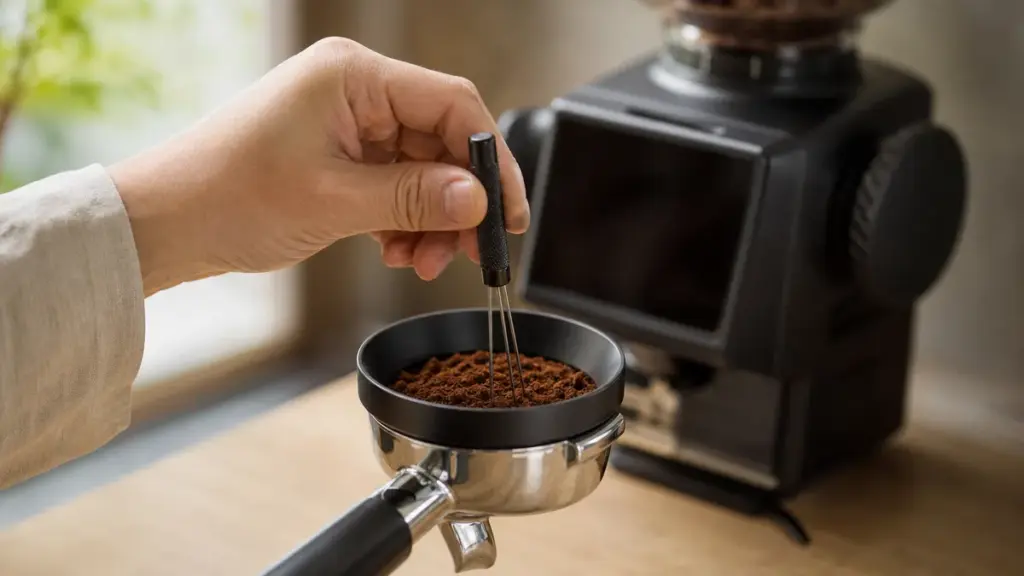
- WDT, the Weiss distribution technique, uses fine needles to stir grounds in the espresso basket before tamping. It aims to break up clumps and distribute the coffee more evenly through the puck, the compacted bed of grounds.
The evidence is different in each case: manufacturer information for the tubes, experimental research for RDT and specialist testing and explanation for WDT. None establishes that every viewer needs the complete routine.
Do not transfer an external-grinder demonstration to an office bean-to-cup machine. Follow the machine’s instructions rather than adding water to its bean hopper or attempting to access its brewing mechanism.
A safety check before copying a recipe
- Read the complete method. Check quantities, serving count and product instructions before starting.
- Count caffeine from every ingredient. Include coffee, supplements and any other caffeinated additions.
- Reject dry scooping. Poison Control warns that swallowing undiluted pre-workout powder can cause choking, breathing difficulties and serious caffeine-related effects.
- Leave pressure systems alone. Never bypass safety valves or copy unapproved boiler modifications. HSE identifies inadequate repairs and modifications as causes of pressure-related incidents.
- Film around safe preparation. Set the phone down securely rather than letting the shot dictate how you handle hot liquid or equipment.
EFSA’s 2015 risk assessment found no safety concerns for healthy non-pregnant adults at single caffeine doses up to 200 mg and habitual intakes up to 400 mg spread across the day. These are population benchmarks, not challenge targets.
The NHS advises no more than 200 mg daily from all sources during pregnancy. Individual sensitivity, medicines and health conditions matter; ask a GP, pharmacist or midwife about personal circumstances.
The best use of coffee and social media is to turn an interesting post into a well-understood experiment, not an obligation to imitate everything on screen.
FAQ
Can I join coffee communities if I only drink instant coffee?
Yes, you do not need specialist equipment to participate. Dalgona’s documented recipe uses instant coffee, while community activities can involve photographs, questions or tasting descriptions rather than brewing equipment. Say what you enjoy and what you want to learn. There is no need to present an ordinary daily drink as something more elaborate.
Do I need an espresso machine to make coffee videos?
No, choose a subject that fits the coffee you already make. You could show an instant-coffee preparation, describe a drink or document your own learning. Concentrate on a clear explanation and an honest result. Specialist equipment only belongs in the video when it is relevant to what you are demonstrating.
What should I ask when a coffee tutorial leaves something out?
Ask for the missing information needed to reproduce it: ingredient quantities, serving count, equipment and any preparation omitted by the edit. For espresso, ask for coffee dose and beverage yield by weight. A specific question is more useful than asking whether the method is “good”, because it gives the creator something concrete to explain.
Where to go next
Read Coffee Fun and Community for more ways to participate beyond individual accounts. For shareable entertainment rather than brewing instruction, try Coffee Jokes and Humour, or use Coffee Trivia and Quizzes to start a conversation without making another drink.
Sources
-
James Hoffmann, official channel directory, undated, retrieved November 2026. Establishes the creator’s connected channels and examples of published work.
https://linktr.ee/jimseven -
Morgan Drinks Coffee, official website and channel directory, undated, retrieved November 2026. Establishes identity, drink-development work, stated competition credential and connected platforms.
https://morgandrinkscoffee.com/
https://linktr.ee/Morgandrinkscoffee -
ASA and CAP, Recognising ads: Social media and influencer marketing, current guidance retrieved November 2026; Influencers’ guide to making clear that ads are ads, fourth edition, 23 October 2026.
https://www.asa.org.uk/advice-online/recognising-ads-social-media.html
https://www.asa.org.uk/resource/influencers-guide.html -
TikTok for Business, Creative Center hashtag pages for café and latte, undated, retrieved November 2026. Used for examples of related tags, not numerical popularity rankings.
https://ads.tiktok.com/business/creativecenter/hashtag/cafe/pc/en?countryCode=UA&period=7
https://ads.tiktok.com/business/creativecenter/hashtag/latte/pc/en?countryCode=PK&period=120 -
Koppi Roasters, Coffee tonic: the origin story, 8 September 2026. First-party historical account and preparation method.
https://koppi.se/blogs/learn/coffee-tonic -
Korea.net, Nurin Nabila, Honorary Reporter, Dalgona coffee craze hits Malaysia, 25 March 2020. Contemporary account of the preparation, naming and international connections.
https://www.korea.net/NewsFocus/HonoraryReporters/view?articleId=183637 -
TikTok Newsroom, “2020’s stars and trends: Look how far they’ve come!”, 2021. Platform retrospective documenting whipped coffee’s historical trend status.
https://newsroom.tiktok.com/2020-s-stars-and-trends-look-how-far-theyve-come/ -
Cleveland Clinic, Can Drinking Protein Coffee Jump-Start Your Day?, 27 May 2025. Dietitian explanation of proffee, preparation and nutritional limitations.
https://health.clevelandclinic.org/should-you-drink-protein-coffee -
Weber Workshops, BEAN CELLAR Bulk, undated, retrieved November 2026. Manufacturer’s stated intended use for long-term freezing.
https://weberworkshops.com/products/bean-cellar-bulk -
University of Oregon, If your next cup of espresso tastes a bit better, you can thank volcanology, 11 December 2023. Institutional account of experimental research on water addition, static and clumping.
https://news.uoregon.edu/content/if-your-next-cup-espresso-tastes-bit-better-you-can-thank-volcanology -
Barista Hustle, Weiss Distribution Technique, 5 March 2021. Technical explanation and discussion of specialist testing.
https://www.baristahustle.com/weiss-distribution-technique/ -
Poison Control, Dry scooping can be life threatening, undated, retrieved November 2026. Medical-toxicology safety guidance.
https://www.poison.org/articles/dry-scooping-can-be-life-threatening -
Health and Safety Executive, Introduction to pressure equipment, undated, retrieved November 2026. Great Britain workplace pressure-equipment guidance, including modification hazards and safe operating limits.
https://www.hse.gov.uk/pressure-systems/about.htm -
European Food Safety Authority, Caffeine, current topic page explaining the 2015 scientific opinion, retrieved November 2026.
https://www.efsa.europa.eu/en/topics/topic/caffeine -
NHS, Foods to avoid in pregnancy, current guidance retrieved November 2026.
https://www.nhs.uk/pregnancy/keeping-well/foods-to-avoid/
This article was researched using official creator channels, contemporary cultural reporting, platform documentation, first-party historical accounts, specialist technical explanations and authoritative safety guidance; no first-hand testing or live popularity ranking was undertaken.
Last checked: November 2026