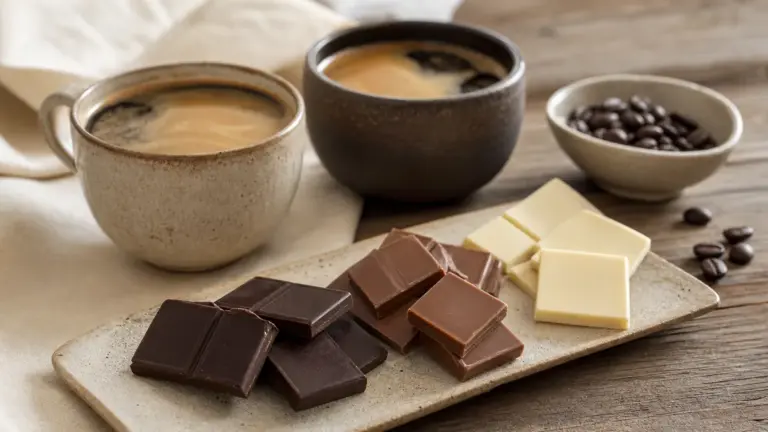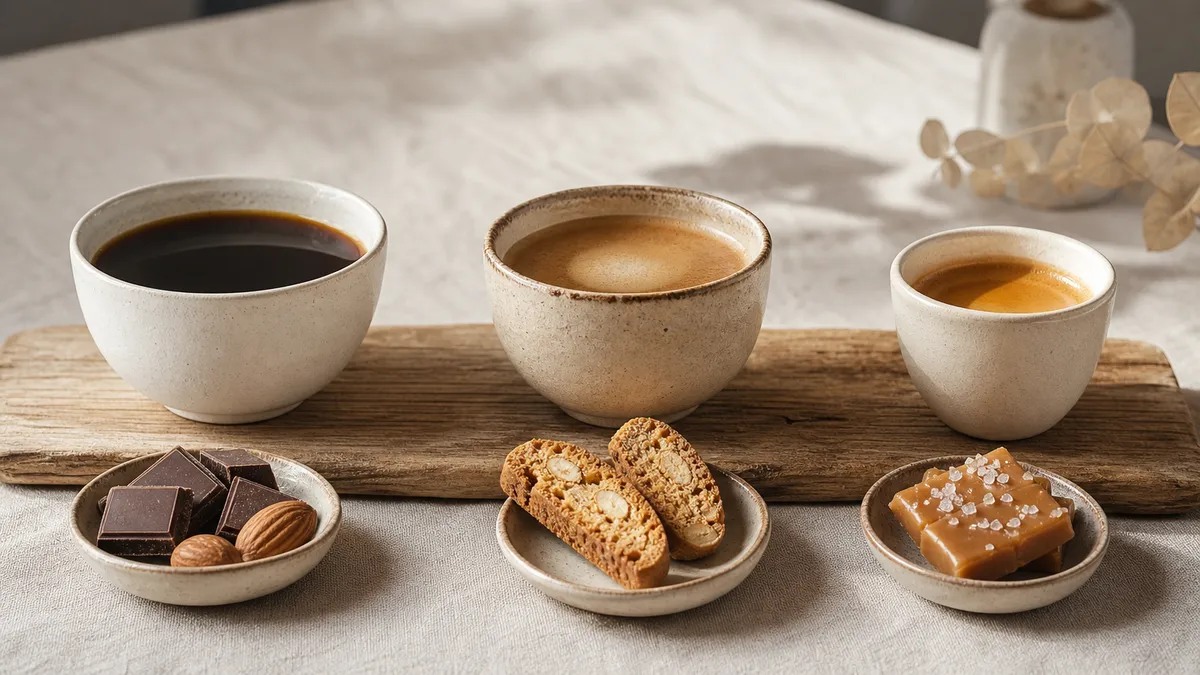
Pairing by roast and origin works best when you match the food to the flavours in the brewed coffee, rather than to the country name alone. Start by trying light roasts with fruit, medium roasts with nuts and toasted foods, and dark roasts with chocolate, then adjust for sweetness, acidity and intensity.
In short
- Read the tasting notes before choosing food: citrus, almond and cocoa suggest different starting points.
- Match intensity first. A delicate coffee deserves a food that leaves room for its flavour.
- Use origin as a clue, not a guarantee: regional descriptions cannot tell you exactly how an individual bag will taste.
- Compare the coffee before and after a bite. Keep the pairing if both still taste appealing.
- The combinations below are editorial tasting suggestions, not scientifically established rules.
Start with the cup, then read the label
Before choosing food, taste the coffee on its own. Look for its main flavour family, its balance of sweetness, acidity and bitterness, and its body, meaning how light or substantial it feels in the mouth.
You do not need to identify a particular orchard fruit or type of cocoa. “Bright and fruity”, “rounded and nutty” or “roasty and bittersweet” is enough to make a useful first choice. The World Coffee Research Sensory Lexicon provides a shared vocabulary for describing coffee, rather than a list of foods that must accompany it.
For this guide, use three selection criteria:
- Flavour connection: does the food echo something you can taste in the coffee?
- Intensity: can you still recognise both after tasting them together?
- Enjoyment: do you prefer the combination to either item alone?
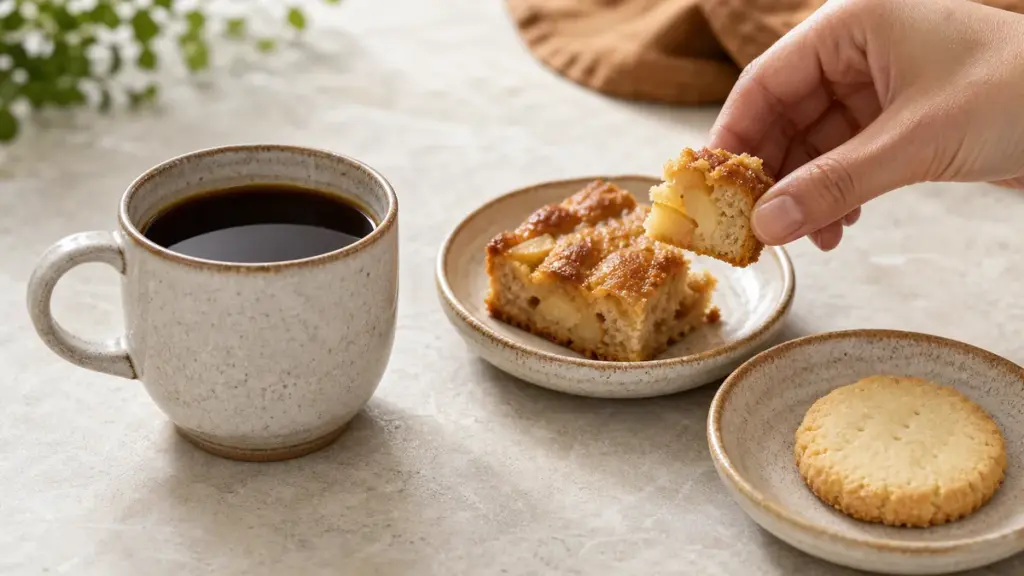
A shared flavour is a convenient starting point, not an obligation. A coffee with apple notes might suit apple cake, but plain shortbread is also worth testing if you would rather give the fruit character space.
For the broader principles behind matching and contrasting flavours, start with coffee and food pairings.
Pairing by roast: fruit, nuts and chocolate
Roast level is useful because it changes the sensory character of coffee. In a controlled sensory study published in 2024, the lighter roast was fruitier and more citrus-like, while the darker roast had stronger cocoa, roasted and bitter attributes.
That supports the broad direction of the suggestions here, but it does not prove that particular foods make successful partners. Taste the actual brew before treating any roast category as a menu.
Light roasts and fruit
For a light roast that tastes fruity or floral, begin with ripe fruit or a lightly sweetened fruit bake. Suggested trials include sliced pear, peach, strawberries, apple cake or a small piece of fruit tart.
Choose the fruit to suit the cup. If the coffee reminds you of berries, try strawberries or a modest spoonful of berry compote. If it is floral and delicate, start with pear or a plain sponge carrying a little fruit rather than a heavily flavoured filling.
Do not assume that the sharpest fruit makes the best partner for a bright coffee. Compare ripe fruit with a tart version and ask whether the combination feels refreshing or simply too sour for your taste.
My first choice would be fruit with restrained sweetness and no heavy icing. It makes the comparison easier: you can decide whether you like the coffee and fruit together before introducing cream, spice or a rich pastry.
Medium roasts and nuts
For a medium roast described as nutty, caramel-like or biscuit-like, try toasted almonds, a hazelnut biscuit, an oat biscuit or a small piece of walnut cake. Choose by the stated flavour profile rather than assuming that every medium roast tastes of nuts.
Begin with plain or lightly sweetened foods. If those work, move towards richer combinations such as almond pastry or nut cake. This gives you a clear progression instead of asking the coffee to compete with nuts, icing, chocolate and spice at once.
Medium-roasted coffee is also a useful place to test mixed-flavour foods. An apple and almond tart offers two possible connections: fruit and toasted nuts. Taste the filling and pastry separately before trying a complete bite.
For a closer look at laminated dough, fillings and toppings, see coffee and pastries.
Dark roasts and chocolate
For a dark roast with cocoa or bittersweet notes, begin with a small piece of chocolate, a chocolate biscuit or a modest portion of brownie. The aim is to explore a flavour connection, not to find the most intense chocolate available.
Try milk chocolate and dark chocolate separately. If the darker option leaves the whole mouthful too bitter or drying for your liking, choose the sweeter option, a less intense bake or a different coffee.
Avoid using chocolate to rescue a brew you already dislike. Taste the coffee alone first. If its dominant impression is unpleasantly burnt, the more useful change may be the coffee or preparation rather than the food.
These suggestions also work in reverse: choose the coffee for the food already on your plate. For a rich chocolate dessert, compare a cocoa-led coffee with a rounded, nutty one instead of assuming that darker must be better.
A practical roast and origin pairing table
The table uses flavour connection and comparable intensity as its criteria. Food choices are editorial starting points; the origin examples are clues to investigate on the bag, not promises about every coffee from that place.
| Coffee profile | Roast or origin clue | Food to try | What to assess |
|---|---|---|---|
| Delicate and floral | A light roast; Yirgacheffe is a possible lead | Ripe pear or plain fruit sponge | Can you still recognise the floral character? |
| Bright and fruity | A light roast with fruit notes | Strawberries or lightly sweetened apple cake | Does the combination feel pleasantly bright? |
| Floral, fruity and citrus-led | A coffee from Cauca with matching tasting notes | A small fruit tart | Is the filling too sharp or sweet for the cup? |
| Nutty and rounded | A medium roast with almond or hazelnut notes | Toasted nuts or a nut biscuit | Do both retain a clear flavour? |
| Chocolate and caramel | A Cerrado Mineiro coffee with those notes | Oat biscuit or a little caramel cake | Does the sweetness suit your preference? |
| Chocolate and nuts | A Mogiana coffee with those notes | Walnut cake or hazelnut biscuit | Does the food support rather than obscure the coffee? |
| Roasty and bittersweet | A darker roast with cocoa notes | Milk chocolate, dark chocolate or brownie | Which option gives the most enjoyable balance? |
For savoury alternatives, use the same tasting criteria rather than forcing a sweet pairing. The dedicated coffee and cheese guide explores that different set of textures and flavours.
Use origin tendencies without turning them into rules
Origin descriptions are most useful when they become questions to ask of a particular coffee. They are less useful when they become fixed national identities.
Ethiopia: look for the regional description
The Ethiopian Coffee and Tea Authority describes Yirgacheffe in floral terms and washed Sidamo as having fine acidity and good body. Those descriptions offer different starting points, even within one producing country.
For a Yirgacheffe coffee whose bag and brewed flavour support that floral description, try a restrained fruit pairing first. If a particular Ethiopian coffee tastes more cocoa-led than floral, follow the cup and choose accordingly.
Colombia: regional differences matter
Café de Colombia’s regional guide describes Cauca with floral and fruity flavours and high citrus acidity. Its description of Magdalena instead includes nutty aroma and dark-chocolate flavour.
That makes “Colombian coffee” too broad a pairing instruction. A fruit tart might be an interesting trial for the former profile, while a nut biscuit might be a better starting experiment for the latter. Neither choice should override the individual coffee’s tasting notes.
Brazil: distinguish the profile, not just the country
Brazilian exporter Exportadora de Café Guaxupé describes Cerrado Mineiro coffees with chocolate and caramel notes, and Mogiana coffees with chocolate and nuts. These are a supplier’s regional descriptions, not independent guarantees.
Use them to narrow a search, then check the individual lot. For pairing purposes, a clear description of the roasted coffee is more actionable than a country name on its own.
Keep processing information beside origin when comparing bags. If two coffees from the same region have different processing descriptions and very different tasting notes, do not assume they need the same food.
Run a simple side-by-side tasting
You do not need a formal cupping session. Use this small comparison to decide what works for your coffee and your preferences.
- Choose one coffee and two foods. Try one obvious flavour connection and one plainer alternative, such as fruit cake and plain shortbread.
- Use your normal successful brew recipe. Keep the preparation unchanged while comparing foods.
- Taste the coffee alone. Write a few words about flavour, bitterness, brightness and body.
- Take a small bite, then another sip. Notice what becomes more enjoyable and what becomes less clear.
- Drink some water before the second food. Repeat with a similarly small bite.
- Choose a winner, or reject both. “Neither” is a useful result, not a failed tasting.
For shared tastings, check ingredients and participants’ allergy requirements before serving. Keep ingredient information available and use separate serving utensils. The Food Standards Agency’s guidance for England, Wales and Northern Ireland recommends written allergen information supported by a conversation for non-prepacked food supplied by food businesses.
Refine the pairing through strength and extraction
Before rejecting a promising combination, distinguish roast level from brew strength. Strength is the concentration of dissolved coffee in the drink; extraction yield is the proportion of the dry coffee dissolved during brewing.
Controlled drip-coffee research by Frost and colleagues found that strength and extraction affected several sensory attributes, including bitterness, sourness, sweetness and thickness. A roast label therefore cannot fully describe the drink you serve with food.
For a useful comparison, hold the coffee preparation steady first. Once you have a preferred food, make a separate trial with the brew if needed. Changing food, grind setting and coffee dose together makes the result difficult to interpret.
Keep two kinds of notes: what you perceived and whether you liked it. The SCA Coffee Value Assessment separates descriptive assessment from preference-based assessment, a useful distinction to borrow at home. “More citrus-like after the bite” is an observation; “too sharp for me” is a preference. Both help you choose the next pairing.
FAQ
Should the coffee and food come from the same country?
No, shared origin is not a requirement for these pairings. Choose by the brewed flavour and the food’s intensity rather than trying to construct a geographically matched plate. A regional combination can be an enjoyable theme, but assess it with the same before-and-after tasting used for any other food.
How should I pair a blend with several origins?
Treat the blend as one finished coffee and start with its overall tasting notes. There is no need to find a separate food for every component. Taste it as you normally drink it, choose its clearest flavour family, then compare an obvious match with a simpler alternative.
Should I test the pairing with milk or sugar added?
Yes, if that is how you intend to drink the coffee. Use the same additions throughout the comparison so you are choosing food for the finished drink. If you also want to explore the black coffee, make that a separate tasting rather than changing the drink halfway through.
Where to go next
Use Coffee and Food Pairings for the wider framework behind pairing by roast and origin. Read Coffee and Pastries to refine choices involving dough, fruit and fillings, or Coffee and Cheese when you want to explore savoury combinations.
Sources
-
World Coffee Research, Sensory Lexicon, version 2.0, October 2017.
https://worldcoffeeresearch.org/resources/sensory-lexicon
Shared vocabulary for describing coffee flavour, aroma and texture. -
Specialty Coffee Association, Coffee Value Assessment, undated web overview, accessed November 2026.
https://sca.coffee/value-assessment
Distinction between descriptive sensory assessment and preference-based assessment. -
Liang, J. and colleagues, Scientific Reports, Sensory analysis of the flavor profile of full immersion hot, room temperature, and cold brewed coffee over time, 2024.
https://www.nature.com/articles/s41598-024-69867-6
Controlled experimental evidence on roast level and sensory attributes. -
Frost, S. C., Ristenpart, W. D. and Guinard, J.-X., Journal of Food Science, Effects of brew strength, brew yield, and roast on the sensory quality of drip brewed coffee, 2020.
https://pubmed.ncbi.nlm.nih.gov/32652586/
Controlled experimental evidence on strength, extraction and sensory character. -
Ethiopian Coffee and Tea Authority, Ethiopia: Taste of Origins, undated booklet, “Specialty Coffees” section.
Official regional descriptions of Yirgacheffe and Sidamo. -
Café de Colombia, Regiones cafeteras, undated web guide, accessed November 2026.
https://cafedecolombia.com/regiones-cafeteras/
Regional sensory descriptions, including Cauca and Magdalena. -
Exportadora de Café Guaxupé, Sustainability Report 2023, “Supply Chain” section, report year 2023.
https://www.guaxupe.com.br/storage/2024/09/Relatorio-de-sustentabilidade-2023-ingles-.pdf
Supplier descriptions of Cerrado Mineiro and Mogiana coffees. -
Food Standards Agency, Allergen Information for Non-Prepacked Foods Best Practice, 24 February 2025.
https://www.gov.uk/government/publications/allergen-information-for-non-prepacked-foods-best-practice/allergen-information-for-non-prepacked-foods-best-practice
Allergen communication guidance applying to England, Wales and Northern Ireland.
Research combined primary sensory studies, industry assessment resources, origin descriptions and official allergen guidance; food combinations are clearly identified as editorial suggestions rather than tested findings.
Last checked: November 2026