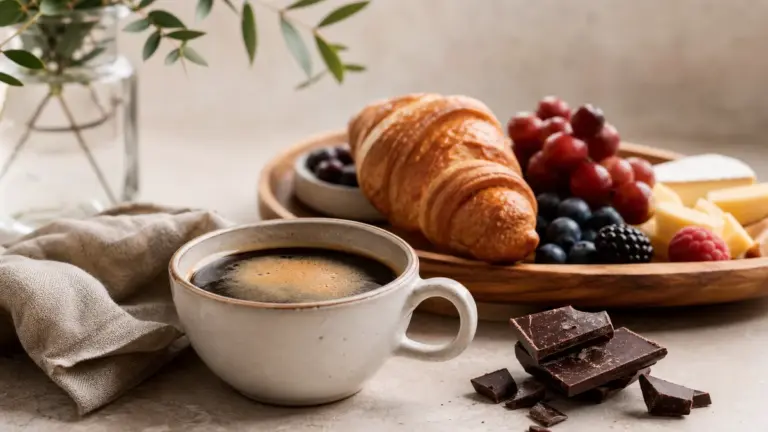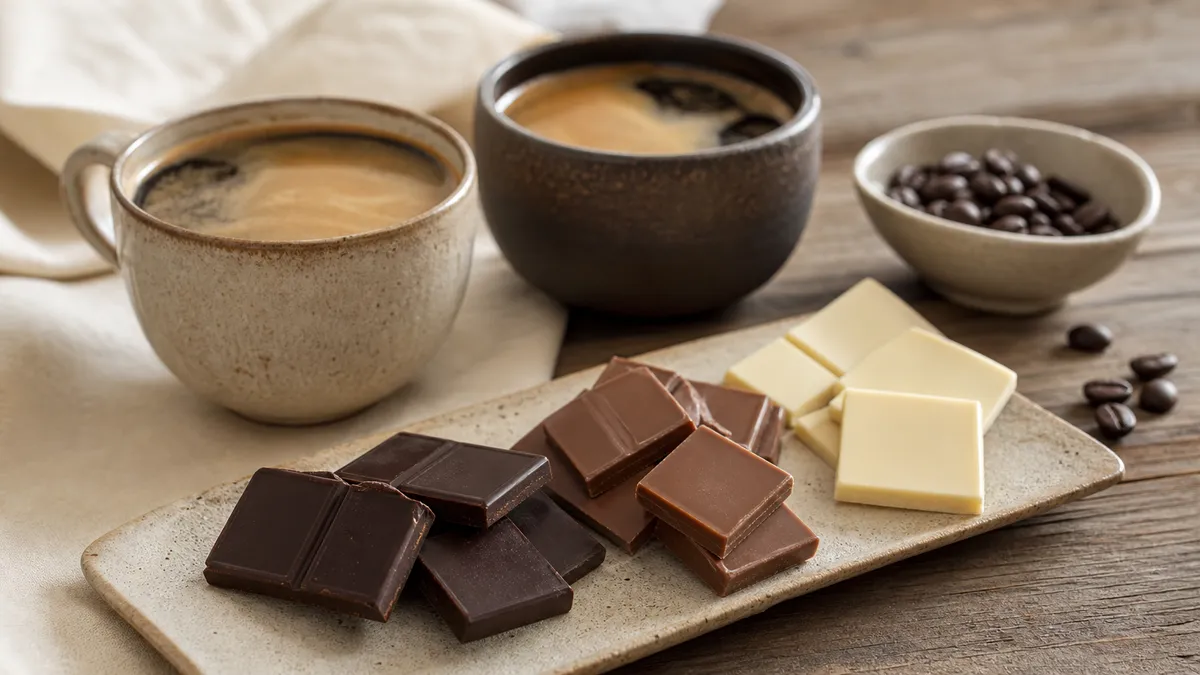
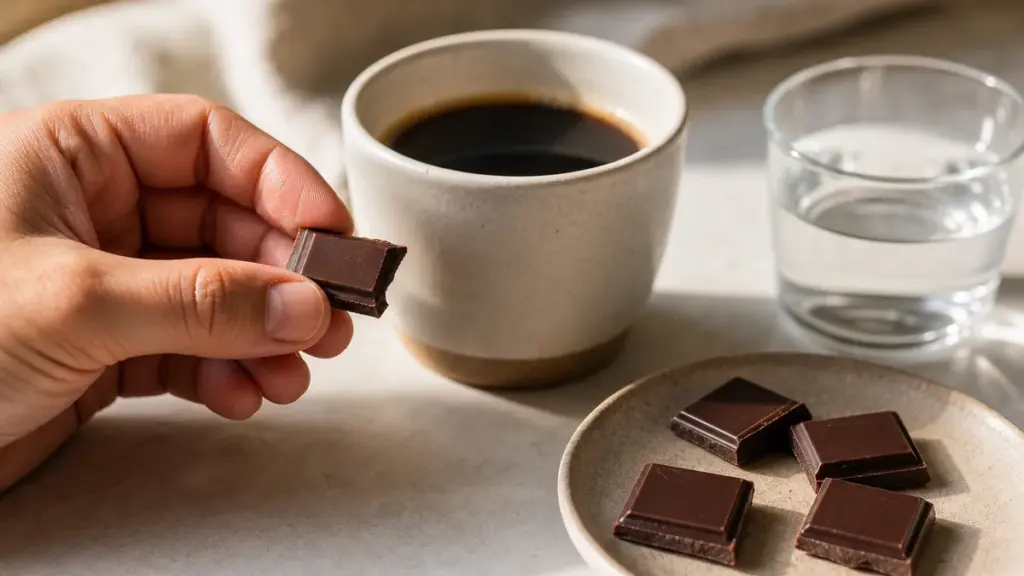
For coffee and chocolate pairings, start with a nutty, caramel-toned coffee beside milk chocolate, or a rounded black coffee beside dark chocolate around 65% to 75% cocoa. These are useful tasting starting points, not fixed rules: the best match lets you enjoy both flavours without either disappearing.
In short
- Treat cocoa percentage as a composition guide, not a flavour score: it includes cocoa butter as well as other cocoa ingredients.
- For a first comparison, choose plain milk chocolate, moderately dark chocolate and a higher-cocoa dark chocolate.
- Match the flavour descriptions before matching countries: nut with nut, fruit with fruit, or a deliberate contrast.
- Taste the coffee alone, then the chocolate alone, then combine them.
- Work from gentler flavours towards stronger ones, rinsing with plain water between pairings.
Best Chocolate-Coffee Pairings
Choose a pairing by considering sweetness, bitterness, flavour intensity and texture. A chocolate that tastes excellent alone is not automatically the best partner for your favourite coffee.
The suggestions below are editorial tasting recommendations, not scientifically established percentage bands or guarantees. Start with whichever description resembles the coffee you already enjoy.
| Chocolate to try | Coffee partner | Pairing approach | Who it suits |
|---|---|---|---|
| Plain milk chocolate, around 35% to 45% cocoa | Coffee with hazelnut, caramel or milk-chocolate notes | Match familiar, rounded flavours | Beginners wanting an approachable combination |
| Dark chocolate, around 55% to 65% cocoa | Balanced black coffee with caramel or dried-fruit notes | Keep some sweetness alongside cocoa character | Milk-chocolate drinkers exploring darker bars |
| Dark chocolate, around 65% to 75% cocoa | Rounded coffee with cocoa, nut or brown-sugar notes | Build a chocolate-led pairing without seeking maximum intensity | Black-coffee drinkers |
| Fruity dark chocolate, around 60% to 75% cocoa | Coffee described as berry-like or gently citrusy | Explore a shared fruit theme | Tasters who enjoy bright flavours |
| High-cocoa dark chocolate, around 80% to 90% cocoa | A full-flavoured coffee you find balanced rather than harsh | Compare intensity and the lingering finish | People who already enjoy high-cocoa chocolate |
For the simplest first attempt, choose plain milk chocolate and a coffee described as nutty or caramel-like. For a more exploratory pairing, compare the same coffee with a moderately dark bar before trying a substantially higher cocoa percentage.
Judge the combination by what happens after the sip. Can you still recognise the chocolate? Does the coffee remain enjoyable? A pairing need not create a spectacular new flavour to work; sometimes the pleasure is simply a clear, balanced finish.
The wider coffee and food pairings hub helps you apply this approach beyond chocolate.
What Cocoa Percentages Actually Tell You
The cocoa percentage describes how much of the chocolate comes from cocoa ingredients. These can include cocoa mass, cocoa butter and cocoa powder. Cocoa mass is the ground cocoa material used in chocolate making.
Consequently, a higher percentage does not tell you exactly how much intensely flavoured, non-fat cocoa material a bar contains. Some of that percentage is cocoa butter.
Nor does the remaining percentage necessarily equal sugar. Depending on the recipe, it can include milk ingredients, nuts, flavourings and other additions. Read the ingredient list and nutrition information rather than calculating sugar content by subtraction.
For pairing, use the percentage to organise a comparison, then let taste decide. Two bars carrying the same percentage can be different tasting experiences because the cocoa and the finished recipes differ.
A useful progression is:
- Milk chocolate first: establish the combination you find most comfortable.
- Moderately dark chocolate next: compare its sweetness, cocoa character and finish.
- Higher-cocoa chocolate last: decide whether the extra intensity improves the pairing for you.
Do not treat the final step as an achievement. If the milk chocolate makes the coffee more enjoyable, that is a successful result.
Why Coffee and Chocolate Can Work Together
Shared flavour descriptions
Coffee has a recognised vocabulary that includes chocolate, cocoa, hazelnut, almond, caramelised notes and fruit. These are sensory descriptions, not a list of ingredients added to the coffee.
Cocoa can also express fruit, floral, nut and caramel-like characteristics. This gives you useful themes to explore: a nutty coffee with nutty chocolate, for example, or a fruity coffee beside a fruit-forward dark bar.
Matching descriptions is a practical way to choose candidates. It does not prove that two foods will taste good together simply because their flavour words overlap.
Balance matters more than maximum intensity
A peer-reviewed consumer tasting study published in 2014 compared chocolate with coffee and tea. Its participants preferred combinations in which neither partner dominated; the tested pairings with 30% and 70% cocoa chocolate were preferred to those with 99%.
This was a controlled sensory study of particular products and consumers, not a universal ranking of chocolate percentages. Its useful lesson is to seek balance rather than assume that the darkest chocolate produces the best pairing.
The previous mouthful changes the next sip
A separate experimental sensory study, published in 2022, found that exposure to basic tastes changed how subsequent coffee attributes were perceived. The direction depended on the coffee, the preceding taste and the attribute being assessed.
That helps explain why tasting separately and tasting together are different exercises. A chocolate may leave your next sip seeming different, but there is no dependable rule that every sweet bar will improve every bitter coffee.
For the broader matching principles, see the complete pairing guide.
Milk Chocolate Deserves a Proper Place
Treat milk chocolate as a serious pairing option, not merely a preliminary step towards dark chocolate. If you enjoy its sweetness and texture, build the tasting around those qualities.
Our suggested starting point is a plain milk bar with a coffee described as caramel-like, nutty or chocolatey. Try the coffee black initially if that is comfortable for you, then repeat with your normal milk addition. You are comparing two different combinations, not testing which drinking habit is correct.
Keep the chocolate plain for the first comparison. A filled caramel, hazelnut praline or fruit centre introduces another flavour to judge, making it harder to identify what you liked about the chocolate itself.
Once you have a favourite plain pairing, try an inclusion deliberately. Compare hazelnut chocolate with your nutty coffee, for instance, while keeping the coffee preparation unchanged. Record whether you prefer the match rather than assuming an echoed flavour must be better.
How to Taste Coffee and Chocolate Together
Use this small home or workplace tasting rather than opening many bars at once. The quantities below are a suggested editorial protocol, not an official sensory standard.
Choose two coffees with contrasting flavour descriptions and three plain chocolates. Prepare enough of each coffee for several small sips, following your usual reliable brewing method.
- Prepare comparable portions. Break each chocolate into pieces of approximately 3 g. Keep the portions similar so that a much larger bite does not distort the comparison.
- Taste the coffees alone. Let them reach a comfortable drinking temperature. Write a few plain words for each: nutty, fruity, bitter, rounded or drying.
- Taste the gentlest chocolate alone. Smell it, place a piece on your tongue and let it soften. Notice sweetness, flavour and texture.
- Try the combination. With a little chocolate still in your mouth, take a small sip of coffee. Consider both the immediate flavour and the finish after swallowing.
- Reset and compare. Rinse with plain water, then try that chocolate with the second coffee. Continue towards the more intense chocolates.
- Repeat your favourites. Revisit the best combinations in a different order before choosing a winner.
A simple note is enough: “prefer together”, “prefer separately” or “one dominates”. Add the reason while it is fresh.
For a shared workplace tasting, retain the packaging so everyone can check ingredients and precautionary allergen statements. Do not assume that a vegan chocolate is suitable for someone with a milk allergy: the Food Standards Agency warns that vegan labelling does not rule out allergen cross-contamination.
Origin Pairings: Use Provenance as a Clue
Origin offers an interesting way into a tasting, but it should not replace the flavour description. World Coffee Research identifies growing conditions, processing, roasting and brewing among the influences on coffee flavour. The International Cocoa Organization likewise describes cocoa flavour as the result of interacting genetic, environmental and production factors.
There is therefore no need to insist that coffee and chocolate come from the same country.
Try a fruit-led pairing across origins
A concrete chocolate example is Valrhona’s Madagascar-origin Manjari 64%, which the manufacturer describes as having tangy red-berry notes. That is a producer’s description of a particular chocolate, not a claim about every Madagascan bar.
As an editorial experiment, pair a chocolate with that description with a coffee whose tasting notes also mention berries. An Ethiopian or Kenyan coffee could be a candidate if the particular bag carries the flavour description you want.
Then compare it with a rounded, cocoa-toned coffee. You may prefer the shared fruit theme, or find the contrasting coffee more comfortable.
Try a nut-led pairing without assuming a national style
If your Brazilian coffee is described as hazelnut and chocolate, use those words to select the bar. Look for a chocolate described as nutty or cocoa-led, whether its cocoa comes from Peru, Ecuador or elsewhere.
This is a flavour-led recommendation involving named origins, not a claim that all coffee or cocoa from those countries tastes alike.
For a more revealing comparison, keep the cocoa percentage similar across two chocolates from different origins. Then compare the same chocolate with different coffees. Changing one partner at a time makes your preference easier to interpret.
Adjust the Pairing Before Rejecting It
If one partner overwhelms the other, first repeat the tasting with equal chocolate portions and similar coffee servings. Avoid changing the coffee, chocolate and milk addition simultaneously.
When a combination seems too severe, our first suggested adjustment is a sweeter chocolate rather than an even more intense coffee. When the coffee disappears, try a smaller chocolate bite or a gentler bar.
If you dislike the coffee alone, choose another coffee before continuing. Pairing is an exploration of foods you enjoy, not a dependable way to repair an unpleasant drink.
Finally, distinguish a clear match from an interesting contrast. One combination may feel seamless; another may make the differences more obvious. Either can be your preferred coffee and chocolate pairing.
FAQ
Should I put the chocolate directly into the coffee?
Not for this tasting method: keep the chocolate separate so you can compare each component and the combination. Melting chocolate into coffee creates a different preparation, with the chocolate becoming part of the drink. That may be enjoyable, but it no longer answers the same pairing question.
Can I use decaffeinated coffee?
Yes, use decaffeinated coffee if that is what you prefer drinking. Apply the same practical comparison: taste it alone, identify the flavour description that seems most useful, then try contrasting chocolates. There is no reason to make a pairing exercise depend on choosing a caffeinated drink.
Do I need single-origin chocolate?
No, single-origin chocolate is optional. It is useful when you want to explore provenance, but the first task is finding a chocolate you enjoy with your coffee. Begin with a plain bar and a clear ingredient list; investigate origins once you have identified the flavours and textures you prefer.
Where to go next
Visit Coffee and Food Pairings to explore other combinations, then read Coffee and Food Pairings: The Complete Guide for the wider matching method. Coffee and Pastries takes the next step into baked accompaniments, while Coffee and Cheese offers a contrasting savoury tasting.
Sources
-
World Coffee Research, Sensory Lexicon: Unabridged Definitions and References, version 2.0, second edition, 2017. Sensory vocabulary and influences on coffee flavour.
https://worldcoffeeresearch.org/download/bf904452-fc8c-488f-b591-c0b20d9bcab2 -
Lindt USA, Cocoa: Cocoa Content in Lindt Chocolates, updated October 2026. Definition of cocoa percentage.
https://lindtusa.zendesk.com/hc/en-us/articles/19229290847900-Cocoa-Cocoa-Content-in-Lindt-Chocolates -
Donadini, G. and Fumi, M. D., An investigation on the appropriateness of chocolate to match tea and coffee, Food Research International, volume 63, pages 464 to 476, 2014. University repository abstract.
https://publicatt.unicatt.it/handle/10807/59602 -
Rune, C. J. B. and colleagues, Pairing coffee with basic tastes and real foods changes perceived sensory characteristics and consumer liking, International Journal of Gastronomy and Food Science, volume 30, article 100591, 2022.
https://researchprofiles.ku.dk/en/publications/pairing-coffee-with-basic-tastes-and-real-foods-changes-perceived/ -
International Cocoa Organization, Fine Flavor Cocoa, undated webpage, checked November 2026. Cocoa flavour characteristics and interacting production influences.
https://www.icco.org/fine-or-flavor-cocoa/ -
Valrhona, Single Origin dark chocolate Manjari 64%, undated product page, checked November 2026. Manufacturer’s origin and tasting description.
https://www.valrhona.com/en/our-products/for-professionals/chocolate-co/couverture-chocolates/single-origin/dark-chocolate-manjari-64 -
Valrhona Collection, How to taste chocolate? Tips and tricks, undated page, checked November 2026. Manufacturer’s tasting method and order.
https://valrhona-collection.us/blogs/news/how-to-taste-chocolate-tips-and-tricks -
Food Standards Agency, Vegan food and allergens, undated PDF, checked November 2026. Allergen cross-contamination and vegan labelling guidance.
Research combined sensory reference material, peer-reviewed study abstracts, manufacturer information and official allergen guidance; the pairing suggestions are editorial recommendations, not reported first-hand tests.
Last checked: November 2026