Turkish coffee is made by gently heating powder-fine coffee with water and, if wanted, sugar in a small pot called a cezve, then serving it unfiltered. For this recipe, start with 7 g coffee and 70 g water, lift the pot before the coffee boils, and let the grounds settle before sipping.
In short
- Choose the sweetness before brewing: sugar normally goes into the pot, not the finished cup.
- The four useful terms are sade, az şekerli, orta şekerli and çok şekerli.
- Stir before heating, then leave the mixture undisturbed.
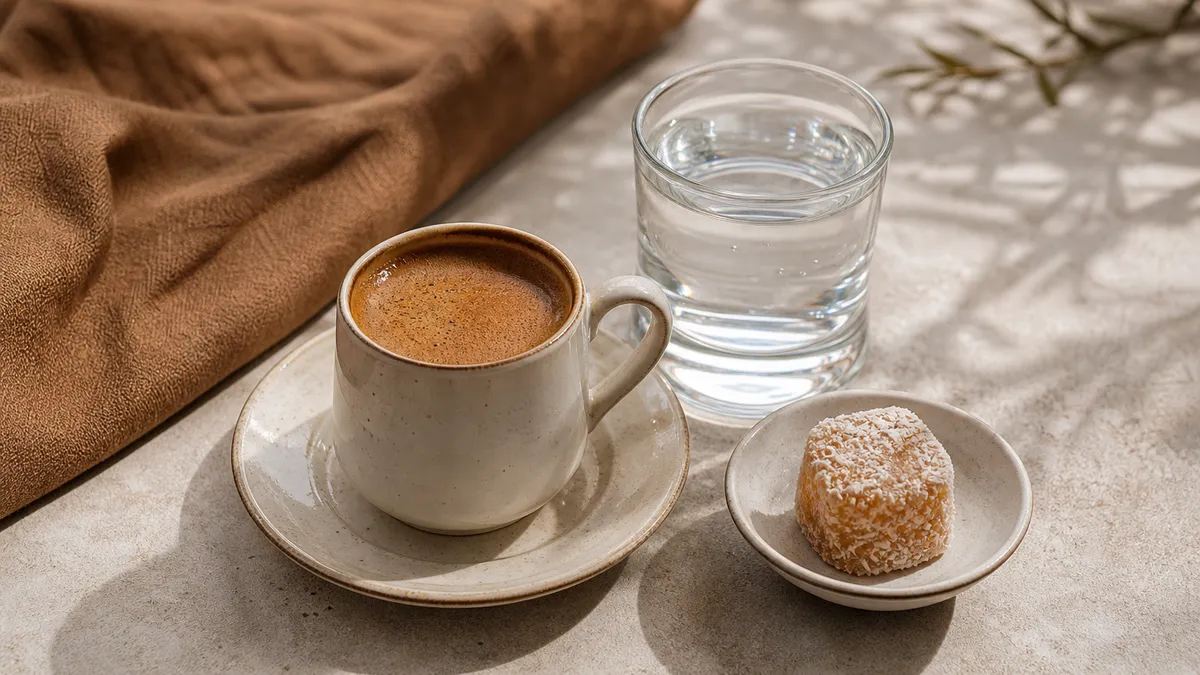
- Serve with a small glass of water and lokum, or another sweet.
- Leave the sediment in the cup. Reading its patterns is a cultural tradition, not a prediction you need to believe.
Turkish coffee recipe card
This is a straightforward, single-rise version: the coffee rises once and is poured without reheating. Traditional guidance also describes repeated rises; neither approach requires a rolling boil. This page concentrates on the recipe and serving tradition rather than pot materials, grinders or heating physics.
Serves: 1
Preparation: about 1 minute
Heating: approximately 2 to 3 minutes
Settling: 2 to 3 minutes
Total: approximately 5 to 7 minutes. These are planning estimates; watch the rising coffee rather than relying on a timer.
Ingredients
- 7 g Turkish-ground coffee, ground to a fine powder.
- 70 ml drinking water, approximately 70 g. Weighing 70 g gives a coffee-to-water ratio of 1:10 by weight.
- 0 g, 2 g, 4 g or 6 g sugar, according to the table below.
- A small glass of drinking water and a piece of lokum, Turkish delight, to serve.
Equipment
A small cezve, a compatible hob, scales, a spoon and a small coffee cup with a saucer. Choose a pot suited to one serving, with room above the mixture for the foam to rise.
Method
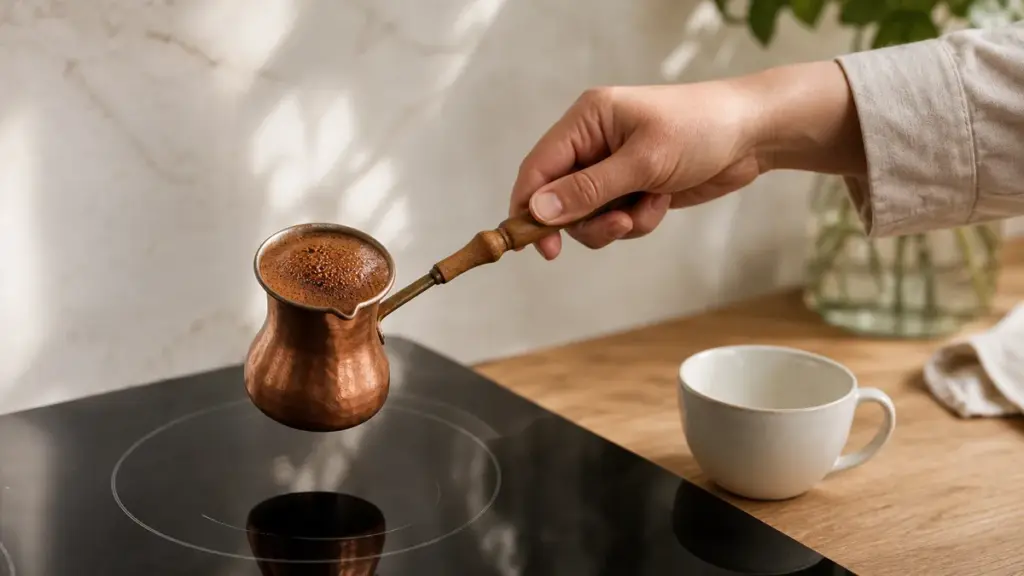
- Combine off the heat. Put the coffee, water and chosen sugar into the cezve. Use room-temperature water; stir thoroughly to wet the powder and break up clumps.
- Heat gently. Place over low heat and stay beside the pot. Do not keep stirring as it heats.
- Watch the surface. A layer of foam should develop and begin rising towards the rim. Aim for approximately 2 to 3 minutes of heating, adjusting the heat rather than forcing the timing.
- Lift before boiling. Remove the cezve as the foam rises, before the mixture boils or spills over. This recipe does not return it to the heat.
- Pour carefully. Pour slowly into the cup, keeping the spout close to its rim to avoid unnecessarily disturbing the foam.
- Let it settle. Wait 2 to 3 minutes before drinking. Sip gently and stop when you reach the thick sediment.
Approximate caffeine: as an illustrative estimate, around 140 to 180 mg for 70 ml of brewed liquid. This is calculated from a laboratory study measuring approximately 1,955 to 2,551 mg per litre in Turkish coffee brewed at 1:10, multiplied by 0.070 litre and rounded. Its hotter starting water and repeated heating differ from this recipe, so this is not a measured result or a guaranteed range for your cup.
Caffeine sensitivity varies. In pregnancy, the NHS advises no more than 200 mg daily from all sources; do not use an approximate recipe estimate to judge a precise remaining allowance. Ask your midwife, GP or pharmacist for personal advice.
Choose your sweetness before brewing
Sade means unsweetened, not merely coffee without milk. Az şekerli means lightly sweetened, orta şekerli, often shortened to orta, means medium-sweet, and çok şekerli means very sweet. You will also encounter şekerli, meaning sweetened.
Keep the coffee and water unchanged for each version:
| Sweetness | Meaning | Coffee and water | Sugar for this recipe |
|---|---|---|---|
| Sade | Unsweetened | 7 g coffee, 70 g water | 0 g |
| Az şekerli | Lightly sweetened | 7 g coffee, 70 g water | 2 g |
| Orta şekerli, or orta | Medium-sweet | 7 g coffee, 70 g water | 4 g |
| Çok şekerli, or şekerli when ordering sweet | Very sweet | 7 g coffee, 70 g water | 6 g |
These are repeatable recipe choices, not fixed national definitions. The Turkish Coffee Culture and Research Association gives broader guidance of 2 to 3 g, 3 to 4.5 g and 4 to 6 g for the three sweetened levels, while the culture ministry describes them using spoon measures. Ask guests before starting and prepare different sweetness levels separately.
Sugar is normally added during preparation. Stirring it into the finished cup disturbs the settled grounds, which is another reason to decide first.
Keep the foam, leave the grounds
The aim is a surface of fine foam, not a vigorously bubbling pot. Use powder-fine coffee, allow space for the rise and pour gently. More heating cycles are not a compulsory test of authenticity: the association describes repeated rises, while Specialty Turkish Coffee’s contemporary method removes the pot before boiling and pours directly.
| Symptom | Likely cause | What to change |
|---|---|---|
| Coffee suddenly overflows | Heat is too fierce or there is insufficient headroom | Reduce the heat and use a suitably sized cezve |
| Foam is lost during serving | Rough pouring or boiling has disturbed it | Lift earlier and pour slowly |
| Every sip feels gritty | Grounds are still suspended | Allow settling time and avoid stirring the cup |
| Sweetness differs between guests’ cups | Different preferences were brewed together | Make separate batches by sweetness |
These are practical troubleshooting judgements based on the preparation guidance, not results from comparative testing.
Serve with water, sweets and time
Place the coffee on a saucer with a small glass of water and a piece of lokum. GoTürkiye describes taking water before the coffee to prepare the palate; the culture ministry also lists chocolate and other sweets as accompaniments. Offer them alongside rather than making the cup itself sweeter by default.
Let the drink settle while you arrange the tray. The grounds remain in the cup, but drinking them is not part of the method. There is no need to chase the final mouthful.
Cardamom and mastic variations
Plain coffee is the baseline here, but cardamom and mastic are recognised aromatic variations. Mastic coffee is called damla sakızlı. For a simple variation without adding another measurement to the recipe, use a coffee already blended with either flavour and retain the same coffee-to-water ratio as your starting point.
The tradition behind the cup
UNESCO inscribed Turkish coffee culture and tradition on its Representative List of the Intangible Cultural Heritage of Humanity in 2013. The recognition concerns preparation, hospitality, conversation and the transmission of knowledge, not a single compulsory recipe.
Reading the remaining grounds, often called tasseography, is part of that social tradition. Patterns in the cup and saucer become prompts for stories about journeys, luck or news. Treat it as a shared pastime, not an evidence-based way of knowing the future.
FAQ
Can I make several cups together?
Yes, provided the cezve is appropriately sized and everyone wants the same sweetness. Multiply the ingredients by the number of servings and leave room for the coffee to rise. Larger batches may heat differently, so keep watching the surface rather than multiplying the cooking time. Share the foam between the cups before finishing the pours.
Do I need a sand heater?
No, a suitable hob is sufficient for this recipe. Sand, coals and ashes are documented ways of heating Turkish coffee, but they are not essential equipment for making it at home. Concentrate on gentle, controllable heat and lifting the cezve before the mixture boils over.
Must Turkish coffee contain spices?
No, neither cardamom nor mastic is required. The basic preparation uses finely ground coffee and water, with sugar according to preference. Aromatic versions are variations rather than ingredients missing from the plain recipe. Start without them if you want to establish how your chosen coffee tastes before changing anything else.
Where to go next
Use Coffee Recipes to choose your next drink after Turkish coffee. For contrasting preparations, read Indian Filter Coffee for another traditional hot coffee, or Vietnamese Egg Coffee for a richer recipe with a separate topping.
Sources
-
UNESCO, Turkish coffee culture and tradition, inscription 2013.
https://ich.unesco.org/en/RL/-00645 -
Republic of Türkiye Ministry of Culture and Tourism, Turkish Coffee, undated.
https://www.ktb.gov.tr/EN-98850/turkish-coffee.html -
Turkish Coffee Culture and Research Association, 7 Steps to Perfect Coffee, undated.
https://www.turkkahvesidernegi.org/en/index.php?gastronomi=menuactive&icerik=7-adimda-mukemmel-turk-kahvesi-kilavuzu -
Specialty Turkish Coffee, STC: Preparation, guide by Turgay Yıldızlı, undated.
https://www.specialtyturkishcoffee.com/how-to-make/stc-preparation/ -
GoTürkiye, Turkish Coffee, cultural and preparation leaflet, undated.
https://cdn.goturkiye.com/musavirlik/be/turkkahvesi.pdf -
GoTürkiye, Turkish Coffee Varieties Guide, undated.
https://goturkiye.com/gastronomy/blog/just-for-the-coffee-gourmets-out-there-types-of-turkish-coffees -
Santanatoglia and colleagues, University of Camerino and Research and Innovation Coffee Hub, Effect of Brewing Methods on Acrylamide Content and Antioxidant Activity: Studying Eight Different Filter Coffee Preparations, 2023.
https://pmc.ncbi.nlm.nih.gov/articles/PMC10604660/ -
NHS, Foods to avoid in pregnancy, current online guidance.
https://www.nhs.uk/pregnancy/keeping-well/foods-to-avoid/ -
EFSA, Caffeine, current topic page summarising its 2015 scientific opinion.
https://www.efsa.europa.eu/en/topics/topic/caffeine -
Istanbul Convention & Visitors Bureau, Visitor Guide 2022, 2022.
https://www.icvb.org.tr/wp-content/uploads/2020/07/Visitor-Guide-2022.pdf
This recipe was researched using cultural institutions, published brewing guidance and laboratory caffeine measurements; it does not claim first-hand testing.
Last checked: November 2026