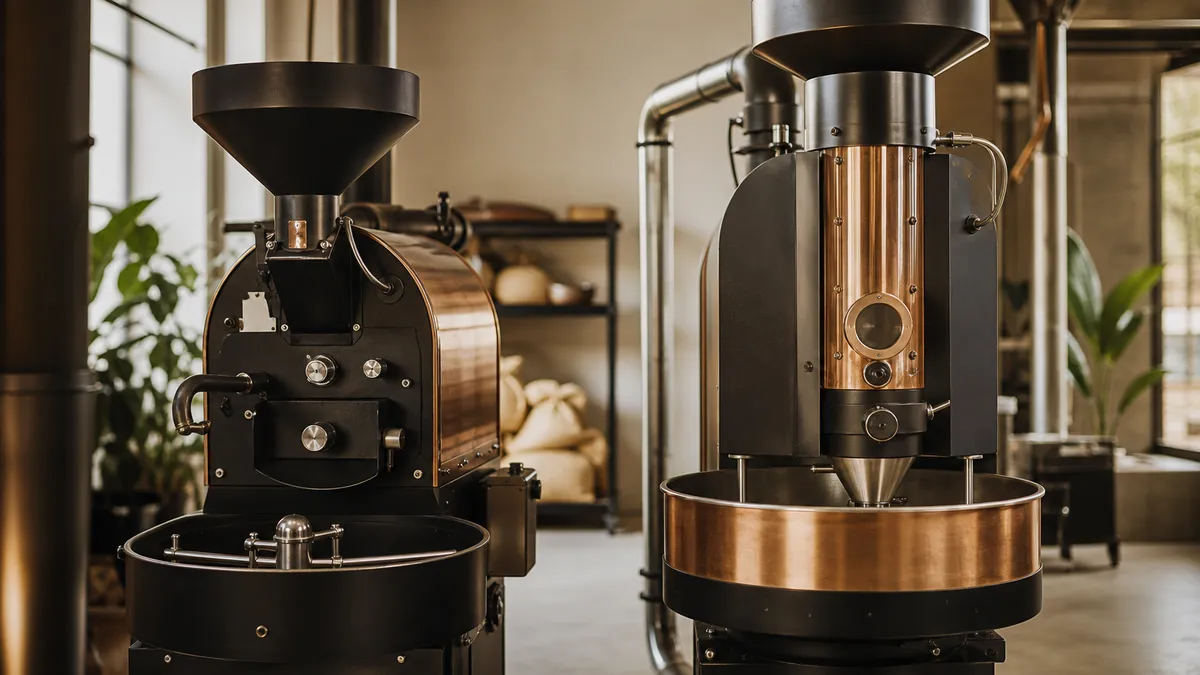
Coffee roasting equipment falls into two broad families: machines that mix beans mechanically, usually in a drum, and machines that use moving hot air to lift and circulate them. The useful distinction is not simply gas versus electricity, but how the machine transfers heat, moves the beans, handles smoke and cools the finished batch.
In short
- Drum construction and heat source are separate choices: an electrically heated machine can still be a drum roaster.
- “Direct flame” is ambiguous. Ask whether the flame heats the drum, contacts the beans or supplies hot combustion gases.
- Fluid bed roasters use airflow for both heating and bean movement; not every hot-air roaster is a fluid bed.
- Compare the permitted green-coffee batch range, not just maximum capacity or a headline hourly output.
- A chaff collector and an afterburner do different jobs. Removing loose skins does not remove all smoke or gaseous emissions.
Drum Roasters
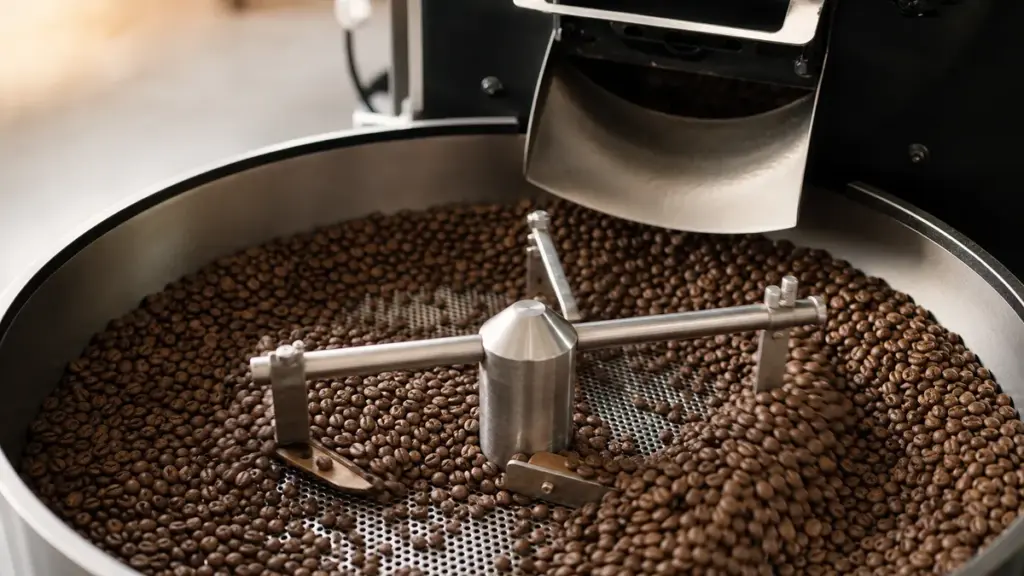
A conventional drum roaster tumbles coffee inside a rotating horizontal cylinder. Internal blades lift and redistribute the beans while hot air passes through the roasting chamber. The drum provides mechanical mixing, but its shape alone does not tell you which heat-transfer mechanism dominates.
Three mechanisms matter:
- Conduction: heat passes through direct contact, including contact between beans and hot metal.
- Convection: moving hot air transfers heat to the beans.
- Radiation: hot surfaces or radiant heaters transfer energy without needing direct contact.
Their relative contributions depend on the machine. PROBAT, for example, describes its G Series drum roasters as transferring heat primarily through convection. Treat claims that all drum roasting is mainly conductive with caution.
For a beginner, the practical questions are straightforward: how are heat and airflow controlled, how are beans discharged, and how are they cooled? For the wider process, start with coffee roasting; this article concentrates on the machinery rather than roast development.
Comparing roasting equipment
The criteria below are bean movement, heat delivery and the main operating consideration. Categories overlap, so this is a map of designs rather than a ranking.
| Equipment | Bean movement | Heat delivery | Who it suits and what to check |
|---|---|---|---|
| Directly heated drum | Rotating drum and internal blades | Heated metal plus hot airflow | Operators wanting drum-based control; check wall heating and airflow separately |
| Indirectly heated drum | Rotating drum or mechanical paddles | Predominantly externally heated air | Operators seeking convection-led roasting; inspect the actual air path |
| Fluid bed air roaster | Air lifts and circulates beans | Predominantly convection | Sample, home or production users, depending on model; airflow must maintain movement |
| Hot air gun arrangement | Usually manual or separate mechanical agitation | Directed hot airflow, with some vessel heating | Experienced experimenters; mixing, containment and safety need particular attention |
Direct Flame Drum Roasters
In equipment discussions, “direct flame” often describes a burner positioned beneath the drum, heating its exterior directly. The beans inside receive heat from the drum and from the air moving through the chamber. It does not necessarily mean that naked flame touches the coffee.
Terminology is inconsistent. The US Environmental Protection Agency’s coffee-roasting document uses “direct-fired” specifically for equipment in which flame contacts the beans, whereas equipment explanations also use direct heating to mean a flame-heated drum. Ask for a diagram rather than relying on the label.
For a directly heated drum, establish what the operator can adjust: burner output, airflow and, where fitted, drum speed. Also ask how the machine behaves between consecutive batches. A demonstration should show the intended working batch, not merely an empty machine reaching temperature.
Do not confuse a flame beneath a solid drum with an exposed flame roasting beans through a perforated chamber. They are different arrangements, even if a seller uses similar language.
Indirect Flame Drum Roasters
An indirectly heated drum receives hot air from a heater or combustion chamber positioned away from the drum, rather than having a burner directly heating its underside. Convection therefore becomes central to heat delivery.
However, indirectly heated does not automatically mean combustion-gas-free. In the EPA’s terminology, an indirect-fired roaster prevents flame contact with the beans but can still expose them to combustion gases. If separation matters, ask whether a heat exchanger keeps the burner exhaust apart from the process air.
This distinction is more useful than choosing between reassuring-sounding labels. Request the route taken by incoming air, roasting exhaust and any recirculated air.
Nor must the drum itself rotate. Loring describes a fixed drum with rotating paddles, showing why chamber shape, mixing method and heating method should be considered separately. It is mechanically agitated equipment, not a fluid bed simply because hot air performs the heating.
Air Roasters
“Air roaster” is a broad description for equipment in which hot airflow does much of the heating. Some designs also use that airflow to move the beans; others retain mechanical mixing.
Electricity is not a separate roasting family. Giesen’s W15E, for example, combines electric infrared panels that heat the drum with a separate hot-air heater. An electric machine can therefore combine conductive and convective heat delivery rather than working like a fluid bed.
The useful buying question is: what does each control actually change? A heater control changes energy input; a fan control changes airflow, which may also affect mixing. Ask the supplier to explain these interactions on the particular machine.
Temperature displays deserve the same scrutiny. Inlet-air temperature, exhaust-air temperature and a probe within the bean mass describe different things. Do not transfer a displayed temperature from another roaster without knowing what each sensor measures.
The equipment supplies and controls heat; the flavour-forming reactions are covered separately in Maillard reaction and caramelisation.
Fluid Bed Air Roasters
A fluid bed roaster uses an upward stream of air to lift and mix the coffee. The moving beans behave collectively like a fluid, rather than being turned by a rotating drum.
Airflow has two linked responsibilities: delivering heat and maintaining circulation. The Coffee Crafters Artisan 3-e manual warns against allowing bean movement to stop while its heating elements are operating. A powerful heater is not useful if the loaded machine cannot keep its beans moving.
Check the manufacturer’s permitted batch range and observe circulation at the intended load. Do not assume that filling the chamber further is a harmless way to increase output.
These machines span different purposes. IKAWA publishes a claimed working range of 40 to 60 g for its Pro50 and 50 to 120 g for its Pro100. Coffee Crafters also manufactures commercial fluid bed equipment, so the category is not confined to small sample roasters.
For cooling, ask whether the beans remain in the roasting chamber or discharge into a separate cooler. The answer is model-specific, not something the term “air roaster” settles.
Hot Air Gun Roasters
A hot air gun can supply heat to beans held in a metal vessel or purpose-built experimental chamber. Bean movement must come from somewhere else, such as stirring or a separate mechanical agitator. An ordinary bowl receiving hot air is not automatically a fluid bed.
This is an experimental equipment arrangement, not a standardised appliance class. There is no universal batch capacity, nozzle distance or operating temperature that can safely be applied to every combination of gun and vessel.
A documented example is Larry Cotton’s wobble-disk design, hosted by Sweet Maria’s. It uses a heat gun with mechanical agitation and includes warnings about hot surfaces, ignition hazards, unobstructed airflow and constant supervision.
For a first machine, my preference is purpose-built coffee equipment with a clear operating manual. That is an editorial judgement based on having documented loading, cooling and safety procedures, not a claim that improvised equipment cannot roast coffee.
Keep the operating method separate from the equipment choice: how to roast coffee at home covers the practical sequence.
Capacity: batch size is not daily output
Compare green-coffee input per batch, the permitted working range and the manufacturer’s stated basis for hourly throughput.
PROBAT’s UG brochure lists claimed batch ranges of 7 to 15 kg for the UG15 and 8 to 25 kg for the UG22. It also states that performance depends on factors including roast colour, roasting time and green-coffee properties. These figures illustrate why a model name is not a complete capacity specification.
For planning, use:
Roasted output per session = green input per batch × completed batches × measured roasted yield
Define roasted yield as the discharged roasted mass divided by the green input mass. Measure it for the coffee and roast you intend to produce rather than borrowing a universal percentage.
Include warm-up, loading, discharge, cooling, cleaning and interruptions in the session. Ask whether cooling can run alongside the next roast, and request a demonstration over consecutive batches. A single successful roast does not establish sustained throughput.
Emissions and afterburners
Roasting exhaust contains more than an attractive smell. The EPA identifies particulate matter, volatile organic compounds, organic acids and combustion products among coffee-processing emissions. Roasting and cooling both need consideration.
A cyclone separates entrained particles, including chaff, the loose skin released during roasting. It is not equivalent to a gaseous-emissions treatment system.
An afterburner, or thermal oxidiser, treats suitable exhaust gases through high-temperature oxidation. Its design must account for temperature, residence time and mixing. Catalytic systems use a catalyst to support oxidation at lower temperatures, but their suitability depends on the exhaust stream.
Some roasters integrate treatment. Loring states that its single burner supplies roasting heat and incinerates smoke from the roast chamber. That is a manufacturer’s description, not independent proof of zero emissions across every outlet.
For a UK installation, discuss extraction, discharge location, cooling exhaust and any approval requirements with the supplier, a competent ventilation specialist and the relevant local authority before ordering. Request performance evidence for the proposed installation, not just the word “smokeless”.
Equipment assessment checklist
- Define the job: sample evaluation, home learning or repeat production.
- Confirm the working load: minimum and maximum green-coffee mass, plus evidence at your intended batch.
- Trace heat and air: identify heaters, combustion-gas routes, recirculation and exhaust treatment.
- Inspect controls and safety: sensor locations, airflow monitoring, alarms and the documented response to power failure.
- Check discharge and cooling: include the cooling exhaust, not only the roast chamber.
- Inspect maintenance access: chaff collectors, fans and ductwork must be accessible for the prescribed cleaning.
- Get the complete specification in writing: request itemised written quotations covering the roaster, extraction, treatment equipment, installation, commissioning and training.
Choose roasting equipment around the whole operating system, not the appearance of the drum or the sophistication of its screen.
FAQ
Can you copy a roast from one machine to another?
Not simply by reproducing the same displayed temperature curve. Machines differ in heat delivery, airflow, mixing and sensor position, so apparently matching readings may describe different conditions. Use the original roast as a reference, establish what the new machine measures, and evaluate the resulting coffee rather than treating the graph as a transferable recipe.
Does an electric roaster produce no smoke?
No. Electric heating removes the need for a gas burner, but coffee still releases roasting emissions. Extraction and treatment requirements depend on the appliance, loading, use and installation. Follow its instructions and assess the actual exhaust arrangements rather than assuming that an electric supply makes indoor roasting automatically suitable.
Is hearing first crack enough to judge a roaster?
No. Ask to assess the audible cues during a real demonstration, but also inspect controls, temperature measurements, bean movement and discharge. Sound is one part of operating feedback, not a substitute for documented procedures. Our guide to first and second crack explains the roasting events themselves.
Where to go next
Read Coffee Roasting for the wider process, then How to Roast Coffee at Home if you are choosing equipment for personal use. First Crack and Second Crack explains the audible milestones, while Roast Cooling, Degassing and Freshness covers what happens after the beans leave the roasting chamber.
Sources
Manufacturer statements below describe claimed construction, capacities and functions, not independently tested performance.
-
US Environmental Protection Agency, AP-42, Fifth Edition, Volume I, Section 9.13.2: Coffee Roasting, September 1995.
https://www.epa.gov/sites/default/files/2020-10/documents/c9s13-2.pdf -
Cropster Firescope, Sungbin Cho, Structure of a Roasting Machine, 19 July 2023.
https://eng.firescope.cropster.com/posts/structure-of-a-roasting-machine-to-understand-the-principle-of-heat-supply -
PROBAT, G Series: Drum Roaster, undated manufacturer webpage, retrieved November 2026.
https://www.probat.com/products/machines/roasting/g-series/ -
PROBAT, UG equipment brochure, 2022 file edition.
-
Giesen, Marc ten Haaken, The power of conduction and convection in coffee roasting, 16 July 2024.
https://giesen.store/blogs/news/the-power-of-conduction-and-onvection-in-coffee-roasting -
Loring Smart Roast, Technology, undated manufacturer webpage, retrieved November 2026.
https://loring.com/technology/ -
IKAWA, IKAWA For Professionals: FAQs, undated manufacturer webpage, retrieved November 2026.
https://www.ikawacoffee.com/professional-faq/ -
IKAWA, Rob Hoos, Rob Hoos’ 2023 IKAWA Roast Profile, 15 September 2023.
https://www.ikawacoffee.com/blog/new-rob-hoos-blog/ -
Coffee Crafters, Artisan 3-e Fluid Bed Coffee Roaster Manual, revision 7, copyright 2018.
https://coffeecrafters.com/wp-content/uploads/3e-manuel-REV-7-final-PDF.pdf -
Larry Cotton, hosted by Sweet Maria’s, Build a Pizza Pan, Red Tube, Wobble-Disk Coffee Roaster, undated document in September 2024 upload.
https://library.sweetmarias.com/wp-content/uploads/2024/09/Wobble-Disc-Coffee-Roaster-3-red-tubes-model-build-instructions.pdf -
Environment Protection Authority Victoria, Thermal oxidising to control odour, updated 18 December 2024.
https://www.epa.vic.gov.au/thermal-oxidising-control-odour
This article was researched through retrieved manufacturer documentation, equipment explanations and environmental-agency guidance; no first-hand equipment testing is claimed.
Last checked: November 2026