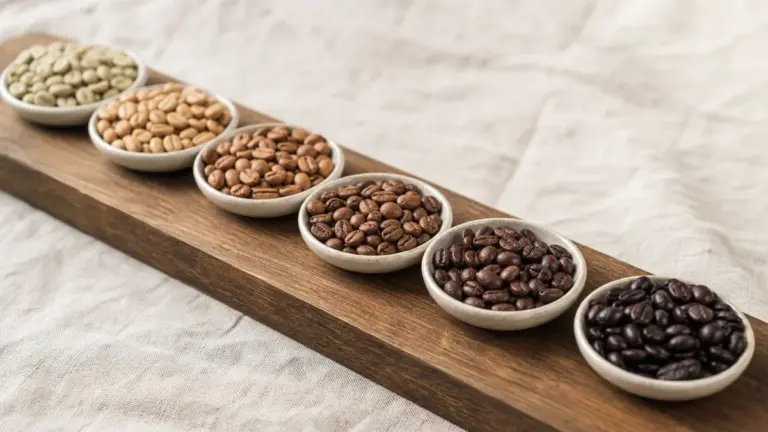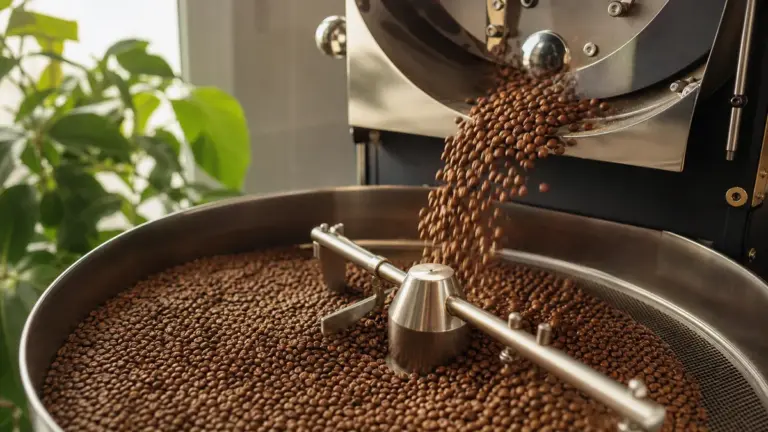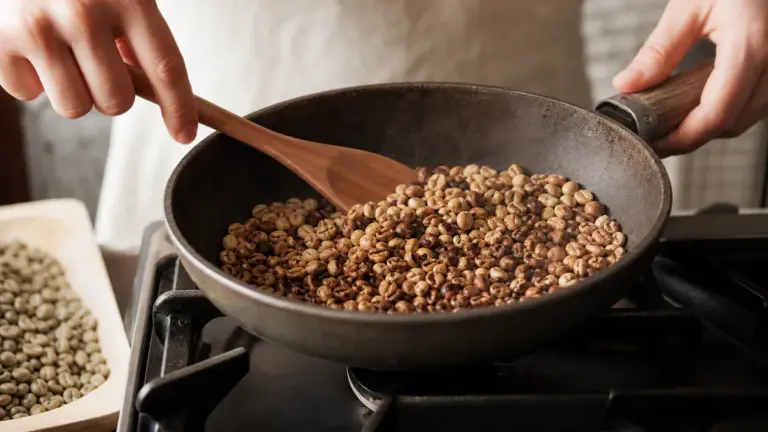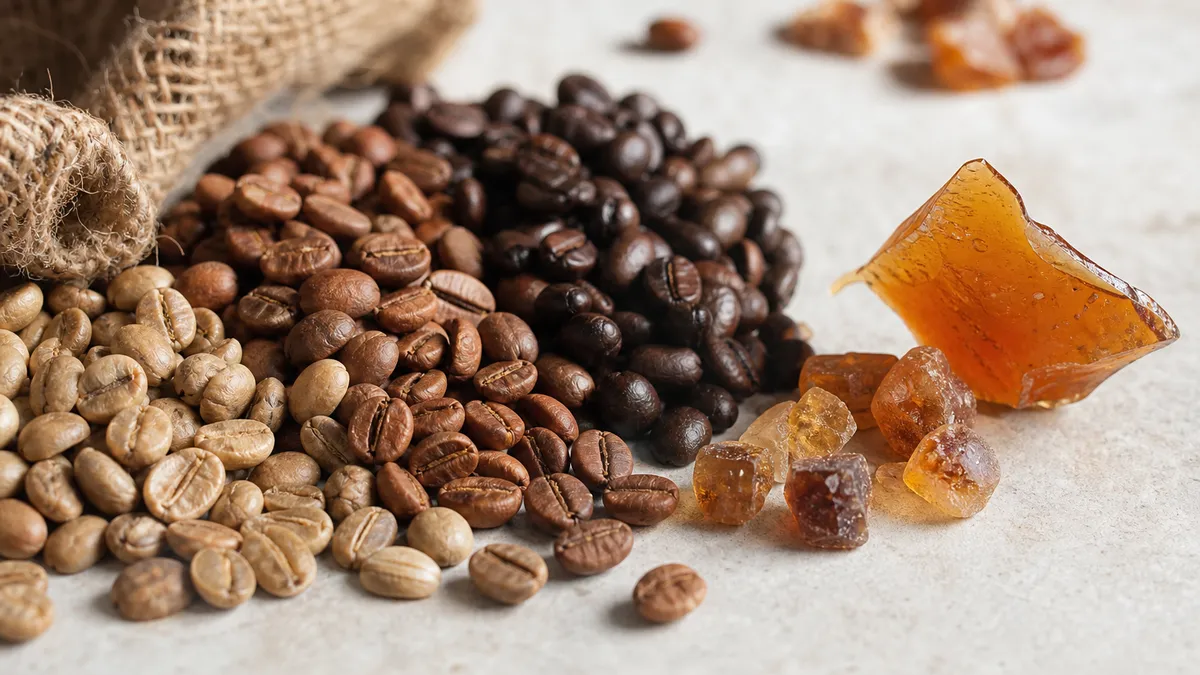
The Maillard reaction and caramelisation are overlapping chemical processes that help turn green coffee into brown, aromatic roasted coffee. Maillard reactions involve reducing sugars and amino compounds, including amino acids; caramelisation is the heat-driven breakdown and transformation of sugars without requiring amino compounds.
In short
- Maillard chemistry produces aroma compounds and contributes to the formation of brown materials called melanoidins.
- Caramelisation transforms sugars rather than simply making coffee sweeter.
- Strecker degradation connects amino acids with reactive carbonyl compounds, helping generate important coffee aromas.
- Temperature ranges are approximate guides, not switches: reactions overlap and depend on time, moisture and the conditions inside the bean.
- Acrylamide forms during roasting but can subsequently decrease. Darker coffee does not necessarily contain more of it.
How Maillard reactions change coffee
The useful starting point is the difference between the ingredients. Maillard chemistry needs a reducing sugar, a sugar with a reactive carbonyl group, and an available amino group, which can come from an amino acid, peptide or protein. Glucose and fructose are examples of reducing sugars.
Once these components react, the chemistry branches. Early products rearrange and break down into smaller, reactive substances; these then participate in further reactions that generate aromas and brown colouring materials. Calling this “the Maillard reaction” is convenient, but it is really a reaction network rather than one tidy transformation.
In coffee, this network helps explain the appearance of roasted, nutty and bread-like aromas. It also contributes to melanoidins, a diverse group of brown, relatively large molecules. Melanoidins are not themselves a cloud of coffee fragrance: they must be distinguished from the smaller, volatile compounds that can escape into the air and reach the nose.
Coffee melanoidins are more complicated than a simple sugar plus amino acid diagram suggests. Experimental work on separated coffee-brew fractions indicates that proteins, carbohydrates and chlorogenic acids, a group of naturally occurring coffee compounds, participate in their formation. Some details of their structures and assembly remain unresolved.
For the wider sequence of changes in the bean, start with coffee roasting. Here, the important point is that browning and aroma formation are connected, but they are not interchangeable measurements.
What caramelisation means inside a coffee bean
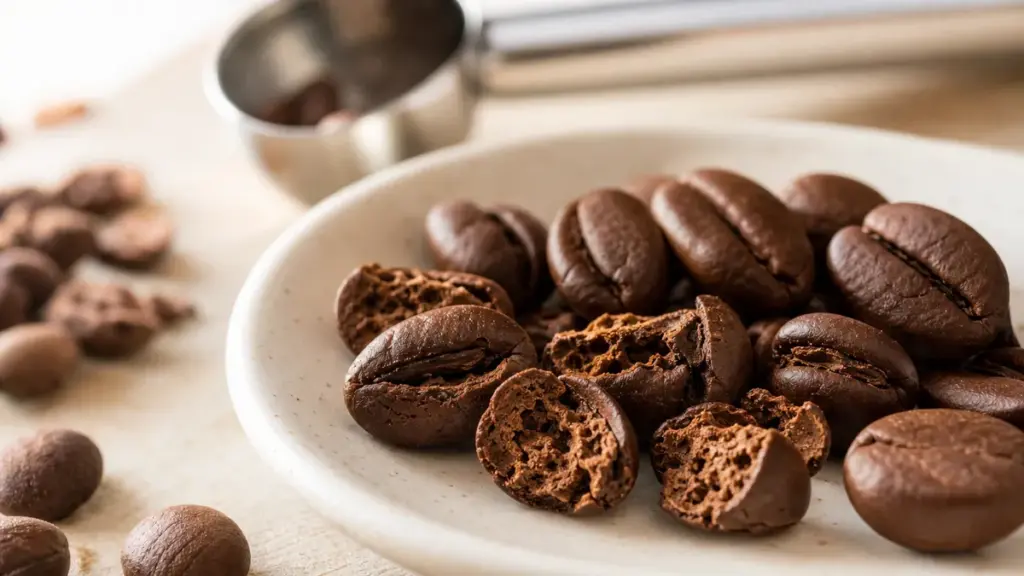
Caramelisation is sugar chemistry driven by heat, without requiring amino compounds. Sugars break down, lose water and undergo further reactions, creating smaller compounds as well as more complex coloured products.
Sucrose is the main free sugar in green coffee. It is not a reducing sugar in its intact form, but its breakdown can supply reducing sugars and other reactive products. This creates a connection between caramelisation and Maillard chemistry: the two pathways can draw on related starting materials and produce substances that enter further reactions.
The familiar kitchen comparison is heated sugar becoming amber caramel. However, a coffee bean is not a saucepan of purified sucrose. Its sugars sit within a changing mixture of water, proteins, carbohydrates, acids and other substances, so a confectionery temperature cannot be treated as a universal coffee-roasting threshold.
Experiments with purified sucrose have demonstrated that decomposition depends on the combination of time and temperature. Those experiments clarify sugar behaviour, but they do not establish an exact caramelisation starting temperature for every coffee bean.
Nor does caramelisation mean that roasting adds sweetness. It consumes and transforms sugars. A coffee can smell caramel-like without containing much remaining sucrose, and a more developed roast need not taste sweeter. Keep the distinction between a sweet-associated aroma and a sweet taste.
Strecker degradation: another route to aroma
Strecker degradation is an important branch of the chemistry associated with Maillard reactions. Reactive dicarbonyl compounds, molecules with two carbonyl groups, react with amino acids to generate aldehydes and other products, including carbon dioxide and aminoketones.
Aldehydes are a family of compounds with widely differing smells. Some Strecker aldehydes contribute malty notes to coffee. Methional, another important coffee odorant, can form through the interaction of the amino acid methionine with a dicarbonyl compound.
Further reactions involving these intermediates help form alkylpyrazines, compounds associated with roasted and nutty aromas. This is one reason “sugars browning” is an incomplete explanation of coffee flavour: amino acids help determine which aroma pathways are available.
Strecker degradation is not a separate roasting stage that begins when caramelisation finishes. It belongs within an overlapping network whose products can themselves become ingredients for later reactions.
Maillard reaction and caramelisation temperatures
Temperature figures are useful only when their limitations are clear. A roasting study may report bean-mass temperature, another may examine a small sample in a laboratory instrument, and another may model the chemistry. These are not identical measurements.
The following table is an orientation guide, not a roasting programme.
| Process or landmark | Approximate temperature guide | What the figure means |
|---|---|---|
| Yellowing, often used to mark the end of the initial drying phase | Around 150°C | An operational landmark, not proof that water loss has finished |
| Increasingly prominent Maillard chemistry | Roughly 140 to 170°C | Published descriptions differ; this is not the full temperature span over which the chemistry occurs |
| Substantial sugar transformation described as caramelisation | Roughly 170 to 200°C | A broad roasting guide, not a universal sucrose starting point |
| First crack | Around 200°C in many reported profiles | A physical event that overlaps with ongoing chemical reactions |
There is a genuine difference in published descriptions. A coffee calorimetry study describes Maillard browning around 140 to 165°C, while a later roasting-model paper uses 150 to 170°C. Neither establishes a temperature at which all Maillard chemistry suddenly starts, or a higher temperature at which it stops.
The later paper reports yellowing at 150 to 156°C and first crack at 200 to 203°C in its recorded profiles. These measurements support approximate landmarks, not a fixed rule for every roaster. They also show why an apparently precise universal first-crack interval can be misleading.
The phrase “drying phase ends” needs similar care. Water loss continues during subsequent roasting. Research on heat and mass transfer explicitly accounts for evaporation alongside heat-generating reactions.
For the physical events rather than the reaction chemistry, see first crack and second crack. Do not use the sound of a crack as evidence that one chemical pathway has handed over neatly to another.
Which aroma compounds are formed?
Coffee aroma depends on a mixture, not one signature “roasting molecule”. The examples below show why chemical family names are useful, but also why they cannot serve as complete tasting descriptions.
| Compound or group | Example contribution to aroma | Chemical connection |
|---|---|---|
| Pyrazines | Roasted, nutty or chocolate-like notes, depending on the compound | Products associated with the Maillard reaction network |
| Furan derivatives | Some have caramel-like, spicy or maple-like notes | Can arise through sugar degradation and Maillard-related pathways |
| Strecker aldehydes | Some contribute malty notes | Products of amino acid reactions with reactive carbonyl compounds |
| 2-furfurylthiol | A particularly important roasted-coffee odorant | Formation involves sugar-derived and sulphur-containing precursors |
Be precise with the word furan. Furan derivatives are a broad chemical family, not a single flavour or safety category. Describing one derivative as caramel-like does not mean every member smells pleasant or has the same toxicological properties.
Laboratory “in-bean” and spiking experiments have identified furfuryl alcohol as an important precursor of 2-furfurylthiol. This illustrates how a sugar-derived intermediate can feed into sulphur chemistry and help produce something recognisably coffee-like.
Sensory reconstruction experiments provide another useful distinction: detecting a compound is not the same as showing that it matters to the smell. Experiments that rebuild an aroma mixture, then omit individual components, help identify which odorants make an important contribution.
Why longer browning does not guarantee better flavour
A roast is not improved simply by maximising Maillard products. Controlled roasting and sensory studies show that both roast colour and time affect the cup.
Across a multi-study investigation, darker colour and longer roasting were associated with greater bitterness and lower perceived acidity, fruitiness and sweetness. Colour was the stronger predictor overall, but time still mattered when colour was held constant.
Another experiment changed development time, the interval between first crack and the end of roasting. Longer development shifted the tested coffees towards more roasted, nutty and bitter characteristics, while shorter development favoured sweeter, fruitier and more acidic characteristics.
These findings do not establish a universal ideal browning duration. They support a more useful practice: judge the finished coffee rather than assuming that a longer named phase must improve it. Our roast levels guide explains the broader sensory differences, while home coffee roasting covers practical operation.
Acrylamide: formation, breakdown and proportionate interpretation
Acrylamide is an unwanted process contaminant that can form through Maillard chemistry, particularly from asparagine, an amino acid, and reducing sugars. In coffee, it forms during roasting rather than ordinary brewing.
Its behaviour is not a simple upward line. Experimental roasting research shows that acrylamide can rise rapidly early in the roast and then decrease as heating continues. Isotope-labelled experiments support both degradation and reactions that leave some material bound within the coffee matrix.
Finished-roast comparisons also require care. One study found its highest concentrations between light and medium roasting; EFSA’s assessment describes lighter roasts as generally containing more than medium and dark roasts. These findings are compatible: an early processing peak and comparisons between finished commercial roast levels are different questions.
Consequently, darker roasting does not necessarily produce more acrylamide, and colour alone cannot establish the concentration in a particular coffee.
What does the benchmark mean?
The benchmark for roasted coffee is 400 micrograms per kilogram, written 400 µg/kg, referring to the roasted product rather than a litre of brewed drink. It is a performance indicator for assessing mitigation, not a maximum legal limit or a boundary between safe and unsafe consumption.
The relevant framework is Regulation (EU) 2017/2158, with assimilated legislation applying in Great Britain and EU legislation applying in Northern Ireland. Food Standards Agency and Food Standards Scotland guidance explains the associated mitigation and monitoring duties.
EFSA’s risk assessment identifies a potential cancer concern, drawing substantially on animal evidence. Human studies have provided limited and inconsistent evidence. That warrants reducing exposure where reasonably achievable, but does not establish that a particular coffee or roast level causes cancer in humans.
FAQ
Does coffee with caramel tasting notes contain added caramel?
Not necessarily: caramel-like notes can come from compounds formed during roasting. For example, particular furan derivatives have caramel-associated aromas. A tasting description identifies a sensory resemblance, not an ingredient, so check the ingredient information separately if you need to know whether a product has been flavoured.
Can I measure Maillard reactions from bean colour alone?
No: colour is useful, but it does not reveal the complete reaction history or aroma composition. Experimental studies have produced sensory differences between coffees roasted to the same colour using different timings. Colour is therefore one observation to combine with the roast record and tasting, not a chemical analysis.
Does brewing continue the same browning reactions?
Ordinary coffee brewing is not another roasting stage. It releases compounds already present in the roasted coffee into the drink and changes how they reach the nose. For acrylamide specifically, the FDA identifies roasting, rather than brewing at home or in a restaurant, as the formation step.
Where to go next
Read Coffee Roasting for the full process, then Roast Levels to connect these chemical changes with differences in the cup. First Crack and Second Crack explains the physical landmarks that overlap with Maillard reactions and caramelisation.
Sources
-
Wageningen University, Bekedam and colleagues. Roasting effects on formation mechanisms of coffee brew melanoidins, Journal of Agricultural and Food Chemistry, 2008.
https://pubmed.ncbi.nlm.nih.gov/18680301/
Experimental fractionation and analysis of coffee melanoidins. -
Mutovkina and Bredikhin. Analysis of coffee thermophysical changes during roasting using differential scanning colorimetry, Food Science and Technology, volume 43, e119722, 2023.
https://sbicafe.ufv.br/server/api/core/bitstreams/31714f8b-3587-4086-ab07-b63db8901b56/content
Primary calorimetry study and its qualified discussion of Maillard temperatures. -
University of Camerino and collaborators, Bruno and colleagues. A preliminary model to establish a digital twin for coffee roasting, Scientific Reports, volume 16, article 15857, 2026.
https://www.nature.com/articles/s41598-026-43923-9
Roasting chemistry model and recorded yellowing and first-crack temperatures. -
University of Illinois, Lee and colleagues. Investigation of thermal decomposition as the kinetic process that causes the loss of crystalline structure in sucrose using a chemical analysis approach (Part II), Journal of Agricultural and Food Chemistry, 2011.
https://experts.illinois.edu/en/publications/investigation-of-thermal-decomposition-as-the-kinetic-process-tha/
Primary experiments on the time-dependent thermal decomposition of sucrose. -
Universidade Estadual de Campinas and collaborators. Enhancing the Understanding of Aroma Formation during Coffee Roasting Using DHS-GC×GC-TOFMS and Chemometrics, ACS Omega, 2025.
https://pmc.ncbi.nlm.nih.gov/articles/PMC12224095/
Primary aroma-monitoring study, with explanations of Maillard and Strecker pathways. -
MDPI, Foods. Fast and Non-Destructive Profiling of Commercial Coffee Aroma under Three Conditions (Beans, Powder, and Brews) Using GC-IMS, 2022.
https://pmc.ncbi.nlm.nih.gov/articles/PMC9572980/
Primary analysis of coffee volatiles and their reported sensory characteristics. -
Food Chemistry. Furfuryl alcohol is a precursor for furfurylthiol in coffee, 2021.
https://www.sciencedirect.com/science/article/abs/pii/S0308814620318707
Primary in-bean and spiking experiments, publisher abstract. -
American Chemical Society, Grosch and colleagues. Sensory Studies on the Key Odorants of Roasted Coffee, ACS Symposium Series, 2000.
https://pubs.acs.org/doi/10.1021/bk-2000-0754.ch021
Researchers’ account of sensory and aroma-model experiments, publisher abstract. -
Bustos-Vanegas and colleagues. Modeling and simulation of coffee bean heating during roasting: effect of heat generation, Frontiers in Food Science and Technology, 2025.
https://www.frontiersin.org/journals/food-science-and-technology/articles/10.3389/frfst.2025.1603783/full
Primary heat-transfer modelling including continuing evaporation. -
Münchow and colleagues. Roasting conditions and coffee flavor: A multi-study empirical investigation, Beverages, 2020.
https://researchprofiles.ku.dk/en/publications/roasting-conditions-and-coffee-flavor-a-multi-study-empirical-inv/
Primary sensory investigation of roast colour and timing. -
Alstrup and colleagues. The Effect of Roast Development Time Modulations on the Sensory Profile and Chemical Composition of the Coffee Brew as Measured by NMR and DHS-GC-MS, Beverages, 2020.
https://researchprofiles.ku.dk/en/publications/the-effect-of-roast-development-time-modulations-on-the-sensory-p/
Controlled roasting, chemical analysis and sensory assessment. -
Vezzulli and colleagues. Acrylamide: impact of precursors concentration, origin, post-harvesting process and roasting level in high-quality arabica and Robusta coffee, International Journal of Food Science & Technology, 2022.
https://ifst.onlinelibrary.wiley.com/doi/full/10.1111/ijfs.15900
Primary comparison of acrylamide across finished roast levels. -
Badoud and colleagues, Nestlé Research and Fraunhofer IME. Fate of acrylamide during coffee roasting and in vitro digestion assessed with carbon 14- and carbon 13-labeled materials, Food Chemistry, 2020.
https://pubmed.ncbi.nlm.nih.gov/32208180/
Primary isotope-labelled experiments; industry research involvement is stated in the affiliations. -
European Food Safety Authority. Acrylamide, current topic page explaining the 2015 scientific risk assessment.
https://www.efsa.europa.eu/en/topics/topic/acrylamide
Authoritative assessment of animal and human evidence. -
Food Standards Agency and Fera Science. Acrylamide and Furan in Retail Products: Combined Results 2020 to 2021, October 2023.
Official report identifying the roasted-coffee benchmark and distinguishing dry product from beverage measurements.
-
Food Standards Agency. Acrylamide legislation, published 2018, current online guidance checked November 2026.
https://www.gov.uk/government/publications/acrylamide-legislation/acrylamide-legislation
Benchmark interpretation and legislative routes for England, Wales and Northern Ireland. -
Food Standards Scotland. Acrylamide in food guidelines, 2019, current online guidance checked November 2026.
https://www.foodstandards.gov.scot/business-guidance/running-a-food-business/publications/acrylamide-in-food/acrylamide-in-food-guidelines/acrylamide-in-food-section-3
Scottish guidance on scope, mitigation and monitoring. -
US Food and Drug Administration. Acrylamide and Diet, Food Storage, and Food Preparation, current online guidance checked November 2026.
https://www.fda.gov/food/process-contaminants-food/acrylamide-and-diet-food-storage-and-food-preparation
Distinction between acrylamide formation during roasting and ordinary brewing.
This article was researched through primary roasting, chemical-analysis and sensory studies, supported by current food-safety authority guidance; no first-hand roasting tests were undertaken.
Last checked: November 2026