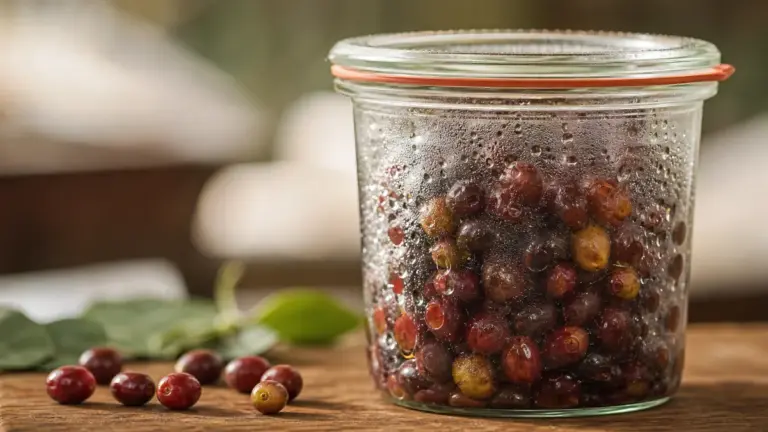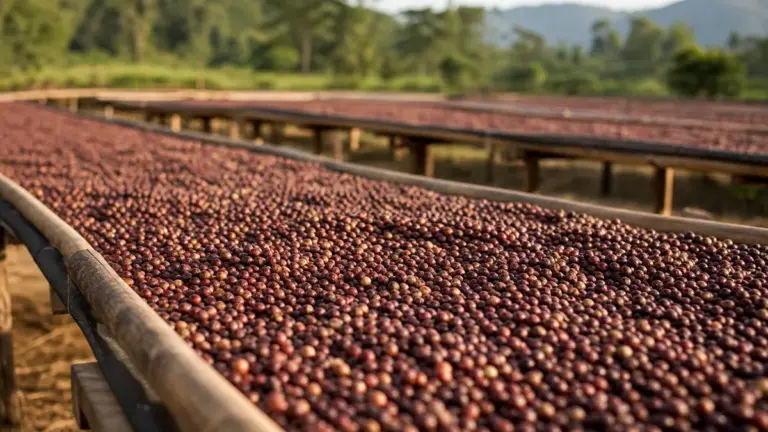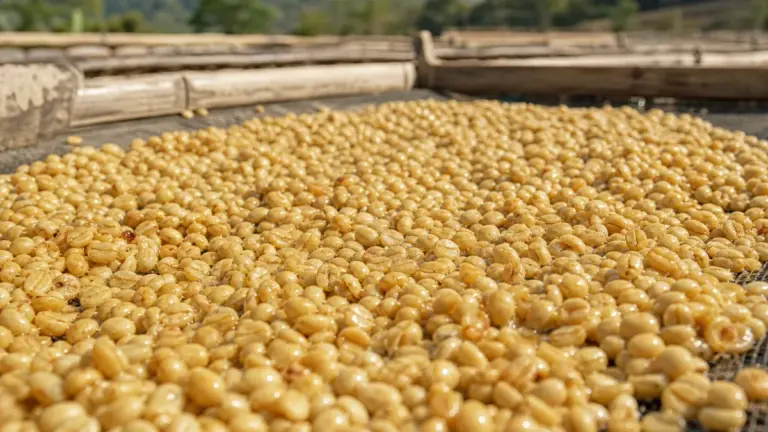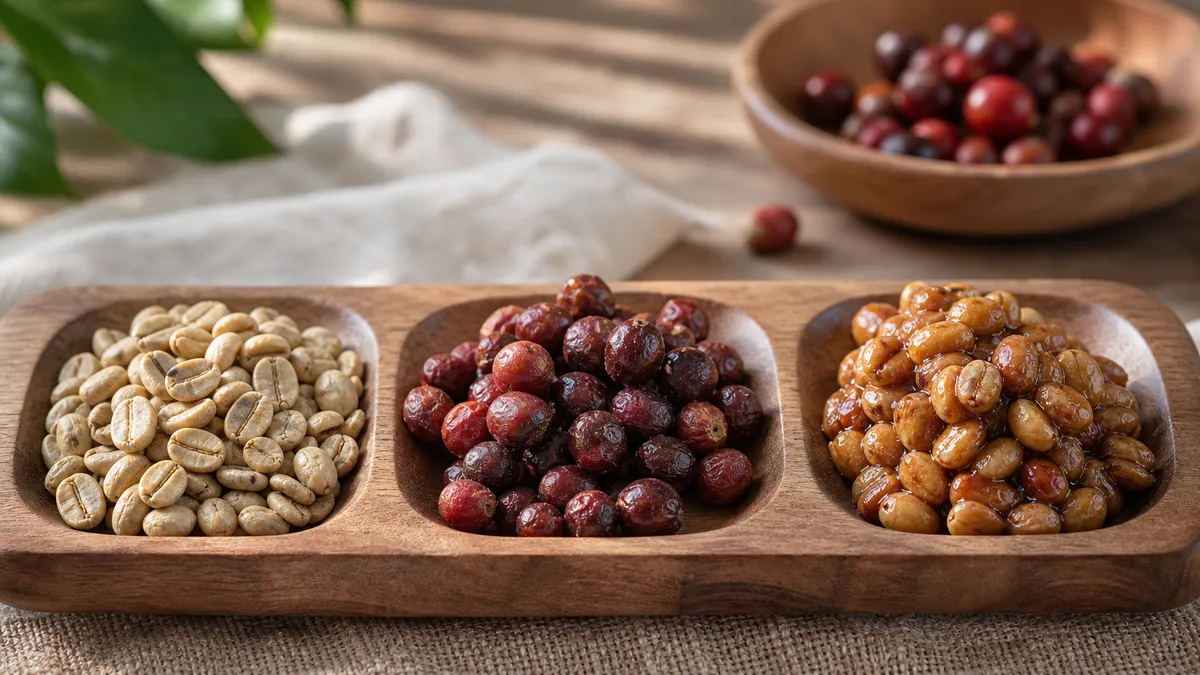
Washed, natural and honey describe what happens to the coffee fruit before its seeds become green coffee ready for roasting. Washed coffee dries with the fruit flesh and sticky mucilage removed; natural coffee dries inside the whole cherry; honey coffee dries after pulping, with some or all of the mucilage still attached. These differences influence flavour, but none guarantees a better cup.
In short
- Choose by the individual coffee’s tasting notes, not processing alone: the three categories contain considerable variation.
- Washed is a useful starting point for exploring acidity and clearly separated flavours; natural for fuller texture and more pronounced fruit character.
- Honey processing involves the coffee’s own sticky fruit layer, not added honey.
- Natural and honey omit the final mucilage-washing stage, but sorting and equipment cleaning can still use water.
- For a fair tasting, compare coffees from the same producer and harvest where possible, with similar roast levels.
Washed vs natural vs honey at a glance
The comparison below uses five practical criteria: what remains during drying, equipment, water requirements, likely sensory character and suitability. Flavour descriptions are tendencies, not specifications; the recommendations are starting points for choosing a tasting sample.
| Criterion | Washed | Natural | Honey |
|---|---|---|---|
| What dries around the seed? | Parchment, with mucilage removed | The whole coffee cherry | Parchment with retained mucilage |
| Main equipment | Pulper, fermentation and washing facilities or mechanical mucilage removal, drying facilities, huller | Sorting equipment, drying facilities and a dry-cherry huller | Pulper, sometimes equipment for partial mucilage removal, drying facilities and huller |
| Water considerations | Washing requires water; machinery and water management make a substantial difference | No mucilage-washing stage, though sorting and cleaning may use water | No final mucilage-washing stage; sorting, pulping arrangements and cleaning still matter |
| Common sensory direction | More apparent acidity, lighter body and clearer flavour separation | Fuller body, stronger fruit or fermented-fruit character | Rounded acidity, sweetness and substantial mouthfeel |
| Who it suits | Readers exploring distinct flavours and acidity | Readers curious about fruit intensity and texture | Readers seeking sweetness and texture without assuming a strongly fermented profile |
The processing distinctions and sensory tendencies come from technical training material and processing literature. The “who it suits” row is editorial guidance, not a quality ranking.
For the wider family of techniques, start with our processing methods overview.
How each process works
A coffee bean is a seed inside a fruit called a cherry. Beneath the skin and flesh sits mucilage, a slippery, sugar-containing layer surrounding the parchment, the protective covering around the seed. Processing separates these materials and dries the coffee so it can be stored and milled.
Washed: remove the mucilage before drying
After sorting, a pulper removes the cherry’s skin and much of its flesh. In a traditional washed process, fermentation helps break down the remaining mucilage, which is then washed away.
Fermentation does not necessarily mean submerging the coffee. Mills can ferment pulped coffee with or without added water, and mechanical mucilage removers offer another route to clean parchment. Equipment-based terminology varies, so a producer’s description is more informative than assuming every “washed” coffee followed an identical sequence.
The coffee then dries in its parchment covering. That covering is removed later during hulling, rather than the bare green seed being exposed throughout drying.
Natural: dry the whole cherry
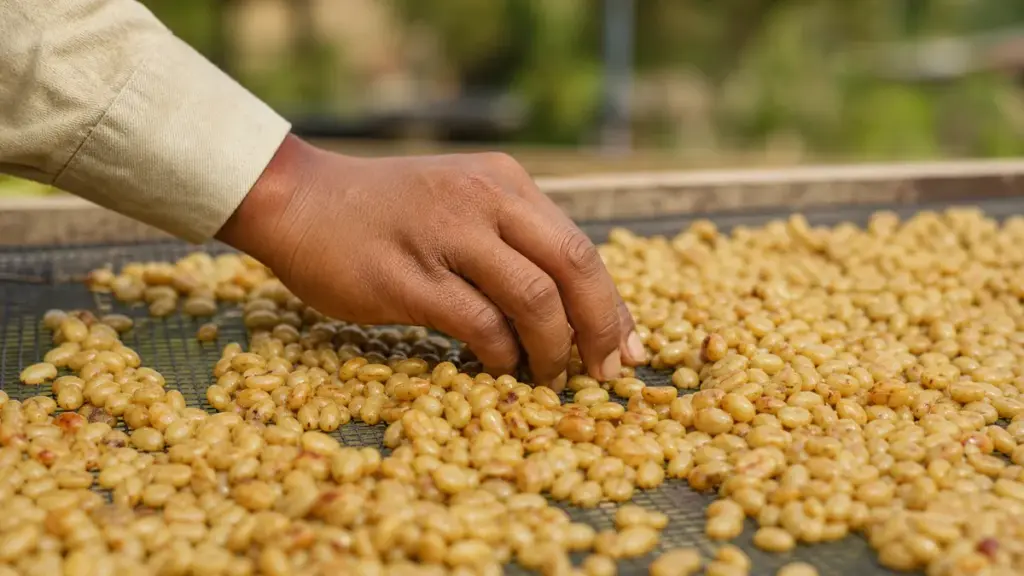
Sorted cherries go to drying beds, patios or mechanical drying systems with their fruit intact. Once dry, a huller removes the dried outer material to release the green coffee.
Whole-fruit drying is not simply leaving cherries in the sun. Producers must manage the drying surface, turning, rain protection and moisture removal. Uganda’s coffee authority specifically advises frequent stirring for uniform drying and avoiding rewetting.
Honey: pulp first, retain mucilage
Honey processing starts with pulping, as washed processing does, but retains mucilage during drying rather than washing it away. Producers may leave most of that layer intact or remove part mechanically or through their chosen fermentation protocol. No added honey is required.
You may encounter yellow, red and black honey descriptions. Published accounts connect these names with mucilage retention and drying conditions, including shade and drying speed. Ask what the producer actually did rather than treating the colour name as a precise recipe or sweetness score.
Equipment, water and the work behind each method
Washed processing needs a way to pulp the fruit, remove mucilage, handle water and dry the parchment. Traditional fermentation tanks and washing channels are one arrangement; compact pulper and demucilager systems are another. The FAO’s processing guidance illustrates why a single water-use figure cannot describe every washed mill.
Natural processing avoids the pulping and mucilage-washing stages before drying. It still needs suitable drying capacity and careful handling, followed by machinery capable of hulling dried cherries. Honey adds a pulper while retaining the need to manage mucilage-coated coffee during drying.
Less washing does not mean no water use. Anacafé’s guidance includes water-based density sorting for both natural and honey preparations, while mills also need clean equipment. Ask which stages a water claim includes: cherry sorting, transport, pulping, washing and cleaning are different operations.
Nor does omitting a washing stage establish the complete environmental impact of a coffee. For an informed comparison, request information about water management, drying energy and the handling of pulp, husks and wastewater. TechnoServe’s mill guidance treats these as separate responsibilities, not something settled by the process name.
What can go wrong?
All three methods depend on sound fruit selection, hygiene and controlled drying. Their vulnerabilities differ, but none makes good results automatic.
Washed coffee can develop fermentation faults. Poorly managed fermentation or dirty tanks can produce sour, onion-like or foul flavours. Equipment adjustment matters too: badly set pulpers can damage seeds before drying begins.
Natural coffee requires careful whole-fruit drying. Uneven handling or rewetting can allow undesirable taints and mould to develop. Frequent turning is therefore part of processing, not an optional finishing touch.
Honey coffee needs close drying supervision. Retained mucilage makes drying management especially consequential. Processing literature describes regular turning to achieve even drying and avoid excessive fermentation or rot. More retained fruit material is not automatically an improvement.
For any method, drying coffee in overly thick layers, allowing it to become wet again or storing it partly dry can encourage mouldy or musty flavours. A fruity description and a drying defect are not interchangeable: ask whether the character is enjoyable and coherent, not merely intense.
Flavour and body: useful tendencies, not promises
Washed coffees commonly present more apparent acidity and less body than comparable naturals. Here, body means the sensation of weight and texture in the mouth, while acidity describes the sourness-related part of flavour. Neither is a verdict on quality.
Natural coffees often offer greater aromatic intensity and fuller texture. Honey coffees can combine rounded acidity, sweetness and substantial mouthfeel. Treat these as directions to explore rather than a fixed ladder running from “clean” through “sweet” to “fruity”.
For tasting, separate questions that are easily muddled:
- Is the aroma floral, fruity, nutty or fermented?
- Does the acidity feel gentle, lively or sharp?
- Does the texture feel light, silky, coating or heavy?
- Is the finish pleasant, drying, bitter or musty?
World Coffee Research’s Sensory Lexicon provides references for describing flavour, aroma and texture. Its vocabulary is useful precisely because “natural” or “honey” is not a complete sensory description.
Why processing changes flavour
The explanation is more complicated than fruit sweetness simply soaking into a seed. In a controlled on-farm washed-processing experiment, researchers changed the fermentation by introducing a selected yeast. They found changes in aroma-related compounds and sensory character, even though measured sugars and organic acids in the roasted beans were statistically similar between treatments.
A separate experimental comparison of natural, honey and fully washed Indonesian coffee identified differences in the chemical profiles of both green and roasted beans. That supports processing as an influence on composition, but does not establish one universal flavour for each method. These are experimental findings, not proof that every natural will taste fruitier or every honey sweeter.
Where you will encounter them
Processing methods cross borders, so country and process should be read as separate pieces of information.
Uganda’s coffee authority describes both wet and dry processing, including washed Arabica production in its mountain-growing areas. Brazilian production provides an established example of pulped-natural processing. These examples alone show why “African coffee” or “Brazilian coffee” does not fully describe how a lot was prepared.
In Central America, Guatemala’s Anacafé publishes guidance covering honey and natural preparations. In Costa Rica’s Tarrazú region, producer Kwiso describes honey, natural and washed methods within its own operation. These are examples of practice, not claims about national market shares.
For UK buyers, ask the roaster for the producer, variety, harvest, processing details and roast description. A process name is a useful first filter; a well-described individual lot is the better basis for choosing.
How to taste the difference fairly
Try a matched set from one producer and harvest, ideally using the same variety and similar roast levels. If that is unavailable, keep the comparison modest: you are tasting three coffees, not proving that processing alone caused every difference.
Use this simple home tasting exercise. It borrows the parallel preparation principle from SCA cupping but is not a formal grading session.
- Prepare three identical heatproof bowls. Grind 10 g of each coffee at the same setting, slightly coarser than a typical paper-filter grind.
- Add 180 g of water to each, a coffee-to-water ratio of 1:18. Use the same water at 93°C, pouring into the bowls in quick succession.
- At 4 minutes, gently break each surface crust with a spoon and skim away floating grounds.
- Allow the coffee to cool to a comfortable tasting temperature. Taste in the same order, then reverse that order.
- Repeat as the bowls cool. Write separate notes for aroma, acidity, sweetness, body and finish before revealing which process belongs to each bowl.
The dose and water quantity are an editorial adaptation. The temperature, grind direction and crust-breaking time follow the retrieved SCA sample-preparation guidance.
Avoid awarding the natural “fruitiest” before tasting it. Describe what is actually present, then decide which you enjoy. If the coffees differ little, record that too.
For a second tasting, choose one coffee whose fermentation is explained in detail. Our guide to carbonic maceration provides a useful next comparison; experimental and infused processing explores labels beyond these basic drying categories.
FAQ
Is honey coffee made with honey?
Ordinary honey processing does not require added honey. The defining feature is retaining coffee-fruit mucilage around the parchment during drying after the cherry has been pulped. If a seller describes additional ingredients or an infusion, ask for the specific production details rather than assuming that “honey” explains everything done to the lot.
Does washed coffee avoid fermentation?
No. Traditional washed processing uses fermentation to help remove mucilage before washing and drying. Mechanical mucilage removal offers a different route, and regional terminology varies. Consequently, “washed” does not by itself tell you whether there was a fermentation stage, whether water was added during it or how the producer controlled it.
Are honey and pulped natural exactly the same?
They overlap, but the labels do not always describe identical protocols. Both can refer to pulped coffee dried with retained mucilage; technical accounts also describe differences in partial mucilage removal and subsequent handling. For a meaningful comparison, ask how much mucilage remained and what fermentation and drying steps were used, rather than relying on either name alone.
Where to go next
Read Coffee Processing Methods to place washed vs natural vs honey within the wider processing family. Continue with Carbonic Maceration for a fermentation-focused technique, then Experimental and Infused Processing for help interpreting more elaborate descriptions.
Sources
-
International Trade Centre, Coffee Processing Theory: A Preparatory Course for Coffee Quality Institute Q Processing Arabica Level 2, student handbook, 2024.
https://www.eacmarkup.org/images/resources/handbook/ITC-MARKUP-II_Coffee-Processing-theory-CQI-QP2-preparatory-course-student-booklet.pdf -
TechnoServe, Coffee Wet Mill Processing Guide, undated document, hosted in 2022.
https://www.technoserve.org/wp-content/uploads/2022/03/TechnoServe-Wet-Mill-Processing-Guide.pdf -
Anacafé, Guía de buenas prácticas para la innovación en procesos poscosecha, 2023.
-
Food and Agriculture Organization of the United Nations, Arabica Coffee Manual for Lao PDR, processing and quality-control chapter, 2005.
https://www.fao.org/4/ae939e/ae939e08.htm -
Uganda Coffee Development Authority, Primary Processing, undated web guidance.
https://nov.ugandacoffee.go.ug/index.php/primary-processing -
World Coffee Research, Sensory Lexicon, version 2.0, 2017.
https://worldcoffeeresearch.org/resources/sensory-lexicon -
Specialty Coffee Association, Coffee Value Assessment: Sample Preparation and Tasting Mechanics, June 2024 document.
-
Poltronieri, P. and Rossi, F., Challenges in Specialty Coffee Processing and Quality Assurance, review, Challenges, 2016.
https://www.mdpi.com/2078-1547/7/2/19/pdf -
De Melo Pereira and colleagues, Conducting starter culture-controlled fermentations of coffee beans during on-farm wet processing: Growth, metabolic analyses and sensorial effects, Food Research International, 2015, abstract retrieved through PubMed.
https://pubmed.ncbi.nlm.nih.gov/28454966/ -
Yulianti and colleagues, Detection of Markers in Green Beans and Roasted Beans of Kalosi-Enrekang Arabica Coffee with Different Postharvest Processing Using LC-MS/MS, International Journal of Food Science, 2023.
https://onlinelibrary.wiley.com/doi/full/10.1155/2023/6696808 -
Kwiso Coffee, Procesos, undated producer account, Tarrazú, Costa Rica.
https://kwisocoffee.com/procesos.aspx
This comparison was researched using retrieved technical manuals, coffee-authority guidance, sensory references and peer-reviewed research, with producer material used only to illustrate that producer’s practices.
Last checked: November 2026