Semi-washed coffee is an ambiguous name: it can describe coffee dried with some sticky fruit coating attached, mechanically cleaned coffee, or Indonesian wet-hulled coffee. Wet-hulled coffee, called giling basah in Indonesia, has its parchment covering removed before drying is complete, rather than afterwards.
In short
- Ask when the parchment was removed: before final drying means wet-hulled; after final drying means a different processing route.
- Published Indonesian studies describe wet hulling at moisture contents ranging from about 30% to 50%, not one universal setting.
- Pulped-natural and honey coffees retain their parchment throughout drying, even when their labels say semi-washed.
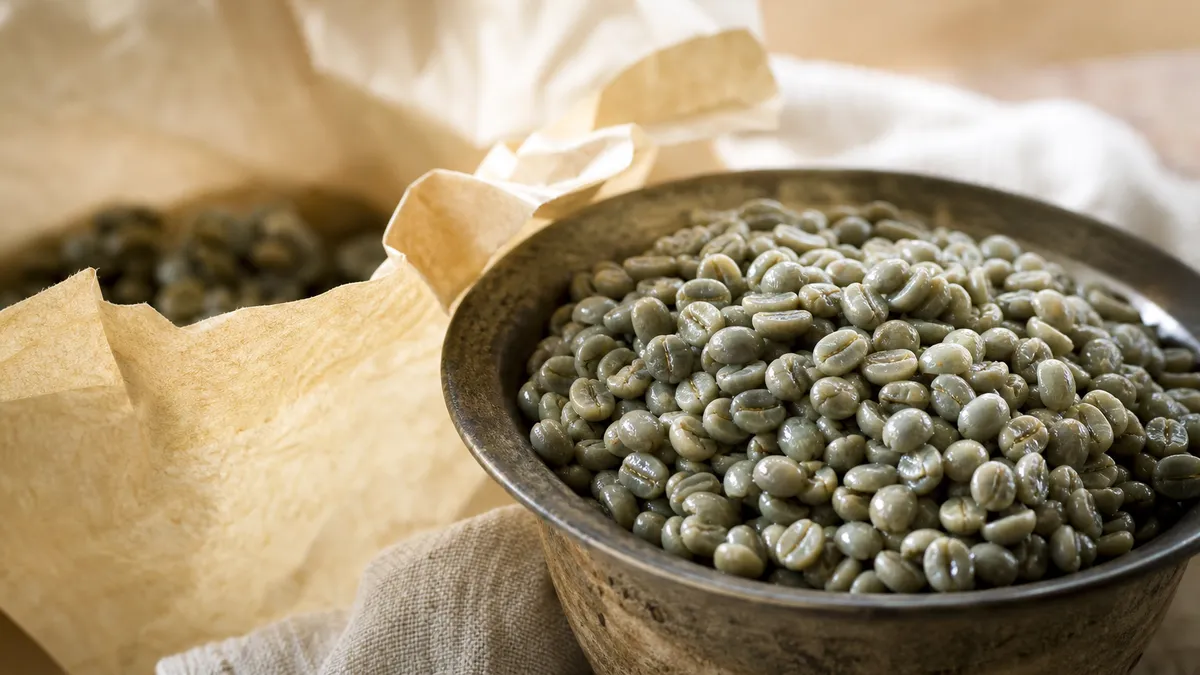
- Wet-hulled green beans can have a distinctive blue-green appearance.
- Earthy flavour, substantial body and restrained acidity are familiar descriptions, but mustiness is not a requirement of the method.
What does semi-washed process mean?
The difficulty is not simply that different sellers use different words. Technical organisations also use semi-washed for different sequences of operations.
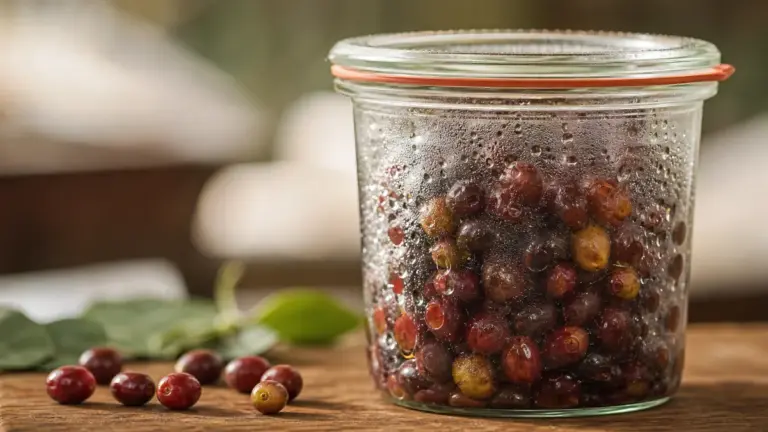
Fairtrade’s coffee standard describes pulped-natural coffee as parchment dried with some or all of its mucilage attached, and lists semi-washed among its alternative names. Mucilage is the slippery fruit tissue clinging to the parchment after pulping removes the cherry’s skin and much of its flesh.
The FAO’s Arabica coffee manual for Lao PDR, however, uses semi-washed for coffee whose mucilage is removed mechanically before drying. Indonesian coffee sold under the same label may instead be wet-hulled.
These are not interchangeable methods. For the wider framework, see coffee processing methods; here, the decisive distinction is whether hulling happens before or after the bean finishes drying.
Pulped natural is not Indonesian wet hulling
Brazilian pulped-natural coffee, also called cereja descascado, dries inside its parchment with mucilage attached. Central American honey processing follows the same broad principle of drying pulped coffee with retained mucilage, although individual protocols differ.
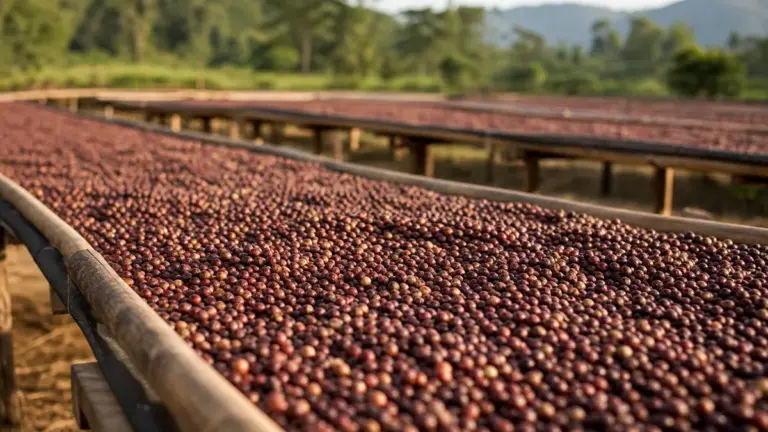
Neither method requires early removal of the parchment. El Salvador’s coffee institute, for example, recommends drying honey parchment to 10.5% to 12% moisture for storage.
Even within Central America, semi-washed does not have one fixed definition. The same Salvadoran manual describes a semi-washed route involving a shortened fermentation and a single washing operation, separately from honey processing. A country name helps establish context, but cannot replace a description of the actual process.
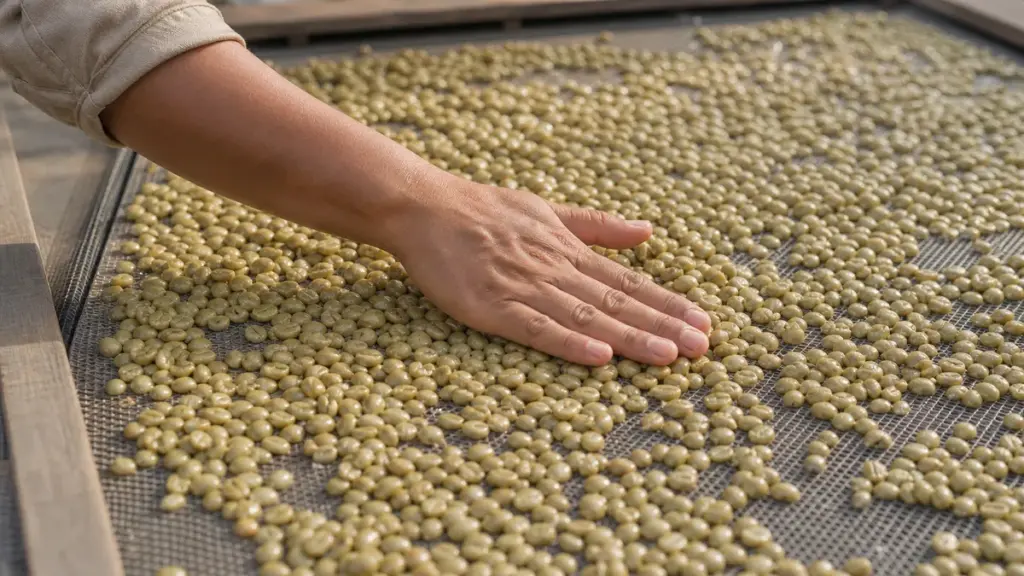
Parchment Coffee
Parchment coffee is coffee whose seed remains enclosed in the parchment layer, the fruit’s tough inner covering, technically called the endocarp. It is a processing stage, not a variety, origin or roast.
Imagine the layers working inwards: outer skin and flesh, sticky mucilage, parchment, then the seed that becomes the roasted coffee bean. Removing the outer fruit with a pulper does not normally remove the parchment.
In conventional washed processing, mucilage is removed and the coffee dries inside that covering. The dried parchment is subsequently stripped away by a huller. In pulped-natural processing, mucilage remains during drying, but the parchment still stays on until the coffee is dry.
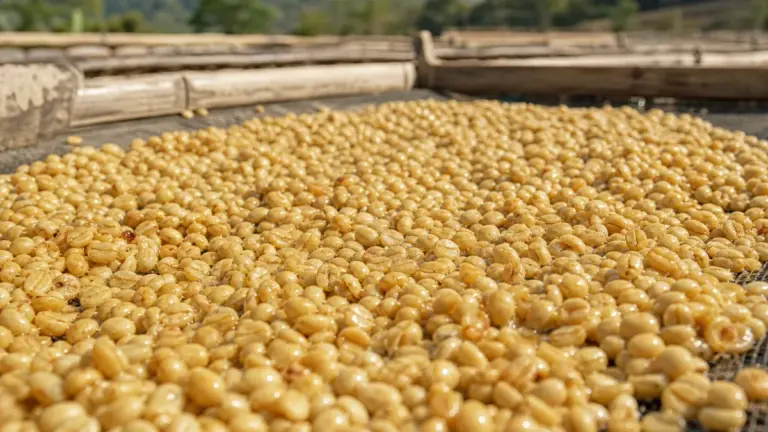
Wet hulling changes that order. The parchment is stripped from a bean that still contains much more water, and the exposed seed then completes drying.
This also explains why “wet parchment” and “wet-hulled coffee” are not synonyms. Wet parchment still has its covering; wet-hulled coffee has already lost it.
The processing sequences compared
| Route | What happens after pulping? | When is parchment removed? | What finishes drying? |
|---|---|---|---|
| Conventional washed | Mucilage is removed, commonly through fermentation and washing | After drying | Bean inside parchment |
| Pulped natural or honey | Some or all mucilage remains during drying | After drying | Bean inside mucilage-coated parchment |
| Mechanically cleaned semi-washed | A demucilager removes mucilage | After drying | Bean inside cleaned parchment |
| Indonesian wet-hulled | Coffee is commonly fermented, washed and partly dried | Before final drying | Exposed green bean |
The table describes broad routes rather than compulsory recipes. For retained-mucilage drying, the honey process is the useful comparison; the natural process instead dries the whole cherry.
Wet-Hulled Coffee
Indonesian wet-hulled coffee is known as giling basah. Its defining operation is mechanical removal of parchment while the coffee is still substantially wet.
A representative sequence is:
- Pulp the cherries. Remove the outer skin and much of the flesh.
- Loosen and remove mucilage. A common route uses fermentation followed by washing, although local handling varies.
- Partly dry the parchment coffee. Stop before reaching the moisture level used for dry storage.
- Wet-hull it. A suitable huller strips away the parchment.
- Finish drying the exposed beans. The coffee must still reach an appropriate final moisture condition before storage and shipment.
How wet is wet hulling?
A Flores processing study describes hulling at 30% to 40% moisture. A North Sumatran study reports 40% to 45%, while an associated FAO project report describes local practice at 40% to 50%.
These figures establish the broad distinction, not a recommended universal operating window. The studies also do not consistently specify the moisture measurement basis, so their percentages should not be treated as perfectly standardised equivalents.
By comparison, the conventional washed control in the North Sumatran study was dried in parchment to 12% moisture. The important contrast is therefore not a small adjustment: wet hulling removes the covering at a much wetter stage.
Hulling moisture and final storage moisture answer different questions. A bean hulled wet is not ready to be packed away simply because its parchment has gone.
Why is wet hulling used in Indonesia?
Wet hulling is associated particularly with Sumatra and also occurs elsewhere in Indonesia. Its use reflects both drying conditions and the organisation of coffee trading.
DRWakefield’s account of Indonesian processing identifies humidity and rain as obstacles to drying coffee fully in parchment. Removing the covering early helps the remaining drying proceed more quickly.
The trading sequence matters too. The FAO’s North Sumatran field report documents farmers selling wet parchment to traders, followed by further handling, hulling and drying. The farmer therefore need not complete every processing stage before selling the crop.
This is not a description of every Indonesian coffee. The Flores study explicitly compared wet-hulled, fully washed and pulped-natural production, and described a relatively dry local environment. Indonesia contains different growing conditions and processing traditions, not one nationwide recipe.
Blue-green beans and earthy flavour
Wet-hulled green coffee can look blue-green or deep green rather than the paler appearance readers may associate with other green beans. Indonesian research reports both bluish-green semi-washed coffee and dark-green wet-hulled beans.
Colour is a useful visual clue, not proof of quality or a complete processing record. Ask for the producer’s method rather than identifying a coffee solely by its shade.
In the cup, classic Mandheling descriptions include low perceived acidity, heavy or complex body, spice and a little earthiness. Body means the drink’s sense of weight and texture; perceived acidity is its bright or tart sensory character.
Earthiness needs careful language. A restrained earthy impression is not the same judgement as an intrusive musty taint. The FAO processing manual warns that drying coffee on soil or dirty surfaces can introduce dirty or earthy flavours, while inadequate drying and damp storage can produce mustiness.
It would therefore be misleading to say that all earthy flavour proves a defect, or that every dirty flavour is an authentic regional characteristic.
Quality debates: character, defects and evidence
Does wet hulling automatically lower quality?
No processing label establishes a quality ranking on its own.
A controlled Flores comparison, published in 2010, had 67 tasters assess blind-coded coffees made by fully washed, wet-hulled and pulped-natural routes. Pulped natural was the most preferred across the varieties studied, but the results also showed that preference and numerical quality assessment were not interchangeable.
A separate Gayo study reported better sensory acceptance for wet-hulled than dry-hulled samples. However, it lacked independent field replication, which limits how confidently its findings can be generalised.
These results argue against treating either washed or wet-hulled coffee as inherently superior. They do not establish that processing is irrelevant.
What actually creates the characteristic flavour?
The evidence is less tidy than familiar tasting descriptions suggest.
The FAO’s North Sumatran trial could not consistently reproduce Mandheling character through its selected storage and processing treatments. Its authors concluded that other uncontrolled factors were probably involved.
The defensible interpretation is that wet hulling belongs to a wider production system. Variety, growing conditions, fermentation, drying, handling and storage can contribute; the available trial does not isolate parchment removal as the sole cause of earthy flavour or heavy body.
Where does quality control matter?
Wet beans can be crushed during poorly managed hulling, and damp coffee needs careful handling during drying and storage. Codex guidance treats moisture control and prevention of rewetting as central to reducing mould-related contamination.
There is also a reporting disagreement worth preserving. The North Sumatran journal abstract found no clear relationship between storage duration and mould infection, whereas the associated FAO report described increasing infection during wet-parchment storage. Both documented mould, but they do not justify a neat rule that a particular delay always produces a particular flavour.
For buying purposes, judge the actual lot: processing detail, physical condition and a clean, enjoyable cup are more useful than defending or dismissing an entire tradition.
A checklist for reading a semi-washed label
Use these questions when a roaster or importer lists semi-washed coffee:
- What does the producer mean by semi-washed? Request the sequence, not another synonym.
- Was mucilage retained, washed away or removed mechanically? This separates several different uses of the term.
- Was parchment removed before final drying? If yes, wet-hulled is the clearer description.
- How was drying completed and checked? Ask about the final condition, not just moisture at hulling.
- What does the roaster mean by earthy? Ask whether the description refers to an enjoyable flavour or masks musty, dirty character.
For semi-washed process coffee, the most useful buying information is the operation behind the label.
FAQ
Does wet-hulled coffee arrive wet?
No, wet-hulled describes its condition during parchment removal, not its intended condition when sold as finished green coffee. Further drying follows hulling. The North Sumatran research used final drying to 12% moisture, while Codex guidance specifies reducing bean moisture to a maximum of 12.5% as part of contamination prevention.
Can a coffee be washed and wet-hulled?
Yes, coffee can undergo washing before it is wet-hulled. Washing concerns removal of mucilage; wet hulling concerns when the parchment is stripped off. That is why “washed” alone can leave an important detail unstated. Ask whether the parchment remained on throughout final drying.
Does semi-washed mean fermented for half as long?
No, semi-washed does not define a universal fermentation duration. FAO uses the term for a mechanically demucilaged route without a separate mucilage-fermentation stage, while El Salvador’s manual describes a shortened fermentation and single wash. Indonesian trade usage can instead indicate wet hulling. The producer’s protocol is the reliable explanation.
Where to go next
Read Coffee Processing Methods for the wider framework, then Honey Process to examine drying with retained mucilage and Natural Process for whole-cherry drying. Anaerobic Fermentation explains a different processing variable, useful when a label combines a fermentation description with a drying or hulling method.
Sources
-
FAO/WHO Codex Alimentarius Commission. Code of Practice for the Prevention and Reduction of Ochratoxin A Contamination in Coffee, CAC/RCP 69-2009, adopted 2009.
https://www.fao.org/input/download/standards/11250/CXP_069e.pdf -
FAO Regional Office for Asia and the Pacific. Arabica coffee manual for Lao PDR, “Harvesting and processing”, 2005.
https://www.fao.org/4/ae939e/ae939e08.htm -
Fairtrade International. Criterio de Comercio Justo Fairtrade para Café para Organizaciones de Pequeños Productores, May 2011 edition, processing definitions. Used for terminology, not current certification requirements.
https://www.fairtradeamerica.org/app/uploads/2020/08/Coffee_SPO_SP.pdf -
Instituto Salvadoreño del Café, with Italian Agency for Development Cooperation support. Manual de Cosecha y Poscosecha del Café, 2024.
-
Marsh, A.; Yusianto; Mawardi, S., including Indonesian Coffee and Cocoa Research Institute researchers. The Influence of Primary Processing Methods on the Cup Taste of Arabica Coffee from the Indonesian Island of Flores, 2010.
https://ei-ado.aciar.gov.au/sites/default/files/MarshEtAl%282010%29InfluencePrimaryProcessingMethodsCupTasteArabiceCoffeeFloresIndo_ICCRI.pdf -
Ismayadi, C.; Marsh, A.; Clarke, R., Indonesian Coffee and Cocoa Research Institute and FAO. Influence of Storage of Wet Arabica Parchment Prior to Wet Hulling on Moulds Development, OchratoxinA Contamination, and Cup Quality of Mandheling Coffee, Pelita Perkebunan, 21(2), 2005.
https://www.ccrjournal.com/index.php/ccrj/article/view/20 -
FAO, Anthony Marsh. Storage of wet Arabica parchment prior to wet hulling including the storage of dry green bean coffee, Project GCP/INT/743/CFC, Annex E.6, report of the 2004/2005 trial; publication year not stated.
https://www.fao.org/fileadmin/user_upload/agns/pdf/coffee/Annex-E.6.pdf -
Abubakar, Y.; Karim, A.; Fahlufi, F., Syiah Kuala University. Flavor of arabica coffee grown in Gayo Palteau as affected by varieties and processing techniques, conference proceedings, volume 1(1), 2011.
https://library.sweetmarias.com/wp-content/uploads/2020/08/Flavor-of-arabica-coffee-grown-in-Gayo-Palteau-as-affected-by-varieties-and-processing-techniques.pdf -
Djafar, Z., and colleagues, Hasanuddin University. Engineering Innovation for Cherry Coffee Wet Processing Using Circulation System and Agitator Grading Machine, Coffee Science, volume 20, 2025, institutional abstract.
https://scholar.unhas.ac.id/en/publications/engineering-innovation-for-cherry-coffee-wet-processing-using-cir/ -
DRWakefield. What is Wet Hulled?, 2024, importer’s processing account.
https://drwakefield.com/news-and-views/what-is-wet-hulled/
Research combined primary processing studies, institutional manuals and Codex definitions, with an importer’s account used for Indonesian production context; differences in terminology and study findings are retained rather than reconciled artificially.
Last checked: November 2026