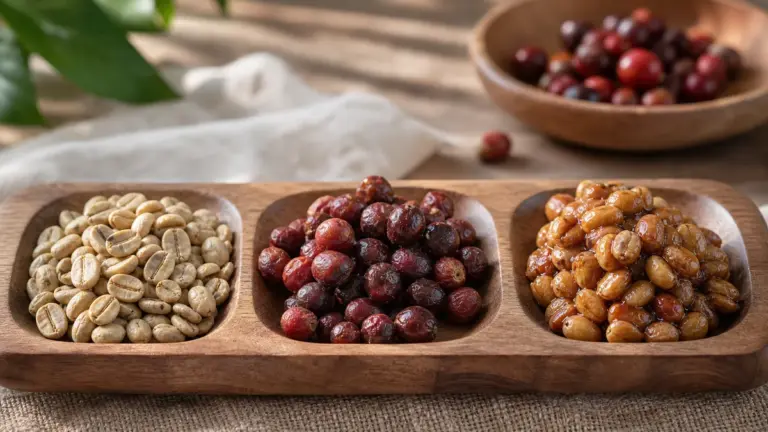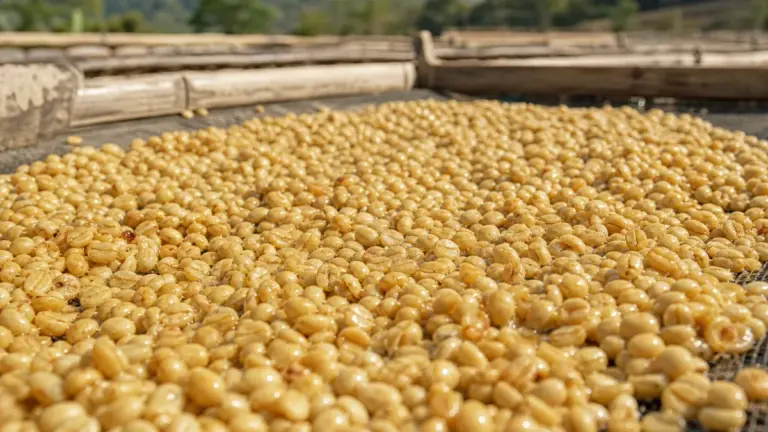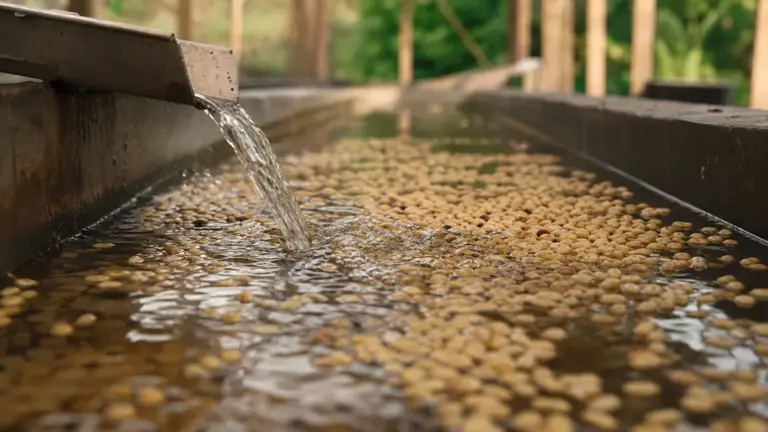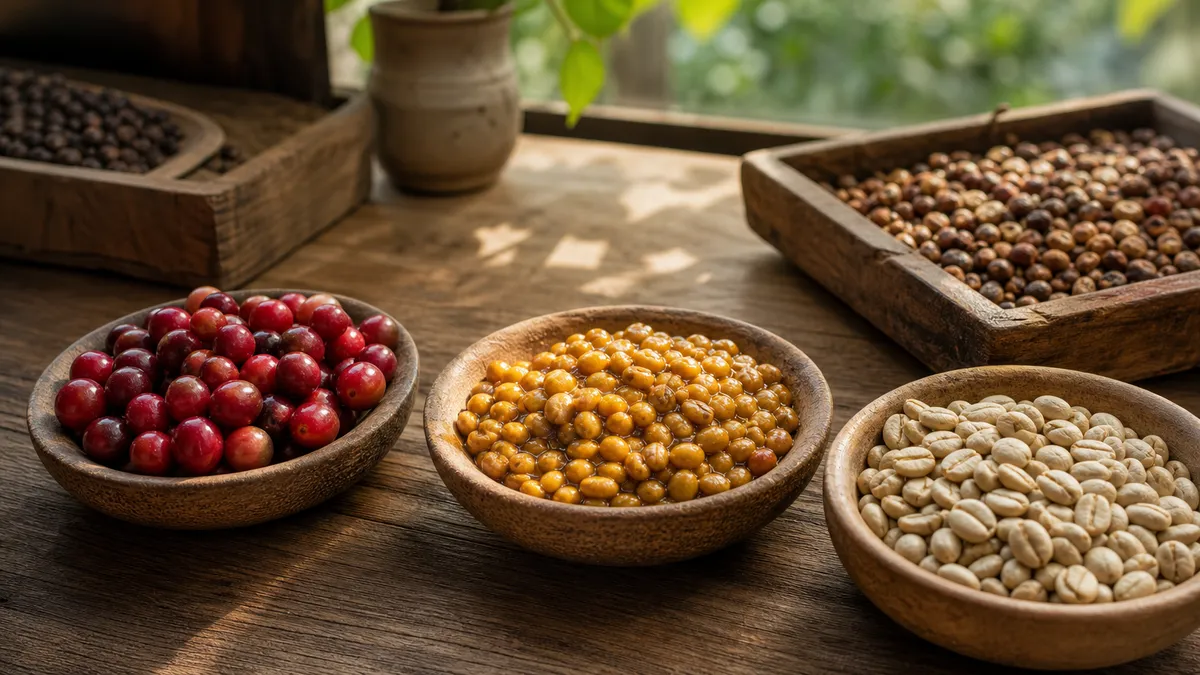
Coffee processing turns freshly picked coffee cherries into dried, unroasted beans that can be stored, transported and roasted. The main methods, washed, natural, honey and wet-hulled, differ chiefly in when the fruit layers and parchment are removed, with fermentation and drying helping to shape the eventual flavour.
In short
- Natural coffee dries inside the whole cherry; washed coffee dries after the pulp and mucilage have been removed.
- Honey processing retains mucilage during drying. The standard method does not involve adding honey.
- Wet hulling removes parchment before drying is complete, unlike conventional washed processing.
- Fermentation conditions and drying management matter as much as the process name.
- TechnoServe’s wet-mill guidance gives a final moisture range of 10% to 12% by wet weight. Even drying and protection against rewetting remain essential.
Why coffee processing exists
A coffee bean is a seed inside a fleshy fruit, usually called a cherry. Around the seed sit several layers, including the skin and pulp, sticky mucilage and parchment, a thin protective covering.
Freshly harvested coffee cannot simply be bagged and shipped in this condition. Processing separates the seed from the surrounding fruit and reduces its moisture so it can move through the supply chain without uncontrolled deterioration.
It is also a quality-making stage. Harvested fruit continues to change, microorganisms grow, and drying affects the seed’s condition. Good processing manages those changes; poor handling can introduce sour, musty or other unwanted flavours.
For navigation through individual techniques, start with our coffee processing methods hub.
The main coffee processing methods compared
The most useful comparison is physical: what surrounds the seed while it dries, and when is that covering removed? Fermentation labels describe another part of the operation, so an anaerobically fermented coffee may subsequently follow a washed or natural route.
| Method | Before main drying | What dries around the seed? | When parchment is removed | What to investigate |
|---|---|---|---|---|
| Washed | Pulp and mucilage removed | Parchment | After drying | Fermentation or mechanical mucilage removal |
| Natural | Cherries sorted and cleaned | Whole fruit, including parchment | After whole-cherry drying | Cherry selection and drying management |
| Honey or pulped natural | Skin and much of the pulp removed | Retained mucilage and parchment | After drying | Mucilage retention and drying protocol |
| Wet-hulled | Cherries pulped, followed by initial processing and partial drying | Parchment initially; then the exposed bean | Before final drying | Hulling stage and subsequent drying |
These are process families rather than identical recipes. Equipment, climate, fruit condition and the producer’s intended result can change the details substantially.
Washed processing
A pulper removes the cherry skin and much of the flesh. The remaining mucilage is removed before the parchment-covered coffee undergoes its main drying stage.
In conventional ferment-and-wash processing, biological activity helps break down the mucilage so it can be washed away. The parchment remains around the seed until dry milling. Our washed processing guide follows that route in greater detail.
Natural processing
Natural coffee dries as whole cherries. Once sufficiently dry, a huller removes the dried fruit layers and parchment to release the green beans.
This retains much more fruit material through drying than washed processing. It also makes careful cherry selection and drying management particularly significant. The natural processing guide explains the method without treating every natural coffee as the same flavour style.
Honey processing
Honey processing removes the skin and much of the pulp but deliberately retains mucilage during drying. Parchment stays in place beneath that sticky layer.
The familiar comparison with honey describes the material surrounding the parchment, not an ingredient added to the coffee. Honey and pulped natural are closely related terms, although the producer’s actual procedure is more informative than either name alone.
Wet-hulled processing
Wet hulling, commonly associated with Indonesia and called giling basah, changes the timing of parchment removal. Coffee is partially dried, hulled while still moist, then dried again without its parchment.
That makes it different from washed coffee which happens to be wet during pulping or fermentation. It also exposes the bean during the final drying stage. Do not assume that a label saying “semi-washed” supplies enough detail: ask whether the parchment was removed before or after final drying.
Mechanical demucilaging: washing without a long tank fermentation
Mucilage does not have to be removed through a separate fermentation stage. A mechanical demucilager uses physical action to remove it after pulping, producing coffee that can proceed directly to drying.
Cenicafé’s published guidance describes its DESLIM equipment as removing mucilage mechanically while also washing and cleaning the coffee. Correct adjustment matters because the machine must remove the surrounding material without unnecessarily damaging the beans.
This distinction prevents a common oversimplification: “washed” does not always mean a long fermentation in a water-filled tank. It describes the processing route, while the mechanism used to remove mucilage needs a further explanation.
Mechanical removal can reduce water demand in an appropriately designed system, but it does not make wastewater and by-product management irrelevant. Ask about the whole mill operation rather than judging environmental performance from one machine.
What fermentation actually does
Fermentation involves microorganisms transforming available compounds, particularly sugars, into other substances. In coffee, yeasts and bacteria can produce alcohols, organic acids and aroma-related compounds while changing the environment around the seed.
The effects are not limited to fruit material being washed away. Research following wet processing from cherries to brewed coffee has found changes in microbial communities, bean chemistry and sensory characteristics. Seed metabolism and the movement of compounds between the surrounding material and bean also contribute.
Time alone is not a recipe
Temperature, oxygen availability, starting microorganisms, fruit condition and whether coffee is submerged all influence fermentation. A duration printed on a bag cannot explain the result by itself.
A controlled processing study published in 2019 compared 16-hour and 64-hour fermentations at one Ecuadorian research plantation. The longer treatment produced more fruity and floral characteristics, among other differences. That is evidence that changing fermentation can change flavour under those conditions, not proof that longer fermentation always improves coffee.
Producers therefore need to monitor the process, not merely wait for a timer. Temperature, pH, mucilage condition and records of previous batches help interpret what is happening. A lower pH indicates a more acidic environment, but does not by itself establish a universal finishing point.
Drying: managing the bean, not just its surface
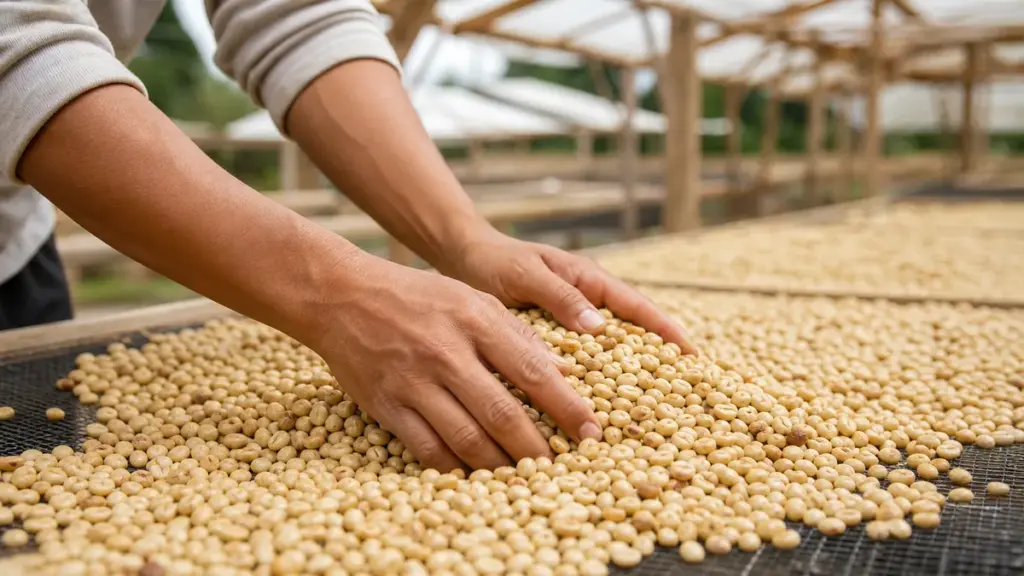
Drying reduces moisture to a condition suitable for subsequent handling and storage. Coffee may dry on patios, raised beds, in mechanical dryers or through a combination of systems.
For wet parchment, TechnoServe distinguishes initial surface-water removal from the slower final drying stage. Its guidance gives a final moisture range of 10% to 12% on a wet basis, meaning water as a proportion of the coffee’s total wet mass.
The challenge is uniformity. Different parts of a bed or batch can dry at different rates. Turning, appropriate layer depth, airflow and temperature management help avoid leaving wet pockets while other beans become excessively dry.
A dry-feeling exterior is not a sufficient measurement. Representative sampling and an appropriate moisture meter are more useful than touch alone.
Moisture content and water activity are different
Moisture content measures how much water is present. Water activity measures how available that water is for processes including microbial growth.
Codex’s coffee guidance identifies moisture below 12.5% by wet weight, together with a maximum water activity of 0.67 to 0.70, as sufficient to protect parchment coffee against fungal damage. These are paired conditions in that guidance, not a guarantee that every batch below a single moisture figure is safe regardless of handling.
Rain, dew and condensation can rewet dried coffee. Protection must therefore continue after the drying bed, through storage and transport.
Resting, conditioning and storage before export
Drying is commonly followed by resting, also called conditioning or curing. The International Trade Centre describes this as a stage that helps moisture become more uniform within the coffee.
This is not an invitation to leave damp coffee sitting in sacks. Conditioning follows controlled drying and requires moisture management of its own. A storage period cannot compensate for an uneven or unsuitable drying endpoint.
Where parchment remains, coffee can be held in that form before dry milling. Naturals may likewise be held in their dried fruit covering until milling. The appropriate sequence depends on the processing and trading arrangements.
Before export, storage should prevent moisture uptake, contamination and exposure to foreign odours. FAO guidance recommends keeping sacks off the floor on pallets and away from direct contact with walls, with inspection and cleaning programmes in place.
Milling: turning dried coffee into export-ready green beans
Dry milling removes the remaining outer material. For naturals, that includes the dried fruit covering; for washed and honey coffees, the main covering to remove is parchment. Wet-hulled coffee has already undergone parchment removal earlier.
Milling also involves cleaning and sorting. Screens separate beans by size, density equipment separates material by density, and manual or optical sorting removes selected defects and discoloured beans.
Equipment calibration matters because hulling can break beans. Milling prepares and grades a lot; it cannot reverse every defect introduced during picking, fermentation, drying or storage.
Visual assessment and cupping, the systematic tasting of prepared samples, provide complementary checks. Attractive green beans and a promising process description are not substitutes for evaluating the cup.
Experimental methods and their flavour effects
Experimental processing usually changes fermentation conditions or introduces additional treatments. It does not remove the need for controlled drying, milling and storage.
- Anaerobic fermentation: processing under oxygen-limited conditions. In self-induced systems, oxygen is progressively consumed while carbon dioxide accumulates.
- Carbonic maceration: a technique adapted from winemaking that uses a carbon-dioxide-rich environment, commonly with whole cherries.
- Starter cultures: selected microorganisms introduced to influence fermentation, rather than relying entirely on the organisms already present.
- Added fermentation materials: fruit or other substrates introduced alongside coffee. These should be distinguished clearly from microbial inoculation alone.
Controlled experiments have demonstrated chemical and sensory changes from such treatments. A study comparing spontaneous and yeast-inoculated anaerobic fermentation found different sensory profiles as fermentation duration changed. Research involving yeast-and-fruit inoculum has also reported changes relative to untreated controls.
Those findings support experimentation, not a universal ranking of methods. Ask what was added, which material was fermented, how oxygen was managed and how the coffee was subsequently dried.
Flavour effects also resist tidy rules. Washed coffees are commonly associated with clarity, but processing does not erase variety, growing conditions or roasting. An Ethiopian comparison found no statistically significant differences in its assessed cup attributes between washed, semi-washed and dry-processed treatments.
Our practical advice: use the process name to choose what to explore, then use the lot’s tasting description and your own preference to decide what to drink.
A checklist for reading a coffee’s processing description
- Identify the drying route. Was it whole cherry, mucilage-covered parchment, clean parchment or an exposed wet-hulled bean?
- Separate fermentation from drying. “Anaerobic” alone does not tell you what surrounded the bean during drying.
- Look for useful detail. Temperature management and the material fermented explain more than duration alone.
- Ask about additions. Distinguish starter microorganisms from added fruit or flavouring materials.
- Check the finishing stages. Drying, conditioning and storage belong in a complete processing account.
- Compare fairly. Where possible, taste differently processed lots from the same producer and harvest, with comparable roasting.
Coffee processing is most informative when the description explains what happened, rather than simply supplying an impressive name.
FAQ
Is natural coffee unprocessed?
No, natural coffee is processed by drying the whole cherry before removing its outer layers. “Natural” names that route, not an absence of human intervention. Sorting, spreading, turning, drying control, hulling and grading can all involve considerable management, even though the fruit is not pulped before drying.
Does honey-processed coffee contain added honey?
The standard honey process does not contain added honey. It retains the cherry’s sticky mucilage around the parchment during drying. If a producer adds honey or another fermentation ingredient, that is an additional treatment and should be described separately rather than implied by the ordinary honey-process label.
Is the processing rest the same as resting roasted coffee?
No, they occur at different stages. Processing conditioning concerns dried, unroasted coffee and includes managing moisture uniformity before further handling. If a description mentions “resting”, check whether it refers to parchment, dried whole cherries, milled green beans or roasted coffee, rather than assuming the terms describe the same operation.
Where to go next
Use Coffee Processing Methods to navigate the wider subject. Read Washed Process for the pulp-and-mucilage removal route, then Natural Process to follow whole-cherry drying and compare the practical demands.
Sources
-
International Coffee Organization, Coffee Development Report 2020: The Value of Coffee, Box C.5 and section C.2.4, 2020.
URL: https://icocoffee.org/wp-content/uploads/2022/11/CDR2020.pdf -
University of California, Davis, Neil McCandless Rotta, Operations and Mass Flows in Postharvest Processing of Coffee: Comprehensive Case Study in Washed Coffee, MSc thesis, 2020.
URL: https://iad.ucdavis.edu/sites/g/files/dgvnsk4906/files/inline-files/Neil%20Rotta%20Thesis%20-%20Final%20Full%20Text%20%282020%29_1.pdf -
Cenicafé, Pabón, Sanz-Uribe and Oliveros-Tascón, Manejo del café desmucilaginado mecánicamente, Avances Técnicos 388, online record dated 2025.
URL: https://publicaciones.cenicafe.org/index.php/avances_tecnicos/article/view/1642 -
Applied and Environmental Microbiology, Zhang and colleagues, Following Coffee Production from Cherries to Cup: Microbiological and Metabolomic Analysis of Wet Processing of Coffea arabica, 2019.
URL: https://journals.asm.org/doi/10.1128/aem.02635-18 -
TechnoServe, Wet Mill Processing Guide, publicly hosted 2022 version.
URL: https://www.technoserve.org/wp-content/uploads/2022/03/TechnoServe-Wet-Mill-Processing-Guide.pdf -
Codex Alimentarius Commission, FAO/WHO, Code of Practice for the Prevention and Reduction of Ochratoxin A Contamination in Coffee, CXC 69-2009, 2009.
URL: https://www.fao.org/fao-who-codexalimentarius/sh-proxy/en/?lnk=1&url=https%253A%252F%252Fworkspace.fao.org%252Fsites%252Fcodex%252FStandards%252FCXC%2B69-2009%252FCXC_069e.pdf -
International Trade Centre, The Coffee Guide, fourth edition, 2021, chapter 5 and Table 8.
URL: https://www.intracen.org/media/5718 -
Food and Agriculture Organization, Enhancement of Coffee Quality through the Prevention of Mould Formation, final technical report, Part D: Guidelines for the Prevention of Mould Formation in Coffee, 2006.
URL: https://www.fao.org/fileadmin/user_upload/agns/pdf/coffee/FTR2006.pdf -
Brazilian Journal of Microbiology, Impact of Different Fermentation Times on the Microbiological, Chemical, and Sensorial Profile of Coffees Processed by Self-Induced Anaerobiosis Fermentation, 2024.
URL: https://pmc.ncbi.nlm.nih.gov/articles/PMC11405557/ -
Food Chemistry, Brioschi Junior and colleagues, Microbial Fermentation Affects Sensorial, Chemical, and Microbial Profile of Coffee under Carbonic Maceration, 2021.
URL: https://pubmed.ncbi.nlm.nih.gov/33046284/ -
Food Science and Technology International, García-López and colleagues, Use of Starter Culture on Biotransformation Processes of Coffea arabica (L.) from Southwestern Antioquia, Colombia, journal issue 2026.
URL: https://journals.sagepub.com/doi/10.1177/10820132251349939 -
Heliyon, Effect of Processing Methods on Physicochemical and Cup Quality of Coffee at Jimma, Ethiopia, 2024.
URL: https://pmc.ncbi.nlm.nih.gov/articles/PMC11088319/
Research combined retrieved institutional processing guidance with primary experimental studies, distinguishing general handling principles from findings specific to individual trials.
Last checked: November 2026