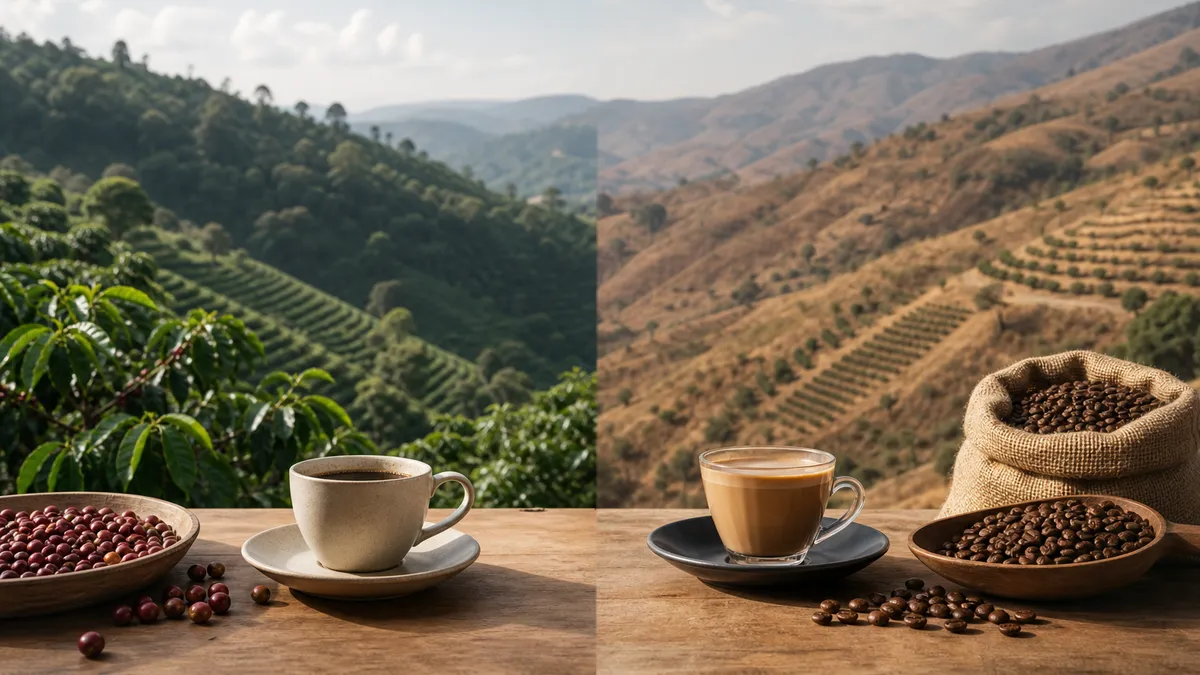
Coffee microclimates are the local conditions of sunlight, temperature, wind and humidity experienced by coffee plants within a farm. Neighbouring plots can produce different-tasting coffee because a sheltered, shaded slope develops differently from an exposed one, even when both grow the same variety. However, differences in picking and processing must also be considered before attributing the flavour to location alone.
In short
- Slope aspect means the direction a slope faces, which influences its exposure to sunlight.
- Shade changes more than temperature: it also affects wind, humidity and the timing of ripening.
- Altitude bands are useful for separating a farm into study areas, but elevation alone does not describe the conditions around the cherries.
- Compare the same variety, similar ripeness and matching processing before drawing conclusions about neighbouring plots.
- Treat a separated micro-lot as something to assess, not automatic proof of a distinctive or better cup.
What makes a coffee microclimate?
A regional weather report cannot describe every corner of a coffee farm. The conditions beneath shade trees, beside a forest edge or on an exposed slope may differ from those recorded at a nearby weather station.
Research in south-western Ethiopia found that both vegetation and topography helped explain conditions beneath the tree canopy. Their importance also changed with the season and with the variable being measured: the factors explaining maximum temperature were not necessarily those explaining humidity.
Microclimate is therefore part of coffee terroir, the wider relationship between a coffee and its growing environment. It is not another name for soil, altitude or origin.
For a beginner, the useful distinction is simple: a farm name tells you where coffee comes from; a plot description starts to explain what the plants experienced there. Neither description, by itself, establishes how the finished coffee will taste.
Most of the sensory examples below concern arabica. They should not be treated as universal predictions for every coffee species or growing system.
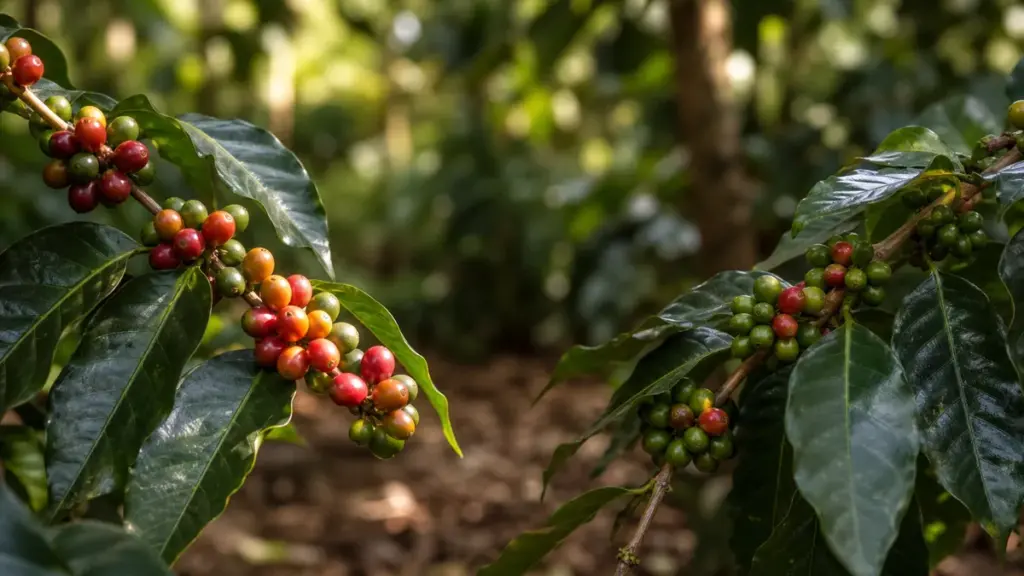
Slope aspect, shade and exposure
Slope aspect: which way the hillside faces
Aspect is the compass direction a slope faces. Along with the steepness of the slope, it affects incoming sunlight and therefore the conditions around the plants.
Avoid rules such as “north-facing coffee is always better”. The useful question is how exposure interacts with the conditions at that particular site, rather than whether one compass direction has an inherent quality advantage.
Even the sides of individual coffee plants can be worth comparing. A Brazilian field study separated cherries receiving morning sun from those receiving afternoon sun, while keeping the cultivar constant. The results depended on altitude, rather than identifying one exposure as universally superior.
For a farm assessment, record when direct sunlight reaches each plot and when it disappears behind neighbouring terrain or trees. A compass reading is a starting point, not a complete description of exposure.
Shade: a management tool, not a quality guarantee
Shade trees alter the amount and distribution of light reaching coffee. A field study in south-eastern Brazil also found reduced wind speed and higher humidity during the dry period in its shaded systems.
Shade can change fruit development. In a Costa Rican experiment using the cultivar Costa Rica 95, researchers compared full sun with 45% shade. Shading delayed ripening and improved beverage quality under those experimental conditions, but also reduced productivity.
That trade-off matters. The aim is not necessarily to create the darkest plot, but to find an appropriate balance between light, crop development and production.
Colombia’s national coffee research centre, Cenicafé, likewise recommends considering regional cloudiness and local limitations when deciding on shade. Its guidance identifies poorly distributed rainfall, low soil moisture retention and high solar radiation as circumstances where shade can be useful.
Wind, humidity and altitude bands
These factors overlap, so assess them together rather than assigning each a separate tasting note.
| Local feature | What to investigate | Why it matters |
|---|---|---|
| Wind exposure | Compare sheltered coffee with more exposed areas | Shade arrangements can substantially change wind speed |
| Humidity | Record conditions within the coffee canopy | Shaded and unshaded areas may experience different air humidity |
| Soil water | Measure rather than infer from shade | Shade trees can also use water, so shaded soil is not necessarily wetter |
| Altitude bands | Compare lower, middle and upper parts of the farm | Elevation interacts with vegetation, exposure and local terrain |
A Peruvian study illustrates why these relationships need checking. Researchers monitored shaded and unshaded coffee within the same plantation for three years. The shaded area had cooler air and soil and higher air humidity, yet its soil was drier during parts of the dry season. The authors suggested that water use by the shade trees helped explain this result.
For the relationship between soil properties and water supply, see soil composition. Shade is not a substitute for understanding what is happening below ground.
Altitude bands are best treated as a way to organise observations. Do not impose a supposedly universal interval or assume every higher block must be cooler at every relevant moment. Record the actual conditions alongside elevation.
For example, ask whether the upper block is exposed or sheltered, and whether its canopy differs from the lower block. Broader seasonal patterns belong in climate variations; microclimate work examines how those patterns are experienced within the farm.
What nearby comparisons actually show
The strongest comparisons reduce competing explanations. Matching the variety and processing does not eliminate every difference, but it makes a local environmental explanation more credible.
Neighbouring experimental plots in Costa Rica
In Turrialba, researcher Reinhold Muschler compared shade treatments within one commercial plantation. The experimental area was selected for similar soil and exposure, and comparisons included shaded and unshaded coffee within Caturra and Catimor 5175.
Only fully ripe cherries were used for the quality samples, and all followed a standard wet-processing procedure at the same experimental mill. Blind tasting found improvements in acidity and body under dense shade for both varieties. Aroma did not follow the same pattern: it was unchanged for Caturra and slightly worse for Catimor.
This is useful evidence that nearby growing conditions can influence the cup without changing variety or broad processing method. It is not proof that every sensory attribute improves together, or that dense shade suits every site.
Contrasting exposure within Brazilian plots
A study in Manhuaçu, Brazil, examined Catuaí IAC 144 at 950, 1,050 and 1,150 metres above sea level. Researchers selectively harvested ripe cherries from the morning-sun and afternoon-sun sides of plants, then compared them within natural and peeled-cherry processing treatments.
At 1,150 metres, the afternoon-sun side produced higher overall sensory scores. At 950 and 1,050 metres, the study reported no significant difference between exposure sides in those scores.
This is finer-scale evidence than a comparison between neighbouring fields: differences were investigated within plants. It also shows why a plausible environmental contrast need not produce a measurable quality difference everywhere.
A necessary counter-example
Research in Carmo de Minas compared Yellow Bourbon and Acaiá across altitude categories, slope exposures and wet and dry processing. It found no significant effect of slope exposure on sensory quality in its univariate analysis.
These studies do not justify a universal rule that exposure always changes flavour. Their different findings support a more careful conclusion: local effects depend on the site, the coffee and the other variables involved.
How farmers can use microclimates
Microclimate information is useful for management as well as for separating coffee. Shade can be adjusted through pruning, while observations of ripeness can guide which areas are ready to pick.
The following is a suggested assessment workflow, not a claim that every farm uses the same system:
- Map meaningful contrasts. Mark changes in slope aspect, canopy cover, wind exposure and elevation. Begin with differences that can be investigated, rather than drawing boundaries solely for a lot name.
- Record comparable conditions. Place instruments consistently and compare equivalent periods. Keep notes on shade management and unusual weather.
- Follow fruit development. Record flowering and ripeness by block. Compare equivalent maturity, rather than insisting that contrasting plots must be harvested on the same day.
- Separate manageable trial lots. Keep each plot’s cherries identifiable through processing, drying and storage.
- Assess before expanding. Taste coded samples and compare production outcomes. Repeat the assessment before treating one result as a dependable plot characteristic.
Two examples of micro-lot separation
These are illustrative trial designs, not reports of named commercial lots.
Shaded edge versus open interior: separate ripe cherries of the same variety from neighbouring shaded and open blocks. Use matching processing and drying procedures, then assess the samples without revealing their identities. The question is whether the difference survives a reasonably controlled comparison.
Lower band versus upper band: separate the same variety from two elevation bands while recording differences in exposure and shade. Pick each at comparable maturity. If the samples differ, investigate the full set of recorded conditions rather than crediting altitude alone.
In both cases, keep the records even if tasting does not reveal a useful distinction. A trial that prevents an unsupported claim has still done its job.
Separating microclimate from harvesting and processing
Neighbouring coffees can differ for reasons introduced after growing. In the Carmo de Minas study, processing affected sensory quality and aspects of green-bean composition.
The comparison therefore needs more detail than “both washed” or “both natural”. Ask how the cherries were selected, how the processing was managed and whether drying and storage were comparable.
Muschler’s Costa Rican trial offers a particularly useful lesson: shaded samples were harvested later because they reached the relevant stage later. Matching maturity did not mean matching the calendar date.
For a reader comparing two coffees, use this order of questions:
- Are they the same named variety?
- Were the cherries selected at comparable ripeness?
- Were processing and drying reasonably comparable?
- Were roasting and brewing controlled for the tasting?
- What measured evidence distinguishes the growing conditions?
Coffee microclimates become a convincing explanation when the growing observations and a careful comparison support one another. A description of a misty hillside, however appealing, cannot do that work on its own.
FAQ
Can coffee microclimates change after trees are pruned?
Yes, pruning can change the shade experienced by coffee plants. Muschler’s research described treatments in which pruning altered the shade pattern and associated conditions. When comparing harvests, ask whether canopy management changed as well as weather. A plot boundary can remain fixed while the conditions within it change.
Does shade-grown coffee always have better aroma?
No, shade does not improve every sensory attribute consistently. In Muschler’s Costa Rican trial, dense shade improved acidity and body, but its effect on aroma was neutral for Caturra and slightly negative for Catimor. That result is a reason to assess individual attributes rather than treating “shade-grown” as a complete flavour description.
What should I ask a roaster offering neighbouring micro-lots?
Ask what was kept comparable and what differed. Useful information includes variety, plot location, harvest selection, processing and drying, together with any measurements of local growing conditions. If the aim is a home comparison, request coffees with comparable roasting and brew them consistently. Treat the tasting as exploration rather than proof of a single cause.
Where to go next
Read Coffee Terroir to place coffee microclimates within the wider growing environment. Continue with Soil Composition for below-ground influences, and Climate Variations for the broader weather patterns that local conditions modify.
Sources
-
Stockholm University and collaborators, Zignol et al., The understory microclimate in agroforestry now and in the future: a case study of Arabica coffee in its native range, Agricultural and Forest Meteorology, 2023.
https://www.plantmicrobeinsect.com/wp-content/uploads/Zignol-et-al_2023_Agr-and-For-Met.pdf -
University of Campinas and collaborators, Coltri et al., Low levels of shade and climate change adaptation of Arabica coffee in southeastern Brazil, Heliyon, 2019.
https://pmc.ncbi.nlm.nih.gov/articles/PMC6395788/ -
CIRAD and collaborators, Vaast et al., Fruit thinning and shade improve bean characteristics and beverage quality of coffee (Coffea arabica L.) under optimal conditions, Journal of the Science of Food and Agriculture, 2006. Institutional abstract consulted.
https://publications.cirad.fr/une_notice.php?dk=530251 -
Cenicafé, Sombrío para el cultivo del café según la nubosidad de la región, 2012. Repository summary consulted.
https://biblioteca.cenicafe.org/handle/10778/376 -
Mendel University in Brno, Ehrenbergerová, Šenfeld and Habrová, Impact of tree shading on the microclimate of a coffee plantation: a case study from the Peruvian Amazon, Bois et Forêts des Tropiques, 2017.
-
CATIE, Muschler, Shade improves coffee quality in a sub-optimal coffee-zone of Costa Rica, Agroforestry Systems, 2001. Author-uploaded full text consulted.
https://www.researchgate.net/publication/290206158_Shade_improves_coffee_quality_in_a_sub-optimal_coffee-zone_of_Costa_Rica -
Federal University of Viçosa and collaborators, Soares Ferreira et al., Association of Altitude and Solar Radiation to Understand Coffee Quality, Agronomy, volume 12, article 1885, 2022.
https://www.mdpi.com/2073-4395/12/8/1885 -
Ribeiro et al., Interaction of genotype, environment and processing in the chemical composition expression and sensorial quality of Arabica coffee, African Journal of Agricultural Research, volume 11, issue 27, 2016.
https://academicjournals.org/journal/AJAR/article-full-text/2C9F8E459324
Research combined primary field studies with coffee research institute guidance, distinguishing experimental findings from site-specific observations and illustrative assessment methods.
Last checked: November 2026