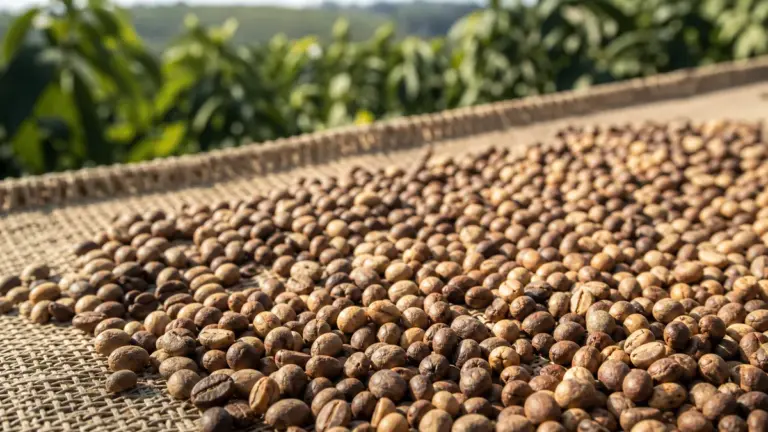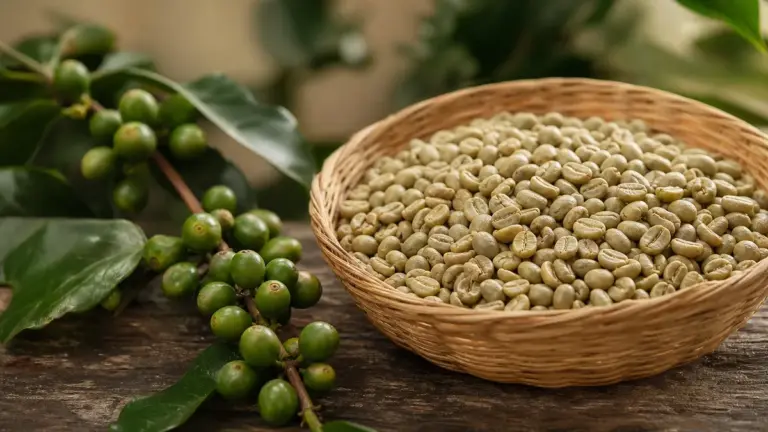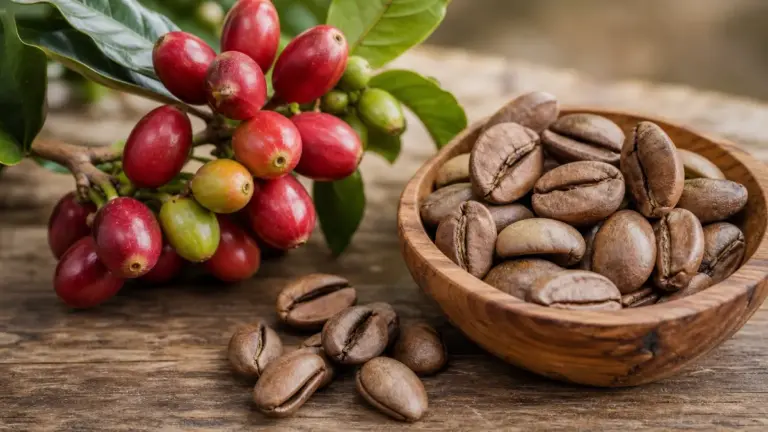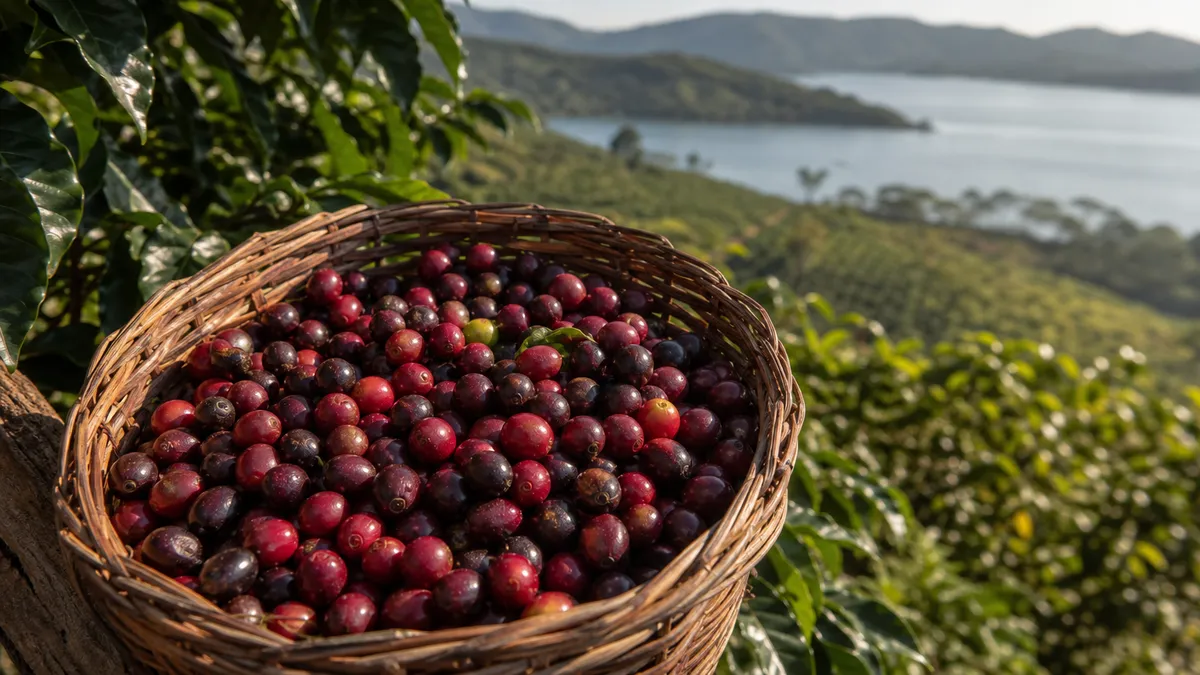
Coffee from the Democratic Republic of the Congo includes bright, fruit-led arabica from the eastern highlands and robusta from lower-lying growing areas. Washed coffees from the slopes around Lake Kivu can offer lemon, berry and tropical-fruit notes with honey-like sweetness, but the named producer and processing method tell you more than the country name alone.
In short
- Look for a named co-operative, washing station or producer, not simply “Congo”.
- Lake Kivu arabica is a useful starting point for readers seeking fruit, sweetness and lively acidity.
- Published growing elevations for SOPACDI and KACCO span approximately 1,460 to 2,000 metres, not a national altitude range.
- Robusta is a separate part of Congolese coffee production, including projects in Ubangi and the Yangambi area.
- Conflict affects people and supply routes. A traceable purchase needs evidence about the particular supply chain, not a general promise to “help Congo”.
Where Congolese coffee grows
The Democratic Republic of the Congo, usually shortened to DRC, should not be confused with the neighbouring Republic of the Congo. For buying purposes, ask the seller to identify the country explicitly rather than relying on “Congolese coffee”.
Within the DRC, the main distinction is between eastern highland arabica and robusta grown across lower-lying areas. The USAID-supported coffee sector guide identifies arabica production in North Kivu, South Kivu and Ituri, with robusta across parts of the north-east, centre and west.
Lake Kivu is the most useful geographical starting point for understanding the arabica discussed here. On its Congolese side, smallholder farms occupy hills above the lake, including the Kalehe area of South Kivu. KACCO describes family plots on these slopes, while SOPACDI identifies its production area around Minova.
However, “Kivu” is not one farm, one variety or one flavour. A coffee labelled South Kivu still needs a more specific identity: a co-operative, station, locality and harvest. Nor should every eastern Congolese coffee be described as lakeside coffee.
For the wider regional context, start with west and central African coffee.
Origin fact panel
The figures below describe named Kivu producers where specified. They should not be read as limits covering every arabica or robusta farm in the DRC.
| Feature | Verified detail | Scope and source |
|---|---|---|
| Altitude | SOPACDI publishes 1,460 to 2,000 metres; KACCO publishes 1,500 to 2,000 metres | Producer-reported farm elevations, Sources 2 and 3 |
| Main varieties | Bourbon is prominent. SOPACDI also lists “Katimor”; KACCO lists local material including Mulungu and Kabare16 | Producer terminology, not a national genetic survey, Sources 2 and 3 |
| Processing | Fully washed and semi-washed arabica are documented. Rikolto also reports trials of natural and honey processing | Named producer ranges and project activity, Sources 2, 3 and 4 |
| Harvest months | SOPACDI: March to June and September to December. KACCO: February to June, with a secondary harvest in October to December | Local calendars, not one national season, Sources 2 and 3 |
| Typical cup profile | Fruit, honey-like sweetness and bright acidity; SOPACDI additionally describes lemon, blackberry and tropical fruit | Producer descriptions, not independent testing by this website, Sources 2 and 3 |
These overlapping but different harvest calendars are useful reminders to ask about the actual lot. Harvest dates and export dates are different information.
What does coffee from the Democratic Republic of the Congo taste like?
For washed Kivu arabica, fruit and sweetness are sensible expectations, provided they remain expectations rather than guarantees. Producer descriptions include citrus, berries, tropical fruit, honey and floral aromas.
KACCO describes bright acidity and a balanced body. In plain terms, acidity is the refreshing, mouth-watering impression in the cup; body is its weight and texture. A coffee can therefore feel lively without being thin, and sweet without tasting sugary.
There is no single compulsory “Congolese flavour”. A named lot may emphasise lemon and honey, another darker fruit or floral aromas. Read the roaster’s description of that coffee rather than assuming the national origin supplies its tasting notes.
The World Coffee Research Sensory Lexicon provides a framework for describing aroma, flavour and texture. Its value here is precision: “fruity” becomes more useful when the seller can explain whether they mean citrus, berry or tropical-fruit characteristics.
My buying preference would be a traceable washed Kivu arabica as a first introduction. That recommendation rests on the detailed producer information available for these coffees, not a claim that washed arabica is inherently better than Congolese robusta or other processes.
Robusta deserves a separate explanation
Robusta, the trade name commonly used for cultivated Coffea canephora, is not simply a stronger version of Kivu arabica. It is a different species and a distinct part of the country’s coffee sector.
Café Africa documents robusta development work in Ubangi, in the north-west, and a value-chain study around Yangambi in Tshopo Province. It also reports work concerning Petit Kwilu in Kongo Central. These examples show why Lake Kivu alone cannot stand for all Congolese coffee.
Yangambi has botanical significance as well as commercial relevance. Peer-reviewed research documents wild C. canephora populations in surrounding rainforest alongside cultivated plants and the INERA coffee collection. Wild plants, research collections and commercial crops should not be treated as interchangeable sources of coffee for sale.
Avoid attaching one unsupported tasting profile to all of this robusta. If buying a named Congolese robusta, ask for its locality, processing method and the seller’s assessment of the actual lot. A description borrowed from washed Kivu arabica would be misleading.
The broader comparison with Cameroon’s coffee is useful when exploring countries whose coffee production also needs more than a single national flavour label.
Processing and the role of washing stations
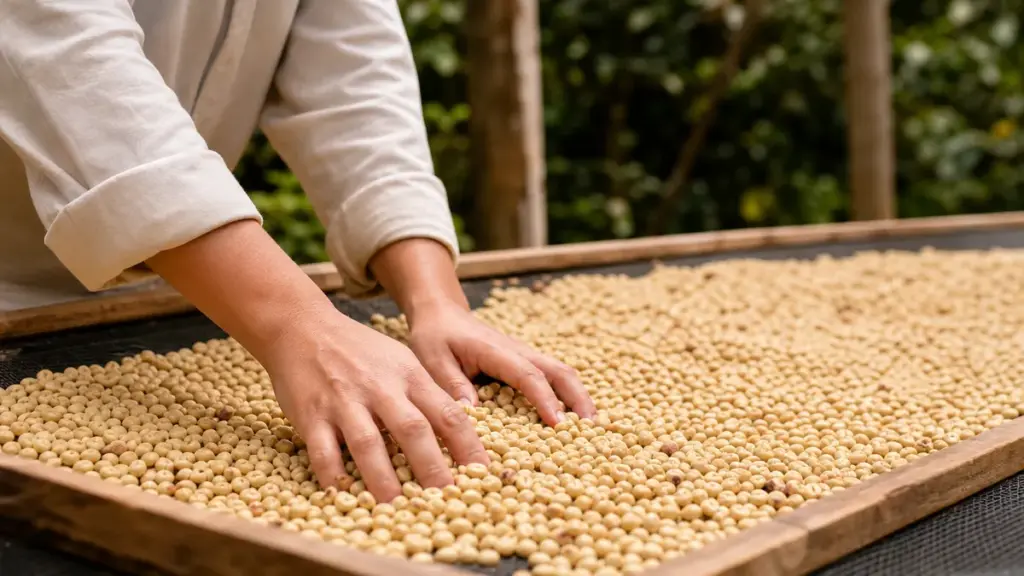
“Washed” describes post-harvest processing, not a brewing instruction. SOPACDI describes a sequence of cherry selection, pulping, fermentation, washing, sorting and drying. Pulping removes the fruit’s outer flesh; subsequent processing prepares the seeds for drying and milling.
A washing station gives growers shared processing equipment and an organised place to handle their crop. Rikolto’s work in eastern DRC explicitly links central washing with reducing variation in coffee quality. It also describes local tasting facilities that allow co-operatives to assess coffee without sending every sample abroad.
Semi-washed coffee needs a little more explanation from the seller. KACCO distinguishes fully washed station processing from semi-washed home processing. Do not assume that every producer uses these labels for an identical sequence of operations.
Natural and honey processes also appear in Rikolto’s project reporting as experimental approaches. That establishes their presence, not their prevalence across the country. For an unfamiliar process, a clear description of what happened to the cherries is more informative than an impressive-sounding label.
The practical lesson is straightforward: processing infrastructure and quality control help explain a coffee’s consistency. Geography supplies context, but it does not replace the work after picking.
What co-operatives contribute
Co-operatives are central to understanding many named Congolese coffees. They can organise processing, provide technical support and bring members’ coffee to buyers. Their name is therefore useful traceability information, not merely background decoration.
SOPACDI and KACCO provide examples from South Kivu. Rikolto documents work with organisations including Kawa Kabuya, Kawa Kanzururu, Kawa Maber and the Idjwi-based SCPNCK. These are distinct organisations serving different places, not alternative names for a single “Kivu co-operative”.
Rikolto also describes access to planting material, business support, local quality assessment and finance. Such services matter because producing coffee and managing an export business require different capabilities.
Nevertheless, membership of a co-operative does not by itself prove a particular household outcome. Ask what the buyer can substantiate: who supplied the coffee, how it was processed, which organisation exported it and whether any certification applies to the lot being offered. A development project’s stated aims should not be rewritten as independently demonstrated results.
Conflict and supply-chain challenges
Conflict is essential context, but it should not become the coffee’s entire identity. UNICEF’s report covering 2025 documents severe humanitarian deterioration, displacement and restricted access in eastern DRC. The International Organization for Migration’s 2026 response plan describes continuing insecurity and acute challenges in North and South Kivu.
For coffee, the relevant consequences include interrupted movement and difficulty maintaining dependable trade routes. The December 2022 USAID-supported sector guide documents poor transport infrastructure, lengthy routes to export ports and road disruption associated with insecurity. Those are structural findings from a dated report, not confirmation that any particular route is open today.
For a current purchase, ask the importer to confirm the dispatch route, stock position and producer relationship. Do not infer the status of an individual co-operative from a national headline.
Equally, avoid accepting a sweeping claim that buying any Congolese coffee automatically delivers peace or guarantees fair treatment. Request specific evidence about the relationship and any stated support programme. Producers deserve recognition for their agricultural and commercial work without being reduced to an anonymous story of crisis.
How to choose a traceable lot in the UK
Use the information accompanying the coffee as your first comparison tool:
- Confirm the country and species. Look for DRC and an explicit arabica, robusta or blend description.
- Find the producer identity. Prefer a named co-operative, station or estate over a country name alone.
- Check the process and harvest. Ask for clarification if either is missing or expressed only in promotional language.
- Read the actual tasting description. Choose the characteristics you want, rather than buying an assumed national profile.
- Question impact claims. Look for a named programme, relationship or applicable certification rather than a broad ethical promise.
For more detailed variety information, distinguish producer labels from verified genetic identity. World Coffee Research describes Bourbon as an arabica variety with excellent cup-quality potential, but also susceptibility to major diseases. Its presence is useful information, not a guarantee of the finished cup.
For coffee from the Democratic Republic of the Congo, the strongest buying description joins place, producer, process and harvest. That gives you something meaningful to taste and compare.
FAQ
Is DRC coffee the same as coffee from the Republic of the Congo?
No. They are separate countries, so a listing that says only “Congo” needs clarification. Ask the seller to state the country and producer explicitly. A named co-operative or locality is also useful because it makes the origin more specific than a national label and helps prevent confusion between similarly named places.
Does a higher growing altitude guarantee better coffee?
No. Altitude is useful context, not a complete quality assessment. The figures in this article describe particular producers’ growing areas, while their processing and quality-control arrangements provide additional information. When comparing bags, prioritise the actual lot description and producer identity rather than choosing whichever listing gives the highest elevation.
Should I only buy Congolese coffee with certification?
Not necessarily. Certification answers questions within a particular scheme; it does not replace information about flavour, producer identity or the supply chain. Ask which certification applies to the coffee being sold, rather than assuming that a co-operative’s past certification covers every present lot. Traceability and clear answers remain useful purchasing criteria.
Where to go next
Read West and Central Africa for the regional framework, then Cameroon for another national origin to compare. Liberia and Côte d’Ivoire and Ghana provide the neighbouring origin guides for extending that comparison without treating the region as one coffee-producing area.
Sources
-
USAID INVEST, Chemonics International and CrossBoundary, An Introductory Guide to the Coffee Sector in the DRC, approved December 2022. Used for production geography, co-operatives and documented transport constraints.
-
SOPACDI, Specialty Arabica, Lake Kivu, DRC, undated live producer profile, checked November 2026. Used for producer-reported altitude, varieties, harvest, processing and sensory descriptions.
https://sopacdi.com/?lang=en -
Kalehe Arabica Coffee Cooperative, Our Cooperative, undated live producer profile, checked November 2026. Used for locality, elevations, varieties, processing, harvest and cup description.
https://www.kacco-rdc.com/en/cooperative -
Rikolto, Speciality coffee from Kivu and Ituri, DRC, undated project account containing historical results. Used for washing stations, processing experiments and co-operative support.
https://www.rikolto.org/projects/speciality-coffee-from-kivu-and-ituri-drc -
Café Africa, Democratic Republic of Congo, live country programme account including 2025 activity. Used for robusta work in Ubangi, Yangambi and Kongo Central.
https://www.cafeafrica.org/partners/democratic-republic-of-congo/ -
World Coffee Research, Bourbon, live Varieties Catalog entry, undated. Used for variety classification, cup-quality potential and disease susceptibility.
https://varieties.worldcoffeeresearch.org/varieties/bourbon -
World Coffee Research, Sensory Lexicon, version 2.0, October 2017, accompanying resource page. Used for the purpose of sensory terminology.
https://worldcoffeeresearch.org/resources/sensory-lexicon -
Verleysen and colleagues, Crop-to-wild gene flow in wild coffee species: the case of Coffea canephora in the Democratic Republic of the Congo, Annals of Botany, 2024. Used for species terminology and Yangambi’s wild and cultivated coffee populations.
https://pmc.ncbi.nlm.nih.gov/articles/PMC11089259/ -
UNICEF, Democratic Republic of Congo, Humanitarian Situation Report No. 2, reporting period January to December 2025, dated 18 February 2026.
https://www.unicef.org/media/179066/file/Democratic-Republic-of-Congo-Humanitarian-Situation-Report-No.2-%28End-of-Year%29-31-December-2025.pdf.pdf -
International Organization for Migration, Democratic Republic of the Congo Crisis Response Plan 2026, 2026. Used for continuing humanitarian and security context.
https://crisisresponse.iom.int/response/democratic-republic-congo-crisis-response-plan-2026
Researched through live searches of primary research, producer publications, development programme accounts and UN reporting; producer descriptions are attributed, and no first-hand tasting is claimed.
Last checked: November 2026