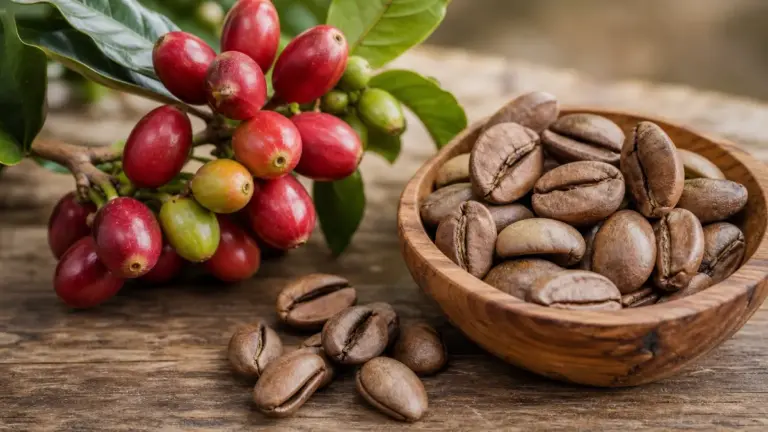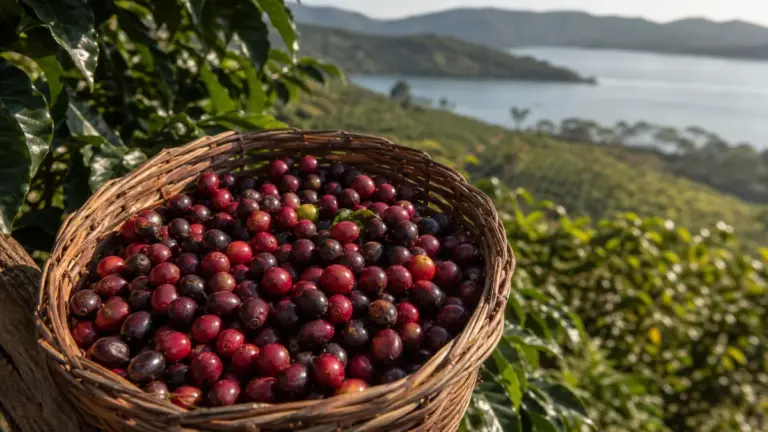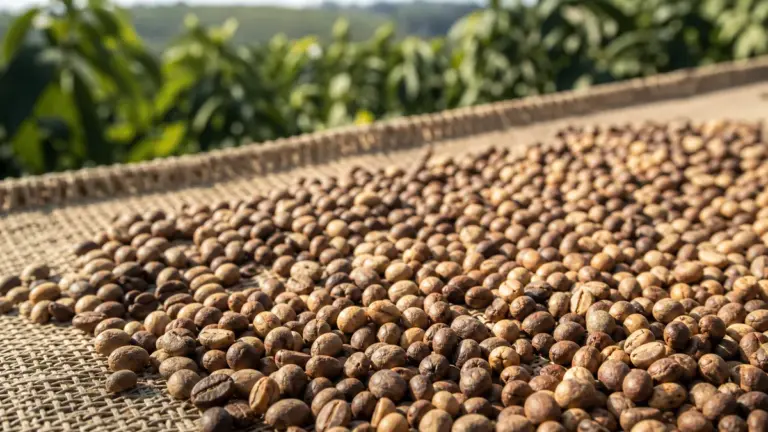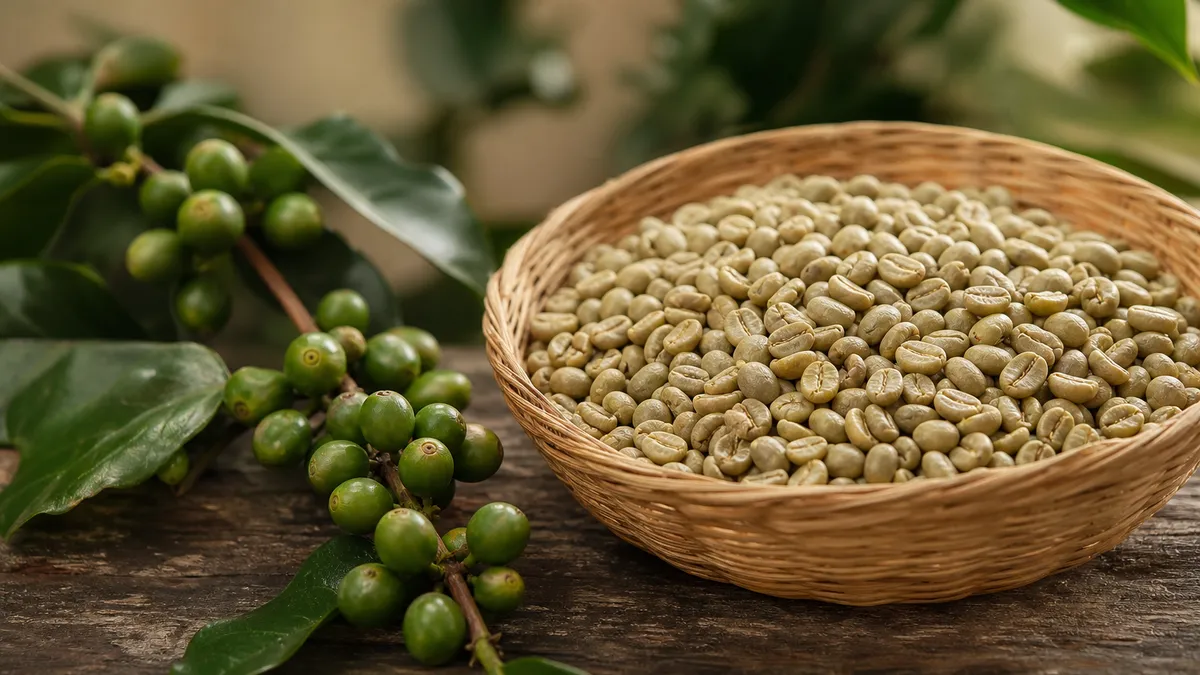
Cameroonian coffee has two distinct sides: highland arabica with chocolate, fruit or tea-like notes, and predominantly lower-grown robusta known for a full, nutty cup. For a useful first purchase, look beyond the country name to the species, growing area and processing method, especially when choosing arabica from Boyo or the western highlands.
In short
- Arabica is concentrated in the West and North-West regions; robusta dominates the national coffee sector.
- Boyo and the Bamenda highlands are useful names to look for on traceable arabica.
- Documented arabica examples grow at about 1,100 to 1,600 metres, but this is not a complete national altitude range.
- Washed arabica is a good starting point for exploring the origin; robusta generally follows a dry-processing tradition.
- Java is an arabica variety with a significant Cameroonian breeding history, not proof that the beans were grown in Indonesia.
Cameroon coffee at a glance
The panel below distinguishes broad background information from named examples. Farm and lot details are more useful than a single supposedly definitive national specification.
| Feature | Arabica | Robusta |
|---|---|---|
| Main growing areas | West and North-West, including the Noun area and Bamenda highlands | Littoral, West, South-West, East and Adamawa |
| Documented altitude examples | Frères du Noun: 1,100 to 1,200 metres; Boyo listing: 1,600 metres | INTAFRI’s Bankim sourcing description: about 700 metres |
| Varieties and planting material | Java and Typica are documented; do not assume either without lot information | Often identified simply as local robusta, rather than by a named cultivar |
| Processing | Washed examples are well documented | Traditionally dry processed |
| Indicative harvest months | September to February in an older sector overview; Frères du Noun lists October to January | November to mid-February in the same older overview |
| Cup expectations | Lot-specific examples include chocolate, red fruit, malt and black tea | Broad sector descriptions emphasise fullness and nuttiness |
The harvest calendar is indicative, not a promise about every district or season. Likewise, the altitude examples show the contrast between particular sources, not the lowest and highest coffee farms in Cameroon.
Where coffee grows in Cameroon
Arabica in the western highlands
Cameroon’s arabica story centres on the West and North-West regions. The National Cocoa and Coffee Board, usually known by its French abbreviation ONCC, recorded these two regions as the sources of all arabica in its 2023/2024 regional production account.
Within the West, useful names include Bafoussam and the Noun area. Belco’s traceability information places the Frères du Noun farm at Kouoptamo and identifies its coffee as washed Java arabica. This is a concrete example of why a regional or farm name tells you more than “Cameroon arabica” alone.
In the North-West, look for Boyo and the Bamenda highlands. These names appear in documented smallholder sourcing relationships, including coffees marketed through the Hilltop Farms network. They identify a producing area or sourcing network, not a botanical variety.
For the wider geographical context, start with west and central africa. Cameroon deserves its own treatment within that region because its commercial coffee includes both highland arabica and a much larger robusta sector.
Robusta in lower and middle elevations
Robusta is particularly associated with the Littoral region, including the Moungo production basin. Other documented growing areas include the West, South-West, East and Adamawa.
“Arabica highlands, robusta lowlands” is a useful first distinction, but it is not a rigid boundary. Cameroon’s sector guide also describes robusta at middle elevations in the West, while INTAFRI identifies a Bankim source at about 700 metres.
The practical point is to ask which coffee you are buying. A Cameroonian robusta and a Boyo arabica should not be treated as interchangeable expressions of one national flavour.
What does Cameroonian coffee taste like?
Arabica: chocolate, fruit and sometimes tea
A sensible starting expectation is an arabica with chocolate-led sweetness and a substantial body, with fruit or tea-like detail depending on the lot. That description comes from specific traded coffees, not a national sensory survey.
For example, UK roaster Ethical Addictions describes its washed Boyo coffee with dark chocolate and red-fruit notes. Forte Legato describes another Boyo offering in terms of malt sweetness, black tea and medium acidity. Together, these illustrate a useful range, but neither description should be transferred automatically to an unrelated Cameroonian coffee.
These are the sellers’ tasting descriptions, not results from testing carried out for this article. Read them as guidance about a particular offering, then check that the bag’s producer, process and roast information match the coffee being described.
My recommendation for a first introduction is a traceable washed arabica whose roaster gives a clear flavour description. It makes the purchase a testable choice: you are looking for the advertised chocolate, fruit or tea character, rather than trying to discover what an entire country “ought” to taste like.
Robusta: full and nutty
Cameroon’s official coffee trade-event guide describes its robusta broadly as rich, full and nutty, with a role in blending. That is a useful orientation, not a guarantee of quality or a detailed description of every lot.
If you are buying robusta specifically, ask for tasting information about that coffee rather than accepting “strong” as the complete description. Fullness, bitterness, sweetness and aromatic character are different things; a useful supplier description should help you decide which you actually want.
For a separate origin comparison, see coffee from côte d’ivoire and ghana, rather than assuming nearby producing countries share Cameroon’s cup profile.
Processing and harvest: why the lot matters
Washed processing is well documented among Cameroonian arabicas. In this method, the fruit is pulped, the remaining sticky material is removed through the wet-processing sequence, and the coffee is dried before final milling.
This need not mean a large central washing station. A field study of North-West producers documented smallholder processing and constraints around access to pulping equipment. Both the equipment and the organisation of the work matter: picking suitable cherries is only the beginning of preparing a consistent coffee.
The study recorded delayed pulping, damaged beans and mixed harvesting as practical quality problems. It was a local study published in 2011, so it should not be read as a current assessment of every Cameroonian farm. Its continuing value is in explaining why “washed” alone is not a complete quality assurance.
Robusta has traditionally been associated with dry processing, in which the fruit is dried before the dried outer layers are removed. The older sector overview gives different harvest windows for the two species, while a current Frères du Noun listing supplies its own farm-specific calendar.
For buyers, the right question is therefore: which harvest, processed by whom, and how? A named farm or producer group with a clear process description is more informative than an unexplained processing label.
Java: Cameroon’s important arabica connection
Java is a variety of Coffea arabica, not another coffee species. Its name also needs separating from geographical origin: Java-variety coffee grown in Cameroon is Cameroonian coffee.
World Coffee Research traces its movement from Ethiopia to the island of Java under the Dutch in the early nineteenth century, then to Cameroon in the mid-twentieth century. Breeder Pierre Bouharmont selected it for partial tolerance to coffee berry disease, a fungal disease affecting the fruit, and suitability for smallholders using few inputs.
After nearly twenty years of selection, WCR places its Cameroonian release between 1980 and 1990. It records a subsequent introduction to Costa Rica in 1991 through CIRAD.
The genetic correction
Java was once considered a Typica selection. WCR reports genetic fingerprinting that instead identifies it with an Ethiopian landrace population called Abysinia. This article follows that classification; it does not attribute the underlying DNA testing to WCR itself.
Cameroonian research also helps explain its agricultural significance. A peer-reviewed paper by Cilas and colleagues describes gains in yield and coffee berry disease resistance from Java selection compared with the traditionally grown Jamaïque, or Typica.
The researchers subsequently investigated lines and hybrids at Foumbot. Their work found genetic variation remaining within the Java material, a reminder that a variety name does not necessarily describe a completely uniform population.
For the drinker, this history makes Cameroon more than a stop on Java’s travels. It was an important place of selection and research. Nevertheless, a Java label is a reason to investigate a coffee, not a substitute for information about its growing conditions, processing or cup.
Production: robusta dominates, but figures need labels
Cameroon’s coffee statistics require care because production, marketed production, purchases and exports are different measures.
The ONCC’s 2023/2024 campaign summary lists 10,091 tonnes of robusta and 502 tonnes of arabica under its marketed-production breakdown. Those species figures demonstrate robusta’s dominance, but the report’s stated combined total does not reconcile with that breakdown. It would be misleading to repeat the combined figure without qualification.
For the following campaign, agricultural trading company STE-SCPB’s report of the official season launch states production of 11,637 tonnes for 2024/2025. This is an attributed report of the announcement, rather than a replacement statistical series assembled here.
The useful conclusion is narrower than a league-table ranking: robusta supplies most of Cameroon’s recorded commercial volume, while arabica represents a smaller, regionally concentrated part of the sector. Neither volume nor national ranking tells you how a particular coffee tastes.
How to choose Cameroonian coffee in the UK
Use the following checklist when comparing bags or asking a roaster about an unfamiliar offering:
- Confirm the species. Is it arabica, robusta or a blend? Do not infer this from the country name.
- Look for a producing area. Boyo, the Bamenda highlands or a named West-region farm gives you something specific to investigate.
- Check the variety claim. Java and Typica are documented, but “Boyo” should not replace a variety description.
- Ask about processing and harvest. Prefer an explanation tied to the offering, rather than an undated national calendar.
- Choose by the described cup. Decide whether chocolate and fruit, malt and tea, or a fuller nutty profile sounds most appealing.
These are selection criteria, not a ranking of suppliers. The commercial listings used here demonstrate documented coffees and tasting descriptions; they are not endorsements or independent verification of every supplier claim.
For a first purchase, I would favour clear traceability over an impressive but unexplained origin story. The best introduction to Cameroon coffee is a bag whose species, producing area, processing and intended flavour are all understandable before you brew it.
FAQ
Is Boyo a coffee variety?
No, Boyo is a producing-area name used for coffees from north-western Cameroon, not a botanical variety. Documented Boyo offerings list Java or Java and Typica separately from the origin. If a description puts Boyo in the variety field, ask the seller to clarify the planting material rather than assuming it identifies a distinct cultivar.
Does “Java” on a Cameroonian bag mean an Indonesian blend?
No, it can identify the Java arabica variety grown in Cameroon. The variety’s historical route included the Indonesian island, but that does not determine where a particular crop was grown. Check whether the label uses Java as a variety or as an origin, and ask for clarification if the wording is ambiguous.
Does a seller’s tasting score apply to all coffee from that producer?
Treat a tasting score as applying only to the coffee and assessment it describes. Ask which harvest or lot was assessed, who evaluated it and whether the offered coffee is the same one. For an unfamiliar Cameroonian coffee, those details are more useful buying evidence than an isolated number without an explanation.
Where to go next
Read West and Central Africa to place Cameroon within the wider growing region. Then use Côte d’Ivoire and Ghana and The Democratic Republic of the Congo as separate origin comparisons, rather than treating Cameroon coffee as representative of its neighbours.
Sources
-
World Coffee Research, Arabica Varieties Catalogue: Java, live edition, publication date not stated. Used for Java’s history, classification and agronomic background.
URL: https://varieties.worldcoffeeresearch.org/varieties/java -
Cilas, C., Bouharmont, P., Boccara, M., Eskes, A. B. and Baradat, P., Prediction of Genetic Value for Coffee Production in Coffea arabica from a Half-Diallel with Lines and Hybrids, Euphytica, volume 104, pages 49 to 59, 1998.
URL: -
Office National du Cacao et du Café, Bilan de la campagne caféière 2023/2024: Arabica-Robusta, 2024. Used for species volumes and regional distribution, with the aggregate discrepancy identified above.
URL: https://www.oncc.cm/content/library/documents/resource-bilan-de-la-camp1734428032.pdf -
STE-SCPB, Campagne caféière 2025/2026 : Le Coup d’envoi est donné à Baditoum, 17 January 2026. Used only for its attributed account of the following campaign’s production announcement.
URL: https://www.ste-scpb.com/fr/actualites/campagne-cafeiere-2025-2026-le-coup-d-envoi-est-donne-a-baditoum -
Islamic Centre for Development of Trade and event partners, OIC Coffee Meet Cameroon: Participant’s Guide, 2023, especially the coffee-sector and producing-area sections.
URL: https://adanatb.org.tr/wp-content/uploads/2023/09/OIC-Coffee-Meet-Cameroune.pdf -
Elad Enock Eric, Van Hall Larenstein, Sustainable Arabica Coffee Production under Market Liberalization in Cameroon, May 2011. Used as historical field research, not a current national survey.
URL: https://edepot.wur.nl/247958 -
Belco, Cameroon: Bafoussam, Frères du Noun, Java, Washed, live traceability listing, publication date not stated.
URL: https://www.belco.fr/en/cafes/012201900600000/freres-du-noun -
Ethical Addictions, Cameroon Boyo, live product listing, publication date not stated.
URL: https://eacoffee.co.uk/cameroon-boyo/ -
Forte Legato Coffee, Cameroon Boyo, live sourcing and product description, publication date not stated.
URL: https://fl.coffee/products/cameroon-boyo -
INTAFRI AGRI LLC, Robusta, live sourcing page, publication date not stated. Used for its Bankim altitude example only.
URL: https://www.intafri.com/robusta
This article was researched through live retrieval of national-board reporting, published agronomic research, historical fieldwork and clearly attributed commercial traceability records; no first-hand tasting is claimed.
Last checked: November 2026