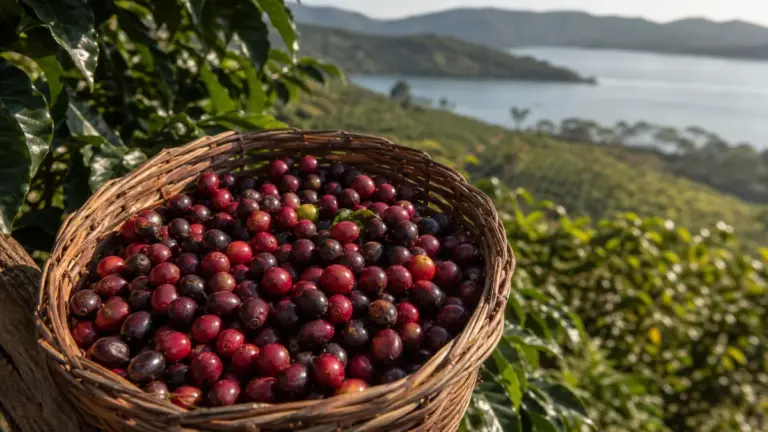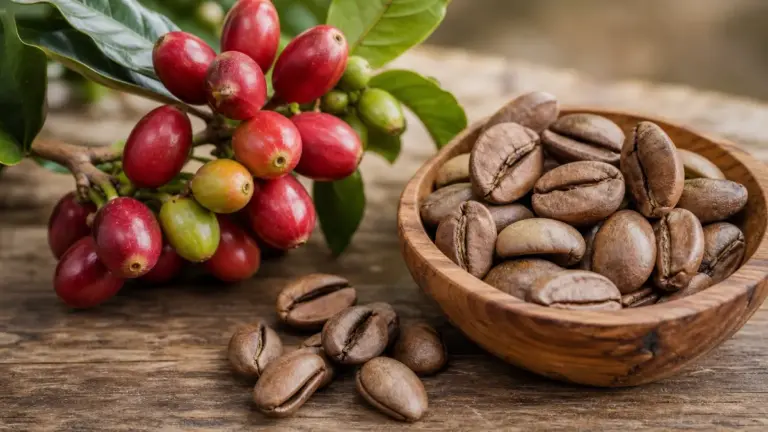
Coffee from Côte d’Ivoire and Ghana is principally robusta, with a generally full-bodied, lower-acidity character rather than the bright, floral style associated with some African arabicas. Côte d’Ivoire has the much larger export sector, while Ghana offers a smaller origin to explore through traceable coffees whose producers describe chocolate, nut and fruit notes.
In short
- Look beyond the country name: ask who grew the coffee, how it was processed and what the roaster actually tasted.
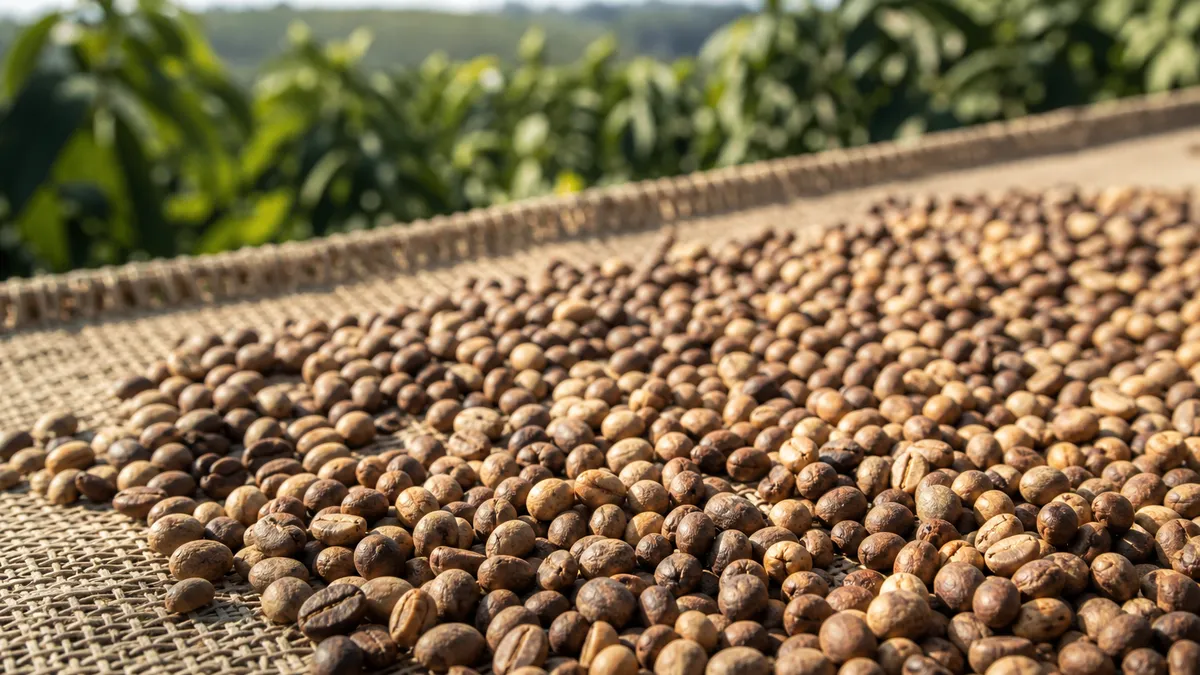
- Natural processing is the established approach: whole coffee cherries are dried before their outer layers are removed.
- The scale differs sharply: ICO figures record 2024 exports of 1,284,816 bags from Côte d’Ivoire and 15,228 from Ghana, using 60 kg bag equivalents.
- Harvest calendars need care: a coffee marketing year is not the same thing as the months when cherries are picked.
- Quality-led robusta is a real development, not a national guarantee: local roasting, careful processing and professional tasting are visible in both countries.
What coffee from Côte d’Ivoire and Ghana tastes like
Robusta is the commercial name commonly used for coffee from Coffea canephora, a different species from Coffea arabica. World Coffee Research describes its broad sensory tendency as lower acidity, greater bitterness and fuller body than arabica. That is useful orientation, but it is not a tasting note for every farm.
For concrete examples, Ivorian roaster Café Continent describes its natural robustas from Danané, Man and Biankouma using dark chocolate, peanut, cocoa and honey notes. Ghanaian producer and roaster Kawa Moka describes chocolate, fruit and nuts in its coffee. These are the businesses’ own descriptions, not independent tasting results.
The practical distinction is between a broad robusta expectation and a documented individual lot. If you enjoy cocoa-led coffee, substantial texture and a pronounced finish, these origins deserve attention. If you prefer delicate floral aromas, ask for a sample rather than assuming that any coffee labelled African will provide them.
Neither country should be treated simply as a smaller version of an East African arabica origin. The wider regional coffee guide provides a better starting point for understanding their place.
Origin fact panel
The panel separates established national characteristics from general species guidance. It deliberately does not turn a typical robusta altitude band into an unsupported national minimum and maximum.
| Characteristic | Côte d’Ivoire | Ghana |
|---|---|---|
| Main commercial coffee | Robusta, Coffea canephora | Robusta, Coffea canephora |
| Altitude context | Low-elevation production. WCR gives approximately 200 to 800 m as a typical robusta production context, not an Ivorian national range | The same general robusta context applies, but it is not a verified Ghanaian national altitude range |
| Main planting material | Robusta clones and seed-propagated hybrids, documented in Ivorian agricultural guidance | Robusta clones and hybrids developed and distributed through Ghanaian research and seed-production programmes |
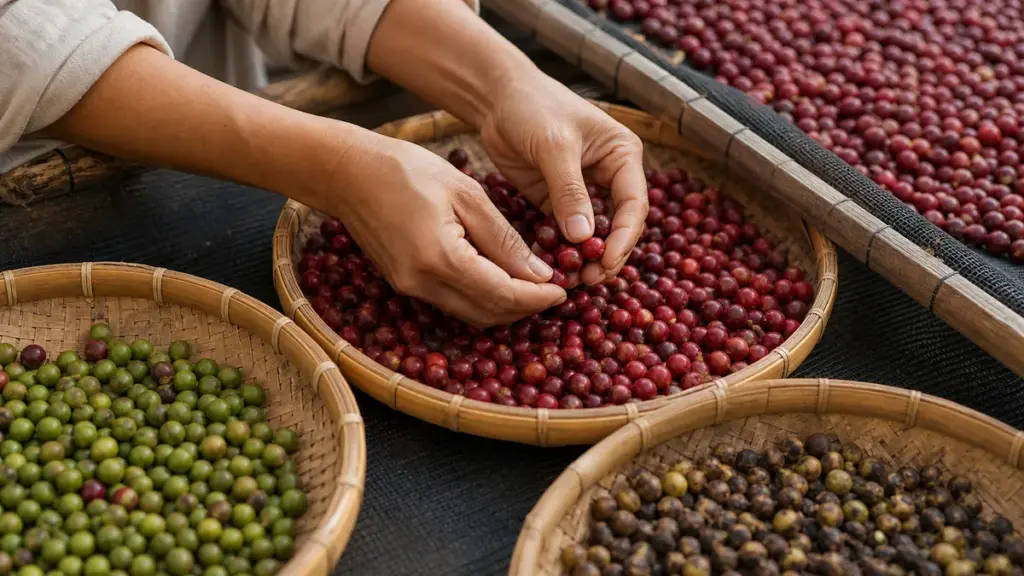
| Established processing | Natural, also called dry processing | Natural or sun-dried processing; raised-bed drying is documented by Kawa Moka |
| Harvest months | FAO’s historical country profile gives October to March; a 2005 field survey recorded August to January, concentrated in September to November | COCOBOD says harvesting starts in September; FAO’s older country profile gives November to March |
| Cup profile to investigate | Full body and robusta bitterness; individual roaster descriptions include chocolate, cocoa, peanut and honey | Broad robusta character; Kawa Moka describes chocolate, fruit and nuts |
How to use the panel: treat harvest months as planning guidance, not a promise about a particular farm. The differences between historical calendars are a reason to request the actual harvest period of the coffee being offered.
“Clone” means planting material reproduced vegetatively from a selected parent, commonly through cuttings. A hybrid is offspring from a cross between parents. Neither word is itself a quality grade, and “robusta” is not a sufficiently precise variety identification.
How robusta production developed
The history has two strands: coffee’s introduction and commercial expansion, and the identification and selection of locally occurring C. canephora. They should not be compressed into a single story about an imported crop.
COCOBOD dates coffee’s introduction to Ghana to the mid-eighteenth century through missionaries. That is a statement about coffee cultivation generally, not evidence that today’s robusta planting material arrived at that date.
In Côte d’Ivoire, a peer-reviewed study of historical herbarium specimens documents native C. canephora recorded near Assikasso in 1909. The study reports that coffee known as Café Petit Indénié was widely cultivated in the east from 1920. Commercial robusta history here therefore includes local genetic resources as well as material brought from elsewhere.
A short verified timeline
- Mid-eighteenth century: COCOBOD places the introduction of coffee cultivation to Ghana in this period.
- 1909: native C. canephora was recorded near Assikasso in eastern Côte d’Ivoire.
- 1920 onwards: Café Petit Indénié was widely cultivated in eastern Côte d’Ivoire.
- 1929: the agricultural station at Man was established, with coffee collections and comparative trials.
- 1957 onwards: Ivorian coffee collections began moving to the research site near Divo.
- 1980s: Ghana’s government established coffee plantations that were subsequently transferred into private participation.
These dates explain why both countries have more behind them than an anonymous robusta label suggests. They also distinguish their histories from neighbouring Liberian coffee, which merits its own account rather than being folded into a generic West African origin.
Production and trade: two very different scales
A useful recent comparison comes from the International Coffee Organization’s September 2025 publication covering calendar-year exports through 2024:
| Measure | Côte d’Ivoire | Ghana |
|---|---|---|
| Coffee exports, calendar year 2024 | 1,284,816 bags | 15,228 bags |
| Reporting unit | 60 kg bag equivalents, all forms | 60 kg bag equivalents, all forms |
These are exports, not production. “All forms” includes coffee traded in different processed forms, expressed on a common reporting basis. The figures should not be presented as the quantity harvested that year.
For a separate production benchmark, the ICO’s Coffee Development Report 2022-23 records Ivorian robusta production at approximately 1.2 million 60 kg bags in coffee year 2022/23. That is an older crop-year estimate, not a November 2026 harvest total.
The clear conclusion is the difference in export scale. It does not establish that an individual Ivorian coffee is more consistent, or a Ghanaian coffee more distinctive. Those are questions for the lot’s documentation and the cup, not national tonnage.
Processing: why drying matters so much
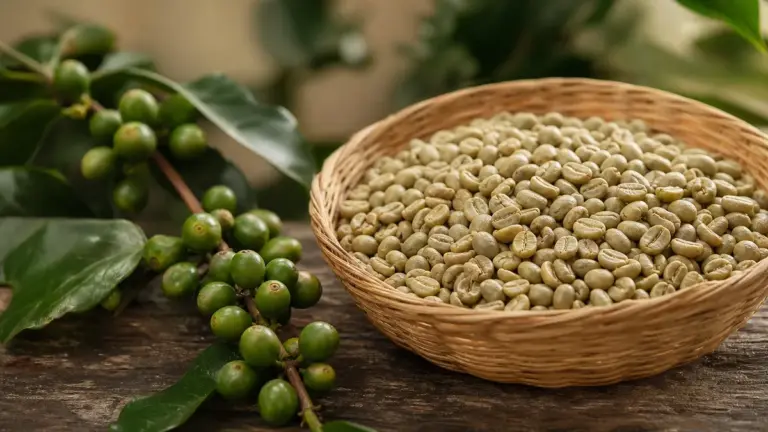
Natural processing means drying the coffee fruit whole, with the seeds still inside. After drying, hulling removes the dried outer material to release the green coffee beans. “Green” here means unroasted, not necessarily green in colour.
FAO’s country profiles describe dry processing in both countries. Its detailed Ivorian study also documents different drying surfaces, turning practices and protection against moisture. Ghana’s ICO country profile describes cherries spread in thin layers on mats or drying grounds and turned regularly.
The mechanism is straightforward: the fruit must lose moisture evenly without remaining damp for too long or becoming wet again. Drying management therefore affects quality before roasting begins. A label saying “natural” tells you the processing category, not how carefully the work was done.
Kawa Moka provides a current producer example: it says red cherries are sorted and dried whole on raised beds. This is evidence of that producer’s method, not proof that raised beds are universal across Ghana.
For buyers, the useful questions are specific:
- Were ripe cherries selected and defective fruit removed?
- What surface was used for drying?
- How was the coffee protected from rain and renewed moisture?
- Were lots kept separate through drying, storage and milling?
- Can the supplier provide a representative sample?
These questions are more revealing than treating sun-dried coffee as either automatically rustic or automatically superior.
Where the coffee is used
Soluble coffee, meaning instant coffee, and blends have been important drivers of robusta demand globally, according to World Coffee Research. FAO’s historical Ivorian profile records exports of green, roasted and soluble coffee, illustrating that the origin’s trade has not been confined to one product.
There is also a different route: keeping an identifiable origin through roasting and sale. Café Continent’s named Ivorian coffees and Kawa Moka’s Ghanaian coffee demonstrate that robusta can be offered as something to examine in its own right, rather than only as an unnamed blend component.
For a home or workplace purchase, start with the intended drink. Ask the roaster whether the particular coffee was developed for espresso, milk drinks or filter brewing, and request preparation guidance. Do not substitute a country reputation for an assessment of the actual coffee.
The comparison with Cameroonian coffee is useful regional reading, but its production and market story should not be assumed to apply to either country here.
Specialty efforts: evidence rather than promises
Ghana’s quality development includes both planting material and post-harvest work. COCOBOD reports that the Cocoa Research Institute of Ghana has developed clonal and hybrid material selected for characteristics including yield, cup quality and tolerance to stresses. Kawa Moka offers a commercial example of origin-focused roasting and sorted, raised-bed natural processing.
Côte d’Ivoire also has documented activity beyond bulk trading. Café Continent markets named local robustas. Separately, an ICO mission report records professional barista and coffee-tasting training held from 5 to 8 May 2025, co-organised by the Conseil Café-Cacao with the International Trade Centre and ACRAM, the African and Madagascan robusta coffee agency.
These are meaningful developments, but their significance needs proportion. Training demonstrates skills investment; a product range demonstrates an attempt to differentiate coffee. Neither establishes the quality of every lot from a country.
For the more curious reader, Côte d’Ivoire’s genetic resources add another layer. The historical-specimen study distinguishes Guinean and Congolese genetic groups within C. canephora and shows why older names can be misleading. Those groups are not separate species or ready-made flavour categories.
The useful buying principle is therefore simple: ask for evidence at the same level as the claim. A named producer, clear process and representative sample support a lot-level decision. A national origin alone does not. The related story in Congolese coffee provides further context without making these origins interchangeable.
FAQ
Does “roasted in Ghana” mean the beans were grown there?
No, the roasting location alone does not establish where the beans were grown. Ask for the agricultural origin as well as the roaster’s address. For an origin-focused purchase, useful details include the producing community or farm, harvest period and processing method. The same distinction applies to coffee roasted in Côte d’Ivoire.
Is arabusta another name for Ivorian robusta?
No, arabusta refers to hybrid material involving arabica and robusta, not a synonym for ordinary robusta. Ivorian agricultural guidance discusses arabusta alongside robusta. If a seller uses the term, ask what planting material the lot contains rather than assuming that all coffee from Côte d’Ivoire is arabusta.
Do chocolate or nut tasting notes mean flavourings were added?
No, those words can describe perceived aromas and flavours rather than added ingredients. However, read the product description: Kawa Moka, for example, also sells explicitly flavoured coffees. For an unflavoured origin comparison, confirm that the product contains coffee only and that its tasting notes describe the coffee itself.
Where to go next
Read West and Central Africa for the regional overview, then Liberia for a separate neighbouring origin history. Cameroon and The Democratic Republic of the Congo provide useful comparisons without reducing Côte d’Ivoire and Ghana to one generic African robusta profile.
Sources
-
World Coffee Research, History of Robusta, live Varieties Catalog, undated. Species, general sensory characteristics, altitude context and uses.
https://varieties.worldcoffeeresearch.org/robusta-2/history-of-robusta -
Ghana Cocoa Board, Coffee, undated. Ghanaian cultivation history, production structure and harvest start.
https://cocobod.gh/pages/coffee -
Plant Ecology and Evolution, New insights on spatial genetic structure and diversity of Coffea canephora (Rubiaceae) in Upper Guinea based on old herbaria, 2020, volume 153(1). Historical records, collections and genetic distinctions.
https://horizon.documentation.ird.fr/exl-doc/pleins_textes/divers20-04/010078955.pdf -
International Coffee Organization, Basis for the initial distribution of votes among exporting and importing Members for coffee year 2025/26, ED 2488/25 Rev. 1, 3 September 2025. Calendar-year export figures, Table 1.
https://ico.org/documents/cy2024-25/ed-2488-r1e-basis-votes.pdf -
International Coffee Organization, Coffee Development Report 2022-23: Beyond Coffee, Towards a Circular Coffee Economy, reporting edition 2022/23. Ivorian robusta production estimate, Figure D.25.
https://ico.org/documents/cy2024-25/coffee-development-report-2022-23.pdf -
FAO, Post Harvest Handling and Processing of Coffee in African Countries, Annex 4, Africa Coffee Producing Countries Profiles, 2000. Historical harvest calendars, processing and traded forms.
https://www.fao.org/4/X6939E/X6939e10.htm -
FAO and CNRA, Brou Oguo Landry, Etude Socio-Economique du Projet Ochratoxine A, final report, July 2005. Ivorian field-survey harvest calendar and drying practices.
https://www.fao.org/fileadmin/user_upload/agns/pdf/coffee/Annex-E.11.pdf -
FIRCA and collaborating organisations, Guide de régénération des vergers de cacaoyer et de caféier en Côte d’Ivoire, undated edition retrieved in 2026. Robusta planting material and arabusta distinction.
https://firca.ci/wp-content/uploads/2026/06/Guide-de-regeneration-des-verger-de-cacaoyer-et-de-cafeier-en-Cote-dIvoire.pdf -
Ghana Cocoa Board, Coffee: Production, Consumption & Potential Health Benefits, 2022. Used only for cultivation and breeding information, not health claims.
https://cocobod.gh/news/coffee-production-consumption-potential-health-benefits -
International Coffee Organization, Country Coffee Profile: Ghana, ICC 122-8, 12 September 2018. Field processing and drying.
https://icocoffee.org/documents/cy2017-18/icc-122-8e-country-profile-ghana.pdf -
Kawa Moka, Our Story and From Seed to Cup, undated live pages. Producer-reported flavour descriptions and processing, not independently tested.
https://kawamoka.com/pages/our-story
https://kawamoka.com/pages/story-of-a-bean -
Café Continent, Cafés, undated live product page. Named Ivorian natural robustas and seller-reported tasting notes.
https://cafecontinent.com/cafes/ -
International Coffee Organization, Informe de misión, MR 02/25, May 2025. Ivorian professional training and participating organisations.
https://www.ico.org/documents/cy2024-25/mr-2c-cote-d-ivoire-may-2025.pdf
Researched through retrieved intergovernmental reports, national agricultural guidance, peer-reviewed historical research and clearly attributed producer descriptions, with historical calendars distinguished from current lot information.
Last checked: November 2026