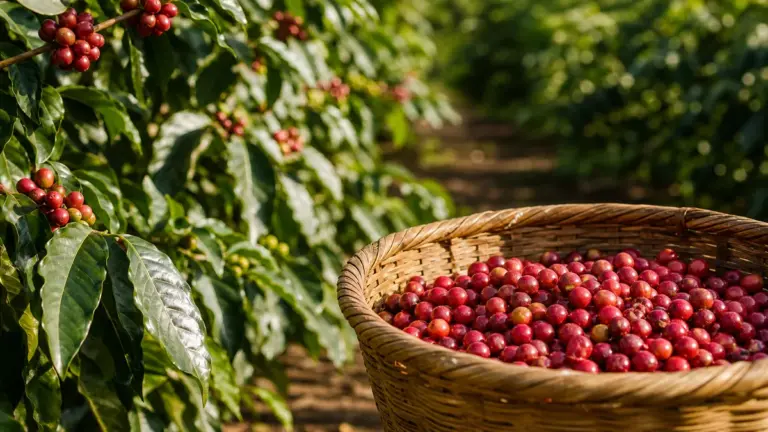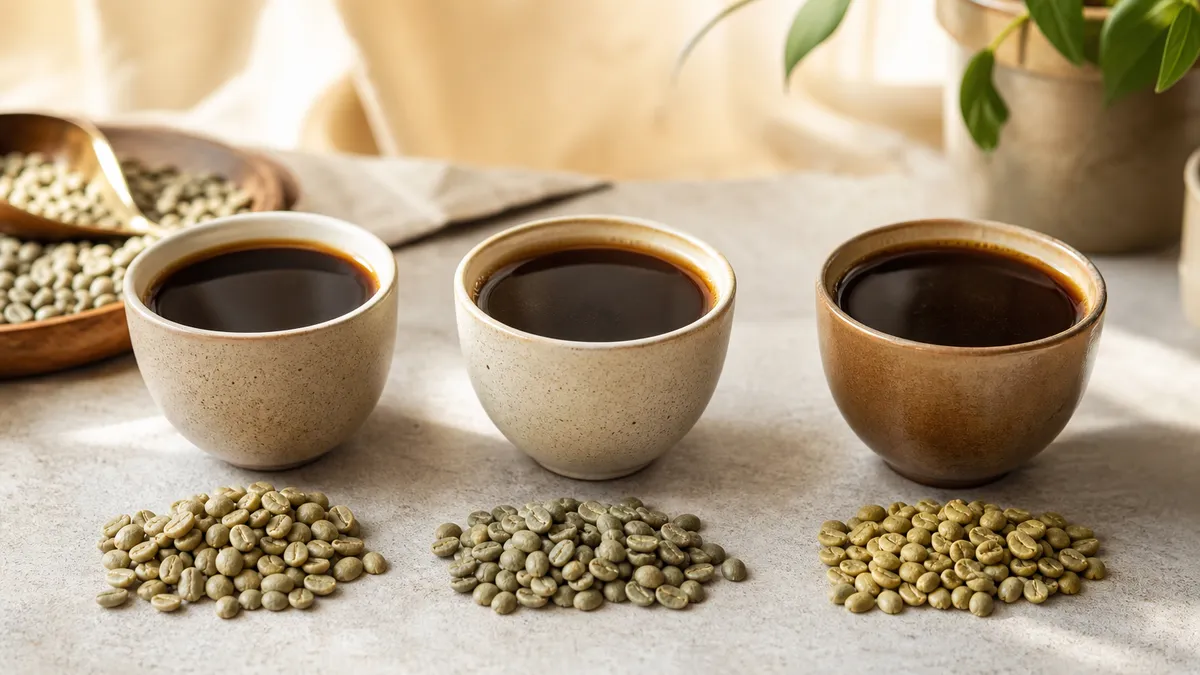
Origin affects coffee flavour through the varieties grown, the conditions in which the fruit ripens and the way producers process the harvest. A place name is therefore a useful clue, not a tasting guarantee: buy by the combination of origin, variety, processing and roast rather than country alone.
In short
- Look for the region, producer or washing station alongside the country name.
- Read altitude as a clue to growing conditions, not a quality score.
- Check processing before attributing a fruity or fermented flavour to geography.
- Compare coffees at similar roast levels, using the same water and brewing method.
- Treat regional tasting profiles as starting points, then judge the particular lot.
What an origin label can tell you
Origin answers “where was this coffee grown?”, but the answer can be broad or precise. A country name covers a much wider range of growing conditions than a named farm or separately identified lot, meaning a batch kept distinct during production.
For buying, specificity gives you better questions to ask. “Guatemala” is a starting point; a named region, producer, variety and process provide a more useful basis for comparison. More detail does not prove better flavour, but it makes the coffee easier to understand and potentially find again.
Think of origin as a bundle of influences rather than an ingredient. Geography helps determine temperature, rainfall and growing conditions, while local planting choices and processing practices also shape what reaches the roaster.
Our coffee growing regions guide provides the geographical overview. Here, the useful question is narrower: which parts of that geographical story can you reasonably expect to taste?
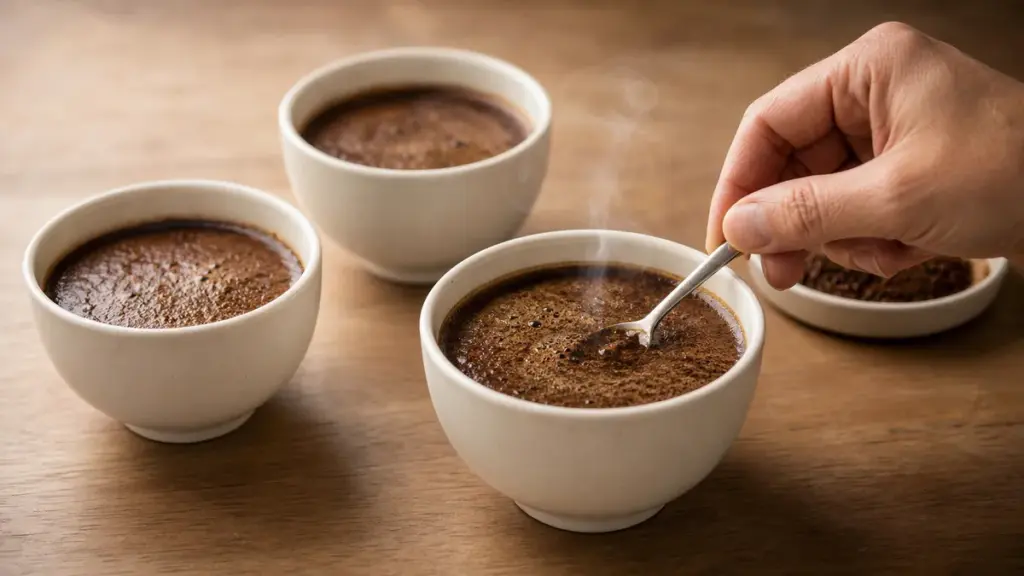
The growing conditions behind origin flavour
Variety: the plant matters as well as the place
A species is a broad botanical grouping; a variety is a more specific plant type within it. Bourbon and Geisha (Panama), for example, are varieties of Coffea arabica, not geographical flavour categories.
World Coffee Research describes Geisha (Panama) as capable of delicate floral, jasmine and peach-like aromas when well managed at high altitude. Its Bourbon entry likewise describes strong cup-quality potential at higher altitudes. These are statements about potential under suitable conditions, not promises for every bag.
This matters when comparing countries. A shared variety gives coffees something in common even when they grow far apart, while different varieties complicate comparisons between neighbouring farms. If you change both country and variety, you are not tasting geography alone.
Altitude: useful shorthand, imperfect prediction
Altitude matters largely because it is associated with temperature. Cooler conditions can prolong fruit development, changing the circumstances in which the seed, the coffee bean, develops.
Research often associates higher-altitude coffee with favourable sensory assessments, but “higher is better” is too simple. World Coffee Research explicitly adjusts its altitude guidance by latitude: a suitable elevation near the equator is not automatically equivalent to the same elevation farther from it.
Shade adds another interaction. A field study in Ethiopia found that altitude, shade and harvest period worked together to influence quality. At its higher sites, dense shade was less favourable than open or moderately shaded conditions.
The practical lesson is to read elevation alongside region and variety. Do not use the largest altitude figure on the shelf as a buying rule.
Climate: more than annual rainfall
Temperature, light exposure and water availability affect coffee development, but they do not operate independently. Shade changes the environment around the tree; rainfall and dry periods occur at different stages of fruit development.
A systematic review found relatively consistent evidence linking altitude and reduced light exposure with improved sensory assessments, but more mixed findings for water stress. That does not establish a universal recipe of maximum elevation, maximum shade and minimum rain.
For the wider climatic setting, see the bean belt. When assessing a particular bag, ask about the lot rather than expecting a national climate description to explain its flavour completely.
Soil: an indirect influence, not a flavour ingredient
Soil can influence tree growth through water retention and nutrient availability. Nutrient management can also affect bean chemistry: a controlled hydroponic experiment found that changing nitrogen and potassium supply altered chemical measures and beverage quality.
That is not evidence that a named soil produces a named tasting note. A claim such as “volcanic soil creates chocolate flavour” needs evidence beyond the presence of volcanoes nearby.
For buyers, “volcanic” is useful geographical information but an incomplete flavour explanation. Ask what the particular coffee tastes like, how it was processed and how the roaster assessed it.
Processing can change what you think is origin
Processing is the work that turns harvested coffee fruit into dried beans ready for further preparation and export. It belongs in any discussion of origin because it happens at the producing end of the chain, yet it is not the same thing as geography.
In natural processing, the fruit is dried intact before the dried outer material is removed. In washed processing, the skin and pulp are removed earlier, with the sticky mucilage around the seed removed before drying. Honey or pulped-natural processing retains some mucilage during drying.
These differences change the conditions around the seed. Microorganisms can break down compounds and produce metabolites during fermentation, contributing to changes in the eventual drink. Experimental research comparing processing and fermentation treatments supports a genuine sensory influence.
However, process names are broad categories, not complete instructions. “Washed” does not tell you every fermentation condition, and “natural” does not specify drying conditions or duration.
If coffees from one country share a processing tradition, some of their apparent regional character may reflect that practice. The growing environment and the producer’s work are both real influences; the difficulty is separating them.
Regional tendencies: useful clues without stereotypes
Regional profiles can help you choose a direction, provided they remain attached to a specific place and, where relevant, a process.
The examples below come from producing-country organisations. They describe those organisations’ published profiles, not independently demonstrated guarantees for every coffee bearing the name.
| Origin example | Published flavour tendency | How to use it |
|---|---|---|
| Washed Yirgacheffe, Ethiopia | Floral, tea-like and lemon-like descriptors | A starting point when looking for floral or citrus character |
| Washed Guji, Ethiopia | Rose, apricot, mango and lime descriptors | A reason to investigate the individual lot’s fruit and floral notes |
| Antigua, Guatemala | Sweetness, rich aroma and balance | A broad profile to compare against the roaster’s description |
| Huehuetenango, Guatemala | Pronounced acidity, full body and wine-like notes | A prompt to explore acidity and texture, not just fruit names |
The contrast between Antigua and Huehuetenango also shows why a single national tasting profile is blunt. Even Anacafé, Guatemala’s coffee association, cautions that individual coffees have complexity beyond its regional descriptions.
Use these profiles to form a hypothesis: “I may enjoy this.” Do not turn them into a verdict: “Coffee from this country always tastes like this.”
How to taste origin fairly
A side-by-side comparison is more useful than trying to remember a coffee from last month. The aim is to notice differences while keeping preparation as consistent as practical.
This is a simplified home comparison informed by SCA preparation principles, not a formal professional assessment.
- Choose a manageable pair. Start with two coffees from different origins, ideally from the same roaster, with similar roast levels and the same broad processing method.
- Hide the descriptions. Have someone conceal the bags and keep a record of which cup contains which coffee. Read the tasting notes afterwards.
- Prepare them consistently. For each coffee, use 11 g of freshly ground beans and 200 g of water, a coffee-to-water ratio of approximately 1:18.2. Use identical heatproof bowls, the same grind setting and water at about 93°C.
- Smell, then steep. Smell the dry grounds before adding water. After 4 minutes, gently stir the floating crust, smell again and skim away floating grounds and foam.
- Taste as they cool. Wait until comfortable to sip. Compare aroma, acidity, sweetness, bitterness, body and aftertaste, returning to each cup as it cools.
- Describe before identifying. Begin with broad observations such as floral, fruity, nutty, light-bodied or drying. Reveal the bags only after recording your impressions.
The World Coffee Research Sensory Lexicon offers shared vocabulary and reference materials for describing coffee. You do not need to identify an exact fruit to make a useful observation.
Repeat the comparison with another pair before forming a regional preference. One enjoyable coffee tells you that you liked that lot, not that you have established the flavour of a country.
Where the evidence stops
Association is not isolation
Field research can show that coffees from different sites have different chemistry or sensory assessments. It is harder to establish which site characteristic caused the difference.
Altitude may change alongside temperature, variety, shade, soil and farm management. Processing may differ too. A systematic review of environmental influences identified inconsistent methods, interacting variables and limited long-term evidence as important constraints.
Controlled experiments can isolate particular interventions more effectively, but their results still need context. A nutrient experiment in hydroponics cannot provide a universal flavour rule for farms with different soils and climates.
Quality scores are not flavour descriptions
A higher sensory quality score does not, by itself, tell you whether a coffee tastes floral, nutty or wine-like. Research on coffee terroir distinguishes descriptive analysis, what the coffee tastes like, from assessments of how favourably it is judged.
Here, terroir means the interaction of place, plant and production practices that contributes to sensory character. Researchers also debate its boundary: should it end at harvest, or include locally shaped processing? The distinction matters when someone claims that a flavour comes “from the land”.
The cup is not an untouched sample of the farm
Roasting, grinding and brewing influence the sensory experience used to assess origin. Comparing a dark-roasted espresso with a lightly roasted filter coffee introduces too many differences to support a confident geographical explanation.
Harvest timing is another part of the buying context, covered separately in coffee harvest seasons.
The most useful way to understand how origin affects flavour is to keep a record of coffees you enjoy, including region, variety, process and roast. Look for patterns across several lots, while leaving room for the next coffee to surprise you.
FAQ
Does a more precise origin label mean better coffee?
No, a more precise label gives you more traceability, not proof of better flavour. A named producer or lot makes it easier to investigate what you are buying and compare it with future purchases. Judge that information alongside the process, roast and your own tasting, rather than treating detail alone as a quality certificate.
Can you identify a coffee’s country just by tasting it?
Do not treat a country identification by taste as certain. Coffees can share sensory descriptors across origins, and processing and preparation complicate the comparison. For learning, recording what differs between cups is more useful than guessing the passport. A successful guess does not establish which growing condition produced the flavour.
What if I cannot taste the fruit named on the bag?
You can still make a useful assessment without identifying that exact fruit. Start with broader categories such as fruity or floral, then compare acidity, sweetness, texture and aftertaste. Shared sensory references can help you practise describing an impression, but the useful outcome is a repeatable observation rather than agreement with every word on the bag.
Where to go next
Read Coffee Growing Regions to put origin names in geographical context, then The Bean Belt Explained for the climatic setting of coffee cultivation. Use Coffee Harvest Seasons by Country when you want to connect an origin with its harvesting calendar.
Sources
-
World Coffee Research, Arabica Varieties Catalogue: Bourbon and Geisha (Panama), live entries, publication dates not stated. Variety identity, quality potential, altitude guidance and Geisha aroma characteristics.
https://varieties.worldcoffeeresearch.org/varieties/bourbon
https://varieties.worldcoffeeresearch.org/varieties/geisha-panama -
World Coffee Research, Sensory Lexicon, version 2.0, October 2017. Sensory vocabulary and reference-based description.
https://worldcoffeeresearch.org/resources/sensory-lexicon -
Ahmed et al., Frontiers in Plant Science, Climate Change and Coffee Quality: Systematic Review on the Effects of Environmental and Management Variation on Secondary Metabolites and Sensory Attributes of Coffea arabica and Coffea canephora, 2021. Environmental evidence and research limitations.
https://www.frontiersin.org/journals/plant-science/articles/10.3389/fpls.2021.708013/full -
Tolessa et al., Journal of the Science of Food and Agriculture, Influence of growing altitude, shade and harvest period on quality and biochemical composition of Ethiopian specialty coffee, 2017, published online in 2016. Field research on interacting growing conditions.
https://pubmed.ncbi.nlm.nih.gov/27786361/
https://library.sweetmarias.com/wp-content/uploads/2020/08/Influence-of-growing-altitude-shade-and-harvest-period-on-quality-and-biochemical-composition-of-Ethiopian-specialty-coffee.pdf -
Clemente et al., Acta Scientiarum. Agronomy, Effects of nitrogen and potassium on the chemical composition of coffee beans and on beverage quality, 2015. Controlled hydroponic nutrient experiment.
https://periodicos.uem.br/ojs/index.php/ActaSciAgron/article/download/19063/pdf_79 -
de Sousa et al., Food Chemistry Advances, Relationship between sensory and microbial profiles of fermented coffee by dry and washed methods, 2023. Processing definitions and experimental fermentation evidence.
https://biblioteca.incaper.es.gov.br/digital/bitstream/item/4430/1/fermented-coffee.pdf -
Ethiopian Coffee and Tea Authority, Coffee, Tea and Spice Exporters Business Directory, undated PDF hosted in September 2022. Published washed Yirgacheffe and Guji profiles.
-
Anacafé, Guatemalan Coffees, Regions and profiles, Antigua Coffee and Highland Huehue, undated live pages. Regional descriptions and their stated limitations.
https://guatemalancoffees.com/main/regions-and-profiles/
https://guatemalancoffees.com/main/regions-and-profiles/antigua-coffee/
https://guatemalancoffees.com/main/regions-and-profiles/highland-huehue/ -
Specialty Coffee Association, SCA Standard 102-2024: Coffee Value Assessment, Sample Preparation and Tasting Mechanics, 2024. Preparation principles used for the explicitly simplified home comparison.
https://sca.coffee/s/AW_SCA-102_Sample-Preparation_281024_Secured.pdf -
Williams et al., Foods, Does Coffee Have Terroir and How Should It Be Assessed?, 2022. Terroir definitions, soil evidence, sensory assessment and preparation controls.
https://pdfs.semanticscholar.org/7fd8/ab7f38938537778a36e5e95dd44ca8074f2e.pdf
This article was researched from retrieved scientific papers, World Coffee Research resources, producing-country organisations and SCA documentation; regional promotional profiles were distinguished from experimental evidence, and no first-hand testing is claimed.
Last checked: November 2026