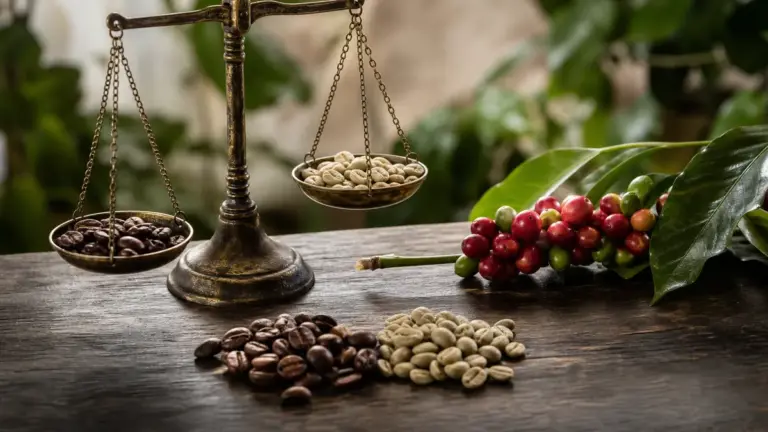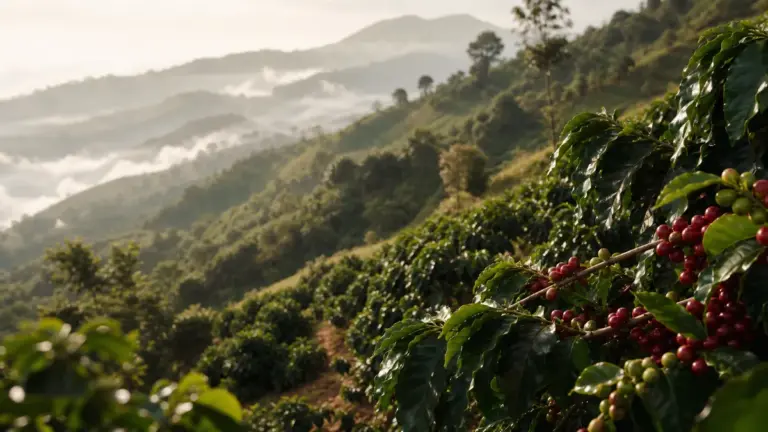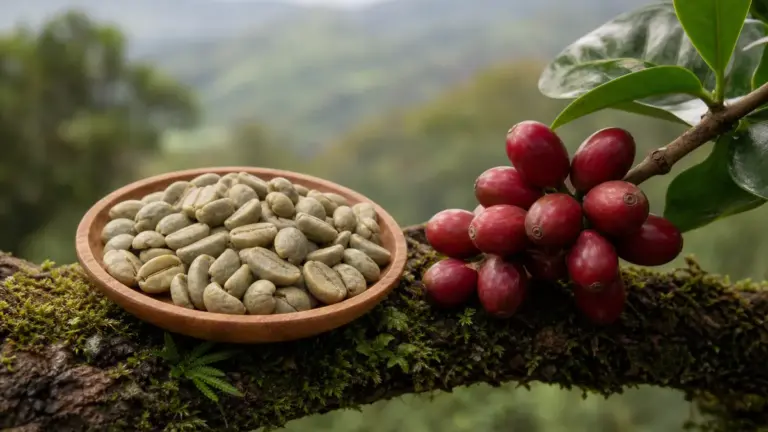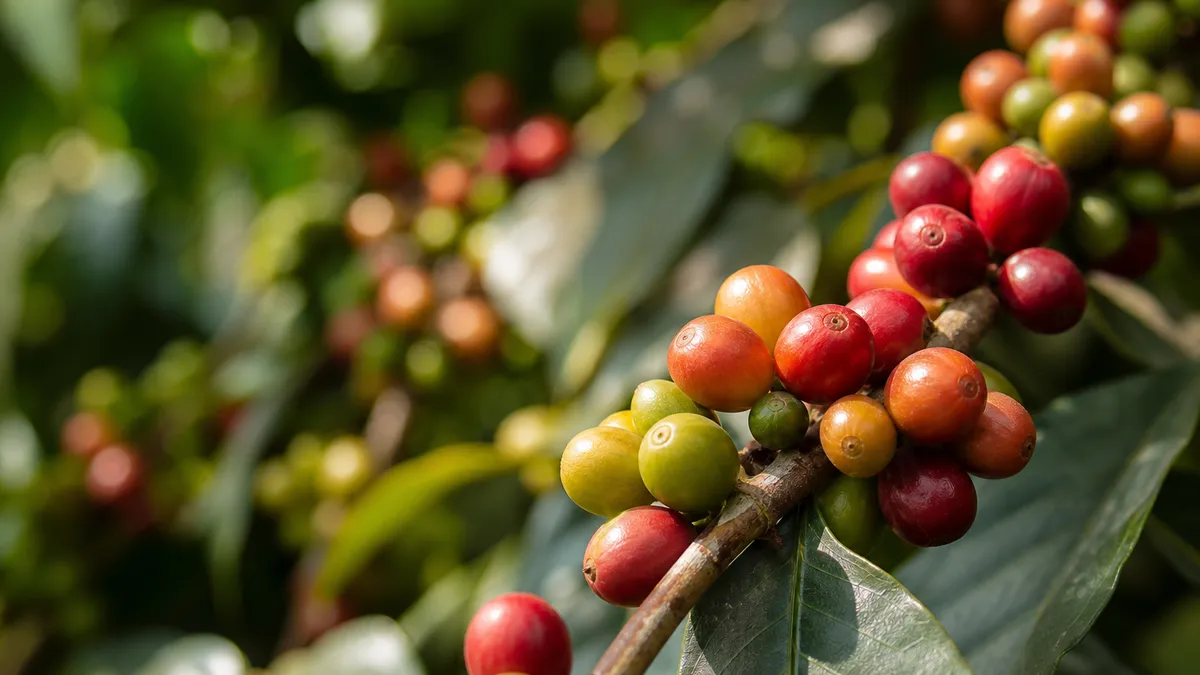
Bolivian coffee can be sweet, clean and rounded, with caramel and chocolate alongside citrus or tropical fruit. For a first taste, look for a traceable washed lot from Caranavi in the Yungas, then explore how other producers and processing methods change the cup.
In short
- Highland growing: Starbucks Coffee Academy gives a principal arabica growing range of 1,200 to 2,000 metres above sea level, not an absolute limit for every farm.
- Read the geography correctly: Caranavi sits within the wider Yungas coffee-growing area, rather than being an entirely separate origin.
- Harvest timing varies: June to October is a useful sourcing guide, while broader calendars extend from May to November.
- The decline is documented: a World Bank assessment recorded national production falling to around 5,400 tonnes in 2018 from an earlier level of 7,800 to 8,000 tonnes. These are historical figures, not a current crop estimate.
- Look beyond the country name: producer, variety, process and harvest information make a more useful buying checklist than altitude alone.
Bolivia coffee at a glance
This panel describes the principal highland origin and documented specialty lots. It is not a claim that every Bolivian farm shares the same conditions or produces the same flavour.
| Feature | Useful guide | Source and qualification |
|---|---|---|
| Altitude | Principal arabica range: 1,200 to 2,000 metres above sea level | Starbucks Coffee Academy, undated origin sheet. Individual farms require their own figures. |
| Main varieties | Typica, Caturra, Catuaí and Catimor | Starbucks Coffee Academy lists these as principal varieties. |
| Processing | Washed is the principal method; natural lots are also produced | Starbucks origin sheet; Agricafe’s published mill description |
| Harvest months | Typically June to October; a broader published window is May to November | Melbourne Coffee Merchants, 2024; Starbucks Coffee Academy |
| Typical cup profile | Sweetness with caramel or chocolate, citrus and sometimes tropical fruit; texture can be creamy or silky | Bolivian National Coffee Council’s 2024 APRAC lot sheet; Melbourne Coffee Merchants’ sourcing observations |
The altitude and variety entries come from the origin sheet; processing and sensory descriptions are supported by producer and buyer records. Treat the flavour row as an orientation, not a national tasting specification.
For the surrounding origins and a route through the continent, start with South American coffee.
Yungas and Caranavi: understanding the names
The Yungas occupy the humid eastern Andean slopes where Bolivia’s main coffee-growing area is concentrated. Caranavi is a municipality within that wider area, so a bag labelled “Caranavi, Yungas, La Paz” is moving from a more specific location to broader geographical descriptions, not listing unrelated growing regions.
For a buyer, Caranavi is a useful starting point, but it should not be the final detail. Ask which community, farm or producer organisation supplied the coffee. A regional name tells you where to begin looking; a named lot gives you something more precise to compare.
One documented example is Walter Flores Uluri’s Café APRAC lot from Uchumachi, Caranavi. Its national competition sheet records washed Red Catuaí grown at 1,600 metres. That combination of producer, community, variety, process and altitude is much more informative than “Bolivian mountain coffee”.
Bolivia’s specialty story also extends beyond the Yungas. Agricafe publishes farm information for both Caranavi and Samaipata in Santa Cruz, and identifies a separate processing mill at its El Fuerte farm in Samaipata. Read these as distinct growing locations rather than assuming every Bolivian lot comes from Caranavi.
What does Bolivian coffee taste like?
A useful starting description is sweetness with clarity, rather than one compulsory fruit note. Melbourne Coffee Merchants describes its Bolivian selections as silky and structured, with examples ranging from sugarcane and stone fruit to wine-like acidity and tropical fruit. These are observations from the coffees it buys, not a representative survey of the entire national crop.
The official APRAC sheet gives a more specific example: caramel and dark chocolate alongside mango, orange-and-lime acidity and a creamy body. It shows why “chocolatey” and “fruity” need not be opposites in a Bolivian coffee. It does not establish that every washed Catuaí lot will taste that way.
For your first purchase, my recommendation is to choose a washed coffee whose description emphasises sweetness and a clear fruit character. Use it as a reference point before trying a more unusual preparation. This is a tasting strategy, not a ranking of processing methods.
Flavour descriptions are sensory comparisons. World Coffee Research’s Sensory Lexicon provides reference aromas, flavours and textures to make that language more consistent. Use tasting notes as prompts for attention, rather than a checklist you must reproduce exactly.
If you are building an Andean tasting sequence, Peruvian coffee is a useful next origin to investigate separately. Compare named lots rather than assuming neighbouring countries should share a flavour.
High farms, varieties and processing
What altitude can tell you
High farms are central to Bolivia’s coffee identity, but elevation is not a quality score. World Coffee Research explains that suitable growing altitude depends partly on latitude: the same elevation does not represent identical growing conditions everywhere. A Bolivian farm’s altitude should therefore be read alongside its location and variety, not used in isolation.
Even within the highlands, published farm bands differ. Agricafe gives 1,400 to 1,650 metres for its Caranavi farms and 1,500 to 1,850 metres for its Samaipata farms. Those are the producer’s published ranges for its own operations, not national boundaries.
Varieties are not separate species
The principal varieties listed in the fact panel belong to arabica coffee, Coffea arabica. Caturra, for example, is a compact natural mutation of Bourbon. World Coffee Research also records its susceptibility to coffee leaf rust, a fungal disease that can cause leaf loss and serious crop damage. A variety name therefore carries agricultural information as well as an expectation about the cup.
Do not assume that a familiar variety makes an unfamiliar origin predictable. Instead, use it to organise a comparison: the same variety across different producers, or different varieties from one producer.
Processing changes what you are comparing
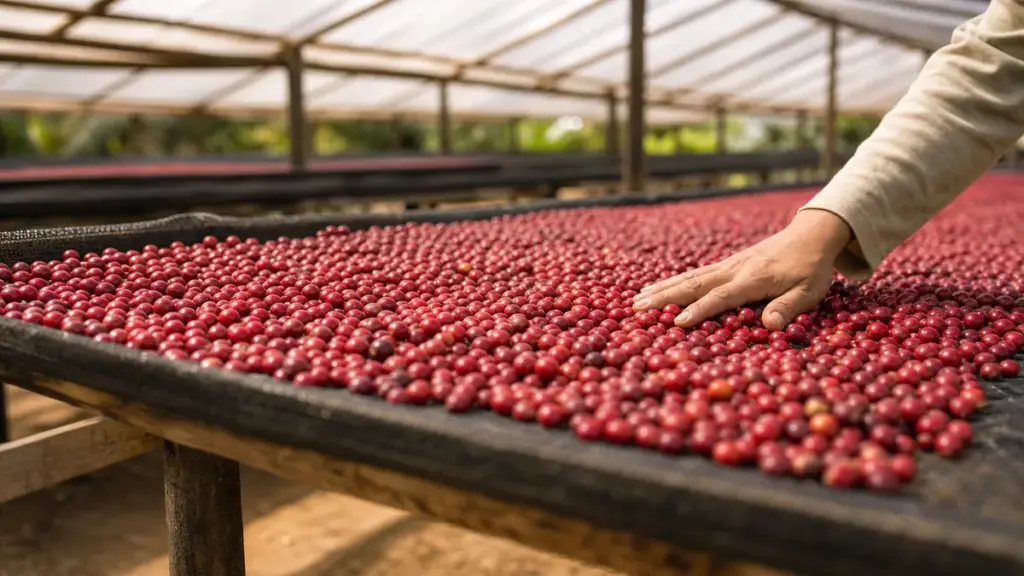
Washed processing removes the fruit and mucilage, the sticky layer surrounding the seed, before drying. Natural processing dries the whole coffee fruit before its outer layers are removed. Honey processing sits between these approaches, with pulped seeds dried while retaining mucilage. These terms describe handling, not grades of quality.
Agricafe documents washed and natural production at its Caranavi hub, using raised beds and mechanical drying. Its published workflow also separates initial processing from later preparation for export. Consequently, ask about the actual lot’s process rather than treating “Bolivia” as shorthand for washed coffee.
For another origin-led comparison, use Ecuador as a separate reading and tasting exercise, keeping variety and processing information beside each sample.
Why did Bolivia’s coffee production decline?
The decline is real, but historical production and export figures must not be mixed together. The World Bank reported production of around 5,400 tonnes in 2018, down from an earlier 7,800 to 8,000 tonnes. Separately, it recorded exports falling from 4,600 tonnes in 2010 to 1,520 tonnes in 2017. Export volume is not total farm output.
That assessment identified several constraints, including low yields, degraded soils, limited inputs, inadequate training and infrastructure weaknesses. It supports a multi-cause explanation rather than a story in which one competing crop accounts for everything. These findings describe the assessment period, not a fresh measurement of conditions on every farm.
Later evidence should also be dated carefully. The International Coffee Organization’s December 2023 report recorded a further 0.9% production decrease between coffee years 2021/22 and 2022/23. That is evidence of a decline in that interval, not proof that production has fallen uninterrupted every year since.
For readers, the useful distinction is between national supply and individual achievement. A contracting sector can still contain producers improving their farming and preparation.
Specialty producers and the work behind the cup
Los Rodriguez and producer training
Agricafe’s Los Rodriguez project combines its own farms with a wider producer-support approach. Its Sol de la Mañana brochure dates the programme’s start to 2014 and describes training in nurseries, planting, pruning, selective picking and farm management. Agricafe presents this as a response to declining production and farm abandonment among its suppliers.
Those are the organisation’s own statements about its programme. They establish its approach, but do not independently demonstrate that it has reversed national decline. When assessing a coffee, keep the producer’s wider work and the quality of the particular lot as related but separate questions.
Cooperatives and agroforestry
Specialty production is not only an estate story. A 2025 IIED case study examines CIAPEC, whose members farm in the Yungas at 1,400 to 1,700 metres. It documents agroforestry, meaning coffee grown within a managed system of trees and other crops.
The study describes training, crop diversification and plantation renewal, while also recording challenges such as disease, soil fertility and labour requirements. This is case-study evidence, not a controlled experiment proving identical benefits everywhere. It gives useful substance to ask about when a seller uses a broad term such as “sustainable”.
For a deeper origin comparison, put Venezuela on your reading list, but keep each country’s production history distinct.
Choosing Bolivian coffee in the UK
My suggested buying checklist is straightforward:
- Identify the producer. Prefer a named farmer, farm, cooperative or clearly described producer group.
- Check the process. Begin with washed if you want a reference point, then compare another preparation.
- Ask for harvest information. Read this separately from the roasting date.
- Choose for your intended drink. Ask the roaster which preparation it recommends for that particular lot.
- Keep the lot details. Record the variety, process and your own impressions before comparing another coffee.
Harvest calendars are guides rather than delivery promises. Melbourne Coffee Merchants places its usual Bolivian harvest from June to October and notes that higher-elevation and rare-variety coffees can ripen later. Its arrival information concerns Australia, so it should not be copied into a UK availability calendar.
The most rewarding way to explore Bolivia coffee is to follow named producers and compare their lots. Let the country name introduce the coffee, then let the details guide your choice.
FAQ
Does a higher-altitude Bolivian coffee automatically taste better?
No, altitude alone cannot establish quality. World Coffee Research treats altitude in relation to latitude and a variety’s agricultural performance, rather than as a universal league table. Use the farm’s elevation as context, then ask for the producer, process and the seller’s assessment of that specific coffee.
Is all Bolivian coffee organic?
Do not assume that it is. The documented production examples include different farming and producer-support arrangements, which cannot establish certification for every coffee sold under the country name. If organic status matters to your purchase, ask the seller for certification covering the actual product rather than relying on a general origin description.
Are chocolate and fruit tasting notes added flavourings?
Tasting notes normally describe sensory impressions, not a recipe of added ingredients. World Coffee Research’s lexicon uses reference flavours and aromas to describe coffee itself. Nevertheless, check the product description if you specifically want unflavoured coffee, rather than using tasting language alone to decide what a seller has supplied.
Where to go next
Read South America for the regional overview, then Peru and Ecuador to plan a comparison between named Andean lots. Venezuela offers another country-specific reading path, with its production history kept separate from Bolivia’s.
Sources
- Starbucks Coffee Academy, Bolivia origin sheet, undated, retrieved November 2026.
URL: - Melbourne Coffee Merchants, MCM’s Harvest Calendar, 25 October 2024, Bolivia section. Buyer observations, not national sensory statistics.
URL: https://melbournecoffeemerchants.com.au/check-out-our-new-harvest-calendar/ - World Coffee Research, Arabica Varieties Catalog: Caturra, undated live entry, retrieved November 2026.
URL: https://varieties.worldcoffeeresearch.org/varieties/caturra - World Bank, Tapping the Potential of Bolivia’s Agriculture and Food Systems to Support Inclusive and Sustainable Growth, report dated June 2019, copyright 2020, coffee assessment.
URL: https://documents1.worldbank.org/curated/en/739681617168032843/pdf/Tapping-the-Potential-of-Bolivia-s-Agriculture-and-Food-Systems-to-Support-Inclusive-and-Sustainable-Growth.pdf - International Coffee Organization, Coffee Report and Outlook, December 2023, Graph 12.
URL: https://www.ico.org/documents/cy2023-24/Coffee_Report_and_Outlook_December_2023_ICO.pdf - Agricafe, Our Farms, undated live page containing farm information explicitly dated 2020.
URL: https://agricafe.com.bo/our-farms-buena-vista/ - Agricafe, Our Mills, undated live page, retrieved November 2026.
URL: https://agricafe.com.bo/our-mills/ - Agricafe, Sol de la Mañana: Our Social Program, harvest 2020/21 brochure.
URL: https://agricafe.com.bo/wp-content/uploads/2021/12/3-BROCHURE-SDM-baja.pdf - IIED, Jose Luis Escobar Guevara and Boris Fernández Arancibia, Enriching coffee agroforestry systems in Bolivia: the role of CIAPEC, 2025.
URL: https://www.iied.org/sites/default/files/pdfs/2025-05/22642g.pdf - National Bolivian Coffee Council, Café APRAC de Walter Flores Uluri, national quality competition lot sheet, 2024, hosted by Bolivia’s Ministry of Foreign Affairs.
URL: - International Trade Centre, MARKUP II, Coffee Processing Theory: A Preparatory Course for Coffee Quality Institute Q Processing Arabica Level 2, student handbook, 2024.
URL: https://www.eacmarkup.org/images/resources/handbook/ITC-MARKUP-II_Coffee-Processing-theory-CQI-QP2-preparatory-course-student-booklet.pdf - World Coffee Research, Sensory Lexicon, version 2.0, 2017, accompanying resource page retrieved November 2026.
URL: https://worldcoffeeresearch.org/resources/sensory-lexicon
Research combined official competition records, institutional production assessments, variety references, a cooperative case study and clearly attributed producer and importer accounts; no first-hand testing is claimed.
Last checked: November 2026