Coffee harvest seasons vary by country, region and altitude: many northern hemisphere origins pick mainly from October to March, while Brazil and Peru harvest largely during the middle of the year. For UK buyers, the useful distinction is between picking and arrival: coffee must be processed, prepared for export and transported before a roaster can offer the new crop.
In short
- Harvest months describe cherry picking, not when roasted coffee reaches UK shelves.
- Colombia has a secondary harvest called the mitaca; Kenya has a fly crop, with timing varying within each country.
- A national calendar is a planning guide, not a forecast for every farm or year.
- Check the harvest season, UK arrival information and roast date separately.
- New-crop status is useful context, but storage conditions and the coffee’s actual flavour also matter.
Why coffee harvest seasons differ
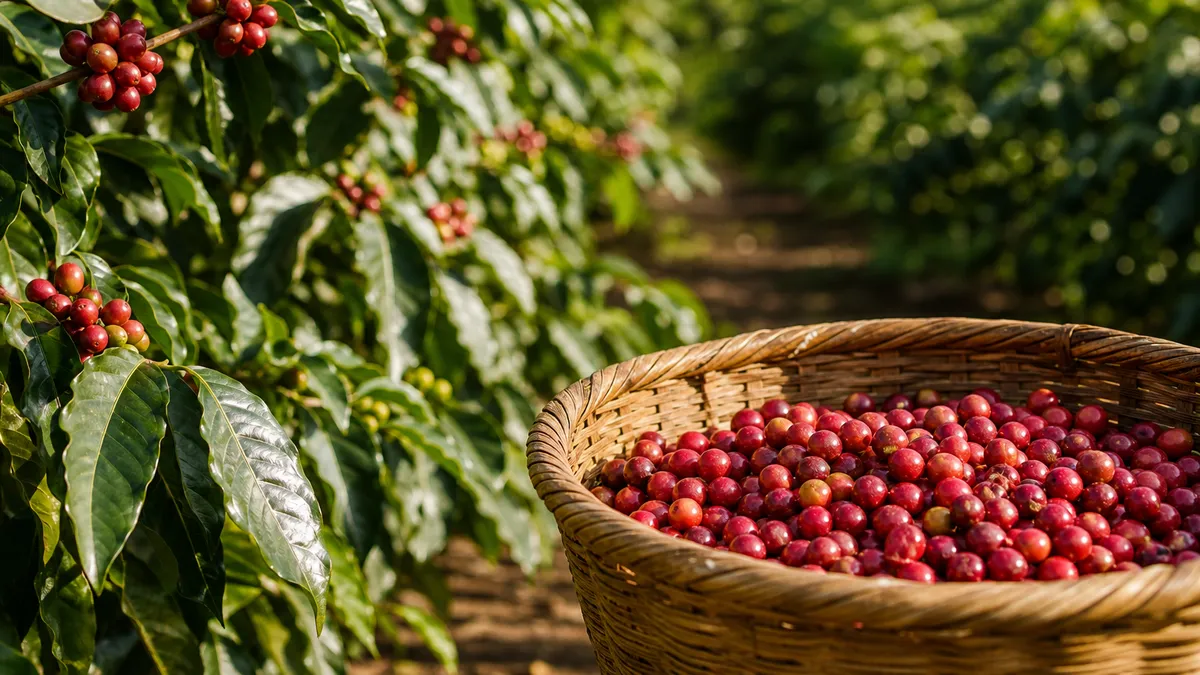
Coffee harvesting follows the development of the fruit, usually called the cherry, rather than a fixed date on a calendar. Rain following a dry period can stimulate flowering; the fruit then develops and ripens over the following months. Different rainfall patterns therefore produce different picking seasons.
As a broad orientation, many northern hemisphere origins harvest around October to March, while southern origins such as Brazil and Peru concentrate much of their picking around May to September. These are useful starting points, not rules that apply throughout either hemisphere.
Near the equator, rainfall patterns and local geography become especially important. Some growing areas have distinct main and secondary harvests, while others have a longer, less concentrated season. Our explanation of the bean belt sets out the geographical background.
Altitude also changes the calendar within a country. Guatemala’s agriculture ministry describes later harvesting in high areas than in lower-growing districts. Costa Rica’s coffee institute publishes different windows for individual regions, which is more useful than treating the country as one uniform season.
For the wider regional picture, start with coffee growing regions. The calendar below focuses specifically on when picking happens.
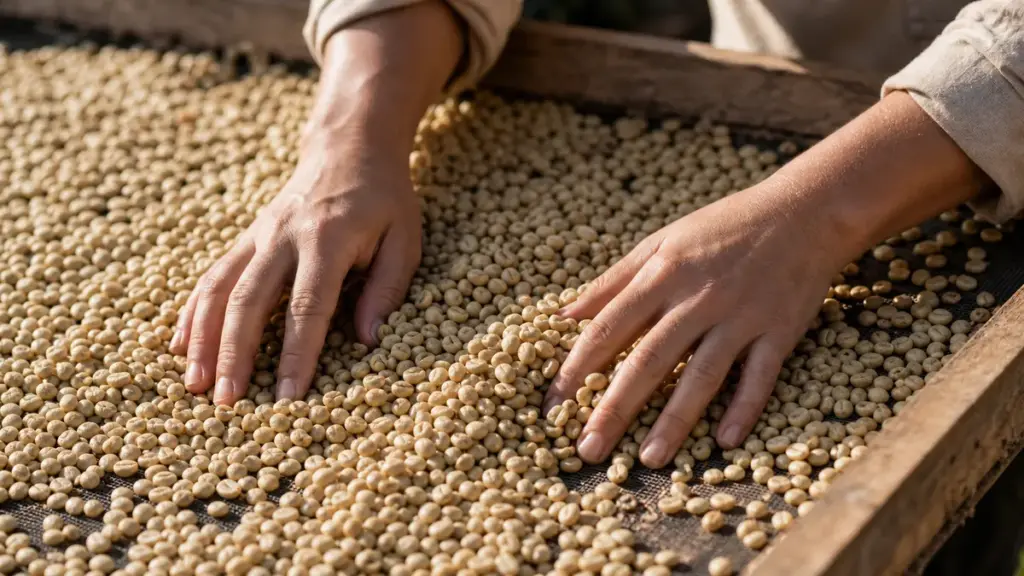
Coffee harvest seasons by country
These are indicative picking windows, not shipment dates or promises of current availability. Months crossing December continue into the following calendar year. The source column identifies the basis for each entry; full references appear under Sources.
| Country | Indicative harvest months | Main, secondary or regional distinction | Source |
|---|---|---|---|
| Brazil | Arabica: May to September; robusta/conilon: April to September | Different starting months by coffee type | USDA, 2025 |
| Colombia | Main peak: October to December; mitaca: April to June | National summary; regional patterns differ | USDA, 2025 |
| Peru | April to September | Peak activity in June and July | USDA, 2025 |
| Costa Rica | July to March across the listed regions | Turrialba starts early; Tarrazú and the Western Valley start in November | ICAFE, undated regional schedule |
| Guatemala | Generally late November to March | Higher areas tend to harvest later; lower areas can start earlier | MAGA, 2025 |
| Mexico | Concentrated in November to March | Production peaks in January and February | Agriculture ministry, 2024 |
| Ethiopia | Mostly October to January | Timing varies by region and altitude | Mercanta, undated |
| Kenya | Main: September to December; fly: May to July | These are the Kenyan authority’s windows; other summaries differ slightly | AFA, 2020/21 yearbook |
| Rwanda | Starts in late February or early March; some northern picking continues to August | One annual crop with regional differences | NAEB, undated |
| Burundi | March to July in the cited 2026 outlook | A seasonal forecast, not a permanent national boundary | Sucafina, 2026 |
| India | Arabica: November to January; robusta: December to February | Different picking windows for the two coffee types | Coffee Board of India, undated |
| Indonesia | Arabica: April and May, with another harvest starting September or October | Southern Sumatran robusta began in late April or May in the cited season, peaking in June and July | USDA, 2025 |
| Papua New Guinea | Main: May to July | Additional picking can occur from March to October | ACIAR, 2025 |
| Vietnam | Robusta: late October to January | Traditional window described in the cited report; rain can delay picking and drying | USDA, 2017 |
The table deliberately preserves differences between sources rather than making every country fit an identical format. A broad national window, a regional schedule and a forecast for one particular season are different kinds of information.
Costa Rica illustrates the problem particularly well. ICAFE’s regional schedule starts Turrialba in July and ends several later regions in March. That does not mean an individual Costa Rican farm harvests continuously throughout that whole period.
Likewise, Indonesia’s entry should not be read as one schedule shared by every island. Ask for the producing area and the lot’s actual picking period before drawing conclusions about its age.
Main crops, fly crops and the Colombian mitaca
A main crop is the principal harvest in the local production cycle. A secondary crop is another distinct picking period, often described as a fly crop. The names tell you about harvest timing, not a quality grade.
Colombia: the regional distinction matters
USDA’s Colombian report identifies national peaks in October to December and April to June, calling the latter the mitaca and locating it predominantly in the central coffee region.
However, a national summary does not describe every Colombian district. Mercanta notes that southern areas, including Huila and Nariño, can have their principal harvest when central areas are collecting their secondary crop. Cenicafé’s agronomic work also documents substantial differences in the distribution of production between regions.
Consequently, “Colombian spring harvest” is incomplete information. Ask which region produced the coffee and whether the seller means its local main harvest, its mitaca or simply the national reporting period.
Kenya: why calendars give different months
Kenya’s Agriculture and Food Authority lists the main harvest as September to December and the fly crop as May to July. The International Coffee Organization’s country profile gives broader harvest periods of April to June and October to December.
Those summaries overlap but do not have identical boundaries. They are country-level descriptions from different documents, not precise forecasts for a particular estate or washing station. This guide follows the Kenyan authority for the crop names and headline months, while retaining the ICO comparison.
For buying purposes, request the crop name and picking months. “Fly crop” alone does not tell you when the coffee arrived, how it was stored or how it tastes now.
From harvest to UK arrival
Picking is only the beginning of the journey. Coffee needs processing and drying, followed by preparation for export, transport and handling at its destination. The exact sequence depends on the processing method and supply chain.
Keep these stages separate:
- Harvest: the period when ripe cherries were picked.
- Processing and drying: preparation of the harvested fruit and seed.
- Export preparation: milling, sorting, sampling and the arrangements needed for shipment.
- Shipment: departure from the exporting country.
- Arrival: landing at the destination port, followed by release and onward delivery.
- Roasting: the separate date when green coffee becomes the roasted product you buy.
How long does shipping take?
There is no dependable single shipping time for all UK coffee imports. Mercanta gives examples of about a month at sea for Colombia and one to two months for Peru. These are indicative sea journeys, not total harvest-to-roastery lead times.
Sucafina identifies weather, blocked roads, dry-mill logistics and differences between locations and processing methods as reasons arrival dates move. A coffee can therefore be harvested on schedule but reach the buyer later than expected.
Ask whether an expected arrival means port arrival, warehouse availability or delivery to the roaster. Those are different milestones.
When should UK buyers look for new crops?
The following importer-published destination-arrival windows are useful prompts for checking UK roasters’ releases. They are not a live UK stock calendar, and individual shipments can fall outside them.
| Origin or crop | Indicative destination-arrival window |
|---|---|
| Brazil | October to January or February |
| Colombia, central main crop | Mid-January to March |
| Colombia, mitaca | August to September |
| Costa Rica | May to July |
| Ethiopia | March to May |
| Kenya, main crop | Mid-April to May |
| Peru | Mid-November to early January |
| Rwanda | Late October to January |
Use these windows to ask questions rather than to reject coffee automatically. For a specific purchase, a confirmed UK warehouse arrival is more useful than a general international arrival calendar.
Harvest year, roast date and freshness
A harvest label and a roast date answer different questions. The former describes the agricultural season; the latter tells you when roasting happened.
A label such as “2025/26” can describe a season crossing calendar years or a reporting period. It does not establish the picking month. The ICO’s statistical coffee year runs from 1 October to 30 September, which should not be mistaken for a universal harvest season.
There are also two different kinds of freshness to consider:
- Green-coffee condition: how the unroasted coffee has changed since processing.
- Roasted-coffee freshness: how the coffee has changed since roasting.
SCA’s explanation of fresh-crop coffee describes fading aroma and flavour during green storage, but also substantial variation in how quickly different coffees age. Its discussion of roasted freshness explains the separate processes of gas release and oxidation after roasting.
The practical implication is straightforward: a recent roast date does not prove a recent harvest, and a recent harvest does not guarantee excellent storage. Neither date replaces tasting.
A practical buying checklist
When choosing a seasonal coffee, ask:
- Where exactly was it grown? Request a region or producer, not only a country.
- When was it picked? Ask for months and year, with main or secondary crop identified where relevant.
- Has it actually arrived? Distinguish a projected shipment from coffee available in the UK.
- How was the green coffee protected? Ask about packaging and storage if comparing older and newer lots.
- When was it roasted? Follow the roaster’s guidance for the particular coffee rather than imposing one universal resting period.
For an office supply, request notification before a seasonal lot changes and taste the replacement before committing to it. Treat coffee harvest seasons by country as a way to understand the supply, not as a substitute for checking the coffee in front of you.
FAQ
Does every coffee farm have two harvests a year?
No, two harvests are not universal. Rwanda’s export board describes one annual crop, while Kenya has distinct main and fly crops. Even where a country has two national production peaks, an individual region may follow a different pattern. Repeated picking visits during one ripening season should not automatically be described as separate crops.
Is past-crop coffee necessarily unusable?
No, past-crop coffee is not automatically unusable. The term generally distinguishes coffee from the preceding season once a new harvest becomes available. SCA notes that coffees age at different rates. Ask about storage and taste the lot rather than treating the crop-year label as a complete assessment of its condition.
Should I wait for the first new-crop release?
Not necessarily. A first release establishes availability, not superiority over every later arrival. Harvest and arrival calendars cannot account for all differences between locations, processing methods and individual lots. If your current coffee tastes good, compare the incoming crop before changing rather than buying solely because it has arrived first.
Where to go next
Read The World’s Coffee Growing Regions: The Complete Guide for a wider view of producing areas, then The Bean Belt Explained for the geography behind cultivation. How Origin Affects Flavour explains what origin can tell you about the cup, beyond its place in the harvest calendar.
Sources
Dates below identify the source edition or publication, not a claim that every harvest window remains unchanged.
- USDA Foreign Agricultural Service, Brazil: Coffee Annual, report BR2025-0013, 2025. Report.
- USDA Foreign Agricultural Service, Colombia: Coffee Annual, report CO2025-0014, 2025. Report.
- USDA Foreign Agricultural Service, Peru: Coffee Annual, report PE2025-0018, 2025. Report.
- USDA Foreign Agricultural Service, Indonesia: Coffee Annual, report ID2025-0021, 2025. Report.
- USDA Foreign Agricultural Service, Vietnam: Coffee Annual, 2017. Report.
- Instituto del Café de Costa Rica, Preguntas frecuentes: Recolección, undated regional schedule referring to the 2020/21 campaign. Regional schedule.
- Guatemala, Ministerio de Agricultura, Ganadería y Alimentación, Época de cosecha del café, 12 February 2025. Article.
- Mexico, Secretaría de Agricultura y Desarrollo Rural, Café, nuestras raíces, 2024. Article.
- Coffee Board of India, website introduction and harvest information, undated. Coffee information.
- Kenya Agriculture and Food Authority, Coffee Year Book 2020/21. Yearbook.
- International Coffee Organization, Country Coffee Profile: Kenya, ICC-124-7, 2019. Profile.
- Rwanda National Agricultural Export Development Board, About Rwanda coffee, undated. Growing calendar.
- Australian Centre for International Agricultural Research, Smallholder Coffee Production in Papua New Guinea: Farmer Training Guide, Unit 3, Module 1: Coffee Harvesting and Processing, Monograph 220, 2025. Training guide.
- Sucafina, Burundi and Rwanda Harvest Update 2026, 25 February 2026. Harvest outlook.
- Mercanta, Coffee Seasonality, undated, retrieved November 2026. Harvest and arrival guide.
- Cenicafé, La agroclimatología del cafeto, in Clima andino y café en Colombia, 2005. Chapter.
- Specialty Coffee Association, Coffee Decoded: What is “fresh crop” coffee?, 2026; and Coffee Decoded: What is “freshly roasted” coffee?, 2026. Green-coffee article; roasted-coffee article.
- International Coffee Organization, International Coffee Agreement 2001, Article 2, definitions. Agreement.
- Sucafina, Our Guide to Buying the Freshest Coffees, 8 February 2021. Sourcing guide.
Researched using government crop reports, national coffee authorities, agronomic guidance and importer logistics information, with harvest dates kept separate from indicative destination arrivals.
Last checked: November 2026