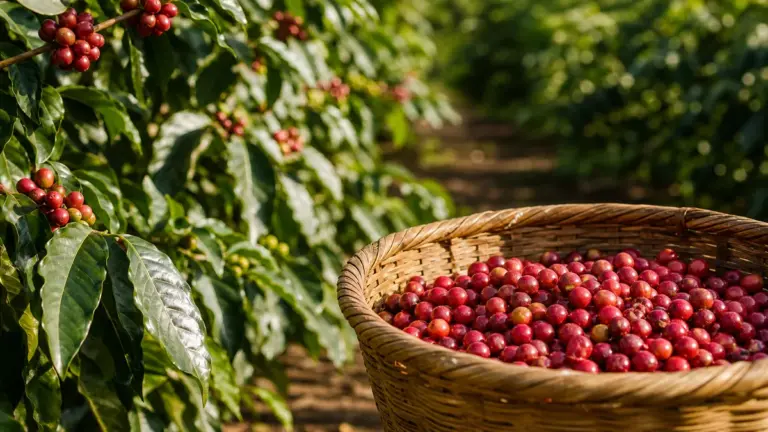
The bean belt, also called the coffee belt, is the broad zone around the equator where most coffee is grown. Its core lies between the Tropic of Cancer and the Tropic of Capricorn, approximately 23.5° north and 23.5° south, because coffee needs warmth, sufficient water and protection from damaging cold.
In short
- Roughly 25°N to 25°S is a useful shorthand for the main growing band, not a fixed agricultural boundary.
- Arabica generally favours cooler conditions than robusta, but published temperature ranges are guides rather than guarantees of yield.
- Altitude matters largely because it changes temperature: coffee does not need a mountain simply because it is coffee.
- Rainfall timing, drainage and local frost risk can matter as much as the annual temperature average.
- Climate change is altering suitable growing areas, sometimes upslope or towards higher latitudes, but suitable land cannot move freely.
Where is the bean belt?
Imagine a broad ribbon around the middle of the Earth, crossing the Americas, Africa, Asia and the Pacific. That is the bean belt: a convenient geographical description of coffee’s principal growing zone, rather than a formally defined region.
Latitude measures distance north or south of the equator in degrees. The geographical tropics extend from the Tropic of Cancer, conventionally rounded to 23.5°N, to the Tropic of Capricorn at 23.5°S. Those figures are rounded reference points, not exact, permanently fixed coordinates.
Coffee-growing boundaries are less tidy. Roughly 25°N to 25°S describes the main band, although published descriptions differ: a US International Trade Commission briefing uses 25°N to 30°S. Neither outline should be read as a line beyond which a coffee plant cannot grow.
Nor does every place inside the ribbon suit coffee. A dry lowland, a cold mountain summit and a sheltered, well-watered hillside can share a latitude while offering very different growing conditions. Our coffee growing regions hub connects this broad geographical picture with the individual regions.
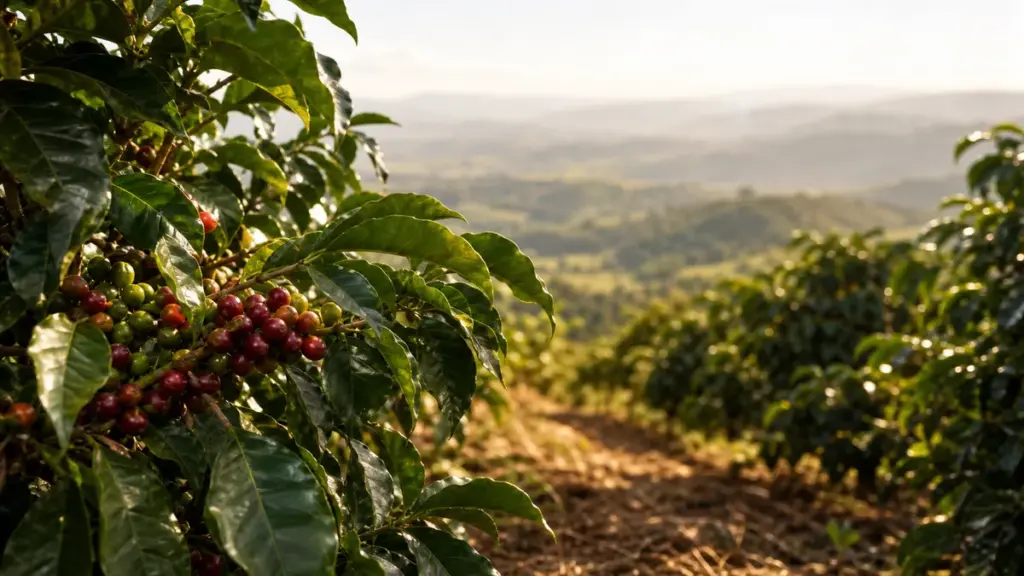
Why coffee grows mainly between the tropics
Coffee needs a workable balance, not simply heat. The tropics provide relatively consistent solar energy through the year, without the pronounced winter reduction experienced at higher latitudes. Suitable sites combine that warmth with enough water and temperatures that allow flowering, fruit development and ripening.
The two principal cultivated species have different ecological backgrounds. Arabica, Coffea arabica, developed in African highland forest conditions. Robusta, the common trade name for Coffea canephora, is associated with warmer African forest environments.
That helps explain why “tropical” does not necessarily mean a hot, low-lying plantation. Within the tropics, elevation can provide the moderate temperatures that arabica favours.
The useful question is therefore not just “Is this farm inside the bean belt?” It is “Does this particular site provide the right conditions for this species and variety?” A variety is a distinct form within a species, and varieties can differ in their agricultural performance.
Temperature and rainfall: arabica versus robusta
The following comparison is a starting point for understanding growing conditions, not a planting prescription. An annual mean is the average temperature across the year; it can conceal damaging hot afternoons, cold nights or seasonal extremes.
| Factor | Arabica | Robusta |
|---|---|---|
| Temperature guide | About 18°C to 22°C is a common introductory range; a major physiology review gives an optimum annual mean of 18°C to 21°C | Traditionally quoted at 22°C to 30°C, but farm-yield research challenges this as a universal optimum |
| Rainfall guide | A physiology review gives about 1,200 to 1,800 mm annually as an optimum guide | The same review gives broadly similar requirements, with greater tolerance of rainfall above 2,000 mm |
| Elevation pattern | Often grown higher near the equator, lower farther from it | Commonly grown from sea level to about 800 m |
| Main caution | Neither cool conditions nor high elevation remove the risks of frost, drought or excessive heat | Greater heat tolerance does not mean immunity to heat or water stress |
Why robusta’s temperature range needs qualification
Calling 22°C to 30°C robusta’s proven optimum would overstate the evidence. Those traditional estimates were largely based on the climate of its native range.
A 2020 study analysed ten years of yield observations from 798 farms in South-East Asia. Its statistical models placed the production optimum below 20.5°C, substantially cooler than the traditional range.
That is observational farm evidence, not a controlled experiment establishing one ideal temperature for all robusta. Nevertheless, it is a strong reason not to assume that robusta will automatically thrive wherever arabica becomes too hot. Growing successfully, surviving stress and producing the highest yield are different outcomes.
Why annual rainfall is not enough
A yearly rainfall total says little about when water arrives. A farm receiving substantial rain may still face a damaging dry period while its fruit is expanding.
A dry interval followed by rain can help synchronise flowering. If flowering occurs in repeated bursts, fruit may also ripen at different times, complicating harvesting. The country-by-country consequences belong in coffee harvest seasons, rather than a single calendar for the whole belt.
Roots also need drainage. FAO guidance for arabica cultivation stresses that coffee does not tolerate waterlogged soil. Irrigation can address some rainfall shortages, but neither irrigation nor a high annual total makes poor drainage harmless.
How altitude changes the picture
Altitude is best understood as a clue to the growing environment, not a quality score.
Near the equator, growers often need higher ground to find moderate temperatures. Farther north or south, similar temperatures may occur lower down. World Coffee Research explicitly adjusts its altitude guidance according to latitude.
Its variety catalogue, for example, defines its “high” altitude category as above 1,600 m between 5°N and 5°S, but above 1,000 m beyond 15° north or south. These are catalogue categories for interpreting variety performance, not universal minimum heights for coffee cultivation.
Cooler conditions can slow fruit development and maturation. That can influence the resulting beans, but the farm’s temperature, variety and management remain more informative than elevation alone. For the sensory consequences, see how origin affects flavour.
There is also a limit to the idea that higher must be better. Moving uphill eventually encounters temperatures that restrict growth or expose plants to frost. Mountains do not provide an endless staircase of increasingly suitable coffee land.
For readers comparing coffee labels, the practical lesson is straightforward: interpret altitude alongside latitude, species and local conditions. Comparing elevation figures without that context can be misleading.
Exceptions: coffee outside the usual band
The bean belt has edges, not walls. Coastal California and subtropical eastern Australia show why a small-scale geographical label cannot replace an assessment of the growing site.
Coastal California
University of California extension guidance describes coffee cultivation around 34°N in the Santa Barbara and Ventura area, well north of the Tropic of Cancer. Coastal conditions there can resemble the moderate environments found at higher elevations in tropical coffee regions.
This allows coffee to grow at relatively low elevations without needing a tropical mountainside. But California is not uniformly frost-free: the same extension account documents frost damage in a planting, while a nearby hillside escaped much of the injury.
A peer-reviewed California suitability study also identified only limited pockets of favourable conditions, concentrated particularly in coastal and near-coastal areas. “Coffee grows in California” should not become “California generally suits coffee”.
The Byron Bay region
Byron Bay lies around 28.6°S, outside the geographical tropics. Coffee production is established in the surrounding subtropical north-east New South Wales region.
The Australian Coffee Growers’ Manual explains that latitude, altitude, slope, aspect and distance from the sea interact to shape growing conditions. Here, lower-elevation sites can provide conditions that would require greater altitude closer to the equator.
The distinction is suitable local conditions, not guaranteed freedom from frost. Australian guidance specifically advises checking weather records and avoiding pockets where cold air collects.
These exceptions confirm the underlying rule: coffee responds to the conditions around its leaves and roots, not to a boundary printed on a map.
Climate change is changing suitable areas, not moving a fixed belt
“Climate change is shifting the bean belt” is memorable but incomplete. The more accurate description is that suitable growing areas are changing, with losses in some places and possible gains in others.
A global modelling study published in 2022 projected changes in arabica suitability under future climate scenarios. Negative changes dominated in major growing regions, while some higher-altitude and higher-latitude locations became more suitable as minimum temperatures increased.
Those are modelled changes in suitability, not observations that farms have already relocated. Nor does a suitable climate automatically create a viable coffee-growing region.
Why moving upslope or polewards has limits
Possible movement faces several geographical and practical barriers:
- Land availability: there may be no suitable higher ground within reach of an existing farm.
- Soil and slope: cooler land can still have unsuitable soil or terrain.
- Water: a more favourable temperature does not guarantee sufficient rainfall or irrigation water.
- Conservation: potential growing areas may overlap forests, protected areas or other valuable habitats.
- People and farming systems: a newly suitable location does not automatically benefit the growers losing suitability elsewhere.
Climate models also simplify reality. The 2022 global study did not model management interventions such as irrigation, and its future assessment did not incorporate every possible change in pests, diseases or extreme weather. Its authors identify those limitations explicitly.
Adaptation can include locally appropriate shade, water management and varieties selected for changing conditions. These measures may help sustain existing production, but they are not a guarantee that every current growing area will remain suitable.
The useful picture is therefore a changing patchwork of growing environments, not a neat ribbon sliding away from the equator.
How to use the bean belt when choosing coffee
For a UK coffee buyer, the bean belt is a first explanation of origin, not a buying grade.
Use it to understand why temperature, water and elevation appear so often in descriptions of coffee farms. Then look for more specific information: the growing region, species, variety and conditions at the site.
Treat geographical claims with the same care as altitude claims. Being grown within the tropics does not prove quality, and being grown outside them does not make a coffee inherently exceptional.
The bean belt explains where coffee cultivation is concentrated. It cannot, on its own, tell you what a particular bag will taste like.
FAQ
Can I grow coffee in the UK?
Yes, as a protected plant rather than a normal outdoor crop. The Royal Horticultural Society recommends arabica for houseplant, conservatory or greenhouse cultivation and rates it for growing under glass all year. This creates a suitable small environment outside the bean belt; it does not make the surrounding outdoor climate suitable for coffee farming.
Are coffee beans actually beans?
No. Coffee beans are seeds inside the coffee plant’s fruit, commonly called a cherry. The RHS describes arabica fruit ripening from green to red and normally containing two seeds. “Bean belt” is therefore an everyday coffee expression, not a botanical description of a region producing legume beans.
Does coffee need volcanic soil?
No. FAO cultivation guidance says coffee can grow on different soil types, although fertile volcanic soils can be suitable. Drainage and the wider growing environment matter more than the volcanic label alone. A farm does not become suitable merely because its soil is volcanic, nor unsuitable because it is not.
Where to go next
Use Coffee Growing Regions to choose an area to explore, then read The World’s Coffee Growing Regions: The Complete Guide for the wider regional comparison. Coffee Harvest Seasons by Country explains when crops are gathered, while How Origin Affects Flavour connects growing conditions with what reaches the cup.
Sources
-
NOAA National Weather Service, What Causes the Seasons?, undated educational resource.
https://www.weather.gov/fsd/season -
US International Trade Commission, Is Robusta on the Rise? Trends in Coffee Species Trade, January 2024. Used for an example of the differing geographical definitions of the coffee belt.
https://www.usitc.gov/sites/default/files/publications/332/executive_briefings/ebot_robusta_on_the_rise.pdf -
DaMatta, F. M. and Ramalho, J. D. C., Brazilian Journal of Plant Physiology, Impacts of drought and temperature stress on coffee physiology and production: a review, 2006.
https://www.scielo.br/j/bjpp/a/bDfpJwLr4xLcznSwy4b9zkf/ -
Prewitt and colleagues, International Journal of Climatology, Classifying Climate-Suitable Lands in California for Coffee Cultivation, 2025 journal publication, first published online December 2024.
https://rmets.onlinelibrary.wiley.com/doi/10.1002/joc.8690 -
Kath and colleagues, Global Change Biology, Not so robust: Robusta coffee production is highly sensitive to temperature, 2020, abstract retrieved through PubMed.
https://pubmed.ncbi.nlm.nih.gov/32223007/ -
FAO, Arabica Coffee Manual for Lao PDR, Chapter 1, “Coffee plant & site selection”, 2005.
https://www.fao.org/4/ae939e/ae939e03.htm -
World Coffee Research, Arabica Coffee Varieties Catalogue: Bourbon, live catalogue, undated. Used for its latitude-dependent altitude definitions.
https://varieties.worldcoffeeresearch.org/varieties/bourbon -
University of California Agriculture and Natural Resources, Ben Faber, Learning Coffee, March 2022.
https://ucanr.edu/blog/topics-subtropics/article/learning-coffee -
AgriFutures Australia, Peasley, D. and Webber, J., Australian Coffee Growers’ Manual, June 2024, especially Section 4.
https://www.agca.au/_files/ugd/61d322_7a404588343048399dab74decb62d82c.pdf?index=true -
Australian Bureau of Meteorology, Climate Data Sites: Byron Bay (Cape Byron Lighthouse), station 058009, live station record, undated.
https://www.bom.gov.au/climate/averages/tables/cw_058009_SiteMap.shtml -
Grüter, R., Trachsel, T., Laube, P. and Jaisli, I., PLOS ONE, Expected global suitability of coffee, cashew and avocado due to climate change, 2022.
https://journals.plos.org/plosone/article?id=10.1371/journal.pone.0261976 -
Bunn, C., Läderach, P., Ovalle Rivera, O. and Kirschke, D., Climatic Change, A bitter cup: climate change profile of global production of Arabica and Robusta coffee, 2015.
https://link.springer.com/article/10.1007/s10584-014-1306-x -
Royal Horticultural Society, Coffea arabica: Arabian coffee, live plant profile, undated.
https://www.rhs.org.uk/plants/4159/coffea-arabica/details
This article was researched using retrieved meteorological records, official cultivation guidance, World Coffee Research’s catalogue and peer-reviewed research, distinguishing general growing guides from observational findings and modelled projections.
Last checked: November 2026