Ruiru 11 and Batian are Kenyan-bred arabica coffees developed to combine disease resistance with productive trees and good cup quality. Ruiru 11 is itself an F1 hybrid, meaning a first-generation cross, whereas Batian is a seed-propagated composite of pure lines. Modern Central American F1 hybrids such as Centroamericano use the same first-generation breeding principle, but their parentage and commercial propagation systems differ.
In short
- Kenya released the compact Ruiru 11 in 1985 and the taller Batian in 2010.
- Ruiru 11 planting seed comes from controlled crosses, not simply from collecting cherries from existing Ruiru 11 trees.
- Batian combines three pure lines selected from F5 breeding material, rather than being another commercial F1.
- Centroamericano and Mundo Maya are commonly multiplied clonally; Starmaya uses specially managed seed gardens with a male-sterile parent.
- Disease resistance and high yield do not automatically mean poor flavour. Trials support good cup-quality potential, but not a universal ranking between varieties.
What makes these coffees different?
These are bred arabica varieties, not growing regions, processing methods or bean grades. Their names describe planting material developed through selection and crossing, with particular combinations of agricultural traits.
An F1, short for first filial generation, is the immediate offspring of a specified cross between parents. A pure line is breeding material selected for sufficiently stable inheritance that it can be reproduced through seed while retaining its defining characteristics.
This distinction matters more than the loose word “hybrid”. A variety can have crosses in its ancestry without being sold to farmers as a first-generation hybrid. Batian is an example.
For the wider naming framework, start with our coffee varieties guide. Here, the useful question is how breeders preserve the combination of characteristics that farmers actually plant.
| Coffee | Breeding identity | Commercial propagation | Important distinction |
|---|---|---|---|
| Ruiru 11 | Composite of F1 hybrid families | Controlled hand-pollinated seed; vegetative methods also used | Not one genetically identical clone |
| Batian | Composite of three pure lines | Seed | Selected from F5 material, not marketed as an F1 |
| Centroamericano, also called H1 | F1 hybrid | Clonal multiplication | Saved seed does not reliably reproduce H1 |
| Mundo Maya | F1 hybrid | Clonal multiplication | Different parents from Centroamericano |
| Starmaya | F1 hybrid | Seed from managed parental seed gardens | Seed production depends on a male-sterile mother |
The table compares breeding and propagation, not flavour superiority or suitability for every farm.
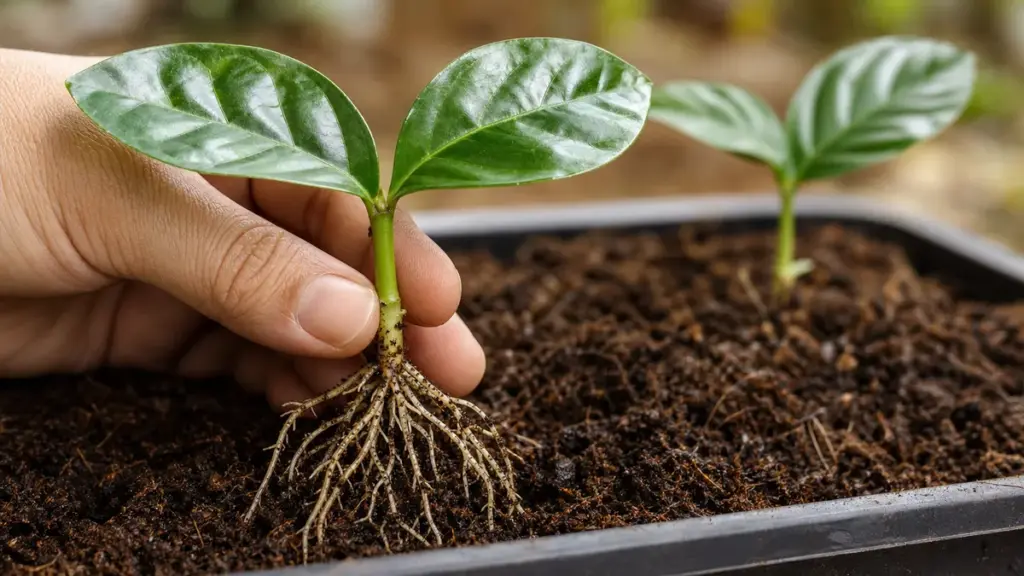
Ruiru 11: Kenya’s earlier F1 hybrid
Kenya’s Coffee Research Foundation, whose work now sits within KALRO, released Ruiru 11 in 1985. It has compact growth, allowing closer planting than Kenya’s traditional tall varieties.
Its breeding is more elaborate than a simple cross between two familiar named varieties. World Coffee Research describes Catimor female parents crossed with complex male breeding material involving K7, SL28, N39 and Rume Sudan, among other ancestors. Breeders assembled disease resistance, compactness and quality-related characteristics through this programme.
The resulting F1 families are mixed to form a composite variety. Consequently, Ruiru 11 is neither a single clone nor a completely uniform population.
For seed production, workers prevent the mother flowers from self-pollinating and apply pollen from the selected male parents. This recreates the intended first-generation crosses.
That is why Ruiru 11 belongs in the F1 story, rather than standing outside it. The distinction from newer Central American hybrids lies in its Kenyan breeding history, composite structure and established hand-pollinated seed system, not in a different meaning of “F1”.
Batian: related breeding material, different inheritance
Batian was released in Kenya in 2010. Unlike compact Ruiru 11, it is a tall variety with vegetative characteristics resembling SL28.
World Coffee Research describes Batian as a mixture of three pure lines. These were developed through individual-tree selections from fifth filial generation, or F5, material associated with male parents of some Ruiru 11 progenies.
Its recorded ancestry includes SL28, SL34, Rume Sudan, N39, K7, SL4 and Timor Hybrid. This is a shared breeding background, not evidence that Batian is simply Ruiru 11 under another name.
Batian’s practical distinction is seed propagation. Its selected lines breed sufficiently true for seed-based multiplication, unlike seed collected from an F1 crop. Nevertheless, “seed-propagated” does not remove the need for reliable nursery identity and properly maintained seed sources.
Neither F5 nor any other generation number is a quality score. It describes a stage in the breeding history.
Disease resistance: useful, but not immunity
Two diseases are central to the Kenyan breeding story:
- Coffee berry disease, usually shortened to CBD, attacks coffee fruit and can cause dark, sunken lesions and shrivelled berries.
- Coffee leaf rust attacks foliage and can cause premature leaf loss, weakening the tree and affecting production.
Kenyan guidance presents Ruiru 11 and Batian as resistant to both diseases. World Coffee Research adds a useful qualification: its current catalogue rates Ruiru 11 as highly resistant to leaf rust, but Batian as having intermediate resistance. Both are listed as resistant to CBD.
Those descriptions should not be flattened into a promise of permanent protection. National extension guidance summarises recommended planting material, while the international catalogue gives more differentiated resistance categories. Disease populations, growing conditions and the particular material being assessed can affect performance.
There is variation within Ruiru 11 too. A Kenyan study found differences in CBD resistance between its sibling families, although all were less susceptible than the SL28 comparison.
For farmers, resistance is therefore one part of disease management, alongside monitoring and locally appropriate husbandry. For buyers, it is not evidence that a coffee was grown without fungicides.
The wider background to resistance-bearing breeding families is covered in Catimor and Sarchimor.
Central American F1 hybrids and hybrid vigour
Hybrid vigour, or heterosis, describes improved performance of a cross relative to its parental material. In coffee breeding, the hoped-for gains include productive growth and yield, but the size and usefulness of the effect must be demonstrated through trials.
Centroamericano, also called H1, crosses T5296 with Rume Sudan. Mundo Maya crosses T5296 with Ethiopian accession ET01, a particular plant collection entry. They are distinct varieties, not interchangeable names for the same hybrid.
These programmes use diverse arabica material to produce combinations that conventional, repeatedly self-pollinated lines may not readily deliver. Ethiopian genetic resources are part of that story, although an accession used by breeders is not the same thing as a retail “heirloom” description. Our guide to Ethiopian landrace coffees explains that distinction.
The evidence is promising but specific. A 2020 multi-environment study compared hybrids and conventional cultivars in seven environments. H1-Centroamericano and H16-Mundo Maya combined strong yield performance with stability across the tested environments.
That does not establish that every F1 suits every site. Nor does “F1” automatically confer rust resistance: resistance depends on the parents and the characteristics retained in the selected cross.
How propagation preserves the variety
Controlled seed production
Ruiru 11 shows that F1 coffee can be produced through hand-pollinated seed. The essential requirement is to repeat the intended parental cross, rather than save seed from the resulting commercial crop.
Starmaya takes another route. Its mother parent is male-sterile, meaning it does not produce functional pollen, but can still receive pollen and form seeds. In a properly managed seed garden, pollen from the selected father produces the intended F1 seed.
Male sterility removes the mother’s ability to self-pollinate. It does not eliminate unwanted pollen arriving from elsewhere, so parental identity and garden management remain important.
Vegetative propagation
Vegetative propagation produces plants from existing plant tissue rather than a new sexual cross. Kenyan guidance includes cuttings and grafting among coffee propagation methods, including the use of Ruiru 11 material.
Commercial Central American F1 production has relied heavily on somatic embryogenesis. In this laboratory process, cells from selected plant tissue develop into embryos and then plantlets. Rooted mini-cuttings can subsequently multiply suitable nursery plants.
It is therefore too restrictive to say that Centroamericano and Mundo Maya “must” always come directly from a laboratory. Somatic embryogenesis and subsequent horticultural multiplication can form parts of the same production chain.
Why saved F1 seed is different
Seed collected from an F1 tree produces the next generation, not a repeat of the original parental cross. Genetic characteristics separate and recombine, a process called segregation.
The seedlings may consequently differ in growth, yield, resistance or cup-quality potential. A farmer might obtain useful plants, but cannot assume that they reproduce the named F1 faithfully. Starmaya’s seed-garden system does not change that principle.
What the cup-quality evidence actually shows
Disease-resistant coffee is sometimes dismissed as productive but plain-tasting. Published evidence does not justify that blanket judgement.
A 2013 Kenyan study examined 34 Ruiru 11 sibling families across three growing environments, using SL28 comparisons. Many families produced cup quality comparable to SL28, but results varied with location, season and family. The researchers also found no correlation between the measured cup-quality traits and CBD resistance in that experiment.
Evidence for Batian needs careful labelling. A KALRO study reported in the 2018 ASIC conference abstracts assessed Batian, Ruiru 11 and SL28 from three Kenyan counties. All showed potential to achieve specialty-grade quality. However, a conference abstract provides less methodological detail than a full research paper and does not establish that Batian consistently outperforms SL28.
For Central American hybrids, the 2020 multi-environment study found that Starmaya and H1-Centroamericano scored better than the Caturra control in sensory assessment. This is evidence from a comparative field experiment, not merely a roaster’s tasting description.
The defensible conclusion is that productive, resistant planting material can also produce good coffee. It is not that a breeding category guarantees a particular flavour or score.
Origin fact panel: the Kenyan context
Ruiru 11 and Batian are varieties, not origins with their own universal harvest calendars. The following panel describes their Kenyan growing context.
- Altitude: the Kenya Coffee Sustainability Manual gives 1,200 to 2,100 metres above sea level as general arabica growing guidance. This is not an exclusive altitude range for either variety.
- Main varieties: Kenyan commercial arabica includes SL28, SL34, K7, Kenya Blue Mountain, Ruiru 11 and Batian.
- Processing: wet processing, producing washed coffee, and dry processing, including buni, are established Kenyan methods.
- Harvest months: AFA’s Kenya Coffee Year Book 2022/23 gives May to July for the early crop and September to December for the late crop, with regional differences.
- Typical cup context: AFA’s washed-coffee flavour work records regional examples including currant, citrus, plum and floral characteristics. These describe sampled regional coffees, not guaranteed Ruiru 11 or Batian flavours.
For a UK buyer, ask whether a listing identifies a genuinely separated variety or several varieties contributing to one lot. For Ruiru 11, Batian and F1 hybrids alike, treat variety as useful background, then judge the actual coffee’s processing, roast and cup.
Farmer adoption: planting material matters as much as breeding
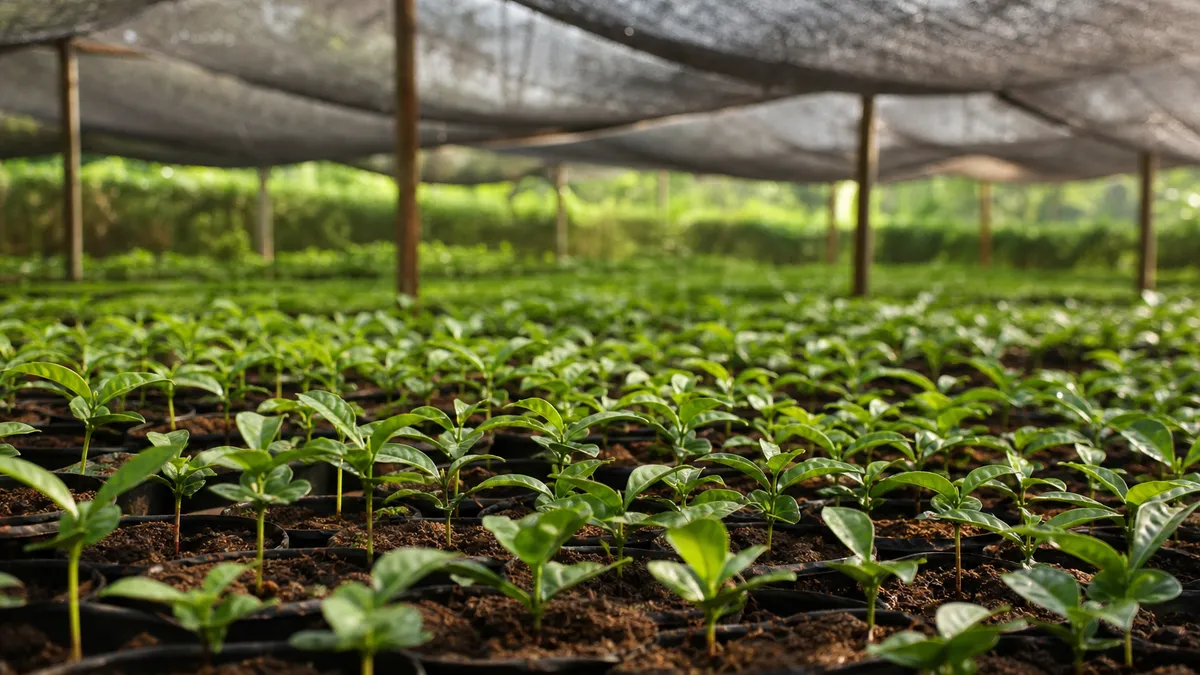
A successful trial does not put healthy seedlings into farmers’ fields by itself. Propagation capacity, nursery skills, reliable identity and appropriate establishment advice all matter.
A 2021 assessment of Kenya’s nursery system identified Ruiru 11 seed production as a constraint. Hand emasculation and pollination required skilled labour, while changing weather disrupted seed-garden scheduling.
Clonal F1 production has different bottlenecks, including specialised laboratory capacity and the transfer of plantlets into nursery conditions. Starmaya’s seed system offers another multiplication route, but still requires maintained parents and controlled production.
Adoption should therefore be judged locally, not inferred from the excitement around a new name. The useful innovation is a suitable plant that farmers can obtain reliably and manage successfully.
FAQ
Are these coffees genetically modified?
The varieties discussed here were developed through crossing and selection, not described by their breeders as genetically engineered products. Somatic embryogenesis is a multiplication technique, rather than evidence of genetic engineering. It grows plants from selected tissue so that a useful hybrid combination can be reproduced without making a new seed cross.
Does Timor Hybrid ancestry make them robusta coffee?
No. These coffees are bred and catalogued as arabica, although their ancestry includes resistance introduced through Timor Hybrid, which has arabica and robusta ancestry. Breeders call the transfer of genetic material into a breeding population “introgression”. That ancestry does not mean the roasted coffee is a physical blend of arabica and robusta beans.
Can I attribute a mixed lot’s fruit flavours to Batian?
Not reliably from the variety list alone. If several varieties contributed to the lot, tasting the finished coffee cannot isolate Batian’s contribution. A meaningful comparison would need separately harvested and processed samples, with growing conditions and preparation controlled as far as practical. Enjoy the flavour description, but do not mistake it for a genetic fingerprint.
Where to go next
Read Coffee Varieties for the wider family of cultivated coffees, then Castillo, Catimor and Sarchimor for other resistance-focused breeding approaches. Ethiopian Heirloom and Landrace Coffees explains the diverse material behind some modern crosses, while Ethiopian Yirgacheffe and Colombian Supremo Explained separates variety names from origin and grading terms.
Sources
-
World Coffee Research, Arabica Coffee Varieties catalogue, live entries, undated:
– Ruiru 11: https://varieties.worldcoffeeresearch.org/varieties/ruiru-11
– Batian: https://varieties.worldcoffeeresearch.org/varieties/batian
– Centroamericano: https://varieties.worldcoffeeresearch.org/varieties/centroamericano
– Mundo Maya: https://varieties.worldcoffeeresearch.org/varieties/mundo-maya
– Starmaya: https://varieties.worldcoffeeresearch.org/varieties/starmaya
Used for breeding identities, parentage, resistance descriptions and propagation distinctions. -
Kenya Coffee Traders Association, Kenya Coffee Varieties, undated, information attributed to the Director of the Coffee Research Institute.
https://www.kenyacoffee.co.ke/resources/Kenya%20Coffee%20Varieties.pdf
Used for the institute’s description of Batian as true-breeding and the Kenyan release dates. -
KALRO and Kenya Coffee Platform, Kenya Coffee Sustainability Manual, undated retrieved edition.
https://www.globalcoffeeplatform.org/wp-content/uploads/2021/03/KCS-MANUAL-review-03112020.pdf
Used for Kenyan agronomy, propagation, disease symptoms and processing context. -
Agriculture and Food Authority, Coffee Directorate, Kenya Coffee Year Book 2022/23, reporting period 2022/23.
https://www.afa.go.ke/download/3199/
Used for varieties, release dates and harvest periods. The retrieved address included a timestamp parameter, omitted here. -
Agriculture and Food Authority, Coffee Directorate, The Kenyan Coffee Flavor Wheel, undated.
https://www.afa.go.ke/download/3279/
Used for regional washed-coffee sensory examples. The retrieved address included a timestamp parameter, omitted here. -
Gichimu, Gichuru, Mamati and Nyende, Variation and association of cup quality attributes and resistance to coffee berry disease in Coffea arabica L. composite cultivar, Ruiru 11, African Journal of Horticultural Science, volume 7, 2013.
https://journal.hakenya.net/index.php/ajhs/article/download/49/45/47
Used for comparative Kenyan cup-quality and CBD-resistance evidence. -
Kathurima and colleagues, KALRO, Sensory and biochemical fingerprinting of commercial coffee varieties under different geographical conditions in Kenya, ASIC Book of Abstracts, 2018.
https://www.alphavisa.com/asic/2023/documents/book-of-abstracts/ASIC27-2018_Portland-USA.pdf
Used as conference-abstract evidence for Batian, Ruiru 11 and SL28 quality potential. -
Marie and colleagues, G × E interactions on yield and quality in Coffea arabica: new F1 hybrids outperform American cultivars, Euphytica, 2020.
https://link.springer.com/content/pdf/10.1007/s10681-020-02608-8.pdf
Used for multi-environment yield and sensory comparisons. -
Georget and colleagues, Starmaya: The First Arabica F1 Coffee Hybrid Produced Using Genetic Male Sterility, Frontiers in Plant Science, volume 10, article 1344, 2019.
https://www.frontiersin.org/journals/plant-science/articles/10.3389/fpls.2019.01344/full
Used for male-sterile seed production and propagation limitations. -
Etienne and colleagues, Coffee Somatic Embryogenesis: How Did Research, Experience Gained and Innovations Promote the Commercial Propagation of Elite Clones From the Two Cultivated Species?, Frontiers in Plant Science, volume 9, article 1630, 2018.
https://www.frontiersin.org/journals/plant-science/articles/10.3389/fpls.2018.01630/full
Used for laboratory propagation and subsequent multiplication through mini-cuttings. -
Agri-Hort Farm Solutions, Kenya Coffee Platform and World Coffee Research, Baseline Assessment of the Coffee Nursery System in Kenya: Final Report, 2021.
https://cdn2.assets-servd.host/worldcoffee-research/production/documents/Baseline-Assessment-of-The-Coffee-Nursery-System-in-Kenya.pdf
Used for documented nursery and Ruiru 11 seed-production constraints.
Research combined live variety-catalogue checks, Kenyan institutional guidance, nursery research and published comparative studies, distinguishing full papers from conference abstracts.
Last checked: November 2026