Caturra, Catuai and Mundo Novo are closely related arabica coffee varieties that helped shape productive coffee farming across Latin America. Caturra is a compact mutation of Bourbon, Mundo Novo comes from a natural cross between Typica and Bourbon, and Catuai combines the two through deliberate breeding. The crucial distinction is their size: Caturra and Catuai are compact, while Mundo Novo is tall and vigorous.
In short
- Compact does not mean tiny beans. These names describe plant genetics and growth, not a miniature grade of coffee bean. WCR lists all three as having average bean size.
- Planting density matters. WCR gives indicative single-stem densities of 5,000 to 6,000 plants per hectare for Caturra and Catuai, compared with 3,000 to 4,000 for Mundo Novo.
- Vigour is not disease resistance. The traditional forms of all three are susceptible to coffee leaf rust.
- A variety is not a tasting guarantee. Growing conditions, processing and roasting help determine what reaches the cup.
Caturra, Catuai and Mundo Novo compared
These are varieties within Coffea arabica, not separate coffee species. Their relationship is easiest to understand as a family tree, but their practical importance lies in the different plants that family produced. For the wider naming system, start with the coffee varieties guide.
The comparison below uses parentage, plant architecture and cultivation implications, rather than trying to rank flavour.
| Variety | Parentage | Growth habit | Main cultivation implication |
|---|---|---|---|
| Caturra | Natural mutation of Bourbon | Compact | Suits closer planting |
| Mundo Novo | Natural Typica × Bourbon cross | Tall and vigorous | Needs more space and appropriate height management |
| Catuai | Deliberate Caturra × Mundo Novo cross | Compact, but less compact than Caturra | Combines manageable stature with productive potential |
Sources: WCR variety entries and IAC breeding records.
Caturra: a smaller Bourbon plant
Caturra arose through a natural mutation, a genetic change rather than a planned cross. Its compact habit is associated with a single gene. Shorter distances between growth points allow a smaller plant with closely arranged branches, making closer planting possible.
That architecture was valuable because growers could fit more productive plants into an area and reach the crop more easily. It does not mean every Caturra tree produces more than every taller tree. The useful distinction is between production per plant and production across the planted field.
Mundo Novo: the tall, vigorous parent
Mundo Novo originated in Brazil through natural crossing between Bourbon and Typica. Brazilian descriptions sometimes name its Typica parent as Sumatra. This is not a claim that it contains a separate coffee species: IAC identifies that Sumatra material with Typica.
Its defining feature is vigorous vegetative growth, meaning strong development of stems and branches. Unlike its compact relatives, Mundo Novo needs room. IAC also highlights its ability to regrow after pruning, useful where growers manage plant height through cutting back.
Catuai: a deliberate combination
Catuai was bred to bring Mundo Novo’s vigour and productive potential together with Caturra’s smaller stature. IAC researchers crossed yellow-fruited Caturra with Mundo Novo in 1949; selected Catuai lines were released in Brazil in 1972.
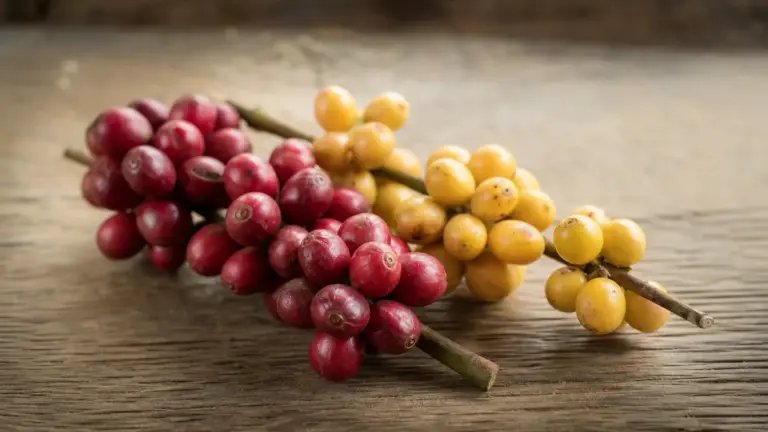
The result was not simply a shortened Mundo Novo. Breeders selected descendants over successive generations for useful combinations of architecture, production and other characteristics. Red-fruited and yellow-fruited lines emerged from that programme, explaining names such as Catuaí Vermelho and Catuaí Amarelo on coffee descriptions.
Why plant size changes yield and farm management
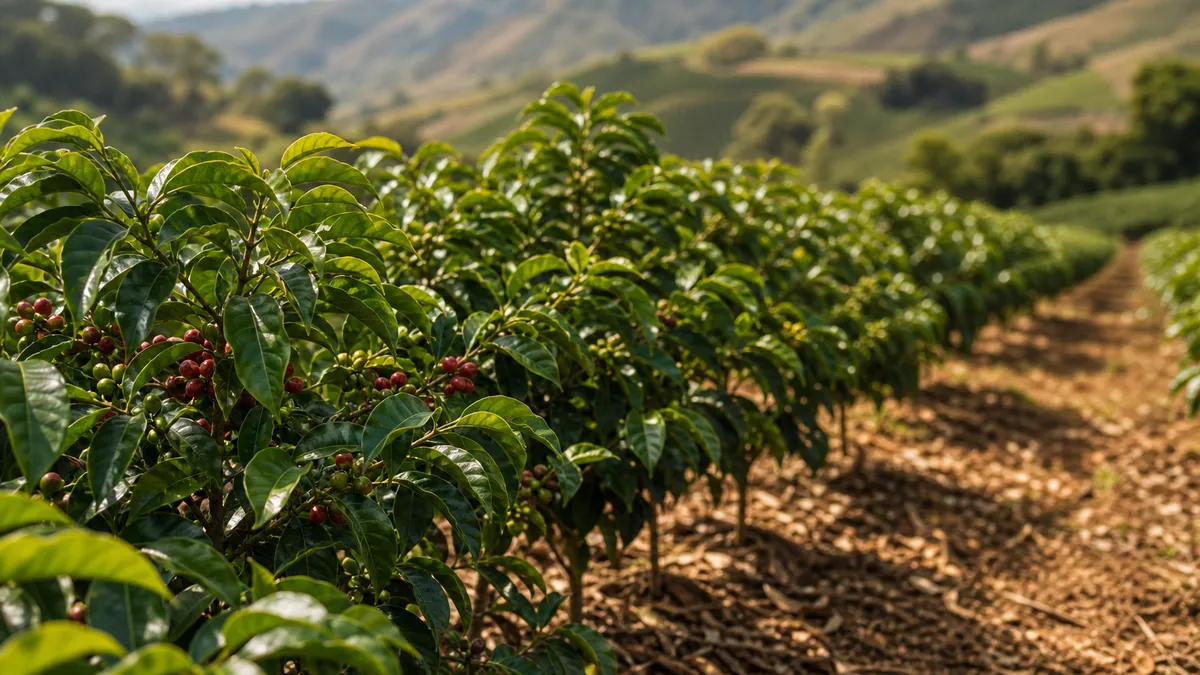
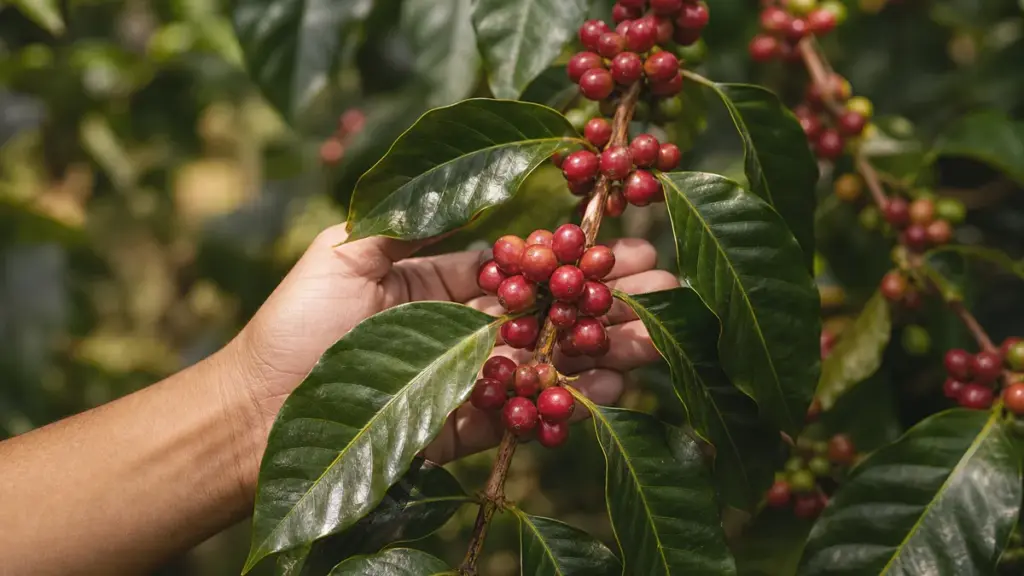
A compact coffee plant can make harvesting and crop treatments easier to carry out. Its smaller canopy also permits closer spacing, increasing the number of plants that can occupy a hectare. This was central to Catuai’s breeding purpose, rather than an incidental benefit.
However, planting density is a cultivation decision, not a fixed property printed into a seed. WCR’s indicative densities assume single-stem pruning, with one main upright stem per plant. They should not be transferred directly to systems that retain several main stems.
Mundo Novo illustrates why context matters. IAC’s Brazilian guidance favours wider planting, giving examples of 3.8 to 4 metres between rows and 0.7 to 0.8 metres between plants. It explicitly says that even dense planting of Mundo Novo needs more space than is normally used for compact cultivars. These are regional recommendations, not universal instructions.
Nor is Catuai automatically the higher-yielding choice everywhere. WCR reports that studies in Honduras and Costa Rica found no significant productivity difference between the Catuai material evaluated and Caturra. A useful claim therefore needs the location, selected line and management conditions, not merely the variety name.
For a reader choosing roasted coffee, the lesson is straightforward: productive farming genetics do not by themselves tell you whether a particular bag will suit your taste.
Where they are grown
Caturra became particularly important in Central America, including Guatemala, Costa Rica, Honduras and Panama. Its role there has been substantial enough for it to serve as a benchmark against which other cultivars are assessed. Brazilian origin does not mean Brazilian predominance.
Catuai is widely cultivated in Brazil and is also established in Honduras, Costa Rica and Guatemala. Mundo Novo has greater commercial importance in Brazil and other South American countries, including Peru, than in Central America. WCR also records Mundo Novo in Malawi, a reminder that these varieties are not confined to Latin America.
Origin fact panel: a Costa Rican example
There is no single altitude range, processing method or harvest calendar for these three varieties worldwide. This panel therefore uses Los Santos, including Tarrazú, Costa Rica, as a clearly bounded example for Caturra and Catuai. It should not be applied to Brazilian Mundo Novo.
| Origin detail | Documented example |
|---|---|
| Altitude range | ICAFE describes coffee production in Los Santos at 1,200 to 1,900 metres above sea level |
| Main varieties | ICAFE identifies Caturra and Catuai as the principal varieties |
| Processing | Regional producer and mill listings document washed and honey coffees, alongside anaerobic processing |
| Harvest months | ICAFE gives November to March; individual producer programmes may have narrower windows |
| Typical cup profile | ICAFE describes good body, pronounced but fine acidity, excellent aroma and a slightly chocolate-like flavour |
Sources: ICAFE’s regional description and Hacienda La Minita’s regional microlot listings. These describe an origin and documented offerings, not an inherent flavour or processing requirement of either variety.
Disease susceptibility: their major weakness
The traditional forms of Caturra, Catuai and Mundo Novo are susceptible to coffee leaf rust. This fungal disease attacks leaves and can cause defoliation and serious crop losses. A vigorous plant can still be vulnerable: strong growth and inherited disease resistance are different traits.
There is also an important naming qualification. A newer cultivar carrying a familiar name may have additional breeding behind it. IAC Catuaí SH3, for example, is a distinct improved cultivar documented as rust-resistant in IAC evaluations, unlike the conventional Catuai comparison cultivars in those trials.
For growers, the exact cultivar identity matters more than the broad family name. For coffee buyers, ask for the full designation when a supplier makes a resistance claim. The wider search for resilient coffee is covered in Stenophylla and Climate-Resilient Wild Species, rather than treating these traditional workhorses as an answer to every growing challenge.
What do they taste like?
There is useful flavour potential here, but no dependable rule that Caturra must taste citrusy, Catuai must taste sweet or Mundo Novo must taste nutty. Research shows that cultivar and post-harvest treatment both matter, while roasting can substantially change the volatile compounds associated with aroma.
For Caturra and Catuai, the Los Santos example gives a grounded starting point: a cup with body, lively but fine acidity and a chocolate-like element. Those are regional expectations, not a way to distinguish the two varieties in a blind tasting. ICAFE attributes that character to the combination of altitude, climate and varieties.
A peer-reviewed wet-fermentation study provides a more specific example for Mundo Novo and red Catuai. Its sensory analysis recorded chocolate, nuts and bitterness for the Mundo Novo samples, while red Catuai showed acidity and sweetness. These were findings from the coffees and processing conditions studied, not universal variety signatures.
Use the specialty varietals guide to put variety claims in context. My advice is to give the actual lot description more weight than a generic flavour chart: ask what was tasted, rather than what the name supposedly promises.
Reading the label more precisely
A bare “Catuai” label can conceal considerable detail. Brazil has several selected Catuai cultivars, and grouping them simply as red or yellow can obscure their identities. Similar naming shortcuts occur with Mundo Novo. A study of Brazilian specialty production identifies this as a limitation when interpreting cultivar information.
For a more revealing comparison, ask the roaster for:
- The selected line, if known, rather than only the family name.
- The farm and growing region, so you know where the coffee comes from.
- The processing description, rather than assuming it from the variety.
- Tasting notes for that lot, ideally with an explanation of how it was assessed.
When tasting side by side, try to keep origin, processing, roast style and preparation as similar as practical. Treat the exercise as a comparison of those coffees, not proof that you have isolated genetics. Change several variables together and it becomes impossible to attribute the difference confidently to variety alone.
For another compact mutation and a very different bean-size story, read about Maragogipe and Pacas. The useful habit is to separate what a variety name tells you about the plant from what the finished coffee actually demonstrates.
FAQ
Are Catuai and Catuaí different coffees?
No, these are spellings of the same variety name, with Catuaí retaining the accent used in Portuguese. More consequential differences appear in the words and cultivar identifiers that follow it. Red-fruited and yellow-fruited selections, and separately improved cultivars, should not be assumed to have identical agronomic characteristics.
Is Caturra the same as Catimor?
No, Caturra and Catimor are not interchangeable names. Caturra is a Bourbon mutation; Catimor refers to a group derived from crossing Caturra with Timor Hybrid material. The resemblance reflects a breeding relationship, but the resulting coffees should not be assigned Caturra’s characteristics merely because their names begin similarly.
Does yellow Catuai mean a lighter roast?
No, yellow Catuai refers to the colour of the ripe fruit, not the roast colour of the bean inside it. IAC distinguishes yellow-fruited Catuai Amarelo from red-fruited Catuai Vermelho. When ordering roasted coffee, ask about the roast separately rather than interpreting the fruit-colour name as a roasting instruction.
Where to go next
Read Coffee Varieties for the wider family map, then Specialty Coffee Varietals for help interpreting variety-led descriptions. Maragogipe and Pacas offers a useful next comparison after Caturra, Catuai and Mundo Novo, while Stenophylla and Climate-Resilient Wild Species explores a different part of coffee’s future.
Sources
-
World Coffee Research, Arabica Coffee Varieties: Caturra, live catalogue, publication year not stated.
https://varieties.worldcoffeeresearch.org/varieties/caturra -
World Coffee Research, Arabica Coffee Varieties: Catuai, live catalogue, publication year not stated.
https://varieties.worldcoffeeresearch.org/varieties/catuai -
World Coffee Research, Arabica Coffee Varieties: Mundo Novo, live catalogue, publication year not stated.
https://varieties.worldcoffeeresearch.org/varieties/mundo-novo -
Instituto Agronômico, Divisão de Pesquisa e Desenvolvimento de Café, institutional cultivar and cultivation guidance, publication year not stated.
https://www.iac.sp.gov.br/centro.php?tag=6 -
Instituto Agronômico, Cultivares de café arábica do IAC: um patrimônio da cafeicultura brasileira, in O Agronômico, volume 59, issue 1, 2007.
https://www.iac.sp.gov.br/media/publicacoes/oagronomico_volume_59.pdf -
Guerreiro Filho, Ramalho and Andrade, Alcides Carvalho and the selection of Catuaí cultivar: interpreting the past and drawing lessons for the future, Crop Breeding and Applied Biotechnology, 2018.
https://new.scielo.br/j/cbab/a/SPvsBKnRTDtfMnQcK7tGFpL/?ilang=en&lang=en -
Fazuoli and colleagues, Instituto Agronômico, IAC Catuaí SH3: cultivar de porte baixo de café arábica, produtiva, resistente à ferrugem e tolerante à seca, Boletim Técnico IAC 238, 2024.
https://www.iac.sp.gov.br/media/publicacoes/iacbt238.pdf -
Instituto del Café de Costa Rica, Los Santos, regional profile, publication year not stated; retrieved indexed page text.
https://www.icafe.cr/nuestro-cafe/regiones-cafetaleras/lossantos/ -
Hacienda La Minita, Beneficio Rio Tarrazu Microlots, live producer and mill listings, publication year not stated.
https://www.laminita.com/coffee-offerings/brt-microlots -
Ribeiro and colleagues, Microbiological and chemical-sensory characteristics of three coffee varieties processed by wet fermentation, Annals of Microbiology, volume 68, 2018; publisher abstract retrieved.
https://link.springer.com/article/10.1007/s13213-018-1377-4 -
Alixandre and colleagues, Physical and sensorial quality of arabica coffee cultivars submitted to two types of post-harvesting processing, Coffee Science, volume 18, 2023.
-
Scientific Reports, Production and trade of specialty coffee in Brazil, 2025.
https://www.nature.com/articles/s41598-025-26620-x
This article was researched using WCR’s catalogue, Brazilian breeding and cultivation records, Costa Rican origin information, producer processing records and peer-reviewed studies, without first-hand cultivation or tasting claims.
Last checked: November 2026