Specialty coffee varietals such as Pacamara, SL28 and SL34 are named varieties of arabica, each with a distinct breeding history and growing characteristics. Roasters name them to tell you more about the plant behind the coffee, but variety indicates potential, not a guaranteed flavour or quality level.
In short
- Pacamara comes from Pacas crossed with Maragogipe and produces exceptionally large beans.
- SL28 is Bourbon-related; SL34 is Typica-related, despite an older account linking it to French Mission Bourbon.
- Both SL varieties were selected through Scott Agricultural Laboratories in Kenya, rather than created by crossing each other.
- All three are susceptible to coffee leaf rust and coffee berry disease. SL28’s drought tolerance does not mean disease resistance.
- Read variety alongside the producer, processing method and the roaster’s description of the actual lot.
What specialty coffee varietals tell you
A variety name identifies the plant material used to grow the coffee. It is different from a country, a processing method or a roast description: “Kenya”, “washed” and “SL28” answer different questions about the same beans.
Pacamara, SL28 and SL34 are useful starting points because their histories illustrate different routes to a named variety. Pacamara is a deliberate cross. The SL varieties came from selecting individual trees with promising characteristics and propagating their descendants.
They are not the only names worth recognising. Caturra, Catuaí, Mundo Novo and Java also belong in a specialty coffee reader’s vocabulary, without forming a league table of better and worse coffee. The wider coffee varieties guide maps those relationships.
For buying purposes, treat the variety as another piece of traceability. A useful description connects the name to a particular producer or washing station, growing location and processing method. A variety name standing alone tells you much less about what you will enjoy.
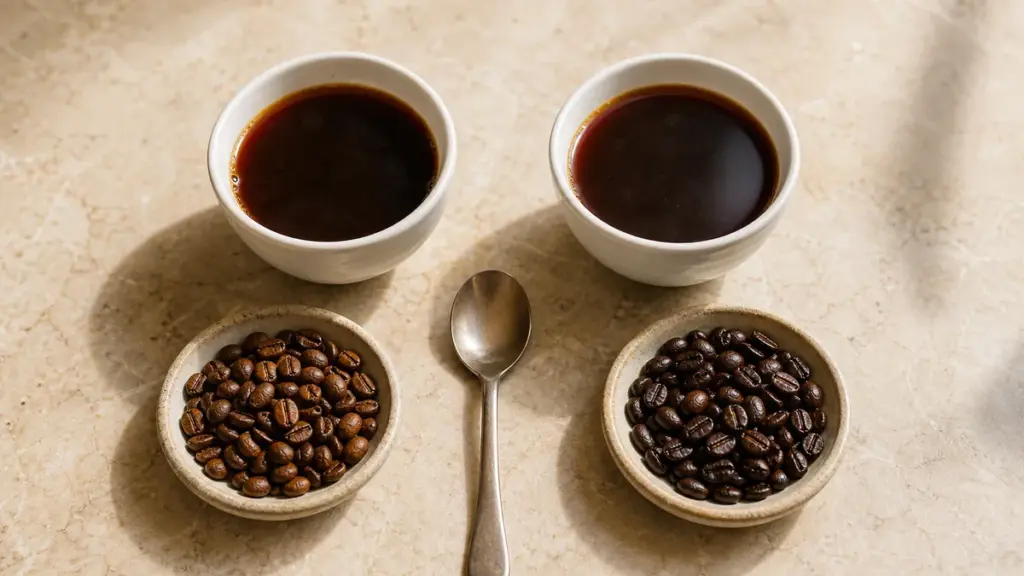
Pacamara
Pacamara was developed in El Salvador from Pacas × Maragogipe. The Salvadoran agriculture ministry dates the start of the breeding work to 1958, at the Instituto Salvadoreño de Investigaciones del Café, usually shortened to ISIC.
Its parents explain much of the interest. Pacas is a natural mutation of Bourbon, while Maragogipe is a natural mutation of Typica associated with very large beans. Pacamara’s own beans fall into World Coffee Research’s “very large” category. For the parents’ separate histories, see Maragogipe and Pacas.
Character and growing regions
El Salvador remains Pacamara’s principal home. The agriculture ministry identifies Alotepec-Metapán as a particularly important growing area, while also recording cultivation elsewhere in Central America, Mexico and Peru.
The ministry’s sensory description includes tropical fruit, floral, chocolate and honey notes, pronounced body and bright acidity. These are reported characteristics, not a promise that every Pacamara will taste of the same fruit. When choosing a bag, favour the roaster’s description of that harvest over a generic variety profile.
Its agricultural limitations
World Coffee Research rates Pacamara’s high-altitude quality potential as exceptional, but also records low yield potential and susceptibility to leaf rust and coffee berry disease.
Another significant qualification is that Pacamara is not fully uniform or stable from generation to generation. Its name therefore should not suggest genetically identical plants everywhere it appears. Large beans make it visually memorable; they do not remove the need to assess the individual lot.
SL28
SL28 was selected at Scott Agricultural Laboratories in Kenya in 1935, from a single tree in a population known as Tanganyika Drought Resistant. Tanganyika is the historical name relevant to the selection’s origin, in what is now Tanzania.
World Coffee Research places SL28 in the Bourbon-related genetic group. The “SL” prefix refers to Scott Laboratories: it does not mean that SL28 and SL34 share the same parentage.
SL28 is a tall plant with large beans and recognised drought tolerance. It spread beyond Kenya to other African countries, including Uganda, Malawi and Zimbabwe, and subsequently to Latin America.
What to expect in the cup
World Coffee Research gives SL28 exceptional quality potential at high altitude. However, its catalogue does not establish a universal blackcurrant or citrus flavour for every SL28 lot.
A useful real-world example is Square Mile Coffee Roasters’ washed Nguguini lot from Kirinyaga, Kenya, described with blackcurrant, cherry and a silky texture. That coffee contained SL28, SL34 and Ruiru 11 together. It illustrates a possible Kenyan lot profile, not proof that SL28 alone produces those flavours.
SL28 remains susceptible to both coffee leaf rust and coffee berry disease. Tolerance of dry conditions and resistance to fungal disease are separate traits.
SL34
SL34 was selected through Scott Agricultural Laboratories in the late 1930s, from a single tree on Loresho Estate in Kabete, Kenya. World Coffee Research records it mainly in Kenya and describes adaptation to high-altitude areas with good rainfall.
It is a tall plant with large beans and usually dark bronze shoot tips. Its catalogue quality potential at high altitude is exceptional, but it is susceptible to leaf rust and highly susceptible to coffee berry disease.
Why its ancestry is sometimes described differently
The original selected tree was labelled “French Mission”. Because that historical coffee population is associated with Bourbon, older accounts consequently describe SL34 as Bourbon-derived.
Genetic testing instead places SL34 in the Typica-related group. World Coffee Research acknowledges the discrepancy and suggests that the historical account of its source population may be incorrect. This article follows the genetic classification while retaining the older account as historical context.
Can you taste the difference from SL28?
Do not assume that SL34 is simply a softer or heavier-bodied version of SL28. The sources used here establish strong quality potential, but not a dependable sensory dividing line between the two.
The Nguguini example shows why attribution matters: a finished lot containing both varieties cannot demonstrate which one supplied its fruit notes or texture. To explore a difference, seek separately identified lots, preferably from comparable growing and processing conditions.
Origin fact panel: the places behind the names
Varieties travel, so none has one worldwide altitude range or harvest calendar. This panel gives geographical context for their best-known homes, rather than pretending these are fixed botanical requirements.
The altitude figures describe growing areas. Harvest windows are indicative country calendars, not predictions for an individual farm.
| Field | Pacamara’s Salvadoran context | SL28 and SL34’s Kenyan context |
|---|---|---|
| Altitude range | Alotepec-Metapán: 1,000 to 2,000 metres above sea level in the ICO country profile | Kenyan growing areas: 1,400 to 2,200 metres in the ICO country profile |
| Main varieties | Bourbon, Pacas and Pacamara are recorded in Alotepec-Metapán | SL28, SL34, K7, Ruiru 11, Batian and Blue Mountain are listed nationally |
| Processing | Wet processing is the general method recorded in the Salvadoran ICO profile; check the individual lot | Washed processing is documented for the Nguguini example |
| Harvest months | October to March in the ICO country calendar | April to June and October to December in the ICO country calendar |
| Cup profile | Reported Pacamara descriptors include tropical fruit, floral, honey and chocolate, with pronounced body | The mixed-variety Nguguini example was described as blackcurrant, cherry and silky; not a universal SL profile |
The Salvadoran and Kenyan ICO profiles were published in 2016 and 2019 respectively. Their regional and seasonal descriptions are useful background, but they should not replace a producer’s current harvest information.
Other specialty coffee varietals worth recognising
Beyond the three main profiles, several names help make sense of roasters’ labels:
- Caturra: a natural Bourbon mutation with compact growth. Its importance is not confined to rare, separately marketed lots.
- Mundo Novo: a natural cross between Typica and Bourbon, selected in Brazil. It is tall and vigorous, with good cup-quality potential.
- Catuaí: developed from Mundo Novo crossed with Caturra, combining that ancestry in a compact plant.
Their detailed relationships belong in Caturra, Catuaí and Mundo Novo, rather than being repeated here.
Java adds another useful example. World Coffee Research classifies the named variety as an Ethiopian landrace selection, meaning material derived from a locally established coffee population. It was once thought to be Typica-related, but genetic fingerprinting changed that interpretation. The catalogue records very good quality potential at high altitude and cultivation history spanning Africa and Central America.
These examples are a reminder to distinguish genetic evidence from an appealing origin story. Neither a familiar name nor an unusual one should substitute for information about the coffee being sold.
Why variety does not determine flavour on its own
The deeper issue is genotype by environment interaction: the same genetic material can perform differently under different growing conditions.
World Coffee Research’s international variety trial evaluated coffees harvested between 2021 and 2023, including 10 varieties across seven origins. Its reported results showed that quality performance depended partly on the growing environment. SL28 performed well at particular African sites, while Pacamara performed well at particular Latin American sites.
This was a multi-location field evaluation with sensory assessment, not a controlled demonstration that one variety always tastes better. The researchers also acknowledged variation associated with processing, storage, roasting, harvest year and cupper preferences.
For a useful comparison at home:
- Choose a question. Compare separately identified varieties, or compare one variety grown in different places.
- Reduce obvious differences. Where possible, choose similar processing methods and roast styles.
- Keep your brewing approach consistent. Avoid changing several variables between samples.
- Taste before reading the notes. Record your own impressions, then compare them with the roaster’s description.
- Keep the conclusion narrow. “I preferred this Pacamara” is justified by your tasting; “Pacamara is better” is not.
Treat specialty coffee varietals as a way to ask better questions about a bag, not as a shortcut around tasting it.
FAQ
Must I drink these coffees black to appreciate them?
No. Drink them in the form you enjoy. For a deliberate comparison, try a little of each without additions first, then add milk or anything else you normally use. That gives you a consistent starting point without turning the tasting into a rule about how coffee ought to be drunk.
Which should I choose as my first purchase?
Choose the best-described lot rather than choosing by variety alone. Look for a named producer or washing station, a clear processing description and tasting notes that appeal to you. If your aim is learning, ask the roaster why that particular coffee is a useful introduction to its named variety.
How should I record a variety tasting?
Keep the record simple: copy the coffee’s identity and processing information, then write what you actually notice about aroma, acidity, sweetness, texture and finish. Note any brewing changes too. Avoid forcing a named fruit into your description just because it appears on the bag.
Where to go next
Read Coffee Varieties for the wider family map, then Maragogipe and Pacas to understand Pacamara’s parents. Caturra, Catuai and Mundo Novo explains another influential set of relationships, while Stenophylla and Climate-Resilient Wild Species moves beyond familiar arabica varieties to the broader question of coffee’s future diversity.
Sources
-
World Coffee Research, Arabica Varieties Catalog: Pacamara, undated living entry, accessed 2026.
https://varieties.worldcoffeeresearch.org/varieties/pacamara
Source for parentage, bean size, quality potential, yield, instability and disease susceptibility. -
World Coffee Research, Arabica Varieties Catalog: SL28, undated living entry, accessed 2026.
https://varieties.worldcoffeeresearch.org/varieties/sl28
Source for selection history, Bourbon relationship, plant traits, distribution and susceptibility. -
World Coffee Research, Arabica Varieties Catalog: SL34, undated living entry, accessed 2026.
https://varieties.worldcoffeeresearch.org/varieties/sl34
Source for selection history, Typica relationship, historical uncertainty, rainfall adaptation and susceptibility. -
Ministerio de Agricultura y Ganadería, El Salvador, Pacamara, variedad de alta calidad y de origen nacional, es parte de Café de El Salvador Bicentenario, 2021.
https://www.mag.gob.sv/2021/09/10/pacamara-variedad-de-alta-calidad-y-de-origen-nacional-es-parte-de-cafe-de-el-salvador-bicentenario/
Source for the breeding programme’s start, parent varieties, growing countries and reported sensory characteristics. -
International Coffee Organization, Coffee Profile: El Salvador, ICC-117-8, 2016.
https://ico.org/documents/cy2015-16/icc-117-8e-profile-el-salvador.pdf
Source for regional altitude, varieties, harvest calendar and general processing context. -
International Coffee Organization, Coffee Profile: Kenya, ICC-124-7, 2019.
https://www.ico.org/documents/cy2018-19/icc-124-7e-profile-kenya.pdf
Source for growing-area altitude, nationally listed varieties and harvest windows. -
Square Mile Coffee Roasters, Our Pick Espresso: Nguguini, week 44, 2025.
A primary commercial description of one mixed-variety lot, used only as an attributed sensory and processing example. -
World Coffee Research, Arabica Varieties Catalog: Caturra; Mundo Novo; Java, undated living entries, accessed 2026.
https://varieties.worldcoffeeresearch.org/varieties/caturra
https://varieties.worldcoffeeresearch.org/varieties/mundo-novo
https://varieties.worldcoffeeresearch.org/varieties/java
Sources for the additional varieties’ ancestry, growth characteristics and quality potential, including the Mundo Novo entry’s account of Catuaí parentage. -
World Coffee Research, Evaluating cup quality in global arabica variety trial reveals complex interaction between genetics and environment, 2024.
https://worldcoffeeresearch.org/news/2024/cup-quality-gxe-imlvt
Source for the multi-location sensory evaluation and its limitations.
This piece was researched using World Coffee Research’s catalogue and trial reporting, official origin publications and an explicitly attributed roaster lot description; no first-hand testing is claimed.
Last checked: November 2026