Liberica and excelsa are coffee species grown alongside the much more familiar arabica and robusta. Liberica is Coffea liberica, while excelsa is now accepted by Kew as the separate species Coffea dewevrei, rather than simply a variety of liberica.
In short
- The older name still appears: Coffea liberica var. dewevrei is a synonym of Coffea dewevrei, not the classification followed here.
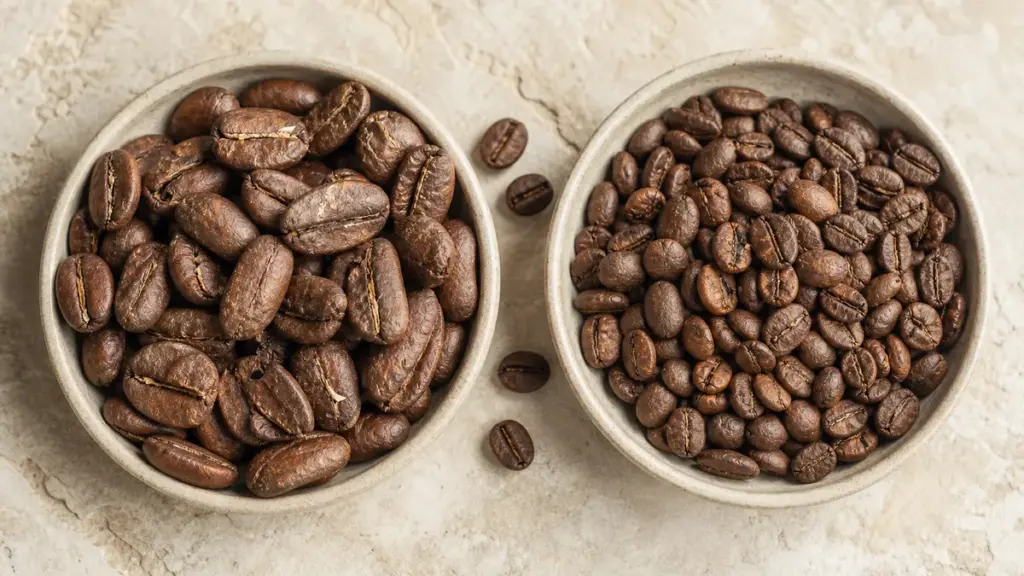
- Large beans chiefly describe liberica: excelsa has smaller beans, closer to arabica in size.
- They occupy different growing niches: published cultivation ranges are generally lower for liberica than for excelsa.
- Expect distinctive flavours: liberica can suggest tropical fruit; excelsa often brings dried fruit, chocolate and spice. These are tendencies, not guarantees.
- Climate interest is justified, but qualified: researchers are investigating both species, rather than treating either as a climate-proof replacement for existing crops.
What is liberica coffee?
Liberica is the coffee produced by Coffea liberica, a tree native to upper West Africa. Kew’s current record places its native range from Sierra Leone to south-western Nigeria. Its African origin should not be confused with the countries where people subsequently established it as a crop.
For readers meeting it for the first time, the most useful distinction is between a species and a named selection within that species. Liberica is not an arabica cultivar in the way that familiar arabica selections are. Our coffee varieties guide provides the wider framework.
Liberica’s conspicuous features include large fruits and beans. A Johor Department of Agriculture account, published by Malaysia’s statistics department, describes both as larger than those of arabica and robusta. It also identifies Malaysian planting material such as MKL 5, MKL 6 and MKL 7, which are named liberica clones, not separate species.
The tree itself can be substantial. The Philippine Department of Agriculture’s Coffee Techno Guide describes liberica as upright, with straight trunks, and capable of reaching 9 m. That is a description of its growth potential, not a recommended harvesting height.
Calling liberica “the third coffee species” is therefore an unhelpful shortcut. It may distinguish it from the two dominant commercial coffees, but it should not imply that coffee botany stops there. For the familiar commercial comparison, see arabica versus robusta.
Excelsa
Excelsa is the common name used here for Coffea dewevrei. Kew accepts that species and lists Coffea liberica var. dewevrei among its synonyms, meaning alternative scientific names referring to the same taxon. Older books, research papers and trade descriptions may therefore use a different name without necessarily describing a different plant.
The decisive recent revision was published on 8 August 2025. Aaron Davis and colleagues combined genomic evidence, plant measurements and geographical records to support separating the former broad concept of liberica into three species: C. liberica, C. dewevrei and C. klainei. This article follows that revision and Kew’s current treatment.
The difference matters beyond the label. Excelsa has smaller fruits and seeds than liberica, with thinner fruit pulp and thinner parchment, the protective layer around the seed. Research describes its seeds as arabica-sized, so pictures of unusually large liberica beans should not automatically stand in for excelsa.
Excelsa is nevertheless a sizeable tree. Field-based research in Uganda describes trees around 10 m or more, and warns that historical reports sometimes confused excelsa with other material sold under liberica-related names. That makes confident claims based solely on an old trade name particularly risky.
For a buyer, the sensible question is not simply “Is this excelsa?” Ask what botanical identity the supplier uses, where the coffee was grown and how that identity was established.
Where liberica and excelsa grow
The Philippines is an established growing country for both coffees. Its Department of Agriculture identifies liberica locally as kapeng barako, while treating excelsa separately in its practical growing guide. The guide’s botanical terminology predates the recent revision, so its local crop information should be read separately from current species naming.
Malaysia is another important liberica-growing country, particularly in discussions of lowland cultivation. The 2025 botanical study also records expanding cultivation of liberica and excelsa across countries including Uganda, South Sudan and India. These should not be presented as equivalent production centres, or as places growing identical planting material.
West Africa is part of the story as a native region, not merely a modern coffee origin. Excelsa’s native distribution lies farther east, across parts of Central Africa and into South Sudan and Uganda. Kew’s species record distinguishes this wild distribution from introduced occurrences.
Origin fact panel
These are species-level reference points and regional examples, not a specification for every farm.
| Feature | Liberica | Excelsa |
|---|---|---|
| Botanical identity | Coffea liberica | Coffea dewevrei |
| Published cultivation altitude | Generally 10 to 500 m in the 2025 study | Generally 500 to 1,200 m in the 2025 study |
| Named planting material | Malaysian clones include MKL 5, MKL 6 and MKL 7 | Ask for the actual selection or accession; “excelsa” identifies the species here |
| Documented processing | Honey processing documented in Malaysian research | Natural, honey, semiwashed and extended-fermentation “wine” processing documented in East Java |
| Harvest examples | Southern Peninsular Malaysia: April to June and October to December | Uganda: January to April |
| Typical reported cup | Tropical fruit, sweetness and low acidity | Dried fruit, chocolate, spice and low to medium acidity |
Sources for the panel: Kew species records; Davis and colleagues’ 2025 and 2026 studies; the Johor agriculture account; Malaysian processing and flowering research; Herawati and colleagues’ processing study; and the Ugandan field review. Harvest windows describe the stated regions only.
Do not turn those altitude ranges into hard biological limits. A subsequent 2026 study gives a broader usual cultivation range for excelsa, reaching 1,500 m. Ask for the actual farm elevation rather than rejecting a traceable lot because it falls outside a simplified species profile.
What do they taste like?
Recent research describes liberica through bold tropical-fruit notes, including jackfruit, mango and passion fruit, alongside low acidity and pronounced sweetness. Excelsa is described through currant, prune, plum, chocolate and spice, usually with low bitterness. These are researchers’ sensory descriptions, not promises that every bag will taste alike.
Other authoritative descriptions are less delicate. The Philippine growing guide characterises barako through strong aroma, powerful body and a medicinal-type flavour. The Johor agriculture account instead highlights fruit, nuts and a lingering sweet finish. Read these as descriptions of particular coffee traditions and material, not competing universal definitions.
Processing gives another reason to avoid sweeping judgements. An experimental study of coffee labelled excelsa from East Java compared natural, honey, semiwashed and “wine” processes, finding differences in aroma chemistry and sensory attributes. Its older botanical name should be read in its historical context; the study did not provide the genomic identification used in the later taxonomic work.
My recommendation is to choose by the lot description rather than by novelty alone. Ask the roaster whether the coffee is fruit-led, woody, chocolate-led or strongly fermented, and whether those notes reflect their own assessment of the current batch. For context on quality-focused selections, read specialty coffee varietals.
Processing and harvest: why the details matter
Honey processing does not mean adding honey. In the East Java study, it involved removing the fruit skin and retaining some sticky mucilage around the seeds during drying. The same research distinguishes this from drying whole cherries as naturals and from processing involving fermentation and washing.
Honey-processed liberica is also documented in Malaysian research, whose authors selected it because local producers commonly used the method. That establishes a real processing practice, not a rule that honey processing is best for all liberica.
Harvest information needs equally careful wording. Malaysian flowering research describes repeated flowering and regional differences in production seasons. Rather than attaching one worldwide harvest calendar to liberica, request the producing region, harvest period and crop year for the coffee being offered.
For a useful first purchase, ask for:
- The species name used by the producer.
- The farm or producer group and growing region.
- The processing method, including any deliberate fermentation treatment.
- The harvest period and roast date.
- The roaster’s suggested brewing approach.
Treat unanswered questions as gaps in traceability, not automatic proof of poor coffee.
Climate resilience: promise without a miracle claim
Renewed interest concerns crop diversification as much as unusual flavour. Kew’s development project investigates liberica, excelsa and related species through farm trials, genetics, chemical research and farmer support. Its principal excelsa work is focused on Uganda, with wider research across Africa and Asia.
The evidence needs separating into different kinds. A 2026 climate study used occurrence records and environmental modelling to examine cultivated liberica. It found cultivation in warmer, wetter and less seasonal conditions than its wild distribution alone would suggest. That is evidence about its growing niche, not a controlled demonstration that it will outperform another coffee under every future climate.
The same study warns that some established cultivation areas, including Sarawak, already operate near the edge of the cultivated niche. Liberica’s potential therefore depends on matching planting material to conditions, while addressing agricultural and processing difficulties. Heat tolerance is not permission to ignore rainfall patterns or local suitability.
Farmers’ experiences also matter, but must be labelled correctly. The Ugandan review reports farmer-led adoption of excelsa in response to difficulties with robusta, including drought, pests and disease. Those observations are valuable leads, not proof of universal resistance. The wider research programme exists partly to test such possibilities more rigorously.
A further complication is hybridisation. A genomic study published on 14 May 2026 confirmed fertile hybrids between liberica and excelsa in cultivation. This helps explain why commercial names alone cannot always settle identity, and opens research questions about combining useful traits. It does not establish that the hybrids are automatically more resilient.
The useful perspective is therefore a broader choice of crops, not a single replacement for arabica or robusta. Our guide to climate-resilient wild species examines that wider question.
FAQ
Is barako always pure liberica?
Do not assume that the word alone guarantees a pure, traceable lot. The Philippine Department of Agriculture identifies kapeng barako with liberica, which explains the association. For a particular product, ask the supplier to confirm its species and whether it is a blend. A familiar local name is useful context, but request a clear ingredient and origin description.
Is excelsa a newly discovered coffee?
No, the recent change concerns classification, not the discovery of a previously unknown crop. Kew records the scientific name Coffea dewevrei as first published in 1899. The 2025 research reinstated species-level distinctions using modern evidence. An older source calling it Coffea liberica var. dewevrei may therefore refer to the same coffee under an earlier treatment.
Can bean size prove which species I have?
No, use size as a clue rather than proof. Liberica generally has larger seeds than excelsa, but research also confirms hybridisation between them in cultivation. For a purchase, prioritise producer records and the supplier’s identification basis. Do not relabel a bag simply because its beans look larger or smaller than an online photograph.
Where to go next
Read Coffee Varieties for the wider naming framework, and Robusta Coffee for the other major warm-climate commercial coffee. Stenophylla and Climate-Resilient Wild Species puts the renewed interest in liberica and excelsa coffee into a broader crop-diversification context.
Sources
-
S1. Royal Botanic Gardens, Kew. Plants of the World Online: Coffea liberica and Coffea dewevrei. Live records, 2026.
https://powo.science.kew.org/taxon/urn%3Alsid%3Aipni.org%3Anames%3A77368785-1/general-information
https://powo.science.kew.org/taxon/urn%3Alsid%3Aipni.org%3Anames%3A747092-1 -
S2. Davis, A. P., and colleagues; Nature Plants. Genomic data define species delimitation in Liberica coffee with implications for crop development and conservation. 2025.
https://pmc.ncbi.nlm.nih.gov/articles/PMC12449269/ -
S3. Davis, A. P., and colleagues; Scientific Reports. Genomic elucidation of hybridization between Liberica and excelsa coffee and its implications for coffee crop development. 2026.
https://pmc.ncbi.nlm.nih.gov/articles/PMC13369886/ -
S4. Davis, A. P., and colleagues; Frontiers in Plant Science. A review of the indigenous coffee resources of Uganda and their potential for coffee sector sustainability and development. Published 2023, volume 13.
https://www.frontiersin.org/journals/plant-science/articles/10.3389/fpls.2022.1057317/full -
S5. Philippine Department of Agriculture, Agricultural Training Institute. Coffee Techno Guide. Undated document, hosted in the November 2022 directory.
https://ati2.da.gov.ph/ati-4b/content/sites/default/files/2022-11/Coffee%20Technoguide%20w%20page%20numbers.pdf -
S6. Johor Department of Agriculture, published by Department of Statistics Malaysia. Serlahkan Keunikan Kopi Liberica Signature Johor, in Laporan Interim Banci Pertanian 2024 Negeri Johor. 2025.
https://www.dosm.gov.my/portal-main/release-document-log?release_document_id=16864 -
S7. Halimah, H., and colleagues; MARDI. Response of Application of Gibberellic Acid and Paclobutrazol on Flowering in Liberica Coffee. 2024.
https://ijafp.org/wp-content/uploads/2024/12/IJAFP15_072.pdf -
S8. Herawati, D., and colleagues; International Journal of Food Science. Profile of Bioactive Compounds, Aromas, and Cup Quality of Excelsa Coffee (Coffea liberica var. dewevrei) Prepared from Diverse Postharvest Processes. 2022.
https://pdfs.semanticscholar.org/2bbb/454d1356c789a209cede309eeeb99815f9a6.pdf -
S9. Ibrahim, A. H., and colleagues; MARDI. Effects of Roasting Degrees on Total Phenolic, Antioxidant Activity and Phenolic Compounds in Local Liberica Coffee Beans. 2024.
https://ijafp.org/wp-content/uploads/2024/10/IJAFP14_FM37.pdf -
S10. Wild, I. M. J., and colleagues; Plants, People, Planet. Climate requirements for cultivated Liberica coffee (Coffea liberica) and consequences for its use and development as a crop species. 2026.
https://nph.onlinelibrary.wiley.com/doi/full/10.1002/ppp3.70183 -
S11. Royal Botanic Gardens, Kew. Excelsa and Liberica coffee development. Undated, active project page checked in 2026.
https://www.kew.org/science/our-science/projects/excelsa-and-Liberica-coffee-development
Research combined current Kew taxonomy with retrieved botanical, agronomic, processing and climate studies, keeping older names and regional observations distinct from current species-level conclusions.
Last checked: November 2026