Arabica and robusta are different coffee species: arabica generally offers more aromatic variety and brighter acidity, while robusta usually brings more bitterness, fuller body and more caffeine. For choosing a bag, start with the flavour you enjoy and how you drink it, not the assumption that arabica is always better.
In short
- Arabica is Coffea arabica; robusta is the common commercial name for Coffea canephora.
- Arabica has 44 chromosomes and can self-pollinate; robusta has 22 and normally needs pollen from another compatible plant.
- Arabica generally contains more sucrose and lipids. Robusta generally contains more caffeine and chlorogenic acids, although individual coffees vary.
- Choose arabica first for aromatic detail; consider robusta or a blend for a more forceful, full-bodied cup.
- Robusta tolerates warmer growing conditions, but neither species is automatically climate-proof or environmentally preferable.
Arabica vs robusta: the side-by-side comparison
The criteria below separate plant biology from drinking preferences. Flavour descriptions are tendencies, not promises: variety, farming, processing, roasting and brewing all influence the result.
| Criterion | Arabica | Robusta |
|---|---|---|
| Botanical name | Coffea arabica | Coffea canephora |
| Chromosomes | 44, arranged in four sets | 22, arranged in two sets |
| Pollination | Self-compatible: its own pollen can fertilise its flowers | Normally self-incompatible: needs pollen from another compatible plant |
| Growing conditions | Generally cooler, often at higher elevations | Generally warmer, often at lower elevations |
| Common flavour tendencies | More aromatic complexity, sweetness and noticeable acidity | More bitterness, lower perceived acidity and fuller body |
| Green-bean chemistry | Generally more sucrose and lipids | Generally more caffeine and chlorogenic acids |
| Common uses | Filter coffee, espresso, blends and instant coffee | Espresso blends, instant coffee and single-species drinks |
| Who it suits | Drinkers seeking aromatic detail or a brighter cup | Drinkers seeking intensity, body or a more bitter profile |
| Main caution | The species name does not guarantee quality | Greater caffeine content and bitterness may not suit everyone |
A blend is not necessarily a compromise. It can deliberately combine arabica’s aromatic character with robusta’s intensity, rather than asking either species to do everything.
For the wider naming system, start with coffee varieties.
Botany: different species, closely related
Arabica and robusta are species, not roast levels, growing regions or grades. A dark-roasted arabica remains arabica; a carefully processed robusta remains robusta.
Arabica is tetraploid, meaning it has four sets of chromosomes, making 44 altogether. Robusta is diploid, with two sets and 22 chromosomes. Genome research shows that arabica arose through natural hybridisation between ancestors of Coffea canephora and Coffea eugenioides. Robusta is therefore part of arabica’s ancestry, not simply its commercial rival.
Their pollination differs too. Arabica can fertilise its flowers with its own pollen, although cross-pollination also occurs. Robusta normally cannot do this successfully and needs another compatible plant as a pollen source.
That distinction matters to breeders and farmers choosing planting material. It does not mean twice as many chromosomes produce twice as much flavour, nor does self-pollination make arabica independent of its surrounding ecosystem.
Robusta also contains substantial genetic diversity. Treating it as one uniform, bitter bean overlooks differences that breeders can use to improve cup quality and agricultural performance.
Altitude and climate: useful tendencies, not fixed borders
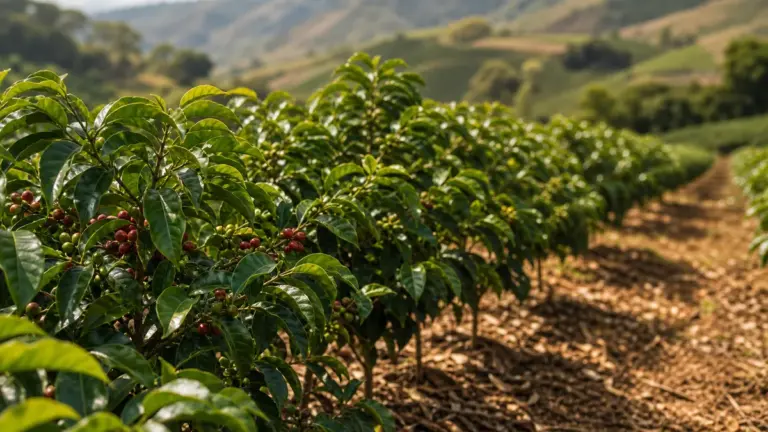
Arabica generally suits cooler conditions than robusta. The International Trade Centre’s broad comparison gives cultivation elevations of 700 to 2,200 metres for arabica, against sea level to 900 metres for robusta, while acknowledging robusta cultivation up to 1,600 metres.
These are orientation figures, not botanical boundaries. Altitude partly stands in for temperature: the same elevation can offer different growing conditions at different latitudes. Rainfall, shade, exposure and the particular variety also matter.
Temperature guidance needs similar care. The International Trade Centre gives broad annual-average ranges of 16 to 24°C for arabica and 21 to 30°C for robusta. However, these should not be read as guaranteed yield optima.
A farm-data study in South-East Asia found robusta’s modelled production optimum below 20.5°C, substantially cooler than conventional guidance suggested. The two approaches measure different things: broad suitability for cultivation is not the same as the temperature associated with the highest observed farm yields.
For buyers, “high-grown” is useful context, not a substitute for knowing the producer, processing method and flavour profile.
Caffeine, sugars, oils and chlorogenic acids
Arabica generally contains more sucrose, the familiar sugar also found in table sugar, and more lipids, meaning fats and oils. Robusta generally contains more caffeine and chlorogenic acids, a family of plant compounds involved in coffee’s chemistry and flavour development.
The direction of these differences is better established than any single neat percentage range. A laboratory comparison of wild accessions found substantial variation within both species, while confirming these average differences for caffeine, sucrose and chlorogenic acids.
What measured beans actually contained
The following figures come from one published laboratory comparison. They are grams per 100 g of green coffee, rounded to two decimal places, not universal species averages or amounts in a prepared drink. The table does not specify a dry-matter basis, so these values should not be silently combined with dry-weight figures from other studies.
| Compound | Arabica sample | Robusta sample |
|---|---|---|
| Caffeine | 1.05 g | 2.57 g |
| Sucrose | 7.14 g | 4.49 g |
| Total chlorogenic acids | 6.97 g | 9.40 g |
This illustrates the usual pattern without pretending every robusta contains exactly twice the caffeine of every arabica. Nor can a green-bean percentage tell you the caffeine in an espresso: the dose, blend and brewing extraction also matter.
Sucrose is an aroma precursor during roasting, not simply sugar waiting to dissolve into the cup. In the same experiment, the roasted samples contained much less sucrose than the green beans. “More sugar in the seed” therefore does not mean the finished drink tastes like sweetened coffee.
Why oils and crema need a more careful explanation
A lipid-characterisation paper reports literature ranges of approximately 15% to 17% of dry green-bean weight for arabica, compared with 7% to 10% for robusta. Other studies report different ranges, so these are useful approximations rather than limits.
Lipids interact with aroma compounds and influence how aroma is retained and released. But “arabica has more oil, therefore more flavour” is too simple.
The crema explanation is also often reversed. Robusta does not generally produce more espresso foam because it contains more oil. Oils can destabilise foam, and an espresso-foam review found conflicting experimental results when comparing the species. Robusta can contribute generous crema, but freshness, roasting, grinding and extraction also matter; crema thickness is not a reliable quality score.
Flavour and uses: choose for the drink you want
Arabica commonly offers a broader impression of sweetness, aroma and acidity. Here, acidity means a bright sensory quality, not a prediction about how coffee will affect your stomach. Depending on the coffee, that brightness can accompany fruit, floral or other distinctive aromas.
Robusta more often tastes forceful, bitter and full-bodied, with less perceived acidity. Sensory research has also found robusta brews more astringent, meaning they create a drying sensation in the mouth. Yet good processing can produce cleaner, more varied flavours than the familiar stereotype suggests.
My suggested starting points are:
- For black filter coffee: begin with arabica if aromatic detail and brightness appeal to you.
- For espresso with milk: compare an arabica coffee with a clearly described arabica-robusta blend. Judge the finished milk drink, not only the espresso underneath.
- For a deliberately intense cup: try a traceable robusta whose producer and processing are identified.
- For lower caffeine intake: do not rely on flavour or the species name alone; seek product-specific information or consider decaffeinated coffee.
Robusta is widely used in soluble coffee and espresso blends, but those uses do not define its quality ceiling. Arabica also appears in instant coffee and ordinary commercial blends. Read robusta coffee for the species-specific detail.
Make a fair tasting comparison
Choose coffees with reasonably similar roast descriptions and use the same brewing method. Weigh equal doses, keep water and beverage quantities consistent, and compare aroma, bitterness, acidity, body and finish.
Taste them without seeing which is which if possible. This is a comparison of those particular coffees, not a controlled experiment proving what every member of each species tastes like.
Buying beyond the species label
“100% arabica” identifies the species composition, not the care taken over harvesting, processing or roasting. Likewise, a blend containing robusta should be judged by what it tastes like and how clearly it is described.
Ask the roaster for the origin, processing method, roast description and species proportions. For workplace supply, request samples and itemised written quotations on the same supply terms before deciding.
Choose on the intended drink and the evidence available, rather than treating the species name as a complete buying specification.
Sustainability and climate resilience
Robusta’s warmer-climate cultivation and genetic diversity make it valuable for adaptation. They do not make it immune to drought, heat or agricultural disease.
The South-East Asian yield study used ten years of observations from 798 farms. It was an observational analysis with climate modelling, not a controlled warming trial, and its optimum should not be imposed on every robusta-growing region. Nevertheless, it directly challenges the idea that higher temperatures will leave robusta unaffected.
Environmental performance also depends on the production system. Land-use change, fertiliser, irrigation and processing can matter more than a species label suggests. Neither “arabica” nor “robusta” tells you whether forest was cleared, how water was managed or whether a sustainability claim has been independently substantiated.
Ask for specific evidence about the farm and supply chain. For the broader adaptation question, see climate-resilient wild species.
Myths about arabica and robusta
- “Arabica is always better.” Species labelling is easy to understand, which makes it attractive marketing shorthand. It cannot replace assessment of the actual coffee.
- “Robusta is only a filler.” Its widespread commercial uses have shaped that reputation. Genetic diversity and careful processing also offer scope for distinctive, desirable coffees.
- “More crema proves better espresso.” Crema is conspicuous, so it is tempting to use it as a shortcut. Foam formation and persistence do not establish flavour quality.
- “Robusta will solve climate change for coffee.” The name and warmer growing conditions encourage this assumption. Farm evidence shows that robusta production is still vulnerable to heat.
FAQ
Does “strong coffee” mean robusta?
No, “strong” can mean several different things. A drink may taste forceful because of its roast, bitterness or concentration, without containing robusta. Robusta generally contains more caffeine, but caffeine content, flavour intensity and the amount of dissolved coffee in a drink are separate characteristics. Ask what the description means rather than treating it as a caffeine measurement.
Can I identify the species just by looking at the beans?
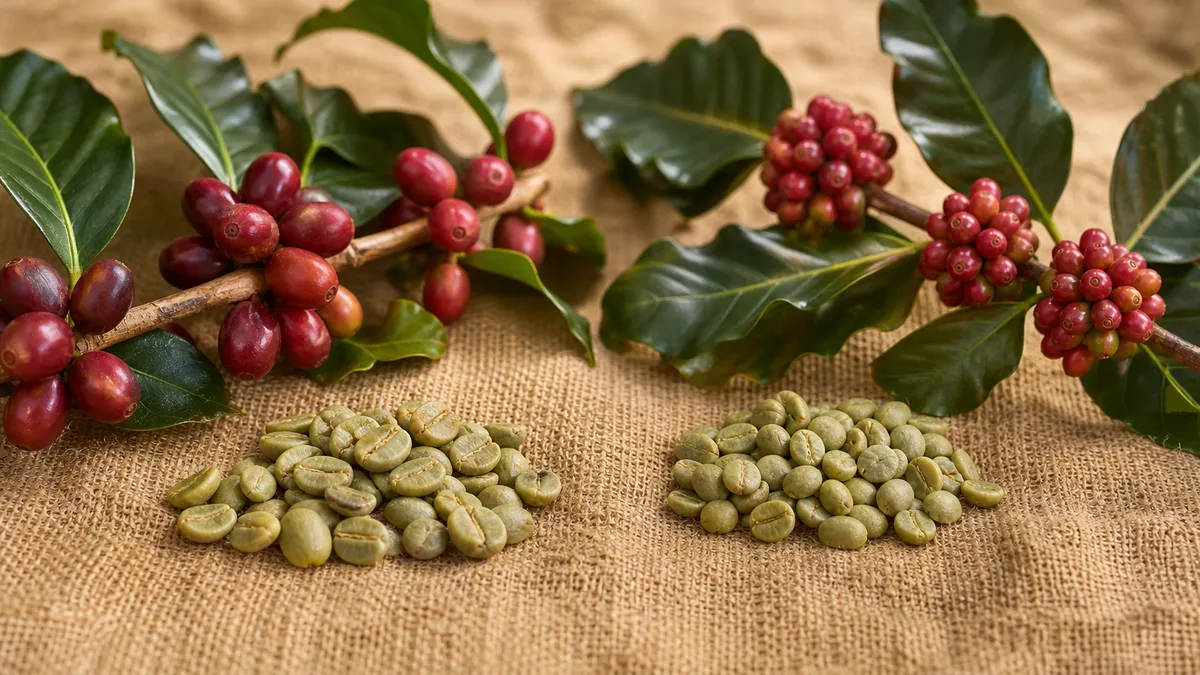
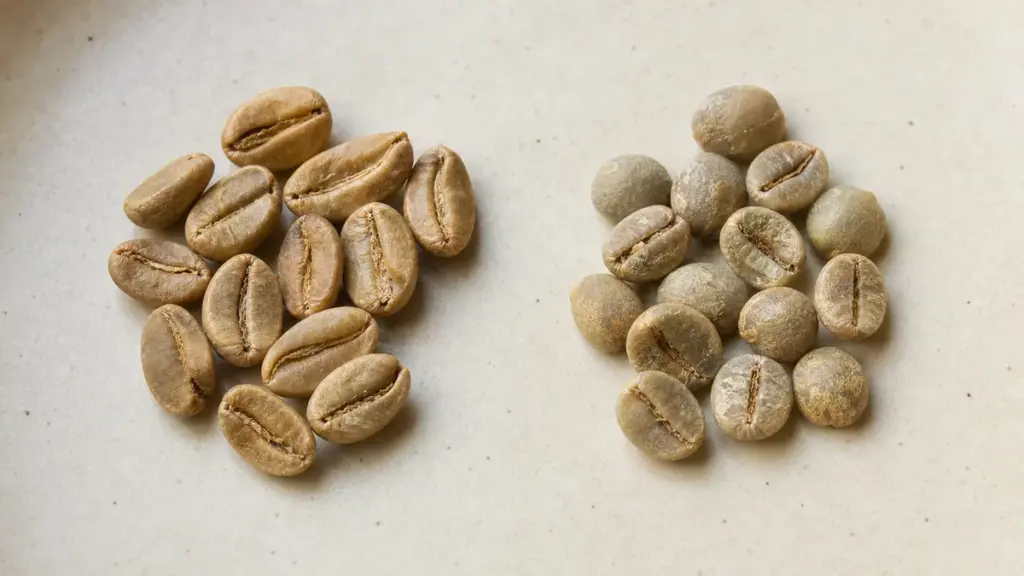
Not reliably enough to verify a purchase. Arabica beans are commonly more oval with a curved centre groove, while robusta beans are often rounder with a straighter groove. However, appearance varies, and roasting changes the beans. Use the producer’s or roaster’s identification rather than trying to authenticate a bag visually.
Is robusta more bitter only because it contains more caffeine?
No, caffeine is only part of the explanation. Robusta also generally differs in chlorogenic-acid composition, while roasting creates further compounds that influence bitterness. Sensory research supports a tendency towards more bitter and astringent robusta drinks, but the finished result also depends on the particular beans, roast and brewing method.
Where to go next
Use Coffee Varieties to place arabica vs robusta within coffee’s wider naming system, then read Robusta Coffee for a closer look at canephora. Geisha explores one arabica variety rather than another species, while Stenophylla and Climate-Resilient Wild Species explains why coffee adaptation extends beyond this pair.
Sources
-
International Trade Centre, The Coffee Guide, fourth edition, 2021. Species comparison, cultivation ranges, bean appearance and commercial uses.
https://www.intracen.org/file/itccoffee4threport20210930webpagespdf -
World Coffee Research, The roots of Robusta: cultivating growth for a species once overlooked, 2024. Pollination, genetic diversity, sensory tendencies and processing potential.
https://worldcoffeeresearch.org/news/2024/the-roots-of-robusta -
Salojärvi and colleagues, Nature Genetics, The genome and population genomics of allopolyploid Coffea arabica reveal the diversification history of modern coffee cultivars, 2024. Chromosomes and arabica’s ancestry.
https://pmc.ncbi.nlm.nih.gov/articles/PMC11018527/ -
Ky and colleagues, CIRAD / Food Chemistry, Caffeine, trigonelline, chlorogenic acids and sucrose diversity in wild Coffea arabica L. and Coffea canephora P. accessions, 2001. Experimental comparison of within-species variation and between-species averages.
https://publications.cirad.fr/une_notice.php?dk=526749 -
Moreira and colleagues, Data in Brief, Data on coffee composition and mass spectrometry analysis of mixtures of coffee related carbohydrates, phenolic compounds and peptides, 2017. Measured green and roasted coffee composition, Tables 1 and 2.
https://pmc.ncbi.nlm.nih.gov/articles/PMC5451187/ -
Journal of Food Composition and Analysis, Lipid characterization of arabica and robusta coffee beans by liquid chromatography-ion mobility-mass spectrometry, 2022. Lipid analysis and reported dry-bean lipid ranges.
https://www.sciencedirect.com/science/article/pii/S0889157522002058 -
Illy and Navarini, Food Biophysics, Neglected Food Bubbles: The Espresso Coffee Foam, 2011. Review of crema formation, lipid effects and conflicting species comparisons.
https://pmc.ncbi.nlm.nih.gov/articles/PMC3140933/ -
Foods, Antioxidant and Sensory Assessment of Innovative Coffee Blends of Reduced Caffeine Content, 2022. Experimental sensory assessment across brewing methods.
https://pmc.ncbi.nlm.nih.gov/articles/PMC8778917/ -
Kath and colleagues, Global Change Biology, Not so robust: Robusta coffee production is highly sensitive to temperature, 2020. Observational farm-yield analysis and climate modelling.
https://pubmed.ncbi.nlm.nih.gov/32223007/ -
Davis and colleagues, Sustainable Development, The Sustainability of Robusta Coffee Under Global Change: A Review, 2026. Temperature, water requirements and production-system sustainability.
https://onlinelibrary.wiley.com/doi/10.1002/sd.71568
The piece was researched using live-retrieved institutional guidance and peer-reviewed research, distinguishing measured samples, general tendencies and modelled agricultural outcomes.
Last checked: November 2026