Robusta coffee is coffee from Coffea canephora, a species generally associated with higher caffeine, substantial body and a more bitter flavour than arabica. It is widely used in espresso blends and instant coffee, but carefully grown and processed fine robusta can also offer sweetness, clean chocolate notes and distinctive fruit flavours.
In short
- Robusta accounted for approximately 43% of estimated world coffee production in 2025/26, calculated from the International Coffee Organization’s September 2026 figures.
- It generally suits warmer, lower-altitude growing areas than arabica, although Uganda demonstrates that robusta is not exclusively a lowland crop.
- Guinean and Congolese are broad genetic groups, not a universally accepted pair of formal subspecies.
- Conilon, widely grown in Brazil, belongs to the same species. Its relationship to other robusta material is more complicated than a simple two-branch family tree.
- Greater disease resistance does not mean immunity, and “fine robusta” should describe assessed quality, not merely appear on a packet.
What is robusta coffee?
Coffea canephora is the botanical species; robusta is its familiar commercial name. In some producing countries, particularly Brazil, “robusta” also has a narrower meaning that distinguishes certain cultivated material from conilon. That difference in usage explains why apparently contradictory descriptions sometimes appear on coffee packaging and in agricultural writing.
It is helpful to separate three questions: which species is this, which cultivated material was planted, and how good is the harvested coffee? A species name does not answer all three. Our coffee varieties guide provides the wider framework.
Robusta is not a minor ingredient in the global coffee supply. The ICO’s September 2026 report estimated production of 79.2 million 60 kg bags of robusta out of 183.6 million bags of coffee overall for 2025/26. Dividing the former by the latter gives approximately 43%, a production share rather than a measure of quality.
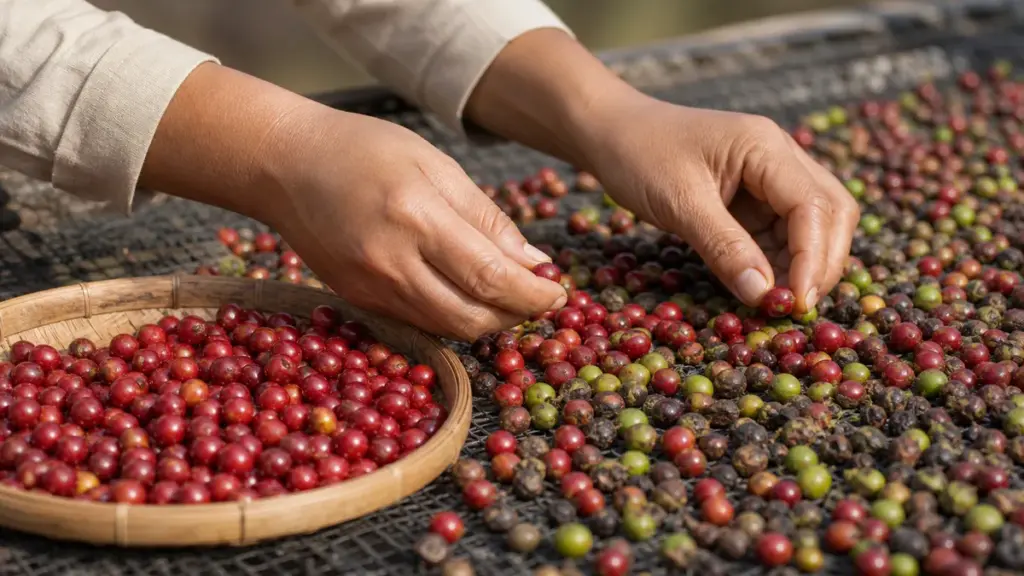
Robusta Subspecies
Genetic groups, not a tidy subspecies list
The heading “subspecies” needs a qualification: the most useful explanation concerns genetic diversity and commonly recognised cultivated groups, rather than an agreed list of botanical subspecies.
World Coffee Research describes two broad genetic groups:
- Guinean, associated with western Africa.
- Congolese, associated with central Africa and containing several differentiated populations.
Older classifications often associate SG1 with Kouilou or conilon material and SG2 with robusta material from the Congo region. However, treating every Congolese coffee as either SG1/Conilon or SG2/Robusta oversimplifies the evidence. A 2025 genomic study of Vietnamese robusta discusses eight geographically structured groups, including a separate Ugandan group, with some closely related groups combined in particular analyses.
These classifications are not necessarily competing answers to precisely the same question. Researchers use different samples, genetic markers and levels of detail. This article follows World Coffee Research for the broad overview and recent genomic research for the finer distinctions.
Conilon, robusta and cross-pollination
Conilon is widely cultivated in Brazil and is C. canephora, not a separate coffee species. Brazilian agronomic literature commonly distinguishes conilon and robusta cultivated types, while breeding also combines their characteristics. Regional names should therefore not be mistaken for perfectly bounded genetic categories.
C. canephora is diploid, meaning it has two sets of chromosomes. It is also normally self-incompatible: pollen from the same plant cannot usually fertilise its flowers successfully.
Successful planting consequently depends on compatible cross-pollination between genetically different plants. Growing many cuttings of one clone does not automatically provide suitable pollination partners, because those cuttings are genetically copies of the same plant.
Robusta Growing Regions
Important producing countries include Vietnam, Brazil, Indonesia, Uganda and India. The species originated in tropical Africa, but its present commercial geography extends well beyond its native distribution.
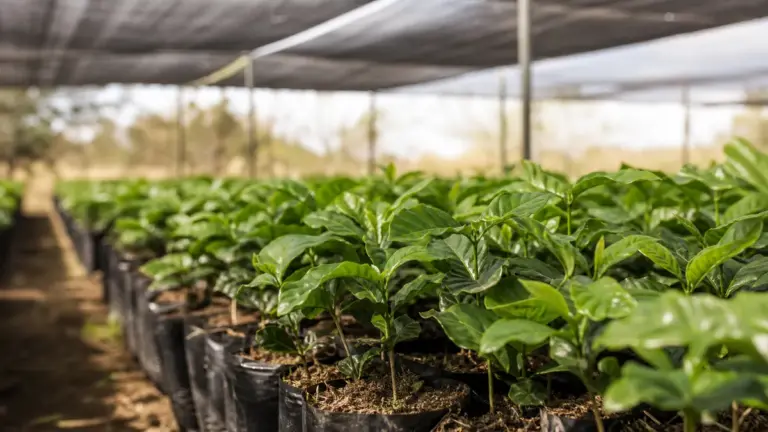
Robusta generally tolerates warmer growing conditions than arabica and is often cultivated at lower elevations. Nevertheless, altitude is an imperfect shorthand for temperature, rainfall and local growing conditions. A Ugandan robusta farm can sit substantially higher than the word “lowland” suggests.
Robusta origin fact panel
Robusta is a species grown across several continents, not one geographical origin. This panel therefore identifies the location behind each farming figure rather than presenting a misleading worldwide harvest calendar.
| Attribute | Reference information |
|---|---|
| Altitude | Uganda’s UCDA handbook gives a cultivation range of 900 to 1,500 metres. This is a Ugandan recommendation, not a worldwide boundary. |
| Cultivated material | Examples include Vietnamese TR4, Brazilian conilon selections and Ugandan coffee wilt disease-resistant clones. These are examples, not a global planting census. |
| Processing | Natural processing, drying the whole cherry, is common in Vietnam and Uganda. Washed processing is also used, including for quality-focused lots. |
| Harvest months | Kew reports a main harvest generally from November to February in central, eastern and northern Uganda, with a smaller crop from May to July. Masaka and western Uganda commonly have their main crop from April to July. |
| Cup profile | CQI’s robusta protocols recognise cocoa, caramel, nuts, spice and fruit among possible positive flavours. No single profile applies to every origin or lot. |
Disease resistance is not immunity
Robusta’s reputation for resilience has a basis, but it needs precision. World Coffee Research describes stronger rust resistance among Congolese material, while resistance varies between cultivated selections.
Uganda’s experience with coffee wilt disease is a clear warning against calling the species disease-proof. UCDA identifies wilt, leaf rust, red blister disease and root rot among diseases affecting robusta. Breeding resistant planting material remains necessary.
Heat tolerance also has limits. A 2020 observational modelling study using farm yields in South-East Asia challenged the assumption that robusta production benefits from consistently high temperatures. Its findings should not be turned into a universal planting prescription, but they undermine the idea that robusta is automatically protected against a warming climate.
Vietnamese Robusta
Vietnam is a major robusta producer, with cultivation concentrated in the Central Highlands. USDA’s May 2026 country report forecast 31.4 million 60 kg bags of robusta for the Vietnamese 2026/27 marketing year, against 1.1 million bags of arabica. These are forecasts, not final harvest totals.
Natural processing has long been the most common processing method described in Vietnam’s ICO country profile. Whole cherries are dried before the dried fruit layers are removed. However, “Vietnamese robusta” is not a sufficiently detailed description to predict the cup.
Cultivated material, cherry ripeness, drying and subsequent preparation all deserve attention. World Coffee Research lists TR4 as a Vietnamese selection, while USDA’s 2026 report describes quality improvement through selective harvesting and better post-harvest processing.
For a UK buyer, useful questions are straightforward: who produced it, which region supplied it, how was it processed, and what does the roaster actually taste? A traceable lot with a clear flavour description tells you more than a national stereotype.
Ugandan Robusta
Uganda matters both as a producing country and as part of robusta’s native African diversity. Its coffee is not simply an imported crop grown somewhere new.
Its relatively high growing elevations also challenge an overly simple arabica-versus-lowland-robusta distinction. UCDA’s recommended altitude range reaches 1,500 metres, although suitability still depends on the particular site.
Kew reports that most Ugandan robusta is naturally processed, while fine lots may be dried on raised beds or processed using pulping and washing. That distinction helps explain why coffees carrying the same national origin can offer different drinking experiences.
Coffee wilt disease has shaped the country’s breeding priorities. Resistant clones are an important part of modern planting material, demonstrating that resilience can be a breeding achievement rather than an automatic property of every robusta tree.
When comparing Ugandan lots, ask for the growing area and processing method before assuming that elevation alone determines quality.
Robusta flavour, caffeine and everyday uses
What does robusta taste like?
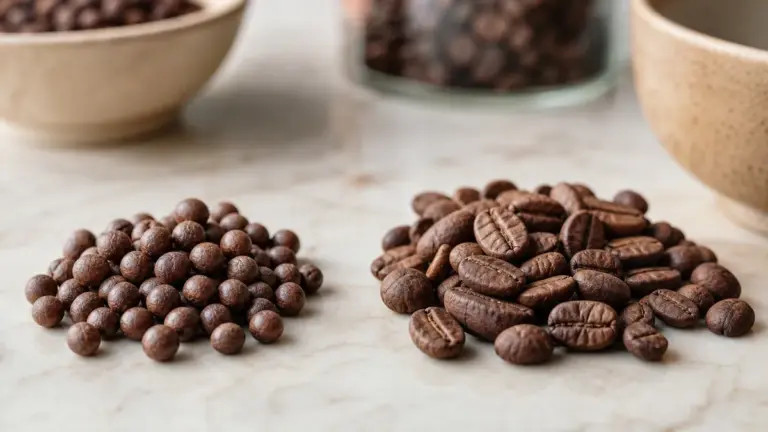
There is a useful distinction between characteristic flavour and a defect. Cocoa, nuts, caramel and a bitter-sweet finish can be positive features. Rubbery, medicinal or dirty flavours should not be excused simply because a coffee is robusta.
CQI’s protocols explicitly recognise fruit, spice and sweetness in fine robusta. They also distinguish those qualities from the harsh, woody or phenolic characteristics found in lower-grade samples. The fair modern view is neither “all robusta is poor” nor “all criticism is prejudice”: quality varies.
How much caffeine does it contain?
Robusta generally contains more caffeine than arabica, but “exactly twice as much” is not a dependable rule.
In a 2020 laboratory study of green coffee from Java, average caffeine concentrations were 2.9% of dry bean weight in robusta and 1.8% in arabica, measured using ultraviolet-visible spectroscopy. These figures describe that sample set and method, not fixed species constants.
They are also bean measurements, not caffeine per drink. A serving depends on the coffee used, dose and extraction. A species label alone cannot establish the caffeine content of an office machine’s finished beverage.
Espresso and instant coffee
Robusta is used in espresso blends to contribute body and foam, alongside its flavour. Crema, the foam on espresso, is one characteristic of the drink, not a substitute for tasting its balance.
It is also extensively used in instant coffee production. Neither use makes robusta inherently inferior: the relevant question is whether the selected coffee produces the intended result cleanly and consistently.
For a fuller species comparison without reducing the issue to a winner and loser, read arabica versus robusta.
Fine robusta: what quality assessment means
Fine robusta is not another species or a particular roast level. It concerns the quality of a coffee lot.
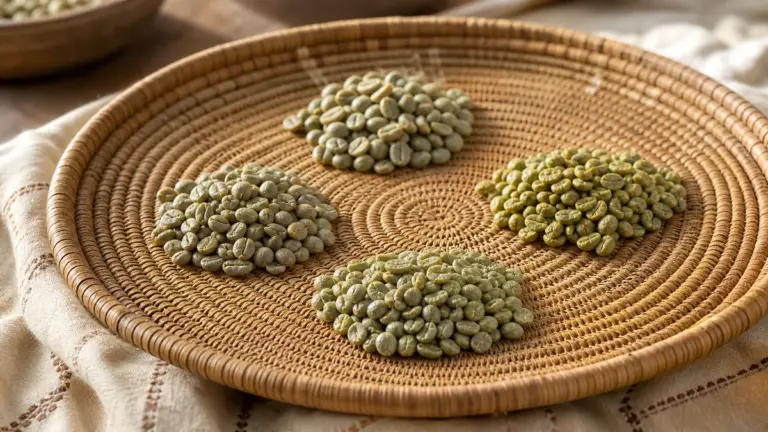
Under CQI’s 2019 Fine Robusta Standards and Protocols, qualifying green coffee has no primary defects and no more than five equivalent secondary defects in a 350 g sample. The document also requires a final cupping score of at least 80, alongside other physical and sensory requirements.
Cupping is a controlled tasting method. Crucially, a score alone is not the entire classification: physical defects and cup cleanliness also matter. Nor should a seller’s use of “fine” be treated as proof of independent certification.
For an initial purchase, my recommendation is to prioritise traceability, the stated assessment method and a flavour profile you genuinely want. Judge robusta coffee as coffee, rather than as an imitation of something else.
FAQ
Is robusta a roast level?
No, robusta identifies coffee from Coffea canephora, not how darkly it has been roasted. A packet’s species description and roast description answer different questions. When choosing a coffee, look for both, together with its origin and processing information, rather than expecting “robusta” to describe the finished flavour completely.
Can robusta have fruity flavours?
Yes, fruity flavours are recognised in fine robusta assessment. CQI’s protocols include descriptors such as cherry, raisin and other fruit notes, alongside cocoa, nuts and sweetness. Those are possible sensory descriptions, not ingredients added to the beans and not a promise that every robusta coffee will taste fruity.
Are conilon and robusta different species?
No, both belong to Coffea canephora. Brazilian agricultural writing often distinguishes conilon and robusta cultivated types, but the names do not provide a complete account of the species’ genetic diversity. Breeding between types further complicates any attempt to identify a coffee’s ancestry from its commercial name alone.
Where to go next
Read Coffee Varieties for the wider framework, then Arabica vs Robusta for a focused comparison of the two main commercial species. Liberica and Excelsa Coffee explores other commercially relevant coffees beyond them.
Sources
-
World Coffee Research, Robusta and History of Robusta, live varieties catalogue, undated; TR4, live variety entry, undated.
https://varieties.worldcoffeeresearch.org/robusta
https://varieties.worldcoffeeresearch.org/robusta-2/history-of-robusta
https://varieties.worldcoffeeresearch.org/varieties/tr4 -
International Coffee Organization, Coffee Market Report: September 2026, Table 3, 2026.
https://www.ico.org/documents/cy2025-26/cmr-0926-e.pdf -
Vi and colleagues, PLOS One, Out of Africa: The genomic footprints of Vietnamese Robusta coffee, 2025.
https://journals.plos.org/plosone/article?id=10.1371/journal.pone.0324988 -
Depolo and colleagues, Pesquisa Agropecuária Brasileira, Expression of self-incompatibility in Coffea canephora genotypes grown in the western Amazon, volume 57, e03031, 2022.
https://apct.sede.embrapa.br/pab/article/download/27174/15123/129957 -
Uganda Coffee Development Authority, Robusta Coffee Handbook, 2019.
https://ugandacoffee.go.ug/file-download/download/public/42 -
Royal Botanic Gardens, Kew and project partners, The Wild Coffee Resources of Uganda: A Precious Heritage, report available from Kew’s January 2024 document directory.
https://www.kew.org/sites/default/files/2024-01/The%20Wild%20Coffee%20Resources%20of%20Uganda.pdf -
Kath and colleagues, Global Change Biology, Not so robust: Robusta coffee production is highly sensitive to temperature, 2020.
https://pubmed.ncbi.nlm.nih.gov/32223007/ -
USDA Foreign Agricultural Service, Coffee Annual: Vietnam, report VM2026-0016, 20 May 2026.
https://apps.fas.usda.gov/newgainapi/api/Report/DownloadReportByFileName?fileName=Coffee+Annual_Ho+Chi+Minh+City_Vietnam_VM2026-0016.pdf -
International Coffee Organization and Vietnam Coffee-Cocoa Association, Country Coffee Profile: Vietnam, ICC 124-9, 4 March 2019.
https://www.ico.org/documents/cy2018-19/icc-124-9e-profile-vietnam.pdf -
Adnan and colleagues, Foods, Reliable Discrimination of Green Coffee Beans Species: A Comparison of UV-Vis-Based Determination of Caffeine and Chlorogenic Acid with Non-Targeted Near-Infrared Spectroscopy, volume 9, article 788, 2020.
https://pmc.ncbi.nlm.nih.gov/articles/PMC7353486/ -
Condelli and colleagues, Journal of Food Science, Drivers of coffee liking: Effect of physicochemical characteristics and aromatic profile on consumers’ acceptability of mono-origin and mono-variety coffees, 2022.
https://pmc.ncbi.nlm.nih.gov/articles/PMC9826037/ -
Coffee Quality Institute, Fine Robusta Standards and Protocols, 2019 edition, retrieved copy hosted by the Specialty Coffee Institute of Thailand.
https://www.scith.coffee/wp-content/uploads/2021/03/Fine-Robusta-Standards-Protocols.pdf
Research combined live checks of primary botanical, agronomic, statistical and sensory sources, distinguishing historical descriptions, current estimates, forecasts and study-specific measurements.
Last checked: November 2026