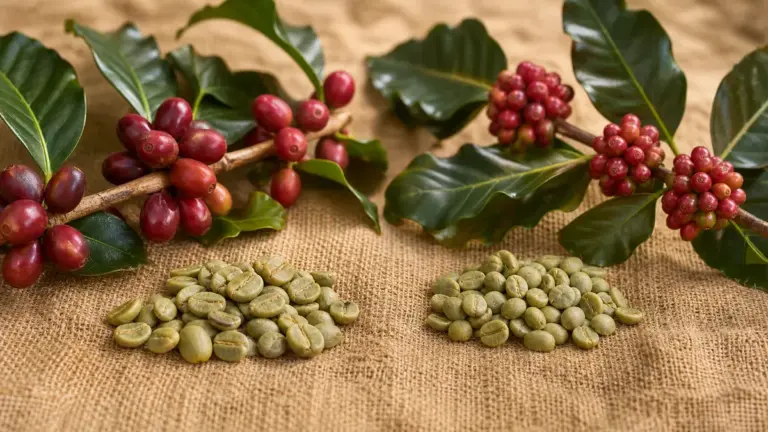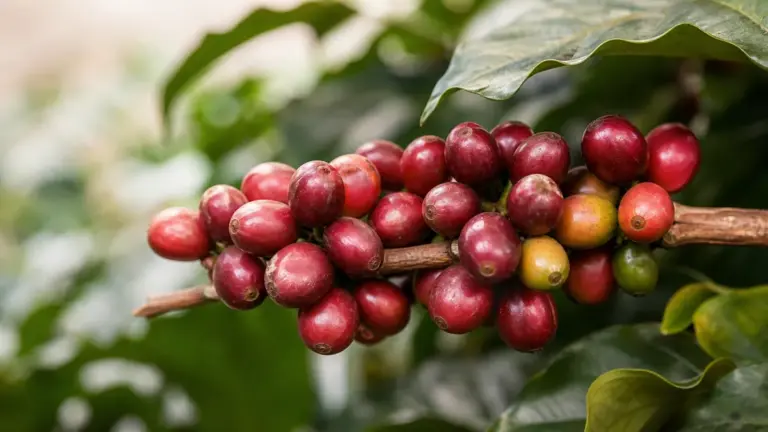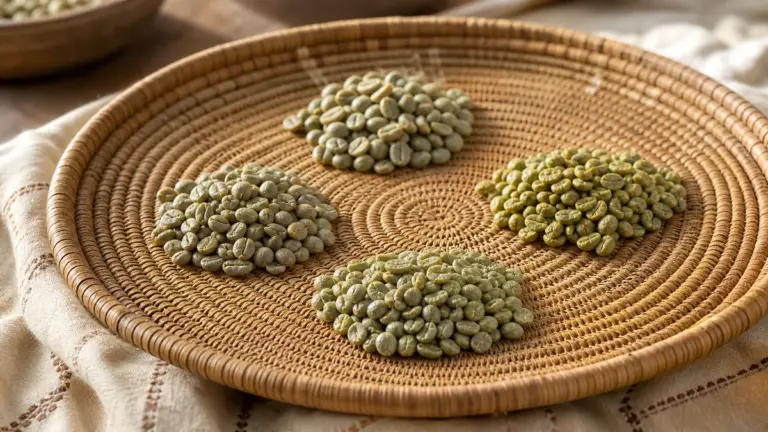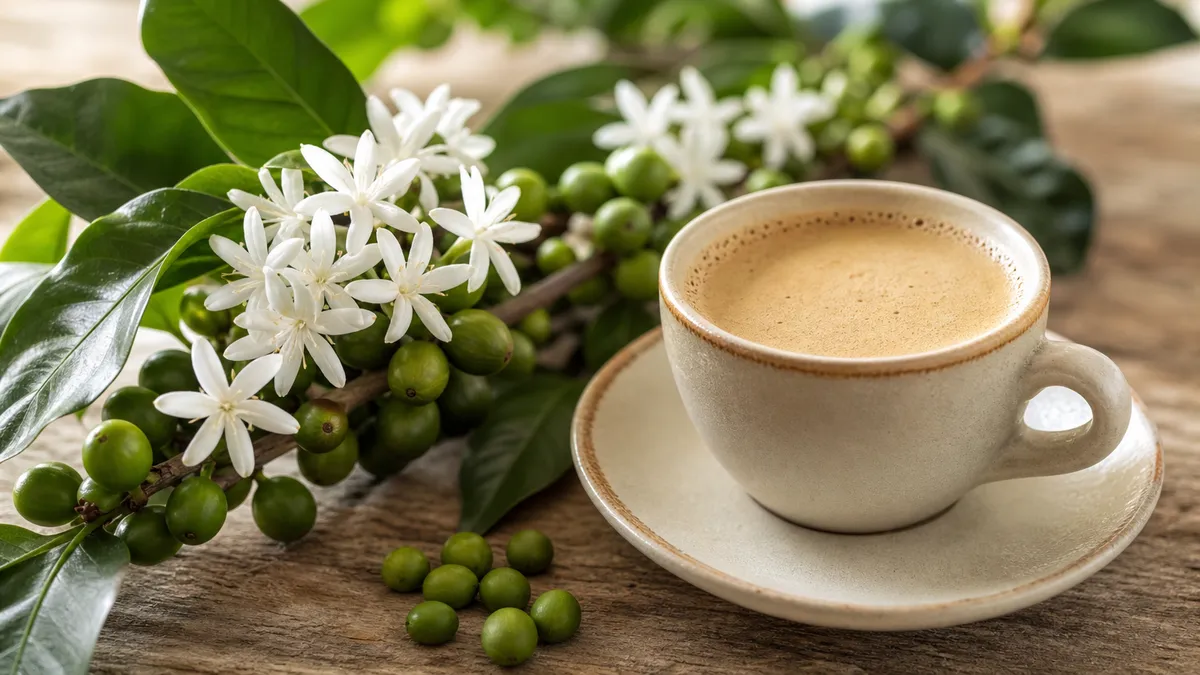
Geisha, also spelt Gesha, is an Ethiopian-origin arabica coffee best known for its floral fragrance, delicate texture and celebrated Panamanian lots. Its reputation rests on exceptional coffees, but its high market position also reflects low yields, meticulous lot preparation, limited availability and competitive auction demand: the name alone does not guarantee a remarkable cup.
In short
- Both spellings are established. Gesha reflects the Ethiopian place name; Geisha appears in historical plant collections and World Coffee Research’s catalogue.
- Panamanian Geisha is a particular genetic line, not a reliable description of every coffee sold under either spelling.
- Look for the producer, named lot, processing method and harvest, rather than buying on the variety name alone.
- Auction results describe small, selected lots of unroasted coffee, not the whole Geisha market.
- For a first tasting, choose a clearly described washed lot and use the roaster’s filter-brewing advice.
What is Geisha coffee?
Geisha belongs to Coffea arabica. It is a variety, not a separate coffee species, a processing method or a roast style. World Coffee Research classifies Panamanian Geisha as an Ethiopian landrace, meaning its ancestry lies in a locally established coffee population rather than a modern, deliberately bred cross.
The distinction matters when reading a bag. “Panama” identifies where the coffee grew; “Geisha” describes its claimed variety; “washed” describes its processing. None of those terms tells the entire story.
Our coffee varieties guide provides the wider framework. Here, the useful question is narrower: which Geisha line, grown where, prepared how, and traceable to whom?
Origin fact panel
Because Geisha grows in different countries, there is no single worldwide altitude range or harvest season. These are documented Panamanian examples, not universal limits.
| Feature | Documented detail |
|---|---|
| Ancestral origin | Coffee forests of south-western Ethiopia; the Panamanian line passed through East African research collections and CATIE in Costa Rica. Sources 1 and 2. |
| Growing altitude | SCAP documents plantings at 1,650 to 1,900 metres above sea level at Hacienda La Esmeralda’s El Velo farm, where Geisha is among the varieties grown. Source 3. |
| Main variety or line | Panamanian Geisha descended from CATIE accession T2722. Other Gesha-named selections need distinguishing individually. Sources 1 and 5. |
| Processing | Washed and natural, with some lots receiving additional controlled fermentation treatments. Source 6. |
| Harvest months | Esmeralda’s auction naming system identifies harvests in January, February, March and April. This is an estate example, not a national calendar. Source 7. |
| Typical cup profile | Floral fragrance, jasmine and stone fruit; washed examples can be bright and clean, while natural examples may be fuller and more fruit-led. Sources 6 and 8. |
From Ethiopia to Panama
Geisha’s fame is Panamanian; its ancestry is Ethiopian. Its journey involved successive collections, research stations and exchanges of planting material, rather than a direct shipment from an Ethiopian forest to a prize-winning estate.
The broad route is well established, although historical accounts differ in their precision.
- 1931: Willem Boot’s historical account, drawing on coffee-breeding expertise, dates seed collection in south-western Ethiopia to this year. It records exports to Kitale in Kenya in 1931 and 1932.
- 1936: The same account records descendant material reaching research stations including Lyamungu in present-day Tanzania.
- 1953: Material reached CATIE in Costa Rica and was recorded as accession T2722. An accession is an individually recorded sample maintained in a plant collection.
- 1960s: CATIE material was distributed in Panama. Boot identifies Don Pachi Serracín as introducing seeds in 1963.
- 2004: The Peterson family separated production from different parts of Hacienda La Esmeralda’s Jaramillo farm. Its distinctive Geisha won Best of Panama.
There is a source discrepancy worth preserving rather than smoothing away. World Coffee Research’s catalogue describes the breakthrough as 2005, while both Hacienda La Esmeralda’s account and the Specialty Coffee Association of Panama, or SCAP, document the first competition win in 2004. This article follows the producer and competition organiser for that event.
The breakthrough was not the creation of a new variety. Separating and tasting a particular lot made qualities apparent that mixed harvesting could obscure.
What does Geisha taste like?
At its most recognisable, Geisha offers a lifted floral fragrance rather than a heavy, roast-led impression. Hacienda La Esmeralda describes jasmine and stone-fruit notes; SCAP’s account of its leading washed coffee also identifies white peach and jasmine.
“Tea-like” is useful tasting shorthand for a delicate, clear impression. It should not mean watery, and it does not mean the coffee contains tea. Equally, a jasmine descriptor describes a perceived aroma, not an added ingredient.
Processing changes the picture. Esmeralda describes its washed coffees as bright, sweet and clean, and its naturals as fuller-bodied, fruity and sometimes wine-like. These are producer descriptions, not promises for every lot.
Editorial recommendation: if you want to explore the variety’s floral character first, begin with a washed coffee whose tasting notes emphasise flowers and stone fruit. Choose an experimentally fermented lot when its particular flavour description appeals, not simply because the processing sounds elaborate.
For other variety-focused reading, Typica and Bourbon provide useful comparisons without treating Geisha as the standard against which every coffee must compete.
Why is Geisha so expensive?
Several different things sit behind its premium reputation.
Low yield is a practical constraint. World Coffee Research rates Panamanian Geisha’s yield potential as low. A small harvest leaves less coffee over which to spread the work of maintaining and harvesting a planting.
Cultivation is not straightforward. The British Society for Plant Pathology identifies height and brittle branches as drawbacks of Geisha in modern farming systems. Its review describes partial resistance to coffee leaf rust, not immunity. Earlier interest in disease tolerance should not be mistaken for a guarantee of trouble-free cultivation.
Exceptional lots require separate handling. Esmeralda describes carefully timed picking, separation of small groups of trees and close attention to processing and drying. Keeping these coffees separate preserves their identity, but requires organisation and labour.
Auction demand adds another influence. A named competition lot combines a finite quantity with public recognition and competing buyers. Its auction result therefore reflects more than the agricultural work needed to produce an ordinary bag.
These factors explain the premium position, but do not prove that every Geisha is better than every other coffee. Treat the variety name as a reason to investigate, not a substitute for a lot description.
Panama auctions: the record and the later result
On 7 August 2025, SCAP reported a world auction record for a 20 kg washed Geisha lot from Hacienda La Esmeralda, bought by Julith Coffee. This was a particular lot of green coffee, meaning beans before roasting.
The later Best of Panama auction closed on 24 September 2026. Its highest-selling lot was Elida Geisha Torre from Lamastus Family Estates, bought by JD.com. The auction offered lots of 15 kg.
These are separate results: the 2026 top lot should not be confused with the 2025 record-setting Esmeralda lot. Nor should either be used as a description of normal retail Geisha. Named lot, auction, date and processing are essential context whenever a record is mentioned.
Gesha/Geisha Variants
Two spellings, not two grades
World Coffee Research uses Geisha (Panama) as its catalogue heading and recognises Gesha as an alternative. It explains that Geisha entered early germplasm records, while Gesha reflects the Ethiopian place name more closely.
Gesha Village associates its Ethiopian material with the Gori Gesha forest. However, historical collection accounts contain uncertainty about similarly rendered place names. It is safer to distinguish the established Ethiopian origin from claims that every historical collection can be pinned to one precisely identified forest.
Neither spelling is a quality grade. “Geisha” on a Panamanian auction listing does not establish an exclusive international trade registration.
Different lines behind the name
Panamanian Geisha descended from T2722 is genetically distinct and relatively uniform, according to World Coffee Research. Other coffees bearing the name do not necessarily share that identity.
Gesha Village’s own descriptions distinguish:
- Gesha 1931: a selection from a diverse forest population, chosen for resemblance to Panamanian Geisha in plant form, bean appearance and cup profile.
- Gori Gesha: material intended to represent the diversity within the Gori Gesha forest, collected by the estate in 2011.
- Illubabor Forest: a separate research-centre selection associated with a 1974 forest expedition. Its presence on the same estate does not make it Panamanian Geisha.
Gesha 1931 should therefore not be described automatically as a genetically identical copy of T2722. Resemblance and verified genetic identity are different claims.
The practical concern is real: World Coffee Research’s report on a DNA-fingerprinting study found substantial inconsistency between some variety names and tested material. That supports asking better traceability questions, not assuming that an unfamiliar Gesha label is fraudulent.
How to buy Geisha
Ask the seller for the producer, farm or plot, lot name, harvest, processing method and roast date. Where available, ask which Gesha line is claimed and how that identification was established.
For UK buyers, favour a roaster who explains the specific coffee and supplies brewing guidance. A clear account of an ordinary production lot is more useful than an unexplained reference to an estate’s auction achievements.
If a coffee is advertised as a competition winner, check the competition year and exact lot. Sharing a farm name with a winning coffee does not establish that it is the same harvest or preparation.
Finally, choose for the drinking experience you want. A plainly described floral washed lot is a sensible introduction; an unfamiliar fermentation treatment deserves a fuller explanation before purchase.
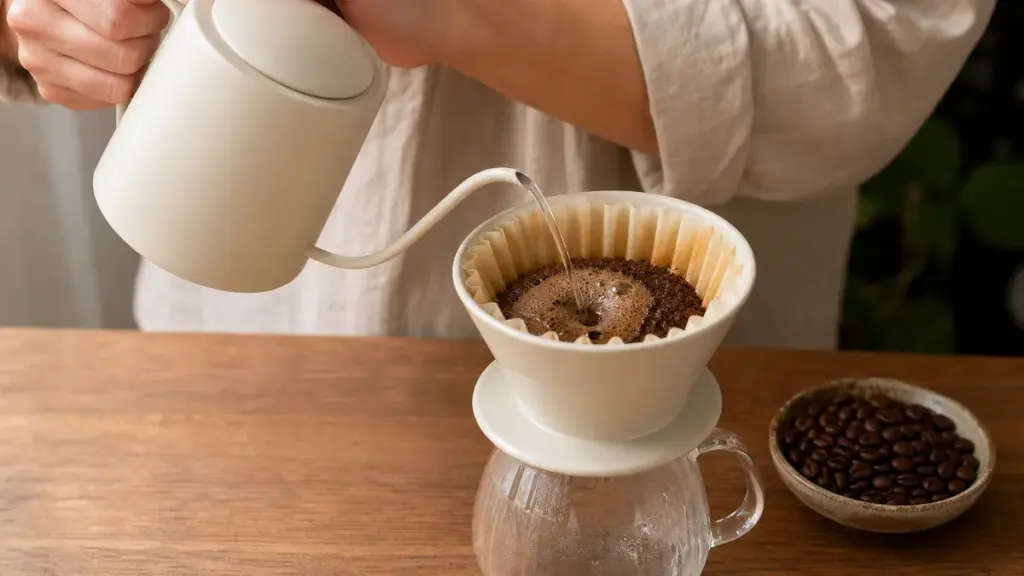
How to brew Geisha
Use the roaster’s recipe first. There is no verified universal Geisha temperature or grind setting that overrides the roast and brewer.
For a repeatable alternative, the SCAA’s published two-cup pour-over method provides this starting point. It is general brewing guidance, not a Geisha-specific standard.
- Fit a paper filter to a suitable two-cup brewer. Rinse and preheat it with hot water, then discard that water.
- Add 22 g of medium-fine ground coffee.
- Prepare 400 g of brewing water at approximately 93.5°C. The coffee-to-water ratio is approximately 1:18.2 by weight.
- Start a timer, pour 50 g over the grounds and wet them thoroughly.
- Allow a 30-second bloom, the initial pause after wetting.
- Pour the remaining 350 g slowly over the following 2 minutes 30 seconds to 3 minutes, keeping the brewer approximately half-filled.
- Remove the filter when drainage slows substantially.
The published guide’s timing summary and detailed pouring instructions are not perfectly aligned. Follow the explicit sequence above rather than treating its summary time as an absolute target.
Editorial tasting suggestion: keep notes on aroma, sweetness, texture and finish before changing the recipe. The aim is to understand the particular Geisha in front of you, not to reproduce an auction description.
FAQ
Does Geisha coffee have anything to do with Japan?
The coffee’s documented naming history points to Ethiopia, not Japan. World Coffee Research explains that Geisha appeared in early plant-collection records, while Gesha reflects the Ethiopian place name. The familiar Japanese word should not be used to infer the coffee’s ancestry or growing origin.
Does green-tip or bronze-tip prove which Geisha I am buying?
No, leaf-tip colour alone does not establish genetic identity. World Coffee Research records both green and bronze tips for Panamanian Geisha. Ask what evidence supports the claimed line, especially when a seller presents leaf colour as proof of authenticity or as a quality guarantee.
Must Geisha come from a winning auction lot to be worth trying?
No, auction status need not be your buying criterion. Decide instead whether the seller provides a convincing account of the lot and a flavour description you want to explore. A competition result concerns a particular entry; it is not a prerequisite for an enjoyable or informative tasting.
Where to go next
Read Coffee Varieties to put Geisha’s naming and ancestry into context, then Typica for another individual-variety guide. Arabica vs Robusta explains the broader species distinction, helping keep Geisha’s reputation separate from claims about arabica as a whole.
Sources
-
World Coffee Research, Arabica Coffee Varieties: Geisha (Panama), live catalogue, undated, checked November 2026.
https://varieties.worldcoffeeresearch.org/varieties/geisha-panama
Catalogue reference for classification, spelling, T2722, yield and genetic identity. -
Willem Boot / Roast magazine, Coffee Varieties, May/June 2006 reprint, hosted by Boot Coffee.
https://www.bootcoffee.com/wp-content/uploads/2012/05/Variety_reprint_May06.pdf
Historical account of collection, East African transfers and Don Pachi Serracín’s introduction. -
Specialty Coffee Association of Panama, Hacienda La Esmeralda, undated member profile.
https://scap-panama.com/haciendaesmeralda/
Competition organiser’s account of the 2004 win and documented El Velo planting elevations. -
Hacienda La Esmeralda, Our Story, undated.
https://haciendaesmeralda.com/our-story/
Producer’s account of separating Jaramillo production before Best of Panama 2004. -
Gesha Village, The Village, undated.
https://www.geshavillage.com/the-village/
Producer descriptions of Gesha 1931, Gori Gesha and Illubabor Forest. -
Hacienda La Esmeralda, Harvesting / Processing, undated.
https://haciendaesmeralda.com/hasvest-wash/
Producer information on lot separation, washed and natural processing, fermentation and sensory differences. -
Hacienda La Esmeralda, Esmeralda Auction: FAQs, 2026 auction edition.
https://auction.haciendaesmeralda.com/faqs
Estate-specific harvest-month naming conventions. -
Specialty Coffee Association of Panama, Café Geisha de Panamá sacude al mundo con impresionantes récords mundiales, 7 August 2025.
https://scap-panama.com/cafe-geisha-de-panama-sacude-al-mundo-con-impresionantes-records-mundiales/
Organiser’s report of the record-setting washed lot, its buyer, quantity and sensory description. -
Specialty Coffee Association of Panama, Subasta mundial del café de alta gama de Panamá…, published 25 September 2026, reporting the 24 September auction close.
https://scap-panama.com/subasta-mundial-del-cafe-de-alta-gama-de-panama-supera-los-3-millones-de-dolares-en-ventas/
Organiser’s closing report identifying Elida Geisha Torre as the highest-selling lot. -
British Society for Plant Pathology, Athina Koutouleas and David B. Collinge, Coffee Leaf Rust: Back with a Vengeance, Plant Pandemic Study 5, September 2022.
https://www.bspp.org.uk/wp-content/uploads/2022/11/PP5-Coffee-leaf-rust-rdcd.pdf
Expert review covering Geisha’s height, brittle branches and partial rust resistance. -
World Coffee Research, Study: Widespread lack of genetic conformity for Arabica coffee, 23 March 2020.
https://worldcoffeeresearch.org/news/2020/study-widespread-lack-of-genetic-conformity-for-arabica-coffee
Research organisation’s report on DNA-based variety authentication. -
Specialty Coffee Association of America, Guidelines for Brewing with a Two Cup Pour-Over Brewer, version 02APRIL2016, revised 2 April 2016.
https://scagermany.coffee/wp-content/uploads/2021/02/best-practices-two-cup-pour-over-brewer.pdf
Source of the general pour-over method, with its timing ambiguity disclosed above.
This article was researched using the variety catalogue, research and expert-review material, producer documentation and the competition organiser’s historical and auction reports, with discrepancies identified rather than silently reconciled.
Last checked: November 2026