Typica is a traditional variety of Coffea arabica and, alongside Bourbon, one of the founding lineages behind much of the world’s cultivated arabica coffee. It is valued for its cup quality, but its low yield and susceptibility to disease make it a demanding plant to grow.
In short
- Typica is a variety within arabica, not a separate coffee species.
- Its journey to the Americas passed through India, Java and European botanical gardens.
- Recognisable traits include tall growth, bronze-coloured young leaves and large beans.
- Pache and Maragogipe are natural mutations of Typica; Mundo Novo combines Typica and Bourbon ancestry.
- Treat the variety name as useful background, not a guarantee of how an individual coffee will taste.
What is Typica coffee?
Typica names both a particular cultivated coffee variety and, more broadly, a group of genetically related coffees. That distinction matters: a coffee described as “Typica-related” is not necessarily the original named Typica variety.
Think of the variety as one member of a larger family. World Coffee Research distinguishes the named Typica and Bourbon varieties from the wider genetic groups associated with them. Our coffee varieties guide provides the broader family context.
Calling Typica a founding arabica lineage does not mean that all arabica descends from it. Rather, Typica and Bourbon became central to the spread of cultivated arabica beyond its original diversity in Ethiopia and its early cultivation in Yemen. Other arabica genetic groups exist, including Ethiopian landraces, traditional populations shaped by local cultivation and selection.
For the difference between a species, a named variety and a cultivated selection, see species, varieties and cultivars explained. Keeping those categories separate prevents a surprising amount of confusion on coffee packaging.
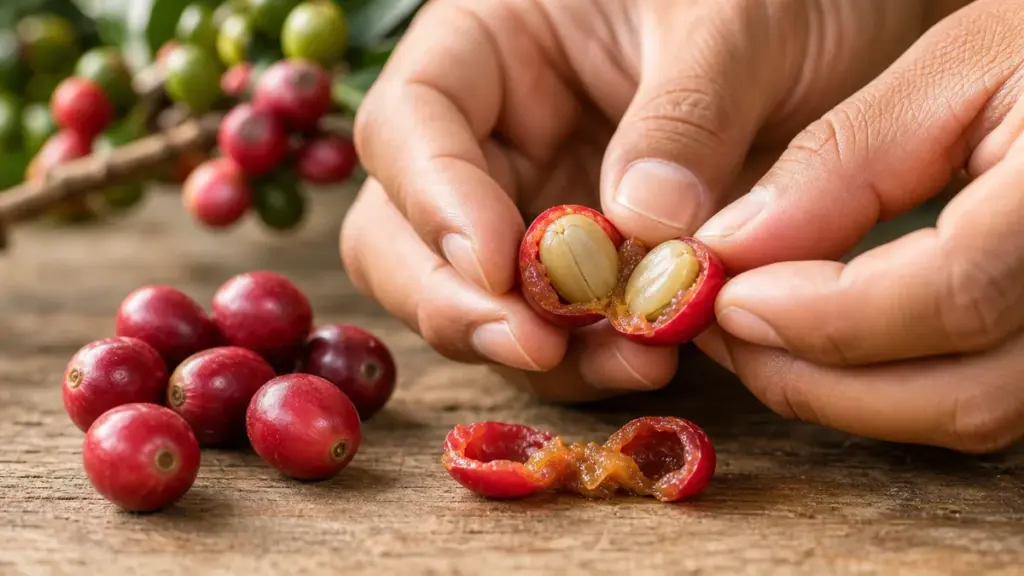
Typica fact panel
A variety is not a geographical origin. Typica grows in different countries, so it has no single altitude range, processing method or harvest calendar.
| Feature | Sourced guide | How to interpret it |
|---|---|---|
| Altitude | WCR places Typica in its high-altitude category: above 1,600 m within 5° of the equator; above 1,300 m at latitudes 5° to 15° north or south; above 1,000 m beyond 15° | These are latitude-dependent suitability guidelines, not the limits of where Typica can grow |
| Named variety and relatives | Typica itself; Pache and Maragogipe are mutations; Mundo Novo is a Typica and Bourbon cross | Related varieties should not simply be relabelled Typica |
| Processing | Washed Typica is documented in Peru; processing is a producer’s choice, not an inherited varietal trait | Sangareni’s washed-coffee listing includes Typica among several varieties, not as a guaranteed single-variety lot |
| Harvest months | March to September in Sangareni’s Pangoa, Peru, production listing | A local example, not a worldwide Typica season |
| Cup profile | Hawaiian industry guidance describes sweetness, balance, nuts and citrus in warmer conditions, with possible floral and berry notes in cooler conditions | These are regional descriptions, not a universal flavour specification |
The altitude distinction is particularly useful when comparing bags. A lower-elevation Typica from a location farther from the equator should not automatically be dismissed because another origin advertises a much higher farm.
From Yemen through Java to the Americas
Typica’s history is a story of cultivated plants moving through colonial networks, not of a variety originating naturally on Java. World Coffee Research traces the route from Ethiopian coffee diversity through Yemen, then India and Indonesia, before European botanical collections supplied plants to the Americas.
An important correction concerns the India stage. WCR’s account says the branch that became Typica probably became distinct when Dutch shipments carried seed from India to Java. The familiar shorthand “Yemen to Java” leaves out that step.
A short timeline
The following dates follow WCR’s historical account:
- Late 1600s: coffee originating from Yemen was growing in India.
- 1696 and 1699: seed shipments travelled from India’s Malabar coast to Batavia, now Jakarta, on Java.
- 1706: a plant from Java reached Amsterdam’s botanical gardens.
- 1714: Amsterdam supplied a coffee plant to France.
- 1719, 1722 and 1727: the Dutch route reached Suriname, Cayenne in French Guiana, and northern Brazil respectively.
- 1723 and 1730: the French route reached Martinique, followed by an introduction from Martinique to Jamaica.
Historical compilations do not agree on every introduction date. The USDA-hosted Coffee Crop Germplasm Vulnerability Statement gives 1718 for Suriname and 1720 for Martinique, rather than WCR’s 1719 and 1723. This article follows WCR’s variety-focused account; the precise year should not be treated as more certain than the records allow.
The larger point is the narrow foundation of these introductions. WCR describes the Amsterdam plant as the ancestor of the named Typica variety that spread through the Americas. That is a statement about this cultivated lineage, not a claim that all arabica coffee came from one tree.
What does the Typica plant look like?
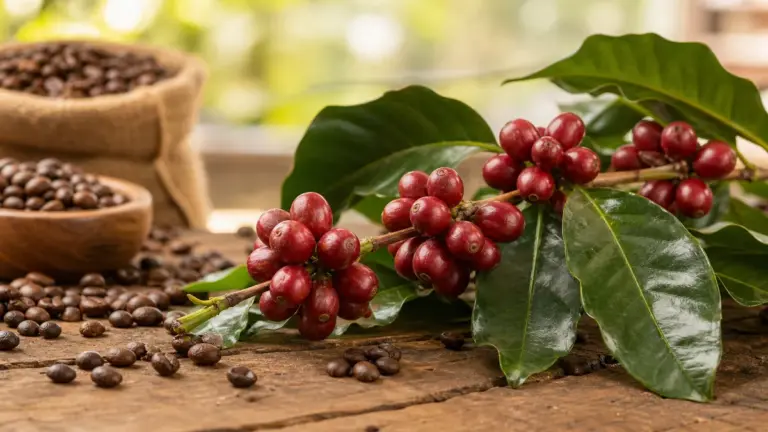
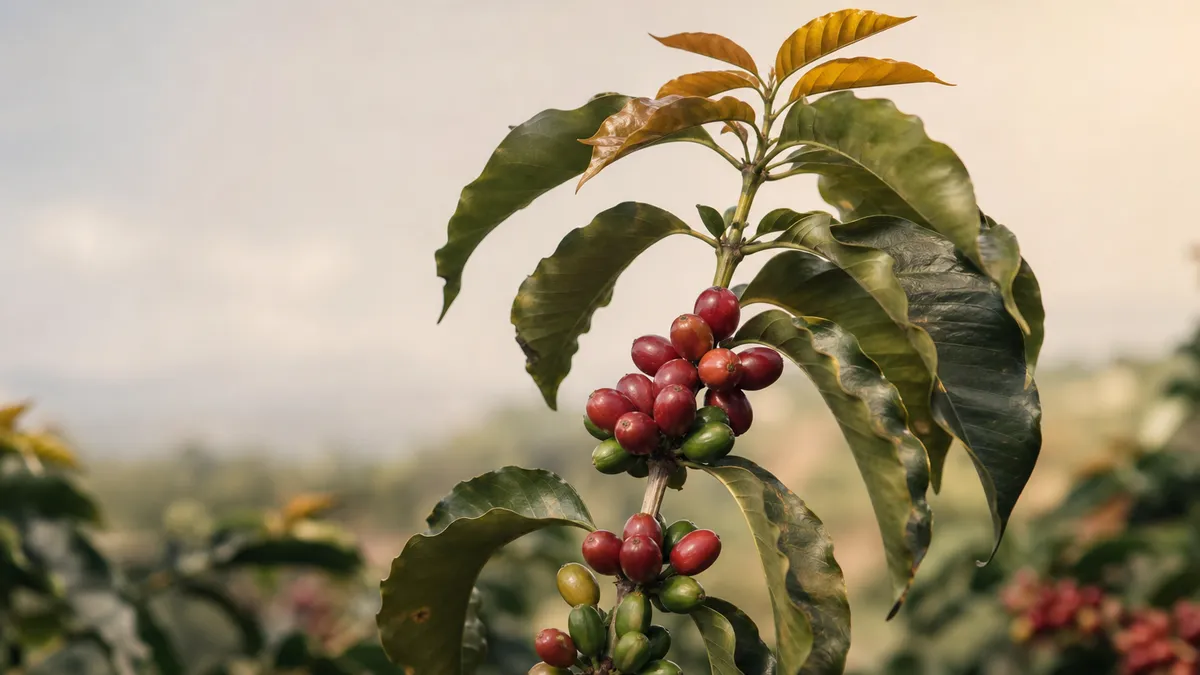
Typica has a tall growth habit rather than the compact form of many later cultivated varieties. Its young leaf tips are bronze, while WCR classifies its beans as large.
The bronze colour belongs to the emerging foliage. A botany chapter published by the Royal Society of Chemistry explains that this colour fades as Typica leaves age, so a mature plant should not be imagined as having a canopy of permanently copper-coloured leaves.
These features are useful clues, not a complete identification method. A photograph of bronze new growth does not establish a plant’s full pedigree, and a bag of large green beans is not enough to prove that the coffee is Typica. Where identity matters, ask for the producer’s variety records rather than relying on appearance alone.
For a buyer, the useful distinction is between a recognisable plant description and a documented lot identity. They are related questions, but they are not interchangeable.
Why yield and disease susceptibility matter
Typica’s main agricultural weakness is the combination of modest production and disease vulnerability. FAO’s Arabica Coffee Manual for Lao PDR describes its yield as low to moderate and its susceptibility to leaf rust as very high.
Coffee leaf rust is a fungal disease affecting the leaves. FAO explains that severe infection can cause leaf drop, damaging the plant’s ability to maintain a productive canopy. This helps explain why a variety capable of producing fine coffee can still be difficult for farmers to retain.
WCR also records Typica as susceptible to coffee berry disease and plant-parasitic nematodes. These are different problems: coffee berry disease attacks fruit, while the nematodes assessed in the catalogue affect roots. Susceptibility does not mean every farm faces every threat, but it does mean Typica should not be presented as a broadly disease-resistant choice.
There is no useful universal yield figure to put on a bag of Typica. A catalogue’s yield category is a comparative guide, not a promise of a fixed harvest from every tree.
For readers interested in the species rather than this particular variety, arabica coffee explains the wider context. Typica’s reputation makes more sense when cup potential and agricultural performance are considered separately.
What does Typica taste like?
The most defensible description is a coffee with the potential for sweetness, balance and a fine cup, rather than one compulsory set of tasting notes. Hawaiian coffee-industry guidance offers a concrete example: nuts and citrus in warmer growing conditions, with floral and berry notes possible in cooler conditions.
Those descriptions are useful starting points. They are not evidence that every washed Typica must taste of lemon, or that a coffee without floral aromas has been misidentified.
WCR’s Sensory Lexicon explains why this caution matters. Coffee’s sensory character reflects genetics, growing conditions and everything that happens after picking, including processing, storage, roasting and brewing. The variety contributes to the result; it does not dictate the whole drink.
When tasting, separate the questions:
- Sweetness: does the coffee suggest a rounded sweetness, or does bitterness dominate?
- Acidity: is the impression citrus-like, berry-like or comparatively subdued?
- Aroma: can you identify floral, nutty or other recognisable characteristics?
- Balance: do those impressions work together pleasantly?
These are tasting prompts, not diagnostic tests for Typica. Judge the coffee in front of you rather than trying to make it match a family description.
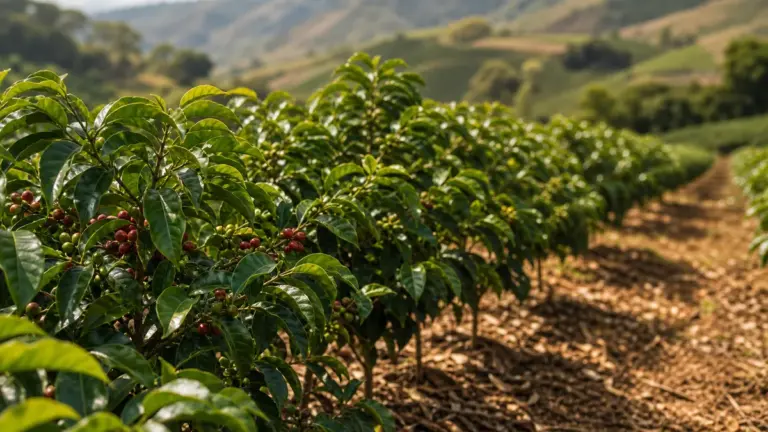
Where is Typica grown now?
WCR identifies Peru, the Dominican Republic and Jamaica as countries where Typica remains widely planted. Jamaica’s Agricultural Commodities Regulatory Authority also describes arabica Typica as the dominant variety being propagated in the Jamaican industry.
There is direct producer evidence from Peru. Cooperativa Agraria Sangareni lists Typica among the varieties in its washed-coffee production from Pangoa, in Junín. That confirms its presence in a producing area without implying that every shipment from the cooperative is pure Typica.
Hawaii provides another example through Kona Typica. Hawaiian industry guidance traces that material to an introduction from Guatemala in 1892.
For UK readers, the practical lesson is to check the complete lot description. “Peru”, “Jamaica” or “Kona” provides geographical information; “Typica” provides varietal information. Ask whether the coffee is a separated Typica lot or a mixture of varieties, and look for a named producer, processing details and harvest information.
Descendants and misleading family names
Typica’s influence extends beyond coffees sold under its own name. Its descendants illustrate two different routes by which cultivated varieties arise.
Natural mutations
Pache is a natural Typica mutation with a more compact growth habit. WCR records its discovery in Guatemala in 1949. It shows that a descendant need not retain the tall stature associated with its parent.
Maragogipe is another natural mutation, recorded near the Brazilian city of the same name in 1870. Its unusually large beans, leaves and spacing between nodes distinguish it from ordinary Typica. Maragogipe subsequently contributed ancestry to Pacamara.
Crosses and genetic relatives
Mundo Novo arose from a natural cross between Typica and Bourbon in Brazil. It therefore belongs on both sides of that family discussion, rather than being described as simply another name for Typica.
The distinction between mutation and cross is useful. A mutation changes inherited material within a lineage; a cross combines parentage. Neither relationship means the descendant will reproduce its ancestor’s flavour or agricultural behaviour exactly.
Finally, do not confuse the island of Java with the named Java variety. WCR says Java was formerly thought to be a Typica selection, but genetic fingerprinting instead links it to Ethiopian landrace material. Typica’s historical passage through Java does not make every coffee bearing that name its descendant.
When choosing Typica coffee, favour a well-documented lot over an elaborate family story. The name is most useful when it comes with enough information to connect the plant, producer and coffee in your cup.
FAQ
Does low yield mean Typica must taste better?
No, low yield is not proof of superior flavour. Typica’s agricultural productivity and its cup-quality potential are separate characteristics. A low-yielding plant can still produce disappointing coffee if growing conditions or subsequent handling are unsuitable. Assess the actual lot rather than treating agricultural difficulty as a tasting credential.
Can I identify Typica from roasted beans?
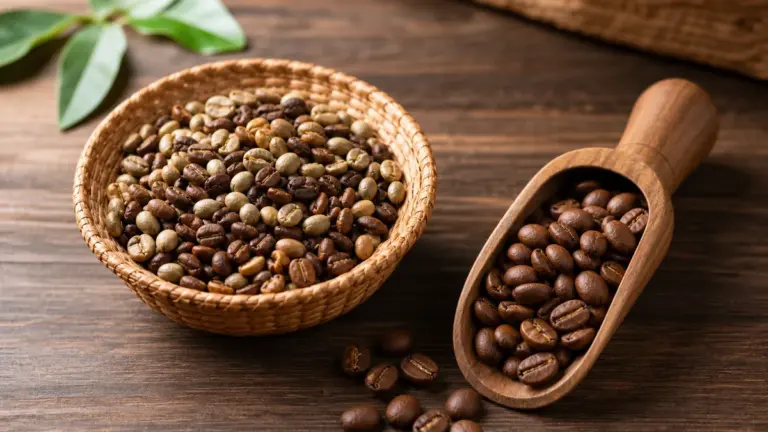
Not reliably from appearance alone. WCR’s classification of Typica beans as large is a descriptive trait, not a unique identification key. Other varieties can also have large beans. For a meaningful identification, look for traceable producer information stating which variety was grown and whether it was kept separate during processing.
Does “Typica and Bourbon” on a bag mean Mundo Novo?
No, that wording does not establish that the coffee is Mundo Novo. It may describe a lot containing separately grown Typica and Bourbon plants. Mundo Novo is a named variety with ancestry from a natural cross between them. Ask the roaster whether the label describes a mixture of varieties or the pedigree of one variety.
Where to go next
Read Coffee Varieties for the wider family, then Coffee Species, Varieties and Cultivars Explained to make sense of botanical and agricultural terminology. Bourbon is the useful companion to Typica’s history, while Geisha introduces a different variety whose reputation also needs to be separated from assumptions about every individual lot.
Sources
-
World Coffee Research, Arabica Coffee Varieties: Typica. Undated live catalogue, checked 2026. Plant characteristics, altitude guidance and susceptibility categories.
https://varieties.worldcoffeeresearch.org/varieties/typica -
World Coffee Research, History of Arabica. Undated live catalogue, checked 2026. Founding lineages, historical movements and continuing cultivation.
https://varieties.worldcoffeeresearch.org/arabica-2/history-of-arabica -
World Coffee Research, Varieties Catalog Goes Global, 2018. Distinction between named varieties and genetic groups.
https://worldcoffeeresearch.org/es/news/2018/varieties-catalog-goes-global -
Coffee and Cacao Crop Germplasm Committee, Coffee Crop Germplasm Vulnerability Statement, 2020. USDA-hosted historical comparison, especially Table 2.
https://www.ars-grin.gov/npgs/cgc_reports/2020%20-%20Coffee%20Vulnerability%20Statement.pdf -
FAO, Arabica Coffee Manual for Lao PDR, 2005. Chapter 2, plant and variety descriptions; Chapter 9, pests and diseases.
https://www.fao.org/4/ae939e/ae939e03.htm
https://www.fao.org/4/ae939e/ae939e0b.htm -
Royal Society of Chemistry, Coffee: Production, Quality and Chemistry, “Introduction to Coffee Plant and Genetics”, 2019. Young-leaf colour and its change with age.
https://books.rsc.org/books/edited-volume/1829/chapter/2242994/Introduction-to-Coffee-Plant-and-Genetics -
Hawaii Coffee Industry, Coffee Varieties. Undated industry guidance, checked 2026. Kona Typica history and regional sensory descriptions.
https://hawaiigrown.coffee/from-harvest-to-cup/coffee-varieties/ -
Jamaica Agricultural Commodities Regulatory Authority, About Coffee. Undated regulatory-authority guidance, checked 2026. Typica’s continuing role in Jamaica.
https://jacra.org/divisions/coffee/about-coffee/ -
Cooperativa Agraria Sangareni, Café Verde Arábico Lavado. Undated producer listing, checked 2026. Pangoa origin, varieties, processing and harvest window.
https://sangareniperu.com/catalogo/detalle/22 -
World Coffee Research, Arabica Coffee Varieties: Pache; Maragogipe; Mundo Novo; Java. Undated live catalogue entries, checked 2026. Mutations, crosses and revised genetic relationships.
https://varieties.worldcoffeeresearch.org/varieties/pache
https://varieties.worldcoffeeresearch.org/varieties/maragogipe
https://varieties.worldcoffeeresearch.org/varieties/mundo-novo
https://varieties.worldcoffeeresearch.org/varieties/java -
World Coffee Research, Sensory Lexicon, version 2.0, 2017. Sensory terminology and the factors contributing to coffee flavour.
https://worldcoffeeresearch.org/resources/sensory-lexicon
https://worldcoffeeresearch.org/download/bf904452-fc8c-488f-b591-c0b20d9bcab2
This article was researched using live variety-catalogue entries, agricultural guidance, a botany reference, regulatory-authority information and a producer’s published listing; no first-hand growing or tasting is claimed.
Last checked: November 2026