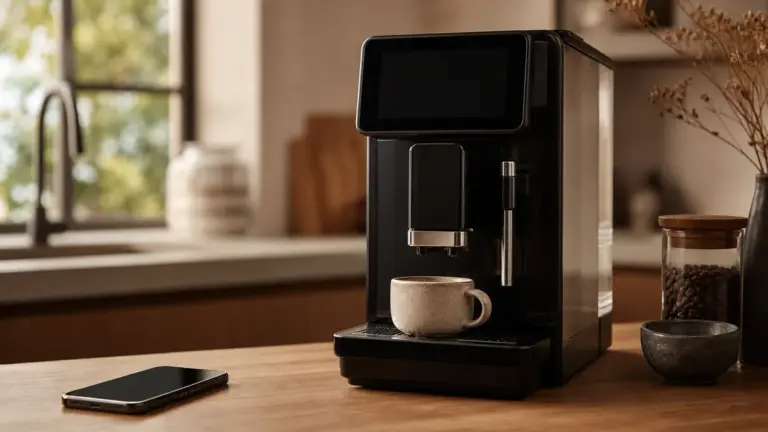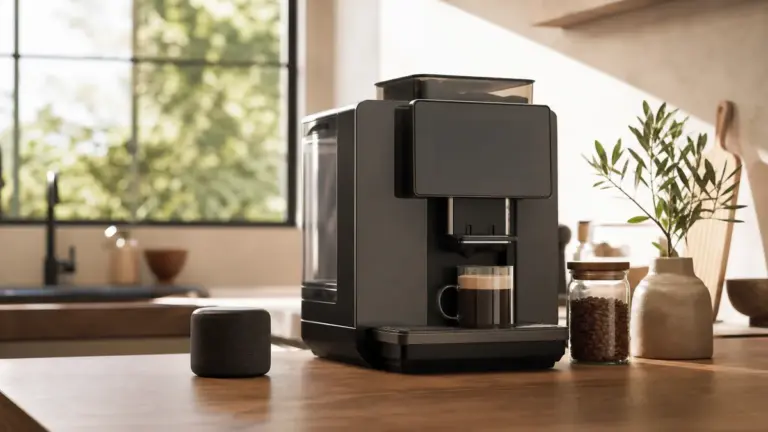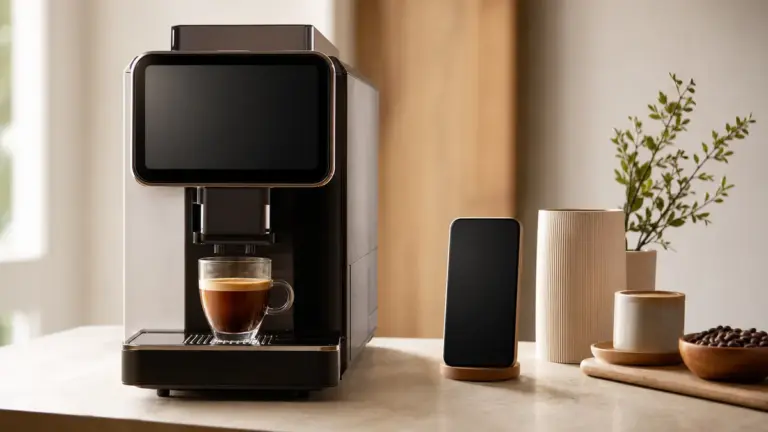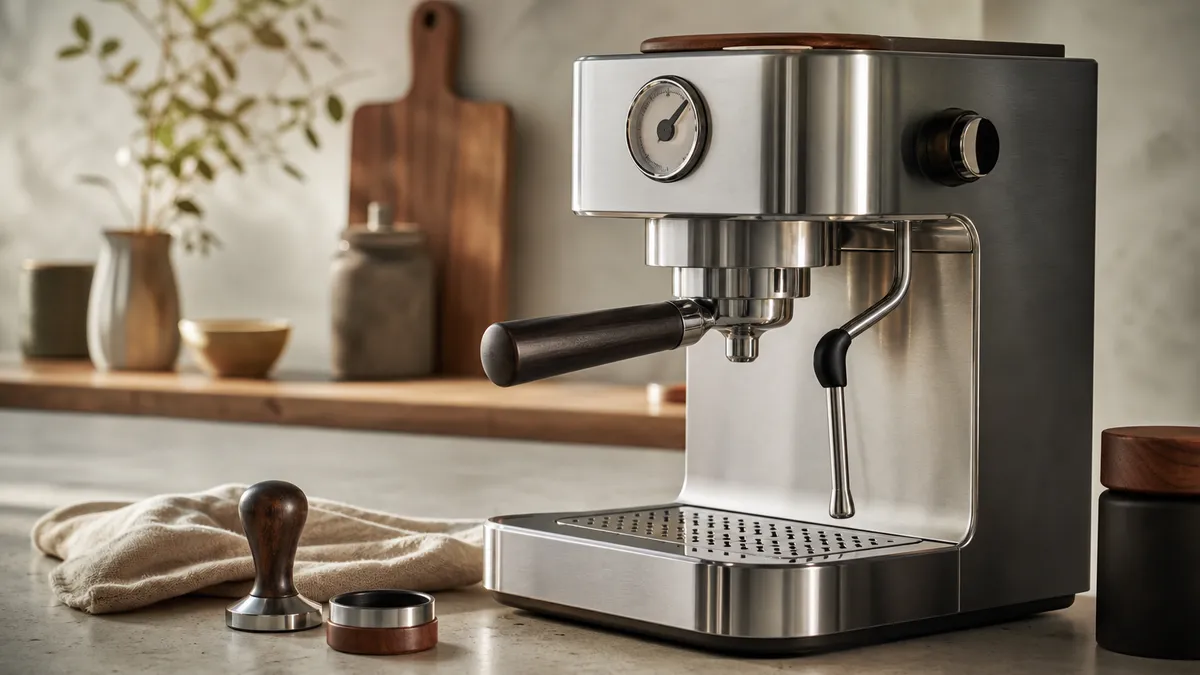
Emerging coffee machine technology is moving towards machines that measure each brew and adjust themselves, rather than simply repeat a timer. Pressure and flow profiling, responsive temperature control and automatic grind adjustment are already available in production equipment; more unusual approaches, such as ultrasonic extraction, remain research and development propositions rather than established UK workplace choices.
In short
- Pressure profiling changes brewing pressure during extraction; flow profiling controls how quickly water enters the coffee.
- Automatic dialling-in generally maintains a chosen recipe, rather than discovering your preferred flavour unaided.
- Sensors provide useful feedback, but ask whether a displayed value is measured directly or calculated.
- Insulated boilers and programmable standby are available now; environmental benefits still need evidence under realistic operating conditions.
- Distinguish a documented production feature from a demonstration, proof of concept or promised software update.
What is genuinely new in coffee machines?
The useful distinction is not between a machine with a screen and one without. It is between equipment that follows fixed instructions and equipment that uses feedback to change what happens next.
A conventional programmed brew might run until a timer expires. A feedback-controlled system measures a variable, compares it with a target and adjusts a pump, heater or grinder. This is called closed-loop control: the result influences the next action.
That principle connects the developments below. For the wider context, including connectivity and digital services, start with coffee and technology.
The examples here are documented manufacturer features, not independently tested recommendations. “Available now” means a technology appears in published production-product documentation, checked in November 2026. It does not establish immediate UK stock, compatibility with every configuration or local servicing provision.
| Technology | Documented example | Position in November 2026 | Best suited to |
|---|---|---|---|
| Programmable pressure and flow profiles | Decent profiling system | Production feature | Enthusiasts who want detailed extraction control |
| Pressure profiles linked to beverage weight | La Marzocco Strada X | Production feature | Staffed specialist coffee service |
| Automatic grind-size correction | Mahlkönig Grind-by-Sync | Production feature with compatibility requirements | Operations maintaining a defined espresso recipe |
| Insulated boilers and programmable standby | La Marzocco Strada X | Production features | Sites with predictable periods of inactivity |
| Ultrasonic extraction | UNSW research and MARIA development project | Research demonstrated; project listed as proof of concept | Technology watching, not routine workplace procurement |
Pressure and flow profiling: controlling the journey
Pressure profiling changes brewing pressure during an espresso extraction. Flow profiling changes the rate at which water is supplied. A profile is the planned sequence of those changes, rather than one fixed setting throughout.
The distinction matters because pressure and flow interact through the resistance of the coffee puck, the compressed bed of grounds. A pressure target does not guarantee an identical flow when the grind, dose or puck preparation changes.
La Marzocco’s technical documentation explains this relationship through the operation of its variable-speed pumps: the machine changes pump output to follow a pressure target as puck resistance varies. Decent’s profile editor allows pressure-led or flow-led stages, with transitions triggered by conditions such as elapsed time or pressure.
What the newer controls add
Profiling itself is not a newly invented idea. The developing capability is how profiles are measured, repeated and connected to the progress of the drink.
La Marzocco describes the Strada X as linking pressure profiles to beverage mass. In other words, the amount of espresso already collected helps govern the pressure curve, rather than relying only on elapsed time.
Its Smart Saturation feature also uses sensed backpressure to automate pre-infusion, the initial wetting stage. These are manufacturer descriptions of the control system, not independent proof that every shot tastes better.
For a keen home learner, the attraction is experimentation with a repeatable record. For an unattended office tea point, detailed profiling may offer little practical benefit unless someone is responsible for setting and checking the recipes.
Temperature control: look beyond the display
A temperature setting is an instruction, not a complete account of the temperature experienced by the coffee. Sensor position and the machine’s response to feedback therefore matter alongside the displayed number.
PID control, short for proportional, integral and derivative control, is a feedback method used to regulate a variable towards its target. La Marzocco documents PID temperature control and independent coffee boilers on the Strada X, allowing different groups to have separate settings.
Decent describes another approach: controlled mixing of hot and cold water, informed by temperature sensors. Its documentation places a brewing sensor close to the coffee, behind the shower screen.
These are different engineering solutions. Neither a complicated display nor very fine adjustment increments, by themselves, demonstrate better temperature stability.
When assessing a claim, ask:
- Where is temperature measured?
- Does the quoted figure describe a setting, measurement resolution or tested accuracy?
- What happens during repeated drinks, rather than an isolated demonstration?
- Can the supplier provide a documented test method?
For home filter brewers, the Specialty Coffee Association’s certification programme provides third-party equipment testing. Check the exact model against the current certified list. Do not treat home-brewer certification as evidence for an unrelated espresso machine or an entire manufacturer’s range.
Automatic dialling-in: maintaining a recipe, not tasting it
Dialling-in means adjusting brewing variables until a coffee produces the result you want. Automatic systems can take over parts of that adjustment, but their target still needs to be chosen sensibly.
Mahlkönig’s Grind-by-Sync system provides a clear production example. Compatible equipment sends brewing information to an electronically adjustable grinder. The system compares extraction times with the recipe target and changes burr spacing when correction is needed.
The manufacturer’s technical FAQ describes using a moving average of brew times. That is more specific, and more useful, than simply calling the system “AI”.
Crucially, this is not a machine tasting the drink. It is a machine responding to measured brewing behaviour. Mahlkönig itself advises establishing recipes by taste, using coffee dose, beverage weight and shot time as guides.
What still needs a person?
Someone must approve the starting recipe and check whether maintaining it continues to produce enjoyable coffee. Consistency around an unsuitable target is still an unsuitable result.
For a workplace demonstration, ask the supplier to show the complete sequence: recipe selection, an extraction outside the target, the resulting adjustment and subsequent drinks. Also ask what happens after changing beans, cleaning the grinder or losing the connection.
Compatibility deserves particular attention. Mahlkönig now documents both cloud-connected and wired arrangements, alongside a connected-scale route. Do not assume that every version requires the same network setup.
Sensors: useful measurements and useful limitations
Sensors make automatic correction possible, but a dashboard can make different kinds of information look equally certain.
Consider three categories:
- Direct measurement: a sensor records a physical quantity, such as pressure or temperature.
- Calculated estimate: software combines measurements with a model to estimate another quantity.
- Operational indicator: recorded activity helps inform a maintenance decision.
Decent explicitly describes using a physical model to estimate flow when its mechanical flow meter operates too slowly for reliable measurement. That is not inherently a weakness. It is a reason to ask what a graph actually represents.
Likewise, Mahlkönig documents operational data and maintenance-related reporting within its connected system. Usage information can support servicing decisions, but a maintenance dashboard should not be mistaken for a guarantee against breakdown.
Before accepting a “predictive” claim, request an explanation of the inputs, the warning generated and the action expected from staff. A clear alert with a defined response is more useful than a reassuring colour on a screen.
App functions are a separate subject. Our guide to smart coffee makers explains connected features without confusing them with extraction control.
Sustainability features: demand operating evidence
Some practical energy-related features are already ordinary production options. La Marzocco lists insulated boilers and programmable standby on the Strada X; its operating documentation also describes an ECO mode that maintains a reduced temperature during temporary inactivity.
These features are worth examining, but their presence does not quantify a workplace’s environmental benefit. Ask for measured electricity consumption under a stated schedule, including warm-up, idle periods, drinks and cleaning.
Apply the same discipline to water and coffee-waste claims. Ask what was measured, what comparison was used and whether cleaning cycles and rejected drinks were included. Avoid treating an efficient extraction process as proof that the complete machine has a lower environmental impact.
Repairability belongs in the discussion too. Request written information about spare parts, software support, access to service documentation and what remains usable without an account or network connection.
Water preparation should not be overlooked in a technically sophisticated installation. Use the local supplier’s postcode-based report where available, then have the installer check the actual supply against the machine’s requirements. Thames Water provides a local water-quality lookup; there is no reason to substitute a generic description of “UK water” for site-specific information.
Beyond production machines: ultrasonic extraction
Ultrasound is a genuinely different research direction, rather than another interface for a conventional pump and heater.
UNSW researchers have used acoustic cavitation, the formation and collapse of microscopic bubbles, to accelerate extraction. Their June 2026 report describes espresso-strength coffee prepared using room-temperature water, following earlier cold-brew research.
The reported sensory experiment compared coffees prepared by different methods after cooling them to the same serving temperature. That detail matters: the findings do not establish that a room-temperature drink provides the same experience as freshly served hot espresso.
The evidence is experimental research, not a long-term field trial of workplace equipment. UNSW’s separate MARIA development listing identifies the project as proof of concept.
The sensible interpretation is promising extraction technology with further commercial development required. It is not evidence that an established, service-supported ultrasonic office machine is ready to replace today’s bean-to-cup equipment.
A practical checklist for assessing emerging coffee machine technology
Use these checks before accepting a demonstration or specification sheet:
- Name the controlled variable. Is the machine changing pressure, flow, temperature, beverage weight or grind size?
- Identify the feedback. Ask what is measured directly and what is estimated.
- Separate automation from guidance. Does the equipment make an adjustment, or tell a person to make it?
- Confirm production status. Request the current manual, exact configuration, UK availability and servicing arrangements.
- Test the fallback. Ask which brewing functions remain available without internet access, a paired device or a cloud account.
- Check the daily work. Include cleaning, calibration, bean changes and fault recovery in the demonstration.
- Get commitments in writing. Record compatibility, support arrangements and any feature essential to your intended use.
For UK consumer purchases, the Consumer Rights Act 2015 requires goods to meet standards including satisfactory quality, fitness for purpose and correspondence with description. An office buying through a business should not assume the same consumer-contract protections apply.
Our judgement: choose emerging coffee machine technology for a task it demonstrably performs, not for a future capability promised in a presentation. Repeatable brewing and understandable support arrangements are stronger selection criteria than an impressive animation.
FAQ
Does a machine described as “AI-powered” automatically make better coffee?
No, the label alone does not demonstrate better coffee. Ask which inputs the system uses, what it changes and how success was assessed. An automatic grind-adjustment system can have a clearly documented function without measuring flavour. Prefer an explanation of its feedback loop and a relevant demonstration over a broad claim about intelligence.
Can existing espresso equipment gain automatic grind adjustment?
Sometimes, depending on the grinder and feedback equipment. Mahlkönig documents a connected-scale route that supplies extraction-time information to a compatible Grind-by-Sync grinder without requiring a directly compatible espresso machine. Check the current hardware and network requirements carefully. This adds a particular feedback function, not every capability of a newer machine.
Should an office wait for ultrasonic coffee machines?
Not on the evidence reviewed here. UNSW has demonstrated ultrasonic extraction experimentally, while its development listing describes a proof-of-concept project. If a workplace needs equipment now, assess production machines against current requirements and support provision. Treat a future ultrasonic product as a separate proposition once its documentation and availability can be verified.
Where to go next
Read Coffee and Technology for the wider map of brewing controls and digital systems, then Smart Coffee Makers to distinguish connected convenience from automatic brewing adjustment. For remote operation specifically, app-controlled machines leads to App-Controlled Coffee Machines, covering a different question from emerging coffee machine technology itself.
Sources
Production features below are manufacturer claims, not independent performance findings.
-
Decent Espresso, Decent profiling, undated, current page checked November 2026.
https://de.decentespresso.com/profiling -
Decent Espresso, How the DE1 measures and Two pumps for accurate temperature, undated current technical pages, checked November 2026.
https://decentespresso.com/docs/how_the_de1_measures
https://decentespresso.com/docs/two_pumps_for_accurate_temperature -
La Marzocco, Strada X product brochure, 2023 file, and Strada X manual, version 2.1, 2025 file.
https://www.lamarzocco.com/tw/wp-content/uploads/2023/10/product_brochure_strada_eng.pdf
https://lamarzoccousa.com/wp-content/uploads/2025/06/MAN.35.1.01_STRADA-X_EN_V2.1_ONLINE-min.pdf -
La Marzocco, The STRADA Explained, Strada EP manual, version 4.2, undated document in a 2023 file path.
https://au.lamarzocco.com/wp-content/uploads/2023/09/MAN.9.1.01_STRADA_EP_EN_V4.2.pdf -
Mahlkönig, The Sync System Connected Coffee Grinding Solution, current product documentation, and The Sync System: Technical FAQ, current technical guidance, checked November 2026.
https://www.mahlkoenig.com/en-de/products/the-sync-system
https://www.mahlkoenig.us/blogs/news/the-sync-system-technical-faq -
Specialty Coffee Association, SCA Certified Home Equipment, current programme description and certified list, checked November 2026.
https://sca.coffee/certified-home-brewer -
Thames Water, Water quality, current local lookup guidance, checked November 2026.
https://www.thameswater.co.uk/help/water-and-waste-help/water-quality -
UNSW Sydney, “Shaking up the coffee world! Entirely new way of making espresso unveiled”, June 2026, and MARIA in Coffee, current development listing.
https://www.unsw.edu.au/newsroom/news/2026/06/New-way-making-espresso
https://www.unsw.edu.au/research/partner-with-us/investment-portfolio/maria-in-coffee -
UK Government, Avoid unfair terms in sales contracts: Implied and statutory rights, current guidance; UK Parliament, Consumer Rights Act 2015, sections 9 to 11.
https://www.gov.uk/unfair-terms-in-sales-contracts/implied-rights
https://www.legislation.gov.uk/ukpga/2015/15/part/1/chapter/2/crossheading/what-statutory-rights-are-there-under-a-goods-contract/data.xht?wrap=true
Researched through live searches of manufacturer technical documentation, SCA certification information, university research reporting and official UK guidance; no first-hand machine testing was undertaken.
Last checked: November 2026