To choose a coffee grinder, start with what you brew, then check its grind adjustment, daily workload and ease of use. Espresso needs particularly small, repeatable adjustments; filter coffee and cafetière brewing call for a different balance of grind range, convenience and capacity.
In short
- Choose for your main brewing method, not an unlikely future upgrade.
- Prefer adjustable burrs over blades when repeatable results matter.
- For espresso, check adjustment precision as well as whether the grinder goes fine enough.
- Try a hand grinder with your usual dose before committing to the effort.
- Check cleaning access, replacement parts, working space and noise with beans in the grinder.
1. Start with what you actually brew
Write down your main brewing method, your usual coffee dose and how many drinks you make consecutively. A grinder for a single morning pour-over has a different job from one preparing espresso for several people.
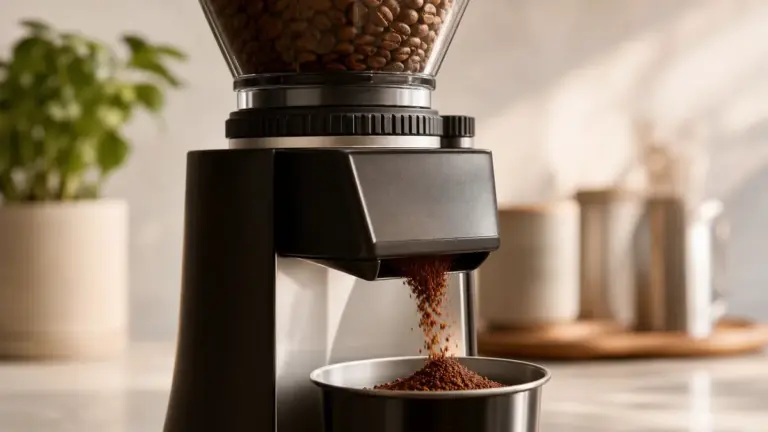
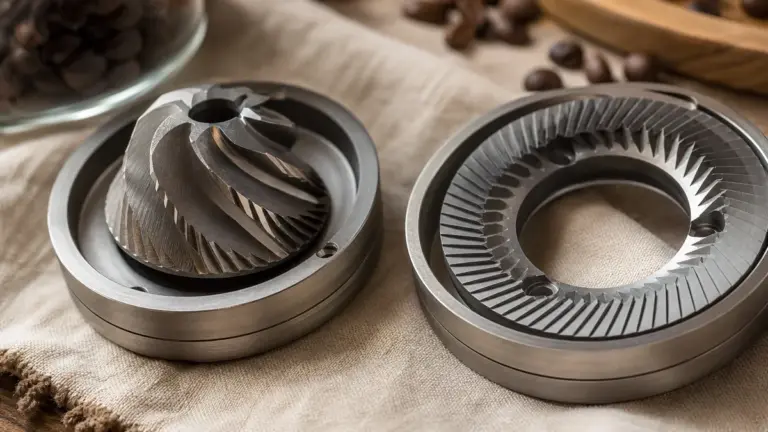
Burr grinders crush beans between toothed surfaces, with an adjustable gap controlling the grind. Blade grinders chop beans in a chamber, making particle size harder to control. For this decision guide, an adjustable burr grinder is the recommended starting point: repeatable settings make it easier to change one thing and understand the result.
Use the table below to shortlist by brewing suitability, adjustment and workflow, rather than appearance.
| What you brew | What to prioritise | Who this suits | Main caution |
|---|---|---|---|
| Pour-over or automatic filter | Useful filter-range adjustment and repeatable settings | Regular filter drinkers | A filter grinder may not support espresso |
| Cafetière | Suitable immersion settings and enough capacity for your batch | People making several mugs together | Check the actual dose capacity |
| Espresso with a single-wall basket | Fine grinding with very small adjustments | People adjusting shots for different beans | “Fine” alone does not establish suitability |
| Espresso and filter | Both ranges, plus an easy return to previous settings | Mixed-method households | Ask for a demonstration of switching |
Manufacturers’ brewing charts are starting points, not universal settings. Baratza’s Encore ESP manual, for example, gives different suggested positions for espresso, pour-over, automatic brewing and French press, while explicitly allowing adjustment for recipe and taste.
For the wider equipment overview, start with coffee grinders. Here, the aim is to narrow your choice, not catalogue every grinder design.
2. Decide whether espresso capability is essential
Espresso is the decision that deserves the closest scrutiny. With a single-wall, non-pressurised basket, grind size affects how readily water passes through the coffee. Small changes can therefore alter the shot substantially.
Ask two separate questions:
- Can it grind sufficiently fine for my espresso setup?
- Can I make small enough adjustments within that range?
A grinder can satisfy the first requirement without making the second easy. A large number of settings is not, by itself, evidence of useful espresso adjustment.
Stepped adjustment uses fixed clicks. Stepless adjustment lets you position the control between marked points. Neither label settles the choice: what matters is whether the available adjustment lets you fine-tune your coffee. Baratza’s published Encore ESP design illustrates this distinction, using smaller changes in its espresso range than in its filter range.
Check your machine’s basket too. Sage distinguishes single-wall baskets for freshly ground coffee from dual-wall baskets, which regulate pressure and accommodate pre-ground coffee. Do not assume those baskets demand identical grinder performance.
Finally, read the exclusions. Fellow explicitly states that its Ode Brew Grinder is not suitable for espresso. A capable filter grinder is not automatically an all-purpose grinder.
3. Set your budget around essential functions
Treat your budget as a boundary, then rank the functions inside it. Our suggested order is:
- Suitability for your brewing method.
- Useful, repeatable adjustment.
- A workflow you can manage comfortably.
- Straightforward cleaning and support.
- Convenience features and appearance.
For filter-only brewing, do not make espresso capability compulsory unless you genuinely intend to use it. For espresso, do not let a touchscreen or elaborate dosing programme distract you from adjustment precision.
Consider ownership as well as the initial purchase. Ask about replacement burrs, other wear parts, cleaning materials, repair arrangements and delivery for servicing. Where these affect your shortlist, obtain itemised written quotations rather than relying on a headline offer.
For a workplace, ask the supplier to confirm suitability for your expected use and busiest period. Include service cover, maintenance responsibilities and any restrictions on business use in that enquiry. Move to commercial coffee grinders when several users, repeated batches or operational continuity become the main concern.
4. Choose manual or electric, then choose the workflow
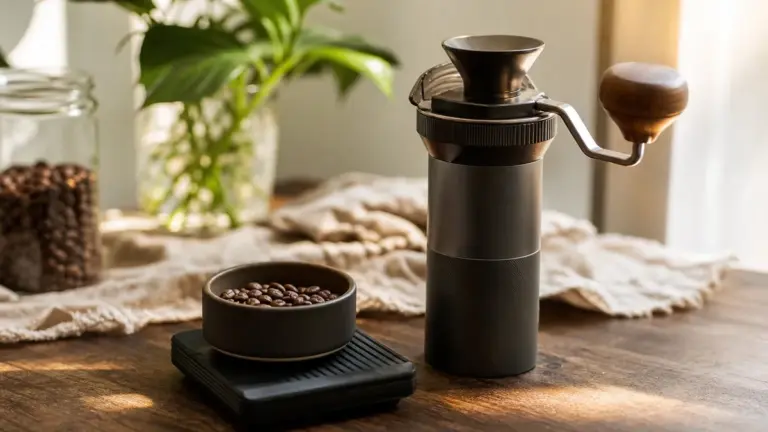
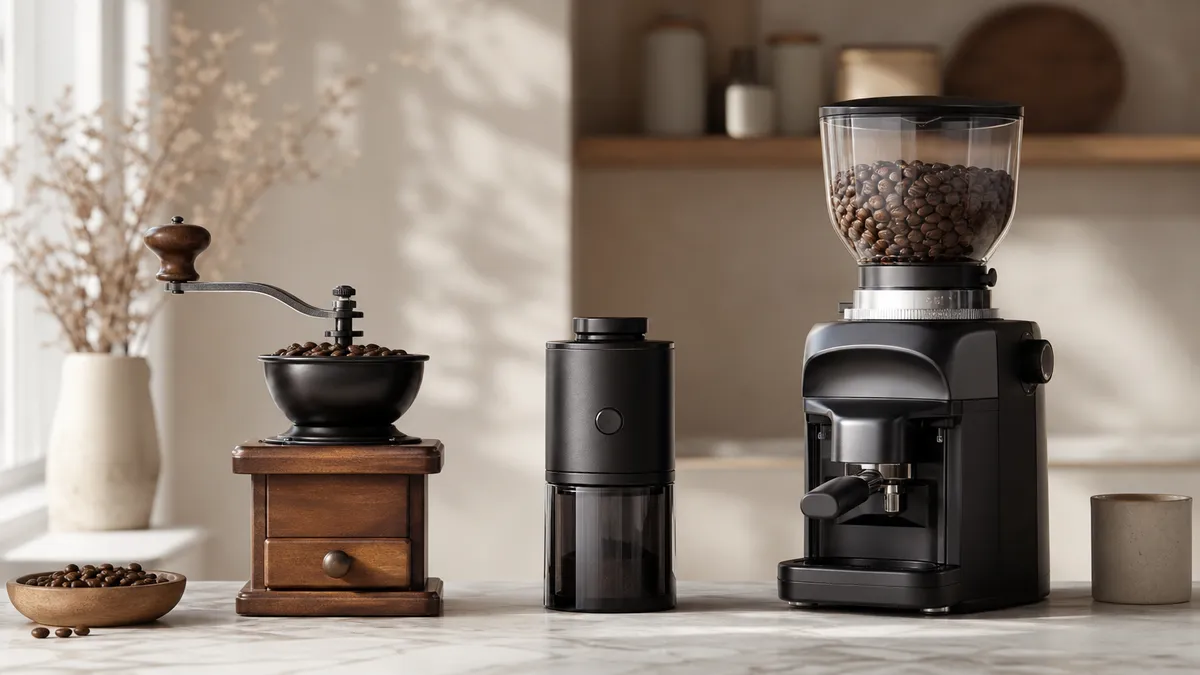
A hand grinder requires you to turn the burrs yourself; an electric grinder supplies that effort through a motor. The useful question is not which category is inherently better, but which you will use willingly.
Before choosing manual, try grinding your normal dose at the intended setting. Assess grip, stability, handle clearance and the effort needed to finish. If another person will use it, let them try too.
Electric is the practical shortlist when you want to avoid hand-cranking or prepare successive doses. Still, test the complete routine: filling, grinding, collecting the grounds and transferring them into the brewer.
Next, choose between keeping beans in a hopper and weighing each dose separately. Single-dosing means loading the beans for one preparation at a time. It is worth considering if you regularly alternate between coffees or decaffeinated beans, but assess the loading and transfer routine rather than assuming the label guarantees convenience.
Our guide to single-dose grinders explores that choice in detail.
Also distinguish dosing controls. A timer controls running time, not directly the mass of coffee delivered. Whatever the control system, check the output with scales when comparing doses.
5. Check space and noise in real use
Measure the whole working area, not just the grinder’s footprint. You need room to open the lid, add beans, remove the grounds container and reach the controls. For a hand grinder, include the handle’s turning space.
Check where the grounds will go. Can you remove the catch cup without moving the grinder? Does your portafilter, the handle holding an espresso basket, fit the support securely? Can you transfer coffee without an awkward reach?
For noise, request a demonstration with beans, preferably at the setting you expect to use. Listen from the place where another person would be working or sleeping, not only from directly beside the appliance.
Treat an isolated decibel claim cautiously unless the measurement conditions are supplied. Ask about distance, dose and operating conditions before using it to compare models. This guide does not rank grinders by loudness because it has not conducted a controlled noise comparison.
6. Read the cleaning instructions before buying
Download the manual before making your final choice. Cleaning access is something you can assess in advance, rather than discovering it after grounds begin accumulating.
Look for clear instructions on removing accessible burrs, brushing the chamber and clearing the outlet. Ask whether reassembly requires recalibration, meaning resetting the reference position used for grind adjustment.
Do not apply one model’s washing instructions to another. Baratza’s Encore ESP manual permits washing certain removable containers but says not to wet the burrs. Comandante’s FAQ gives different instructions for different models, including warnings against soaking its C40 or putting it in a dishwasher.
For electric grinders, unplug before cleaning or disassembly. Use cleaning products only where the manufacturer permits them, and do not substitute rice or other materials for approved grinder-cleaning products.
Ask the seller how to obtain replacement parts and technical help in the UK. A removable burr is useful, but it does not, by itself, establish the availability of long-term support.
7. Use a repeatable brew check
If a retailer offers a demonstration, ask to use your normal brewing method. For a filter-grinder comparison, the following check is adapted from Hario UK’s V60 guide. It is a practical comparison recipe, not a grinder certification test.
Use the same beans, brewer, filter papers and water throughout.
- Prepare the brewer. Rinse the paper with hot water, warm the vessel and discard the rinse water.
- Weigh the coffee. Use 15 g and select the manufacturer’s suggested filter setting.
- Prepare the water. Use 250 g of brewing water, approximately 250 ml, at 94 degrees Celsius. This is a coffee-to-water ratio of approximately 1:16.7 by weight.
- Time the grinding. Record how long the dose takes, together with any difficulty loading, collecting or transferring it.
- Brew consistently. Wet all the grounds, wait about 30 seconds, then pour slowly in circles to a total water weight of 250 g. Hario’s guide suggests an overall process of about 2 minutes 30 seconds, but do not treat that as a compulsory pass mark.
- Repeat after one adjustment. Taste, change only the grind setting and brew again. Assess whether the control is easy to use and whether the change is useful.
The chosen temperature sits within Hario’s published range of 92 to 96 degrees Celsius. Keeping the water unchanged helps avoid confusing a water change with a grinder change.
For espresso, use your machine’s recommended basket dose and hold the beverage yield constant while adjusting the grind. Do not compare shots by volume alone or change dose, yield and grind simultaneously.
Interpret problems before rejecting the grinder
These are diagnostic starting points, not proof of a fault. Brewing technique and preparation can produce similar symptoms.
| Symptom | Likely cause to investigate | Fix |
|---|---|---|
| Filter water drains unusually slowly | Grind too fine for the recipe | Try a coarser setting while keeping the recipe unchanged |
| Filter coffee tastes weak and drains quickly | Grind too coarse may be contributing | Try finer, then reassess |
| Espresso flows too quickly | Grind too coarse; also check dose and preparation | Verify preparation, then adjust finer |
| Espresso barely flows | Grind too fine; also check basket dose | Verify dose, then adjust coarser |
| Grounds stop emerging normally | A blocked outlet or accumulated coffee | Stop, unplug and follow the model’s clearing instructions |
Your final coffee grinder checklist
Before ordering, confirm:
- [ ] The manufacturer supports your main brewing method.
- [ ] Adjustment is suitable for espresso, if required.
- [ ] Capacity accommodates your normal dose or batch.
- [ ] The complete routine is comfortable and manageable.
- [ ] Working clearance and loaded noise are acceptable.
- [ ] Cleaning instructions are clear.
- [ ] Replacement parts, support and intended-use restrictions are understood.
- [ ] The seller’s returns policy and warranty terms are documented.
For UK consumer purchases, GOV.UK explains that faulty-goods rights exist independently of a manufacturer’s warranty. It also distinguishes those rights from change-of-mind returns. Do not assume a household consumer policy applies unchanged to a business purchase.
FAQ
Can I compare grind-setting numbers across different grinders?
No, setting numbers are model-specific reference points, not a shared measure of particle size. Start with each manufacturer’s brewing chart and adjust through brewing. Even within one model, follow its calibration instructions before assuming that another owner’s preferred number will give you the same result.
Does SCA certification for my brewer cover the grinder too?
No, certification of a brewer does not certify a separate grinder used alongside it. The Specialty Coffee Association distinguishes home brewers from home filter grinders in its equipment programme. Check the exact product and certification category rather than treating an SCA reference elsewhere in a setup as approval of everything.
Can one grinder serve ordinary coffee and decaf?
Yes, but examine how you will change beans and clear the grinder between them. Grounds retained inside the grinding path can complicate switching. Ask the manufacturer about its recommended procedure, and do not interpret “single-dose” or “low retention” as a guarantee that no previous coffee remains.
Where to go next
Read Coffee Grinders for the broader equipment overview, or Single-Dose Grinders if changing beans is central to your routine. Choose Commercial Coffee Grinders when workplace demand and servicing determine the shortlist. Knowing how to choose a coffee grinder means matching its actual job before comparing its extras.
Sources
-
S1. Sage, “Burr grinder vs blade: Which is better?”, undated. Used for grinding mechanisms and the relationship between particle size and extraction.
https://www.sageappliances.com/uk/en/blog/coffee-and-espresso/burr-grinder-vs-blade.html -
S2. Baratza, “Encore ESP Operations Manual”, January 2023, version 1.0. Used for adjustment ranges, brewing starting points, safety, cleaning and blockage guidance. These are manufacturer-published instructions, not independently tested performance findings.
https://assets.breville.com/ZCG495/manual-encoreesp-v1-0-en-010923.pdf -
S3. Sage, “the Bambino BES450/SES450 Quick Guide”, undated, document revision UG6/E21. Used for single-wall and dual-wall basket distinctions and espresso flow troubleshooting.
https://assets.sageappliances.com/SES450/SES450_EU_UG6_E21_FA_WEB.pdf -
S4. Comandante, “Frequently Asked Questions”, undated. Used for model-specific cleaning instructions and grind-setting guidance.
https://comandantegrinder.com/pages/faq -
S5. Fellow, “Ode Brew Grinder Gear Guide”, undated. Used for the manufacturer’s espresso exclusion, retained-grounds discussion and maintenance information.
https://fellowproducts.com/pages/gear-guide-ode?view=gg-ode-2 -
S6. Hario UK, “Expert V60 Brew Guide”, undated. Used for the filter comparison recipe, water temperature, timing and grind-adjustment suggestions.
https://www.hario.co.uk/pages/brew-guides-v60-expert -
S7. GOV.UK, “Accepting returns and giving refunds: the law”, current online guidance, undated. Used for the distinction between faulty-goods rights, warranties and change-of-mind returns.
https://www.gov.uk/accepting-returns-and-giving-refunds -
S8. Specialty Coffee Association, “SCA Certified Home Equipment”, current online directory, undated. Used to distinguish home brewer and home filter-grinder certification categories.
https://sca.coffee/certified-home-brewer
This article was researched using retrieved manufacturer manuals, manufacturer guidance, the SCA equipment directory and GOV.UK consumer guidance; the decision sequence is editorial advice, not a first-hand product test.
Last checked: November 2026