Good espresso grinders combine fine, repeatable grind adjustment with consistent dosing and a workflow that suits the person making the coffee. The buying test is not simply whether a grinder goes fine enough, but whether you can make small, controlled changes without fighting retained grounds, awkward controls or an unsuitable dosing system.
In short
- Prioritise small, repeatable adjustments over the total number of grind settings.
- Stepless adjustment lets you choose positions between marked settings; closely spaced steps can also work well.
- Choose single dosing for changing beans frequently, or hopper dosing for repeated drinks using the same coffee.
- Treat burr diameter, motor speed and “quiet” claims as specifications to investigate, not quality rankings.
- Check the grinder with your actual basket, portafilter and intended workflow before committing.
Why espresso demands a dedicated grinder
Espresso depends on water passing through a compacted bed of finely ground coffee. Changing the grind changes how readily that water flows: too fine can restrict the shot to drips, while too coarse can produce a fast, thin extraction. The useful adjustment range is therefore about control, not merely reaching a powdery texture.
For a beginner, the essential purchase is a burr grinder with adjustment designed for espresso. Burrs are the paired cutting surfaces that grind the beans. This article concentrates on their espresso-specific demands; coffee grinder basics covers the wider categories.
Before blaming a grinder, establish consistent preparation. Changing the coffee dose, tamping unevenly or using different beans between tests makes it difficult to judge what a grind adjustment actually did. A capable grinder cannot remove every other variable.
Fine adjustment: stepped versus stepless
A stepped grinder moves between fixed positions. A stepless grinder allows continuous movement within its adjustment range, so you can stop between the marked reference points.
Neither description settles the buying decision. Closely spaced espresso steps can offer useful control, while a stepless dial can be awkward if its markings are difficult to read or its mechanism moves unintentionally. Look for a setting you can change deliberately, record and return to.
Some grinders use separate macro and micro controls: one makes broad changes and the other refines the setting. Baratza documents this approach on several espresso models. It is another route to fine control, rather than a compromise simply because the grinder has numbered positions.
Ask for a demonstration using one coffee and an unchanged dose. Can the operator make a small adjustment and produce a corresponding change in shot flow? A specification listing numerous settings across everything from espresso to cafetière does not answer that question.
Also distinguish burr movement from ground particle size. Mazzer, for example, describes adjustment increments as changes in burr separation. That is not a promise that every particle becomes precisely that much smaller.
Choose the dosing workflow first
Single dosing and hopper dosing describe how beans enter the grinder. Timed dosing and grind-by-weight describe how the grinder controls its output. They are related choices, but not interchangeable terms.
The comparison below uses four criteria: preparation effort, bean switching, dose control and suitability for repeated drinks. These are workflow recommendations, not a ranking of flavour.
| Workflow | How the dose is controlled | Best suited to | Main compromise |
|---|---|---|---|
| Single dosing | Weigh beans before grinding; check grounds afterwards | Frequent bean changes and deliberate home preparation | A separate weighing and loading step for each drink |
| Timed hopper dosing | Run the grinder for a programmed duration | Repeated drinks using one coffee | Output weight needs checking and the timer may need resetting |
| Grind-by-weight hopper dosing | A scale measures the dose during grinding | Repeated drinks with less manual dose correction | Scale calibration, portafilter compatibility and support become buying checks |
Single dosing
Load only the beans needed for the next drink. This makes changing between coffees straightforward, provided the grinder’s retained and exchanged grounds are suitably controlled.
Do not assume that an almost empty hopper turns any grinder into a purpose-designed single-dose machine. Ask whether the manufacturer supports that use and what procedure is needed to clear the chamber and chute.
Timed dosing
Timed grinders stop after a selected duration, not after measuring a selected mass. Mahlkönig notes that coffee condition and grind adjustment can affect the quantity delivered by time-based dosing.
Weigh the grounds when setting the timer, then check again after changing coffee or grind size. A familiar button press is convenient, but it is not evidence that the dose remains unchanged.
Grind-by-weight
Grind-by-weight, often shortened to GBW, uses a scale to control the delivered mass. Mahlkönig’s E65S GbW, for example, monitors weight through a load cell beneath its portafilter support.
That controls dose, not extraction. You still need to adjust the grind and prepare the coffee bed consistently. Ask how calibration works and whether your portafilter sits securely without touching surrounding surfaces.
Retention: what “low” needs to mean
Retention is ground coffee left inside the grinder. Exchange is previously retained coffee displaced into a later dose.
The distinction matters. Equal bean input and ground output do not, by themselves, prove that all the coffee delivered belongs to the newly loaded beans. Some grounds can remain while others leave.
When assessing a retention claim, ask:
- Was the grinder freshly cleaned or already in normal use?
- Was it tested at an espresso setting?
- Were bellows, a chute knocker or another clearing tool used?
- Does the figure describe total retained coffee, dose loss or exchanged grounds?
Manufacturer procedures matter here. Mazzer’s instructions for minimising Philos retention include operating its chute-clearing features. Compare the complete routine, not a headline figure detached from the actions required to achieve it.
For someone changing beans frequently, my preference is an uncomplicated clearing routine and repeatable output over a dramatic “zero” claim. For repeated drinks from one hopper, assess how much purging the manufacturer recommends after adjustment.
Burr size, speed and noise
Burr diameter is not a buying hierarchy
Burr size tells you a dimension, not the whole cutting design. Mazzer offers different Philos burr sets with the same diameter but different stated flavour intentions. Those sensory descriptions are manufacturer claims, not independent proof that a buyer will prefer one.
Compare intended use, adjustment, output and cleaning access alongside diameter. Avoid choosing a grinder solely because its burrs are larger than another model’s.
Flat and conical describe different burr arrangements. Neither label alone establishes which complete grinder is right for your coffee and workflow.
Compare grinding time, not just motor speed
Revolutions per minute describe rotational speed. They do not directly tell you how long a dose takes to grind.
For a useful specification example, Mahlkönig claims an average output of 4 to 5 g per second for the E65S GbW at 50 Hz, at its stated laboratory grind condition. The company explicitly says output depends on the coffee and fineness. Treat that as a conditional manufacturer specification, not a guaranteed espresso preparation time.
For repeated use, ask about the permitted duty cycle, meaning the operating and rest pattern, rather than assuming a fast individual dose establishes commercial suitability.
Hear the grinder working
Eureka markets its Mignon Silenzio 55 with noise-reduction technology, but a feature name is not a comparable noise measurement.
My recommendation is to hear a grinder processing beans in a room resembling yours. Judge the pitch, vibration and duration as well as loudness. An idle-motor recording does not demonstrate the sound of grinding coffee.
Clumping and static control
Static electricity generated during grinding can make grounds cling to surfaces, scatter or form clumps. The Specialty Coffee Association’s research discussion connects these effects with particle charge and explains why reducing visible mess is not the only consideration.
A declumper is an outlet component intended to break up clumps. Ask how it is accessed for cleaning and whether replacement parts are available. Do not remove it merely because another owner reports different results without it.
Active systems, sometimes marketed as ion or plasma generators, use ions to reduce electrical charge. Acaia describes its Ion Beam this way. These are manufacturer claims about static management, not proof of better espresso flavour.
The Ross Droplet Technique, or RDT, means lightly moistening beans before grinding. Controlled laboratory research found that adding water reduced charging and clumping. In a separate experimental preprint, both water and ionisation reduced visible mess, but only water changed the tested espresso brewing parameters.
That evidence does not make RDT universally suitable. Mazzer advises against spraying beans because of potential clogging, jamming and oxidation. Follow the grinder maker’s instructions: a laboratory mechanism and appliance-specific operating advice answer different questions.
Seasoning, alignment and maintenance
Burr seasoning means an initial period of grinding intended to prepare new burr surfaces for normal use. There is no sensible universal quantity to apply to every grinder.
Manufacturer instructions differ. Baratza’s Sette 30 manual describes an initial seasoning procedure; Mazzer says its burr finishing makes extended seasoning unnecessary. Follow the instructions for the actual model rather than grinding through an arbitrary quantity of coffee.
Alignment concerns the positioning of the burrs relative to one another. It differs from calibration, which establishes the adjustment reference. Mazzer describes factory parallelism checks and stresses clean mating surfaces when fitting replacement burrs.
For a new grinder, ask the supplier to investigate persistent problems before attempting shims or other alignment modifications. Prioritise accessible dry cleaning, available burrs and clear reassembly instructions over an upgrade path you may never use.
Pairing espresso grinders with machines
Start with the basket rather than the machine’s appearance. Sage’s guidance distinguishes single-wall baskets, intended for freshly ground coffee and adjustment of grind, dose and tamp, from dual-wall baskets, which regulate pressure and accommodate pre-ground coffee.
For a single-wall basket, choose a grinder with demonstrably fine espresso adjustment. For a dual-wall basket, do not assume that the finest possible setting is desirable; follow the machine instructions and assess the resulting flow.
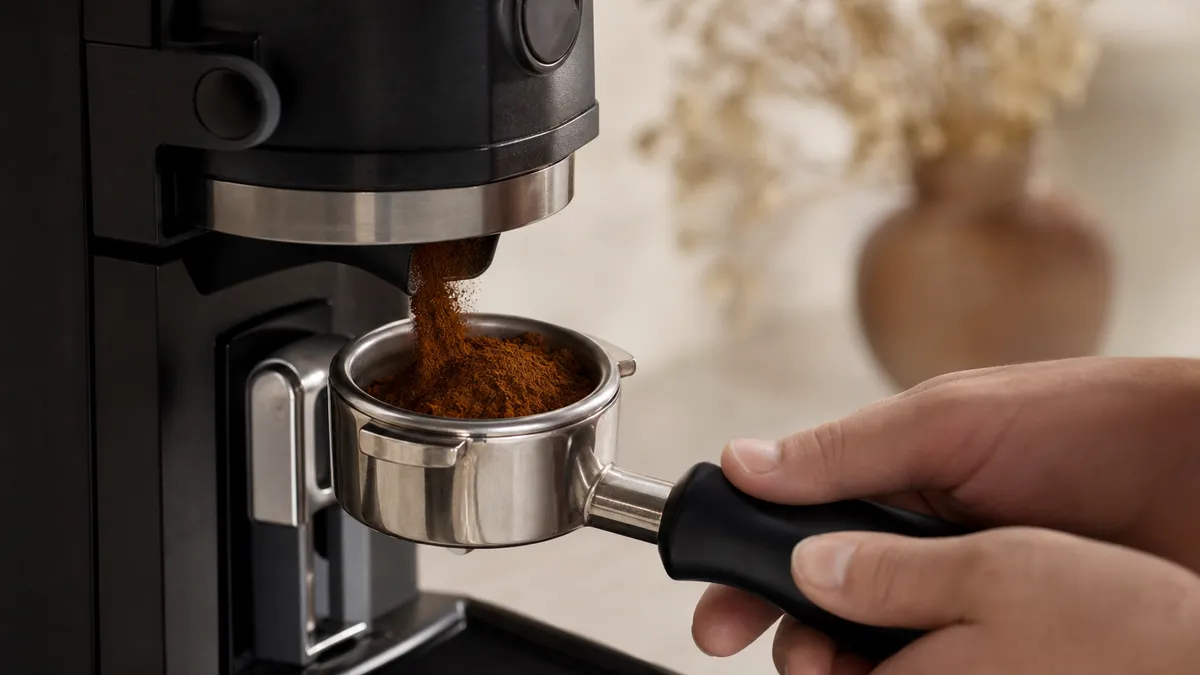
Check whether the portafilter fits the grinder’s fork, whether the outlet centres grounds over the basket and whether a dosing cup transfers cleanly. These are practical compatibility checks, especially with GBW supports.
For a shared workplace using a separate portafilter machine, prioritise straightforward controls, cleaning responsibility and supplier-confirmed workload suitability. Commercial grinder requirements deserve a separate assessment from occasional home use.
Entry-level, enthusiast and commercial choices
Rather than fixed monetary bands, use these capability tiers:
- Entry-level espresso: prioritise fine adjustment, repeatable dosing and straightforward cleaning. Accept manual weighing if it keeps the workflow clear.
- Enthusiast: consider easier bean switching, more convenient adjustment, quieter operation or a preferred dosing routine. Identify the specific problem an upgrade would solve.
- Commercial: require documented workload suitability, service arrangements, parts availability and training. Do not infer these from burr diameter or a large hopper.
For each shortlist, request itemised written quotations covering the grinder, necessary accessories, delivery, servicing and replacement burrs. Compare the same inclusions and VAT basis without assuming that a more elaborate feature list means a better fit.
If espresso and filter share one grinder, demonstrate a complete change to filter and back again before buying. Filter grinder priorities explain that separate decision.
The most useful final test for espresso grinders is practical: can you adjust, dose, clear and clean this one comfortably with your machine?
FAQ
Can an espresso grinder also grind for filter coffee?
Some can, but verify the manufacturer’s intended range and the practicality of returning to an espresso setting. A grinder may cover both methods while making frequent changes inconvenient. During a demonstration, change to filter, return to espresso and check the required clearing procedure rather than judging versatility from the dial alone.
Does grind-by-weight replace a separate coffee scale?
Not completely: it controls the ground coffee dose, not the mass of espresso brewed into the cup. You may still want a separate scale for checking output and following a dose-to-yield recipe. Also check how the grinder’s weighing system is calibrated and what support the supplier provides if readings become inconsistent.
How often should espresso grinder burrs be replaced?
Use the manufacturer’s model-specific guidance rather than a universal calendar interval. Mahlkönig, for example, publishes burr-life information under stated conditions, but that is a manufacturer specification rather than a guarantee for every coffee and workload. Ask a supplier to assess persistent grinding problems before assuming worn burrs are the cause.
Where to go next
Read Coffee Grinders for the wider equipment choices, or Manual Hand Grinders if you want to investigate a manually powered espresso workflow. Filter Coffee Grinders covers priorities beyond espresso, while Commercial Coffee Grinders is the next read for repeated workplace or hospitality service.
Sources
- Baratza, Dialing in Espresso: Burr Types, Adjustments, and Troubleshooting, undated, retrieved November 2026. Manufacturer guidance.
- Sage, the Duo-Temp Pro, BES810/SES810 User Guide, F23 file revision, 2023. Manufacturer manual.
- Mahlkönig, E65S GbW, current product specifications, undated, retrieved November 2026. Manufacturer product page.
- Mazzer, FAQ B2C, undated, retrieved November 2026. Manufacturer technical answers.
- Mazzer, Help & FAQ, undated, retrieved November 2026. Burr replacement and alignment guidance.
- Eureka, Mignon Silenzio 55, current product details, undated, retrieved November 2026. Manufacturer product page.
- Specialty Coffee Association, It’s Electric: Understanding and Reducing Static Electricity During Grinding, Issue 21, 2024. Research explanation.
- Méndez Harper and Hendon, Chemical strategies to mitigate electrostatic charging during coffee grinding, experimental preprint, 2023. Research preprint.
- Acaia, Ion Beam, current product description, undated, retrieved November 2026. Manufacturer technology description.
- Baratza, Sette 30 Manual, version 3, May 2019. Manufacturer manual.
Researched using manufacturer specifications and operating instructions, alongside primary experimental research and the SCA’s explanation of grinding static; no first-hand testing is claimed.
Last checked: November 2026