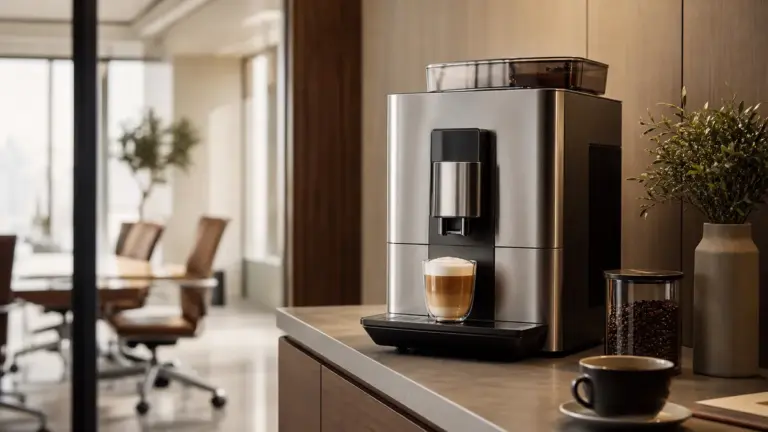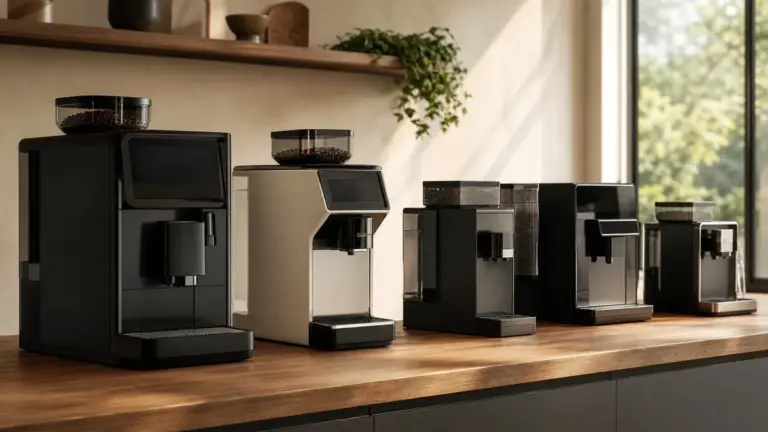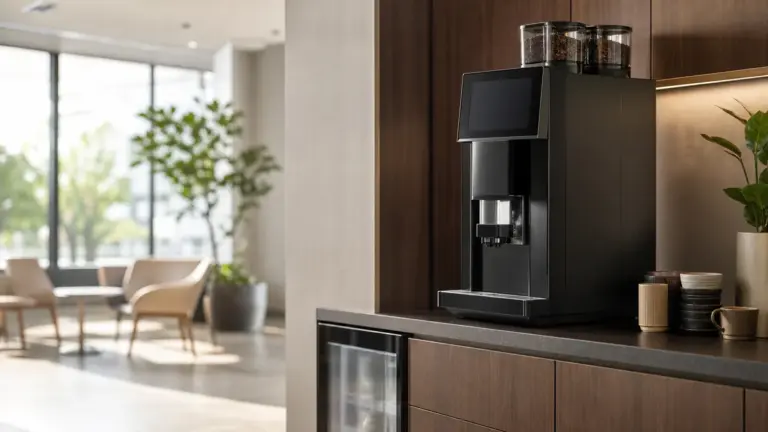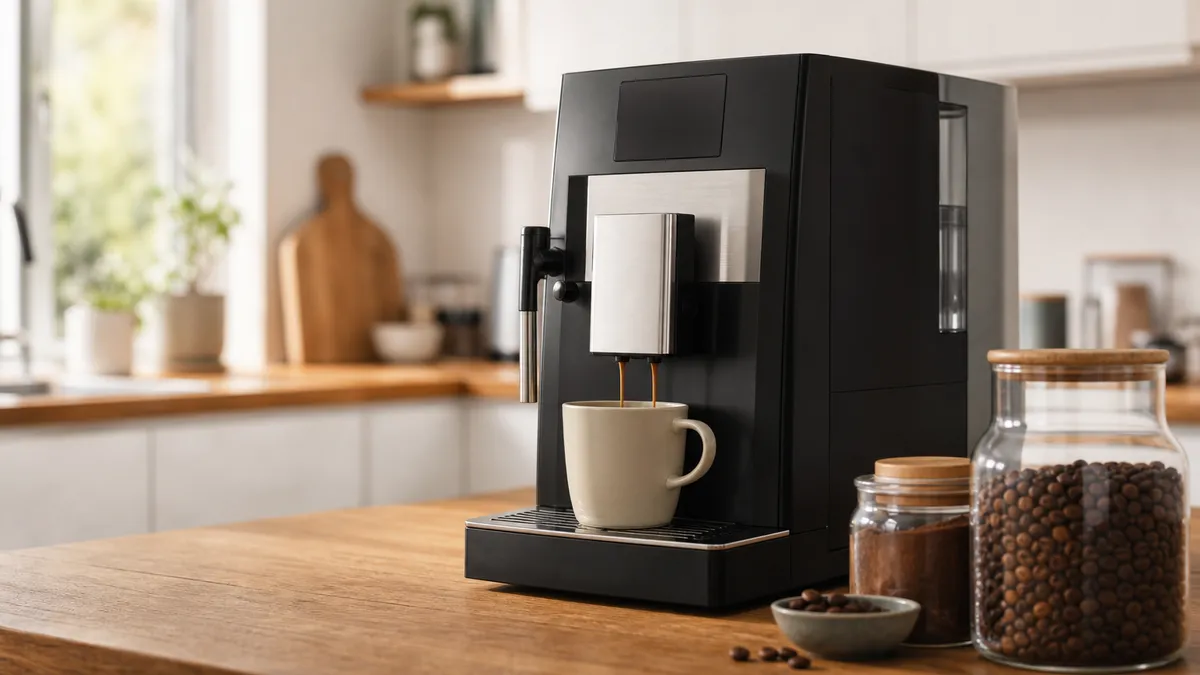
Necta office coffee machines cover compact self-service coffee points and large freestanding vending installations, with different models using beans, instant ingredients or fresh milk. Necta belongs to Italy’s Evoca Group, but an important buying detail has changed: several familiar Necta tabletop product pages now direct buyers to Gaggia Professional machines, so check the exact model and specification rather than relying on the badge.
In short
- Choose the format first: a tabletop machine for a staffed tea point is a different proposition from a freestanding machine with automatic cup dispensing.
- Check the milk system: bean-to-cup coffee does not necessarily mean fresh milk.
- Treat daily output figures as guidance: they do not establish how quickly a machine will clear a busy break-time queue.
- Separate old and new specifications: Kometa, Krea Touch and Kalea Plus pages now redirect to Gaggia Professional products.
- Get UK support commitments in writing: confirm installation, cleaning training, servicing, parts availability and breakdown arrangements.
Necta at a glance
Company and brand fact panel
- Brand: Necta.
- Parent group: Evoca Group, formerly N&W Global Vending.
- Headquarters: Valbrembo, in the province of Bergamo, Italy.
- Ownership: Lone Star Funds lists Evoca Group as an active investment of Lone Star Fund IX, acquired in 2016.
- Main machine classes: hot-drink vending machines, historically a substantial tabletop coffee range, and separate snack, food and cold-drink dispensers.
- UK presence: Evoca UK Ltd, with a registered office in Kingswinford, West Midlands.
Necta is best understood as a professional self-service equipment brand, not simply a maker of office espresso machines. Its range spans different ways of preparing and dispensing drinks, so two machines carrying the Necta name can have very different ingredients, refill routines and installation requirements.
For the wider comparison framework, start with UK office coffee machine brands. Here, the useful questions are which Necta format fits your workplace and whether a supplier is proposing an established Necta model or a newer Evoca product.
Company background and the Gaggia connection
Necta and Wittenborg combined to form N&W Global Vending in 2000. The business adopted the Evoca name in November 2017.
Evoca’s connection with Saeco and professional Gaggia is more than a distribution arrangement. Its 2017 acquisition of Saeco Vending included licences to use the Saeco and Gaggia brands in the professional coffee-machine market. That distinction matters: professional equipment should not be confused with domestic products carrying familiar brand names.
The current product pages show how the portfolio has developed. When checked in November 2026:
- Necta’s Kometa address redirected to Gaggia Professional G 100.
- Krea Touch redirected to G 300.
- Kalea Plus redirected to G 500.
These redirects establish the current route through the manufacturer’s catalogue, not that the machines are identical. Gaggia describes the G 300 as a new generation inspired by Krea, while its published specifications differ from the older machine.
Ask suppliers to identify the manufacturer’s product code, generation and configuration on the quotation. A familiar model name is not a sufficiently precise specification.
The Necta office coffee machine range
The comparison below uses published manufacturer information, not independent performance testing. Its criteria are format, milk system, capacity and relevance to a current purchase.
Specifications checked in November 2026. Older brochure figures describe those documented versions, not guaranteed current UK availability.
| Model or family | Format | Milk or ingredient approach | Published capacity | Buying significance |
|---|---|---|---|---|
| Kometa | Tabletop | Beans with soluble ingredients | 0.6 kg standard bean hopper; output guidance differs between brochures | Original page now redirects to G 100 |
| Krea Touch | Tabletop | Beans with soluble ingredients | 1.2 kg bean hopper; 100 drinks daily in the K-range guide | Original page now redirects to G 300 |
| Kalea Plus | Tabletop | Fresh-milk configurations available | 200 drinks daily in the K-range guide | Original page now redirects to G 500 |
| Koro Prime | Compact tabletop | Espresso, fresh-milk and instant versions documented | 750 g bean hopper on documented espresso versions | Establish exact version and availability |
| Korinto Prime | Tabletop | Espresso, fresh-milk and instant versions documented | 950 g bean hopper on documented espresso versions | Do not confuse with smaller Koro |
| Opera and Canto families | Freestanding vending | Preparation system depends on version | Original Canto Plus/Top brochure specifies 650 stored cups | Check generation, cup system and ingredients |
Tabletop machines
Tabletop machines belong on a suitable worktop or dedicated cabinet, with access for filling, cleaning and servicing. They suit workplaces where people bring a mug and someone takes responsibility for replenishment.
Kometa illustrates why detailed checks matter. Its original English brochure gives dimensions of 308 mm wide, 571 mm deep and 629 mm high, before allowing working clearance. It specifies a standard 600 g bean hopper and optional payment equipment.
Koro Prime and Korinto Prime need equally careful identification. Their published brochures include instant-only versions as well as espresso versions. The family name alone therefore does not prove that a particular machine grinds beans.
Freestanding vending and other dispensers
Freestanding machines combine a floor-standing cabinet with vending functions such as stored cups and payment integration. They are worth considering for shared buildings, larger staff areas and workplaces that need a managed vending service.
Opera and Canto are established names in this category. The former Opera product address now redirects to Necta’s Barista 600, whose published specification lists storage for up to 600 cups.
Necta also supplies snack, food and cold-drink dispensers. These may form part of a workplace refreshment installation, but they are separate equipment, not additional capabilities of a coffee machine.
If this is your preferred format, Coffetek’s office machines provide a useful next comparison.
Understanding capacities and workplace demand
Capacity can mean bean storage, water storage, waste storage, cup storage or suggested daily output. These figures answer different questions.
There is also a genuine discrepancy in Necta’s Kometa documentation. The K-range overview suggests 80 drinks daily, whereas the dedicated English Kometa brochure states up to 100. Neither figure is an independently measured workplace result. Ask the supplier which document applies to the proposed machine and have the agreed duty level recorded.
For context, current Gaggia pages suggest up to 100 drinks daily for G 100, 150 for G 300 and 250 for G 500. Do not transfer these ratings backwards to older Necta machines.
A simple headcount and daily-cups matrix
The following is an illustrative planning exercise, not a manufacturer recommendation. It assumes everyone listed is on site and each person takes two machine-made drinks daily, excluding visitors.
| People on site | Assumed drinks per person | Calculated daily drinks | Next check |
|---|---|---|---|
| 20 | 2 | 40 | Refill access and cleaning responsibility |
| 40 | 2 | 80 | Margin below the agreed daily rating |
| 60 | 2 | 120 | Larger tabletop capacity or distributed provision |
| 100 | 2 | 200 | Peak queues and whether multiple machines suit better |
Replace these assumptions with attendance and drink counts from your own workplace.
Storage also needs its own calculation. Assuming a 10 g dose, a 600 g hopper holds beans for 60 single-dose drinks before allowing for setup use or other losses. That is arithmetic, not a measured refill interval.
Request a demonstration using your intended mug sizes and drink mix. Time a sequence of drinks, rather than one espresso, and include the rinses or operator actions that occur during normal use.
Milk choice and everyday operation
Bean-to-cup describes the coffee preparation, not the milk system. A machine can grind beans for espresso and use a soluble milk ingredient for cappuccino.
Necta’s historical range includes both soluble-ingredient and fresh-milk configurations. Current Gaggia G 100 specifications likewise distinguish powdered-milk and fresh-milk versions.
Choose by tasting the actual proposed ingredients and recipes. Do not accept a fresh-milk demonstration as evidence of how a powdered-milk configuration will taste.
For fresh milk, require a demonstration of refrigeration, milk-path cleaning and the complete shutdown routine. For soluble ingredients, ask to see canister handling and mixer cleaning. In either case, have the supplier identify the tasks that automatic programmes do not perform.
If milk choice and recipe control are your main priorities, compare the requirements discussed in Schaerer’s office machines, rather than judging machines by menu length alone.
UK servicing and installation
Evoca has a UK company and publishes its Kingswinford contact details. Separately, the group introduced Evoca Care on 3 September 2026, bringing parts, accessories, technical support and training under a global aftermarket identity.
Neither fact establishes a particular engineer response time at your postcode. Make the proposed service arrangement part of the buying decision.
Before accepting a quotation, request written answers covering:
- Installation: site survey, water connection or tank arrangement, electrical requirements, filtration and commissioning.
- Operator duties: filling, waste removal, cleaning, cleaning products and holiday shutdown.
- Technical support: who takes the first call, attendance arrangements, exclusions and escalation.
- Parts: support for the exact model, particularly older or refurbished machines.
- Continuity: what happens if the machine cannot be repaired promptly.
Ask the installer to assess your site water and specify treatment for the actual machine. Measure access for opening doors, removing containers and filling hoppers, not just the cabinet footprint.
For ownership comparisons, obtain itemised written quotations covering the machine, installation, ingredients, filters, cleaning materials, servicing, repairs, payment equipment and any connected services. Use one agreed period and expected drink total, then divide the complete quoted total by expected drinks. Keep the VAT basis consistent and include staff time separately.
Advantages, limitations and who they suit
These are editorial assessments of the documented formats and buying requirements, not reliability rankings.
Advantages
- Broad self-service choice: tabletop and freestanding formats let you start with the workplace’s dispensing needs.
- Different ingredient systems: documented versions accommodate soluble ingredients or fresh milk, depending on model.
- Manufacturer documentation and UK presence: there is an identifiable route for checking specifications and support arrangements.
Limitations
- Names need careful checking: catalogue redirects and replacement products make old specifications easy to misapply.
- Capacity claims need qualification: suggested daily output is not a queue-clearing guarantee.
- Configuration changes the experience: an instant version, bean-to-cup version and fresh-milk version should not be treated as equivalent.
- Service must be assessed locally: group-level support information is not evidence of contracted attendance at your site.
Necta office coffee machines deserve a shortlist place where the priority is practical, managed self-service. Choose the format, taste the specified drinks, watch the cleaning routine and agree support before choosing the badge.
FAQ
Can a Necta machine provide drinks without taking payment?
Payment is not compulsory simply because a machine supports vending equipment. Kometa’s original brochure lists its payment module as an option, while freestanding specifications identify supported payment protocols. Ask the supplier to demonstrate the intended free-vend setup and confirm which accessories are included, rather than assuming every advertised payment feature is fitted.
Does a Necta machine always need a mains water connection?
No, water arrangements vary by model and version. The Koro Prime brochure documents an espresso version with a 3.2 litre internal tank as well as plumbed versions. That does not establish tank compatibility for another model. Have the supplier specify the actual water arrangement and explain the filling, cleaning and installation requirements.
Is an older Necta machine automatically obsolete?
No, age or a catalogue redirect alone does not establish that a machine is unsupported. However, this research does not establish a universal parts-support period for older Necta products. Before accepting a refurbished machine, obtain its model code, service history, warranty terms and written confirmation that your chosen service provider supports it.
Where to go next
Read UK Office Coffee Machine Brands to build a shortlist across machine types, then Coffetek Office Coffee Machines if freestanding vending remains a priority. Bravilor Bonamat Office Coffee Machines is the useful next read if you want to reconsider the preparation format before committing to bean-to-cup.
Sources
-
Evoca Group, “Where we are”, undated, current page checked November 2026. Italian headquarters and UK company details.
https://www.evocagroup.com/en/company/where-we-are -
Lone Star Funds, “Private Equity”, undated, current portfolio checked November 2026. Evoca investment, acquisition year and active status.
https://www.lonestarfunds.com/investment-strategies/private-equity/ -
Evoca North America, “Notre histoire”, undated. N&W formation and November 2017 renaming.
https://evocagroupna.com/fr/notre-histoire/ -
N&W Global Vending, press release on the Saeco Vending investment, 6 March 2017. Professional Saeco and Gaggia brand licences.
https://www.evocagroup.com/sites/corporate/files/press/2018-05/N%26W%20Press%20Release%206%20Mar%202017.pdf -
Necta, “K-range”, English brochure, undated, hosted May 2024. Historical tabletop formats and suggested daily outputs.
https://newebcdn-necta.evocagroup.com/sites/necta/files/2024-05/Necta_K-Range_English.pdf -
Necta, “Kometa”, English brochure, undated, hosted September 2023. Dimensions, hopper, daily-output claim and optional payment module.
https://necta.evocagroup.com/sites/necta/files/2023-09/necta_kometa–brochure_english–web.pdf -
Gaggia Professional, “G 100”, “G 300” and “G 500”, undated, current product pages checked November 2026. Redirect destinations, configurations and current claimed outputs.
https://gaggiaprofessional.evocagroup.com/en/products/superautomatic-machines/g-100
https://gaggiaprofessional.evocagroup.com/en/products/superautomatic-machines/g-300
https://gaggiaprofessional.evocagroup.com/en/products/superautomatic-machines/g-500 -
Necta, “Koro Prime”, English export brochure L487K1, undated, hosted March 2019. Ingredient versions, hopper and tank specifications.
https://newebcdn-necta.evocagroup.com/sites/necta/files/2019-03/KORO%20PRIME%20English%20Export_L487K1_.pdf -
Necta, “Korinto Prime”, English export brochure L488K1, undated, hosted March 2019. Espresso, fresh-milk and instant versions and bean capacity.
https://newebcdn-necta.evocagroup.com/sites/necta/files/2019-03/KORINTO%20PRIME%20ENGLISH%20EXPORT_L488K1_.pdf -
Necta, “Canto Plus & Top”, English brochure L325U3, undated, hosted May 2018. Historical cup-storage specification.
https://necta.evocagroup.com/sites/necta/files/2018-05/CANTO%20PLUS_TOP.pdf -
Necta, “Barista 600”, undated, current product page checked November 2026. Opera redirect, freestanding format, versions and cup storage.
https://necta.evocagroup.com/en/products/coffee-vending-machines/barista-600 -
Necta, homepage, undated, current page checked November 2026. Coffee vending and separate snack, food and cold-drink dispensing categories.
https://necta.evocagroup.com/en -
Evoca Group, “Introducing Evoca Care, the new Aftermarket identity”, 3 September 2026. Published scope of group aftermarket services.
https://www.evocagroup.com/en/news-media/news-events/introducing-evoca-care-new-aftermarket-identity
This profile was researched from manufacturer documents, live catalogue redirects and the investor’s portfolio listing; it does not claim hands-on testing or independently verified reliability.
Last checked: November 2026