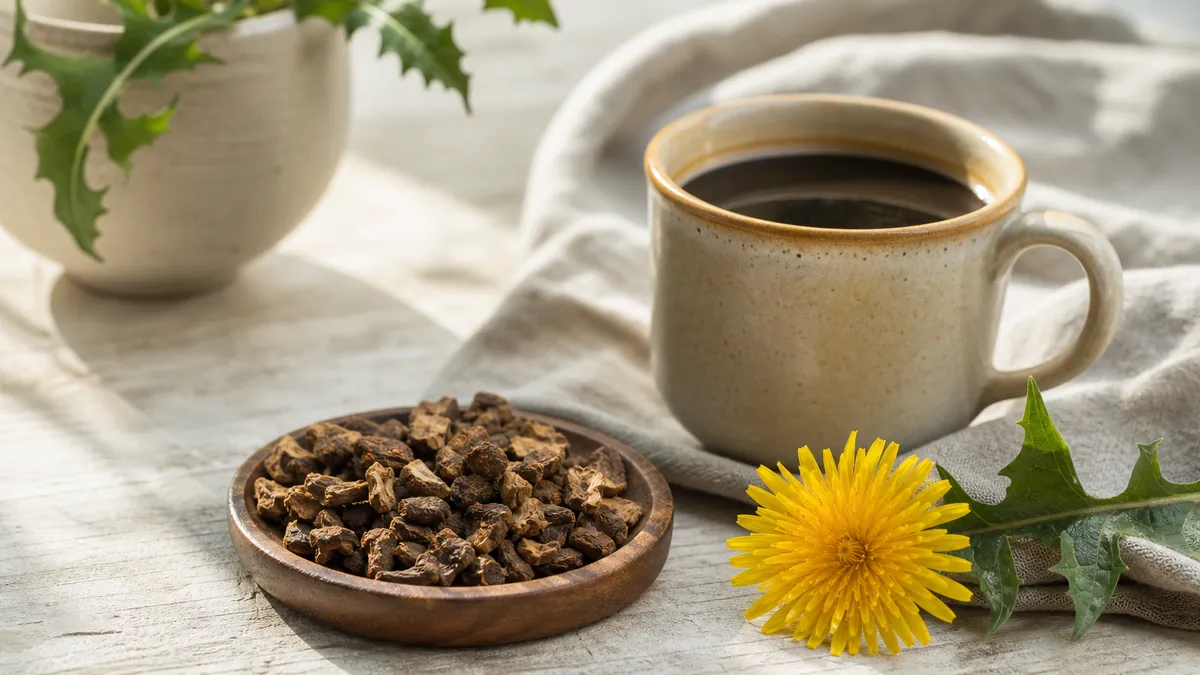
Dandelion root coffee is a dark, roasted drink made from dandelion roots rather than coffee beans. Pure dandelion root is naturally caffeine-free, with an earthy, nutty bitterness, but claims that the drink detoxifies the liver or treats disease go well beyond the evidence.
In short
- Choose roasted root, rather than dandelion leaf tea, for the coffee-like version.
- Check the whole ingredient list: a blend containing ordinary coffee is not caffeine-free.
- Loose roasted root can be simmered and strained; tea bags and instant products need their own packet instructions.
- Treat it as a drink, not a liver cleanse, weight-loss treatment or substitute for prescribed medicine.
- Ask a pharmacist or GP before regular use if you take medicines or have gallbladder, bile duct or liver problems.
What is dandelion root coffee?
Dandelion root coffee belongs to the family of coffee substitutes: drinks that fill a similar place in the day without necessarily containing coffee. The root is cleaned, cut, dried and roasted, then brewed in water. “Coffee” describes its intended use and roasted character, not its botanical identity.
Dandelion is commonly identified in herbal references as Taraxacum officinale. The root is the part used for this drink, although other dandelion products contain leaves or a mixture of leaves and root. Those preparations should not be treated as interchangeable when discussing flavour, instructions or research.
The easiest introduction is a packaged, food-grade roasted root product with clear ingredients and brewing directions. There is no need to identify and dig up a wild plant simply to find out whether you like the drink.
It also helps to separate three products:
- Roasted root pieces, which need brewing and straining.
- Tea bags, which hold the root during steeping.
- Instant drinks, which should be prepared according to their own directions.
Do not assume that a powder is instant. Finely ground root and a soluble drink extract are different preparations.
What does it taste like?
Expect roasted, earthy and nutty flavours with a noticeable bitter finish. These descriptions appear both in published sensory research on dandelion root beverages and in a manufacturer’s description of its roasted root tea.
The resemblance to coffee is useful but limited. Think of it as a separate roasted drink, rather than something that must pass for your usual coffee. Taste it plain first, then decide whether you prefer milk or a plant-based alternative.
A small sensory study published in 2014 used 50 untrained panellists to assess dandelion drinks and mixtures with coffee. Some coffee-containing blends were preferred to dandelion root alone. That is evidence about those recipes and those tasters, not proof that everyone will prefer a blend.
If the roasted-root idea appeals but this particular bitterness does not, chicory coffee is the useful neighbouring subject. The broader alternatives to coffee guide helps you choose by the experience you want, rather than by health marketing.
Is dandelion root coffee caffeine-free?
Pure roasted dandelion root is naturally caffeine-free. However, the name on the front of a packet is not enough to establish the caffeine content of a blend.
Read the ingredient list for ordinary coffee or other caffeine-containing additions. Published dandelion beverage research includes mixtures with both ground and instant coffee, so “dandelion coffee” does not always mean a drink made only from dandelion.
For a straightforward caffeine-free choice, look for a single-ingredient roasted root product explicitly described as caffeine-free. If avoiding caffeine is medically important, ask the manufacturer about the finished product rather than estimating from its name.
Caffeine-free also does not mean suitable for everyone. Herbal ingredients have their own safety considerations, quite separately from caffeine.
How to make dandelion root coffee
Start with ready-roasted, food-grade root. Follow the packet when it gives a specific method, because cut size and formulation differ.
The following is an editorial starting recipe, adapted from a published roasted-root simmering method. Its measured dose is a suggested culinary starting point, not a clinically established serving, a tested optimum or a medicinal recommendation.
Simple saucepan method
Makes: one mug
Preparation and brewing: approximately 15 minutes
Ingredients
- 5 g loose roasted dandelion root
- 250 ml drinking water
- Milk or a plant-based alternative, optional
Equipment: small saucepan, scales, measuring jug, fine strainer and mug.
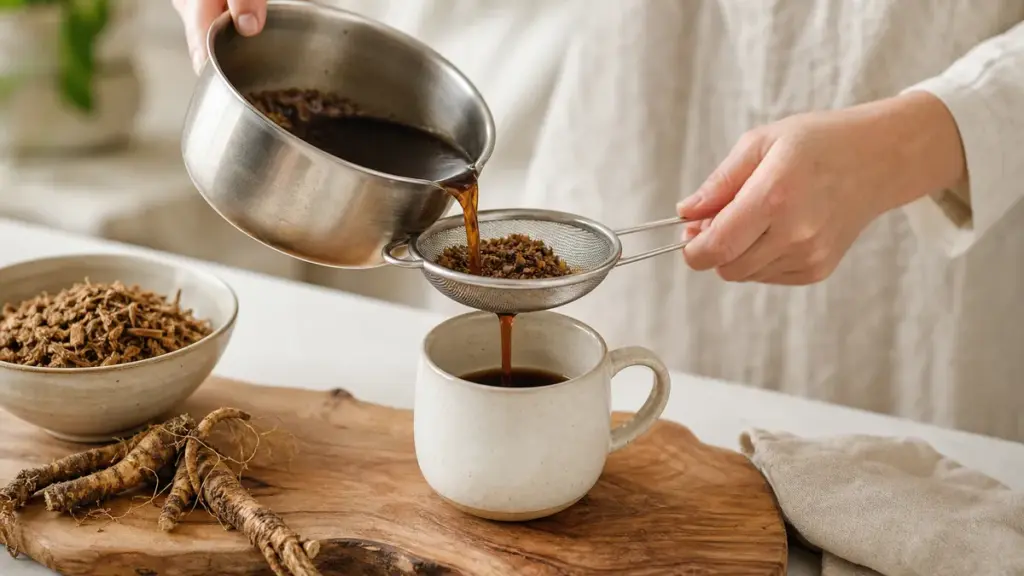
- Measure the root and water. Put both into the saucepan. Keep a note of the product and dose so you can repeat a cup you enjoy.
- Bring to the boil. Reduce the heat to a gentle simmer rather than maintaining a vigorous boil.
- Simmer for 10 minutes. This follows the simmering time in North Branch Nature Center’s roasted-root recipe. If your packet specifies a different time, use that instead.
- Strain into a mug. Keep the solid pieces out of the finished drink.
- Taste before adding anything. Dilute with hot water if it is stronger than you want, then add milk or your preferred alternative if desired.
Simmering plant material in water is called a decoction. It differs from an infusion, where hot water is poured over the ingredient and left to stand.
For tea bags, use their stated steeping method instead. For example, Traditional Medicinals directs a covered steep of 10 to 15 minutes for its roasted dandelion root bags. That is a product-specific instruction, not a universal rule.
Adjusting the next cup
Change one thing at a time. The suggestions below are practical recipe adjustments, not findings from comparative brewing trials.
| Symptom | Likely cause | Suggested fix |
|---|---|---|
| Too bitter or strong | The dose or brewing time exceeds your preference | Dilute this cup; reduce the dose next time |
| Too weak | Too little root for your preferred strength | Increase the dose modestly, keeping time unchanged |
| Gritty | Small particles have passed through the strainer | Use a finer strainer or paper filter |
| Unlike the expected roasted drink | The product may contain unroasted root, leaves or other ingredients | Check its composition before changing the recipe |
Do not put root pieces into a bean-to-cup machine’s bean hopper. This saucepan method needs no coffee machine.
Can you roast the roots yourself?
You can, but buying prepared root removes the identification stage. Food Standards Agency guidance says to be certain of a wild plant’s identity and to wash harvested food thoroughly. A yellow flower alone is not sufficient identification for something you intend to eat.
North Branch Nature Center’s preparation method calls for washing away soil, removing the leaves and dicing the root before roasting. Its recipe uses approximately 175°C for 40 to 50 minutes, until the pieces are dehydrated and deep golden brown. This is a converted temperature from that particular recipe, not a validated universal roasting profile.
Watch the root rather than treating the timer as a guarantee. Follow the source method’s colour and dryness cues, then cool before storing.
Avoid roots from sprayed lawns and roadsides. If you cannot confidently establish both the plant’s identity and a suitable harvesting location, use a packaged food product instead. Roasting is not a substitute for safe identification and sourcing.
Health claims versus evidence
The most defensible reason to drink dandelion root coffee is that you enjoy it and want a caffeine-free roasted drink. Its medicinal reputation requires a different standard of evidence.
Digestion and traditional use
The European Medicines Agency’s dandelion root monograph recognises traditional medicinal uses for mild digestive complaints, temporary loss of appetite and certain minor urinary complaints. Crucially, these indications are based on long-standing use, not well-established clinical efficacy.
That distinction matters. A record of traditional use does not establish that a mug of roasted root coffee reliably relieves bloating, improves digestion or treats a urinary problem. Nor does the monograph make every commercial drink equivalent to the medicinal preparations it describes.
Antioxidants and laboratory findings
Research has measured antioxidant activity in dandelion extracts. One beverage study used laboratory assays, including a test of an extract’s ability to reduce iron compounds.
These are chemical measurements, not demonstrations that drinking roasted root coffee prevents illness. The study also used laboratory extraction procedures that differed from making a mug with water. Its results should not be converted into a promised health benefit per serving.
The US National Center for Complementary and Integrative Health concludes that there is no compelling scientific evidence supporting dandelion for any health condition. Evidence about extracts, isolated compounds or laboratory reactions should therefore stay clearly separate from claims about the finished drink.
“Detox” and treatment claims
Do not choose dandelion root coffee as a liver cleanse or a treatment for disease. Promotional language about “supporting detoxification” does not establish a meaningful clinical benefit.
This is particularly relevant to liver claims: the EMA monograph actually advises against medicinal dandelion root use in people with liver disease and several biliary conditions. A product can have a long medicinal history without being an appropriate remedy for self-treatment.
Who should take extra care?
NCCIH considers dandelion in amounts commonly found in food likely safe, while noting greater uncertainty about larger amounts. That is not a guarantee for unlimited strong drinks or concentrated supplements.
Before making it a regular habit, consider:
- Medicines: NCCIH identifies theoretical interaction concerns with medicines including diabetes treatments, anticoagulants, antiplatelets and diuretics. Ask a pharmacist to check your particular medicines.
- Gallstones, bile duct or liver conditions: the EMA advises against medicinal root preparations in these circumstances because of possible stimulation of bile secretion.
- Allergy: allergic reactions can occur. The EMA contraindicates its medicinal preparations in people hypersensitive to dandelion or plants in the daisy family.
- Pregnancy and breastfeeding: safety data are insufficient, particularly beyond ordinary food amounts. Ask your midwife, pharmacist or GP rather than assuming caffeine-free means pregnancy-safe.
The EMA guidance concerns medicinal preparations, not a determination that every occasional food serving carries the same risk. Equally, there is no sound basis for declaring every strength and frequency of roasted-root drink safe for everyone.
FAQ
Can I drink dandelion root coffee every day?
There is no well-established universal daily allowance for roasted dandelion root coffee. Follow the product’s directions, avoid treating stronger as better, and distinguish a food drink from a concentrated extract. Check with a pharmacist or GP before regular use if you take medicines, have a relevant medical condition or develop symptoms.
Can I add milk?
Yes, milk is an optional serving addition, and the North Branch Nature Center recipe suggests cream as an alternative. Try the drink plain first so you can judge its bitterness and strength. Then add your preferred accompaniment for taste, rather than expecting it to change the evidence behind the drink’s health claims.
Is dandelion root coffee the same as dandelion tea?
Not always: “dandelion tea” can describe roasted root, unroasted root or a leaf-and-root mixture. A product called tea may therefore be the same roasted drink discussed here, but it may also be quite different. Read the ingredient list and preparation instructions rather than relying on either “tea” or “coffee”.
Where to go next
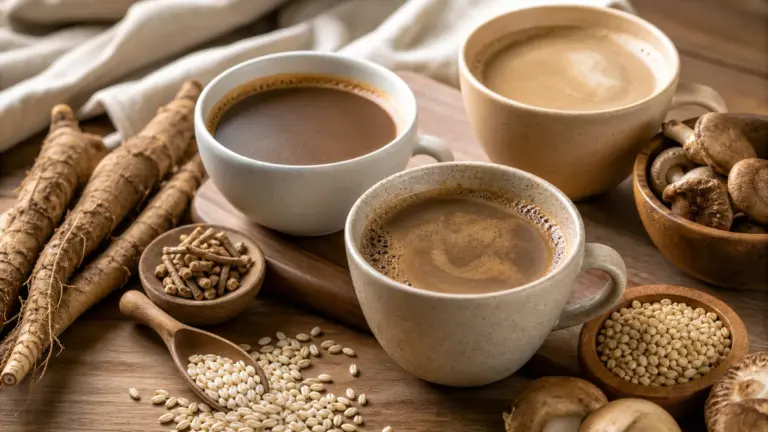
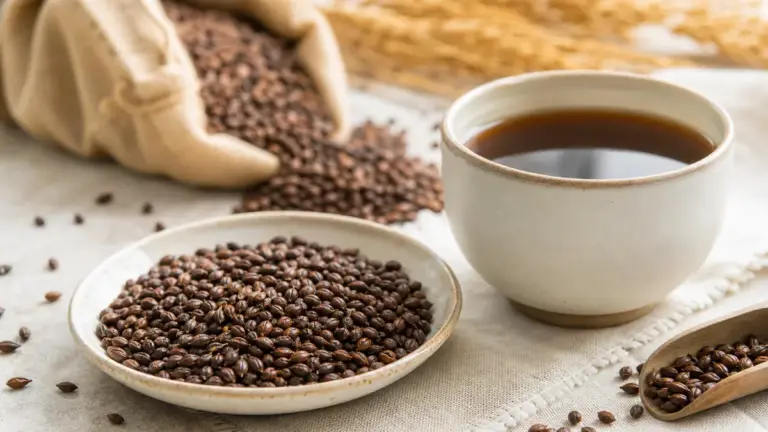
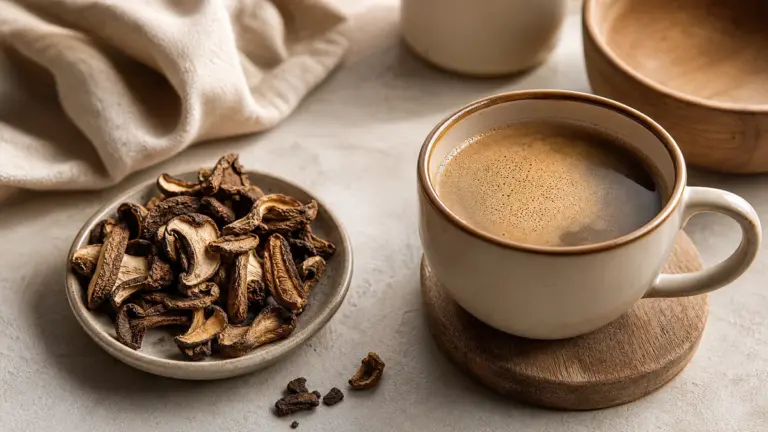
For a wider choice beyond dandelion root coffee, read Alternatives to Coffee. Chicory Coffee and Barley Coffee explore two other roasted substitutes, while Mushroom Coffee addresses a different category whose name also needs careful interpretation.
Sources
-
National Center for Complementary and Integrative Health. Dandelion, updated November 2024. Evidence summary, food-use safety, interaction uncertainties and pregnancy considerations.
https://www.nccih.nih.gov/health/dandelion -
European Medicines Agency, Committee on Herbal Medicinal Products. European Union herbal monograph on Taraxacum officinale F.H. Wigg., radix, first version, adopted 24 November 2021, published 2022. Reference EMA/HMPC/475726/2020.
https://www.ema.europa.eu/en/documents/herbal-monograph/final-european-union-herbal-monograph-taraxacum-officinale-fh-wigg-radix_en.pdf -
Abdel-Moemin, A. R., and Osama Aboraya, A. Innovative beverages of coffee and tea based on dandelion (Taraxacum officinale) roots and leaves. Agricultura, volume 11, issues 1 and 2, 2014, pages 1 to 10. Author-uploaded full text.
https://www.researchgate.net/publication/279482980_Innovative_beverages_of_coffee_and_tea_based_on_dandelion_Taraxacum_officinale_roots_and_leaves -
Traditional Medicinals. Roasted Dandelion Root Tea, undated product page, retrieved November 2026. Used for its declared ingredients, caffeine-free description, flavour description and preparation directions, not as evidence of medicinal efficacy.
https://www.traditionalmedicinals.com/products/roasted-dandelion-root-tea -
North Branch Nature Center, Ken Benton. Roasted Dandelion Root Tea, undated recipe hosted in its April 2020 directory. Used for culinary preparation and sourcing cautions.
-
Food Standards Agency. Guidance for safe foraging, 2023. Guidance published for England, Northern Ireland and Wales.
https://www.gov.uk/government/publications/guidance-for-safe-foraging/guidance-for-safe-foraging -
NHS. Medicines in pregnancy, page reviewed 2022, with an additional update dated September 2025. Used for advice about herbal remedies and discussing their use with healthcare professionals.
https://www.nhs.uk/pregnancy/keeping-well/medicines/
Research combined official herbal safety assessments, NHS and FSA guidance, a primary beverage study and published preparation instructions; the suggested measured recipe is an editorial adaptation, not a first-hand test.
Last checked: November 2026