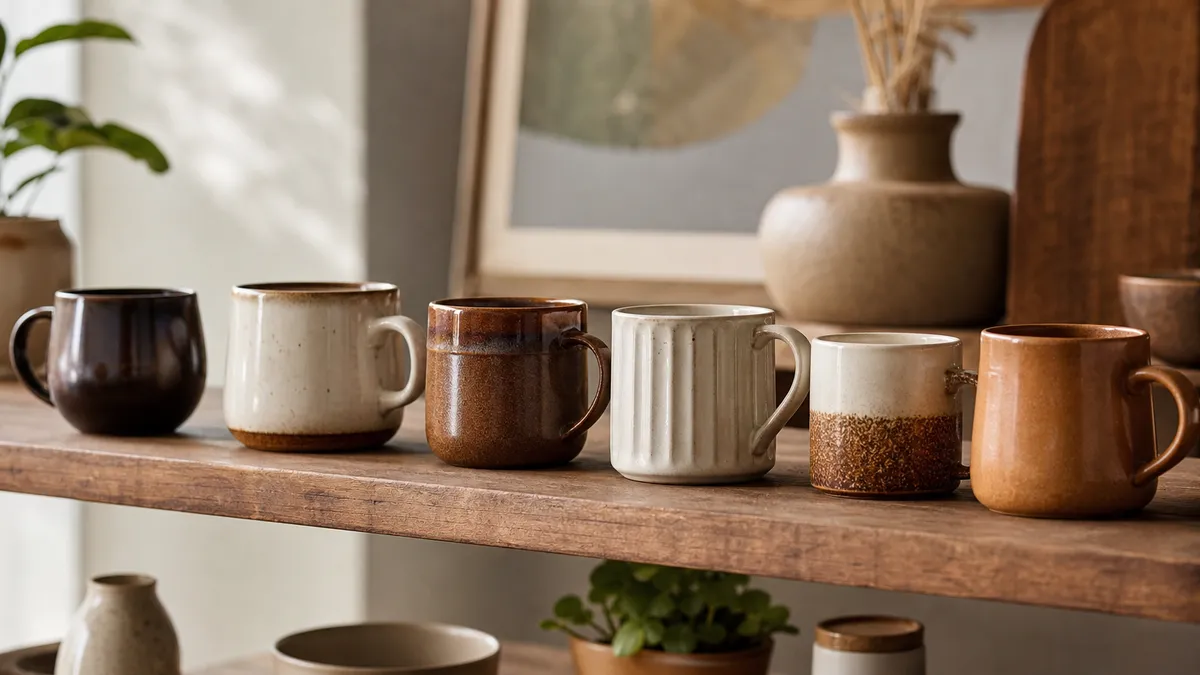
A good coffee mug fits your usual drink, feels comfortable when full and has clear instructions for washing and reheating. When comparing coffee-designed mugs, choose capacity, handle and rim before decoration: an attractive mug is only useful if you enjoy drinking from it.
In short
- Match the cup to the drink, not the other way round. Manufacturer examples include 70 ml demitasses, 120 ml cortado glasses and 150 to 165 ml flat white cups.
- Compare construction as well as material. A double wall and a lid address different routes of heat loss.
- Test the handle with water in the mug, with the seller’s permission. An empty mug tells you little about its loaded balance.
- Dishwasher-safe and microwave-safe are separate claims. Check the exact product, including its decoration.
- Treat promises about rims preserving crema or improving aromatics cautiously. Research supports some effects of cup shape on perception, not a universal best design.
What makes coffee-designed mugs useful?
There are two different kinds of coffee design: decoration that celebrates coffee, and physical design that suits drinking it. A mug can do both, but a coffee illustration tells you nothing about its capacity, balance or care requirements.
For this guide, the buying criteria are straightforward: an appropriate working capacity, comfortable grip, pleasant rim, stable base and care instructions that match your routine. Appearance comes after those essentials, although there is nothing wrong with choosing a colour you particularly like.
Start with the coffee you actually drink. An espresso drinker needs a small cup rather than a miniature version of a large breakfast mug; someone carrying filter coffee between a kitchen and a desk should prioritise secure handling and room below the rim.
For the broader choice of useful objects and presents, see coffee merchandise and gifts. Here, the focus is the drinking vessel itself.
Materials: stoneware, porcelain or borosilicate glass?
Material is a useful starting point, but it is not a complete performance specification. Compare the finished vessel, including its thickness, weight, shape and construction.
The table below compares these materials by practical appeal, limitations and the reader each is likely to suit. The recommendations are editorial judgements, not results from comparative product testing.
| Material | Main appeal | What to check | Best suited to |
|---|---|---|---|
| Stoneware | Substantial ceramic forms and expressive glazed finishes | Full weight, rim comfort and the maker’s care instructions | Someone who enjoys a solid, tactile everyday mug |
| Porcelain | Available in both fine-walled cups and substantial coffee-service designs | Actual wall thickness and handle clearance, rather than assuming it is delicate | Espresso and milk-drink drinkers wanting a purpose-shaped cup |
| Borosilicate glass | Transparency and greater thermal resistance than conventional soda-lime glass | Whether it is single- or double-walled, plus product-specific washing instructions | Someone who wants to see the coffee and milk |
| Double-walled borosilicate glass | An insulating construction as well as a transparent vessel | Handling instructions and whether microwave use is expressly permitted | Someone prioritising insulation without an opaque mug |
Stoneware is a ceramic category, not a guarantee that every handmade or factory-made mug behaves identically. Denby describes its own stoneware as vitrified, meaning fired into a non-porous, non-absorbent body, and declares it suitable for microwave and dishwasher use. Those claims belong to its products, not automatically to every stoneware mug.
Porcelain need not mean a fragile-looking teacup. Coffee-service porcelain includes substantial designs: notNeutral’s Lino espresso cup, for example, is fine porcelain with a shaped handle and curved interior. Look at the object rather than relying on the material name.
Borosilicate glass expands relatively little as its temperature changes, helping it resist thermal stress. That does not make it unbreakable, nor does it mean that every glass made from it is suitable for every appliance.
Crucially, borosilicate describes the glass composition; double-walled describes the construction. A single-walled borosilicate glass is not an insulated vessel simply because it is heat-resistant.
Choose the size by your usual drink
Use the following manufacturer examples as reference points, not fixed definitions of the drinks. ACME and Loveramics sell different capacities within familiar coffee categories, so the drink name alone is not enough.
| Drink | Verified capacity examples | Buying advice |
|---|---|---|
| Espresso | ACME demitasse: 70 ml; notNeutral Lino: 89 ml | Choose a small vessel that accommodates your shot without needing to fill it to the rim |
| Cortado or piccolo | Loveramics Twisted cortado glass: 120 ml | Check your own espresso and milk serving before ordering |
| Flat white | ACME Classic: 150 ml; Loveramics Deco: 165 ml | Choose the size that preserves your preferred coffee-to-milk balance |
| Cappuccino | Loveramics Twisted glass: 180 ml; ACME Classic: 190 ml | Allow for the finished drink, including foam |
| Latte or filter coffee | ACME examples include a 240 ml tumbler and 280 ml latte cup | Measure your normal serving and leave comfortable carrying room |
These are the manufacturers’ stated capacities, checked in November 2026. They are not independently measured working volumes.
Ask whether an advertised capacity is measured to the brim or to a recommended fill line. A mug that only just contains your drink leaves no useful room for carrying, stirring or adding milk.
Do not add extra milk merely to make a large cup look full unless you want a milkier drink. Equally, there is no requirement to fill a filter mug completely: buy for the serving you enjoy, rather than the largest vessel that fits the cupboard.
Also measure the space beneath your machine’s spout. Include the mug’s height, its width with the handle, and the room needed to lift it out.
Heat retention: why thicker is not always better
Coffee loses heat through several routes, including heat transfer to the cup and surroundings, and evaporation from its exposed surface. A mug’s behaviour therefore depends on more than whether its label says stoneware, porcelain or glass.
A cold, substantial ceramic mug can take heat from the coffee as the two move towards a shared temperature. Pre-warming reduces that initial temperature difference. Where the maker permits it, use warm water and empty the cup before brewing; do not microwave an empty mug as a shortcut.
Thicker walls also mean more material to heat. That is why “thicker keeps coffee hotter” is an incomplete buying rule: starting temperature and vessel construction matter too.
Double-walled glass uses a gap between its walls as part of its insulating design. Bodum describes this construction as keeping hot drinks hot, but that manufacturer claim is not a measured comparison with every ceramic mug.
For slow drinking, consider a compatible lid. In a controlled cooling study comparing several cup types, adding a lid had a greater effect on cooling rate than changing the cup material. It addresses heat loss at the open top, which wall insulation alone does not eliminate.
Ask for the test conditions behind any precise heat-retention promise: drink volume, starting temperature, room conditions, lid use and the temperature used to define “hot”. Without those details, a stated duration is difficult to compare.
Handle comfort, balance and everyday design
Handle comfort is personal. A design intended for a finger-and-thumb pinch may suit a small espresso cup but feel awkward on a full mug.
If possible, assess these details in person:
- Clearance: can you hold the handle without pressing your knuckles against the body?
- Grip: does its shape support your preferred hold without squeezing?
- Balance: can you lift and tilt the filled mug without an uncomfortable pull on your fingers?
- Base: does it sit flat, without rocking?
- Rim: is the drinking edge smooth and comfortable from different positions?
Do not judge by handle size alone. notNeutral describes its flush handle as designed for comfort and control, but that remains the maker’s design intention, not proof that it fits every hand.
Surface decoration deserves the same practical scrutiny. Check that raised patterns do not interfere with your grip, and that any intended stacking arrangement feels secure rather than improvised.
For an office cupboard, favour designs whose care instructions everyone can follow. A beautiful hand-wash-only mug is an awkward communal choice if everything routinely goes into the dishwasher.
Dishwasher and microwave safety
Check dishwasher and microwave suitability separately on the product page, packaging or base marking. An instruction for one process does not establish suitability for the other.
Royal Doulton’s care guidance illustrates the distinctions: its stoneware and porcelain guidance permits microwave use except where precious-metal decoration is present, while dishwasher use is directed at items marked dishwasher-safe. Its earthenware has different restrictions.
Gold or platinum decoration can rule out microwave use even when the underlying porcelain is otherwise suitable. Villeroy & Boch specifically excludes its metallic-embellished dinnerware from microwave use.
For glass, follow the exact model’s instructions rather than a general assumption about borosilicate. Bodum expressly lists dishwasher and microwave suitability for the Pavina product consulted here; that permission should not be transferred to unrelated double-walled glasses.
Also follow warnings about sudden temperature changes. Royal Doulton advises against rapid temperature changes for its stoneware and porcelain. Appliance-safe does not mean immune to thermal stress.
For a personalised or decorated mug, ask the seller whether the care instructions cover the finished design, not merely the undecorated blank.
Rim shape, aroma and what the evidence supports
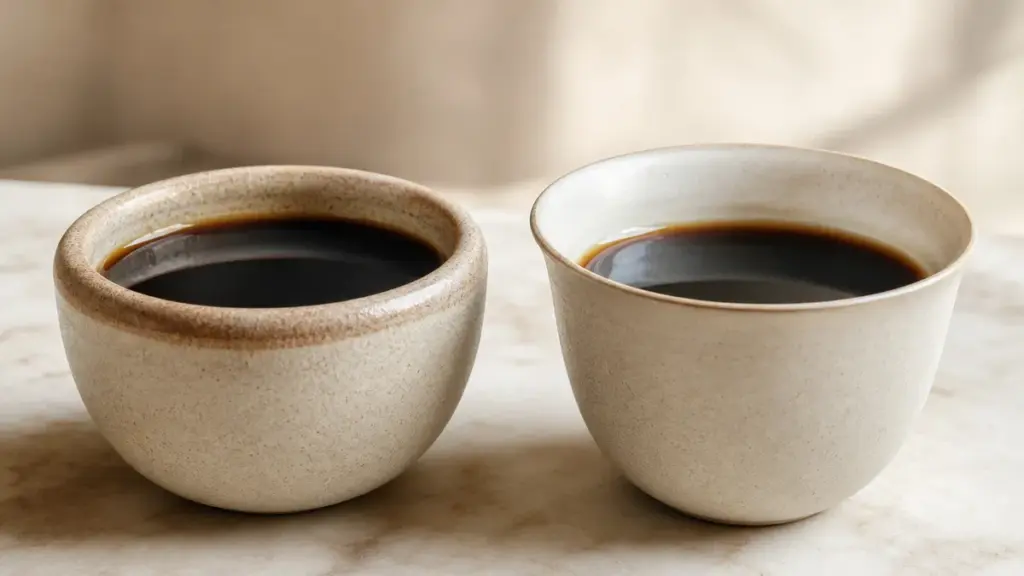
A thick, rounded rim and a thin, flared lip feel different against the mouth. Choose between them partly by preference, rather than treating either as technically superior.
Claims that a thick rolled rim preserves espresso crema, or that a thin flared lip necessarily improves filter-coffee aromatics, go beyond what the research consulted establishes. Neither is a dependable universal buying rule.
There is, however, experimental evidence that overall cup shape can influence reported coffee perception. A 2018 tasting experiment found differences in aroma, flavour and liking judgements between coffee served in differently shaped cups.
That is more informative than a decorative claim, but it does not isolate rim thickness as the cause or prove that one cup improves every coffee. A separate 2017 study used pictures of mugs to investigate expectations, not actual drinking: its findings should not be presented as proof of flavour changes during tasting.
For your own comparison, use the same coffee and similar serving temperatures. Notice both the aroma and the physical drinking experience, but do not mistake a preferred cup for evidence that the coffee itself has chemically improved.
Choose decoration freely once those functional details work. For objects intended mainly for display, explore coffee art and home décor; for a present built around several useful items, see coffee gift sets.
FAQ
Is a handmade mug better than a factory-made mug?
Not automatically. Treat handmade production as an aesthetic and craft preference, then apply the same checks for capacity, comfort and care instructions. Ask the maker about the finished mug’s intended use. For an everyday purchase, a clear answer about microwave and dishwasher suitability is more useful than a general description such as “ceramic”.
How can I choose a mug as a gift without knowing the recipient’s preferences?
Start with the vessel they already use and the drink they normally make. Match its approximate size and handling style unless they have expressed a wish for something different. Avoid imposing hand-washing or a very unusual grip on someone who values convenience. A familiar shape with thoughtful decoration is a sensible editorial choice.
Do matching cups matter when comparing coffees?
Matching cups are a sensible way to reduce distractions during an informal comparison. Experimental research shows that cup shape can influence reported coffee judgements, so changing both coffee and vessel makes the result harder to interpret. Use similar serving temperatures too, and keep the exercise about your preferences rather than declaring a universal winner.
Where to go next
For coffee-designed mugs within a wider present, read Coffee Gift Sets; for the broader selection process, start with Coffee Merchandise and Gifts. Coffee Art and Home Décor helps when appearance is the main purpose, while Coffee Posters and Prints offers an alternative for someone whose favourite drinking mug needs no replacement.
Sources
-
Denby, Stoneware Declaration of Conformity, 22 April 2025. Manufacturer declaration, hosted by its distributor.
https://www.hwlarsen.com/document/59621e23-5d68-46f1-acfe-6aa0a0d16167/462010005_doc.pdf/download -
notNeutral, Lino Espresso Cup Only, Indigo, undated product specification, accessed November 2026.
https://www.notneutral.com/products/lino-espresso-indigo-cup -
SCHOTT, Borosilicate Glass, undated technical overview, accessed November 2026.
https://www.schott.com/en-gb/expertise/materials/borosilicate-glass -
ACME USA, ACME Cups, undated manufacturer catalogue, accessed November 2026.
https://www.acmecupsusa.com/collections/acme-cups -
Loveramics, Product: twisted glass, 21 June 2022; and 165ml Flat White Cup and 13cm Shared Saucer, undated product specification, accessed November 2026.
https://usa.loveramics.com/blogs/journal/twisted-glass
https://www.loveramics.com/products/deco-165ml-flat-white-cup-saucer -
Bodum, PAVINA double-wall glasses, item 4559-10-12US, undated manufacturer specification and care guidance, accessed November 2026.
https://www.bodum.com/us/en/4559-10-12us-pavina -
Journal of Food Engineering, Experimental study of airflow and heat transfer above a hot liquid surface simulating a cup of drink, 2017. Primary experimental research.
https://www.sciencedirect.com/science/article/pii/S0260877416303752 -
Burns, Temperature dissociation of liquids in reusable thermoplastic containers: An eco-friendly scald risk?, 2019. Primary experimental research.
https://www.sciencedirect.com/science/article/pii/S0305417919302554 -
Royal Doulton, Care Guide, undated manufacturer guidance, accessed November 2026.
https://www.royaldoulton.com/en-gb/pages/care-guide -
Villeroy & Boch, Frequently asked questions, product-care section, undated, accessed November 2026.
https://www.villeroy-boch.com/service/faq/dining-lifstyle-faq/ -
Food Quality and Preference, The shape of the cup influences aroma, taste, and hedonic judgements of specialty coffee, 2018. Primary tasting experiment.
https://www.sciencedirect.com/science/article/pii/S0950329318300855 -
Food Quality and Preference, Does the shape of a cup influence coffee taste expectations? A cross-cultural, online study, 2017. Primary online experiment.
https://www.sciencedirect.com/science/article/pii/S0950329316302191
Research combined manufacturers’ published specifications and care instructions with primary research on cooling and sensory perception; the buying checklist is editorial guidance, not a report of first-hand testing.
Last checked: November 2026