
Coffee appears in art and literature as a drink, a daily ritual and a reason for people to gather, while coffeehouses have given writers and artists places to meet, observe and exchange ideas. Its creative significance lies in a contrast: the same table can support lively conversation or make someone’s solitude more visible.
In short
- Separate coffee as a subject within a work from the coffeehouse where creative people met.
- Coffeehouse culture connects reading, conversation and artistic networks, not simply solitary inspiration.
- A café scene does not prove that everyone pictured is drinking coffee.
- Famous examples reward close attention to ordinary details: a spoon, an empty chair, a window or the distance between people.
- Museum records, original texts and artists’ letters are stronger evidence than stories about a celebrated writer’s favourite table.
How coffee becomes more than a drink
A useful way to approach coffee in art and literature is to look for three roles: object, ritual and setting. The object might be a cup or coffee pot. The ritual might be serving a visitor, repeating a morning routine or lingering after a conversation. The setting might bring strangers together without requiring them to speak.
These distinctions help explain why coffee can matter even when the drink receives little description. Ask what would change if the cup disappeared. Would a meeting lose its reason to continue? Would a character’s hesitation become less noticeable? Would a painted table feel less occupied?
Coffee should not, however, become a universal explanation for creativity. Evidence that writers frequented coffeehouses establishes a social connection. It does not establish that coffee caused their ideas or that a particular work was written there.
This guide concentrates on those connections between people, places and creative work. The wider coffee and arts guide provides the route into the subject’s other branches.
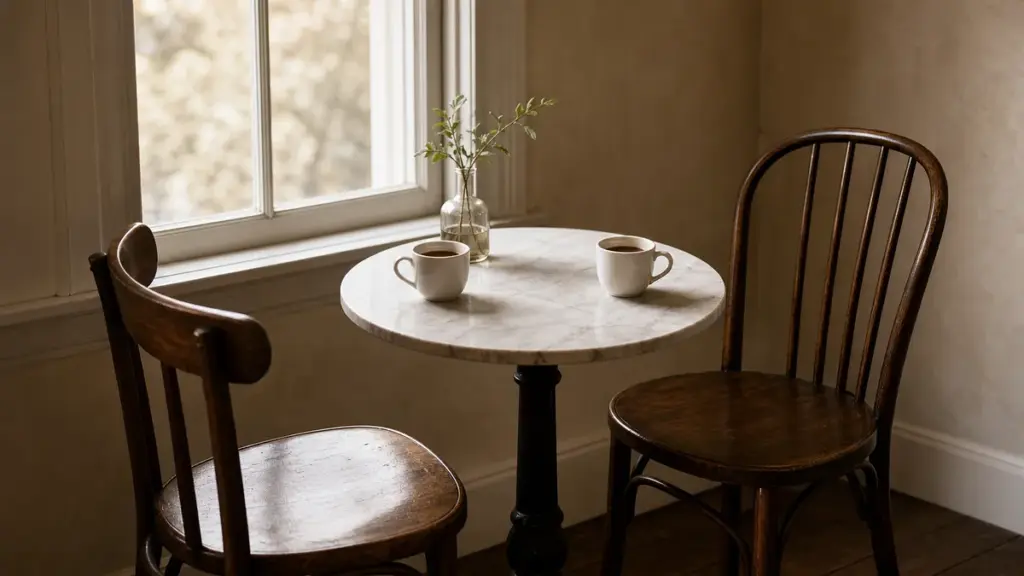
Coffeehouses as creative meeting places
London: conversation moving into print
The Courtauld’s account of Georgian London describes coffeehouses as places for reading newspapers, exchanging news, conducting business and debating public affairs. Its examples of literary customers include John Dryden, Jonathan Swift, Joseph Addison and Samuel Johnson. The creative significance is not just that recognised authors drank there, but that reading and discussion occupied the same room.
Joseph Addison made that relationship explicit in The Spectator, No. 10, dated 12 March 1711. He presented the periodical as a way of bringing philosophy out of scholarly seclusion and into everyday social settings, including coffeehouses and tea tables.
Read together, the historical account and Addison’s essay suggest a productive exchange between conversation and print. A paper could supply material for discussion; discussion could give a writer subjects, objections and examples of human behaviour. The coffeehouse was both a possible audience and a place to observe one.
That relationship was not always flattering. The Courtauld also records satirical criticism of coffeehouse gossip, idle talk and verbal posturing. For a writer, conversation offered material precisely because it could be foolish, competitive or revealing, as well as thoughtful.
Vienna: a network, not just a writing desk
Peter Altenberg’s autobiographical sketch commonly presented in English as How I Became a Writer offers a particularly vivid account of literary recognition beginning in a café. In the version hosted by the University of Washington, he describes writing at Café Central when Arthur Schnitzler and other literary figures arrived.
Altenberg tells how a sketch passed from that encounter to a reading and then to an invitation to contribute further work. This is the author’s retrospective account, not an independently documented transcript of the meeting. Its value here is the mechanism it describes: someone notices a manuscript, shares it and introduces its writer to another audience.
The table is therefore more than an attractive workplace. In Altenberg’s telling, it connects private writing to readers, advocates and publishing opportunities. His story makes the social work surrounding literature unusually visible.
The Austrian Commission for UNESCO identifies newspapers, characteristic furnishings and literary communication as elements of Viennese coffeehouse culture. Its inscription in Austria’s national inventory of intangible cultural heritage dates from 2011. That is national recognition, not an inscription on UNESCO’s worldwide Representative List.
Looking beyond European literary cafés
UNESCO’s account of Turkish coffee culture describes coffeehouses as places where people converse, share news and read books. It also identifies the tradition with hospitality and friendship, and notes its celebration in literature and songs.
This offers a useful corrective to treating coffee culture as the invention of a few celebrated European artistic circles. An invitation to coffee can carry cultural meaning through ordinary social practice, without a famous author or painter being present. The conversation itself may be the significant event.
Conversation and solitude in famous works
Addison: writing intended to enter conversation
Addison’s Spectator essay is useful because it does not merely mention coffeehouses as background. It names them among the places where ideas should circulate.
The distinction matters. A coffeehouse can function as a literary setting, but it can also shape a writer’s conception of an audience. Addison imagines thought becoming part of daily sociability rather than remaining confined to specialised study.
For more sustained attention to individual texts, follow the guide to coffee in literature.
Eliot: a small utensil measuring a life
In T. S. Eliot’s The Love Song of J. Alfred Prufrock, the speaker says:
I have measured out my life with coffee spoons;
The poem appeared in Poetry in June 1915. One useful reading of the line is that an ordinary utensil makes a whole life seem divided into small, repetitive portions. Coffee is not presented here as adventurous fuel for creation; its associated object becomes a measure of familiarity and restraint.
The surrounding poem moves through social anticipation, self-consciousness and hesitation. That context makes the spoon more telling than an isolated quotation on a coffee mug. It belongs to a voice preoccupied with what might happen, what others might think and whether to act.
This is interpretation of the speaker’s language, not evidence about Eliot’s own coffee habits. A poem’s “I” should not automatically be treated as its author.
Van Gogh: the café as an experiment in seeing
Vincent van Gogh’s Terrace of a Café at Night (Place du Forum), dated 1888, turns a social setting into a study of night-time colour. In a letter to his sister Willemien that September, he describes small figures drinking beneath a large yellow lantern, with blue, violet and green surroundings.
His account is valuable because it explains an artistic problem rather than leaving us to invent one. He was interested in painting night without relying on black and described his enjoyment of working on the spot after dark.
A reasonable visual reading is that the illuminated terrace offers a place of human activity within the darker street. But the letter does not identify every drink. The work belongs in a discussion of café culture without needing the stronger, unsupported claim that each figure holds coffee.
Hopper: together without obvious connection
Edward Hopper’s Nighthawks (1942) offers a counterpoint. The Art Institute of Chicago describes an all-night diner with three customers and an attendant, separated from the viewer by an uninterrupted stretch of glass.
The museum records an important qualification: Hopper denied deliberately filling his paintings with symbols of isolation, while acknowledging that urban loneliness probably entered Nighthawks unconsciously.
That leaves room for interpretation without making it compulsory. The diner may feel lonely, sheltered, tense or strangely companionable. Its figures share a place, but the picture does not supply a reassuring account of their relationships.
For a closer look at visual examples and their materials, composition and context, see coffee in visual art.
A short timeline of coffee and creative culture
These selected dates connect documented texts, artworks and cultural recognition. They are reference points, not a claim that coffee’s artistic history followed a single path.
| Date | Verified example | What to notice |
|---|---|---|
| 1711 | Addison’s The Spectator, No. 10 | Coffeehouses named as places for ideas to circulate |
| 1888 | Van Gogh’s Terrace of a Café at Night and related letter | A social setting becoming an experiment in colour |
| 1915 | Publication of Eliot’s Prufrock in Poetry | An everyday coffee utensil carrying psychological meaning |
| 1942 | Hopper’s Nighthawks | Physical proximity without an explained social connection |
| 2011 | Viennese coffeehouse culture entered Austria’s national inventory | Recognition of a continuing cultural practice |
How to look and read more closely
Use this checklist with a painting, poem, novel or short story. It works best when you begin with what is actually present, before deciding what coffee must symbolise.
- Identify the evidence. Is coffee named, visibly identifiable or merely assumed because the setting is a café? Keep those possibilities separate.
- Follow the human action. Who serves, waits, reads, writes or speaks? Ask whose activity receives attention and whose remains in the background.
- Look at distance. Notice the spacing between chairs, bodies and tables. In writing, look for interruptions, silence and answers that fail to connect.
- Examine repetition. A repeated serving or familiar utensil might suggest comfort, habit or confinement. Test the interpretation against the surrounding work.
- Check the historical claim. Distinguish a documented visit from a claim that an entire book was written at a particular table. Look for letters, manuscripts, contemporary accounts or scholarly editions.
The final step is to keep observation and interpretation distinct. “There is no visible entrance” describes a feature identified in the museum’s account of Nighthawks. “The viewer feels excluded” interprets its effect.
Both kinds of statement can be useful. The stronger reading shows how it reached its conclusion, rather than treating the conclusion as something everyone must see.
FAQ
Does a café painting always belong to the history of coffee?
No, a café setting does not establish that coffee is the painting’s principal subject. It may matter more as a place for observing people or studying light, movement and social relationships. Van Gogh’s terrace is a useful example: his letter discusses drinking figures, but concentrates on colour and painting at night rather than identifying their beverages.
Were historic coffeehouses equally open to everyone?
No, cultural importance should not be confused with equal access. The Austrian Commission for UNESCO’s account states that Viennese coffeehouses were initially reserved for men before women were admitted. Access needs checking for the particular city and period; evidence of lively intellectual exchange does not, by itself, establish an inclusive institution.
How can I check a claim about a writer’s favourite café?
Start with the writer’s letters, diaries or memoirs, then compare them with scholarly research and the venue’s account. Distinguish “visited”, “met other writers there” and “wrote this work there”, because each requires different evidence. Altenberg’s autobiographical sketch supports discussing his own account of a literary encounter, not treating every detail as independently corroborated.
Where to go next
Start with Coffee and the Arts for the broader cultural connections. Continue with Coffee in Paintings and Sculptures for visual works, or Coffee in Literature for closer reading of coffee in art and literature’s written branch.
Sources
- The Courtauld, “Georgian London’s Coffeehouses”, undated. Historical overview of coffeehouse activities, literary customers and satire. Retrieved source.
- Joseph Addison, The Spectator, No. 10, 12 March 1711. University of Virginia, Literature in Context, annotated transcription. Retrieved text.
- Peter Altenberg, “How I Became a Writer”, text identified by the host as “So wurde ich”, 1913, with a 1919 edition reference. University of Washington, Vienna 1900, English-language transcription. Retrieved text.
- Austrian Commission for UNESCO, “Viennese coffee house culture”, national inventory entry, inscribed 2011. Retrieved entry.
- UNESCO, “Turkish coffee culture and tradition”, Representative List entry, 2013. Retrieved entry.
- T. S. Eliot, “The Love Song of J. Alfred Prufrock”, first published 1915. Poetry Foundation, authorised text and original issue contents. Retrieved poem; June 1915 issue.
- Kröller-Müller Museum, “Terrace of a Café at Night (Place du Forum)”, undated collection record for the 1888 painting. Retrieved record.
- Van Gogh Museum and Huygens ING, Vincent van Gogh: The Letters, letter 678, to Willemien van Gogh, 9 and about 14 September 1888; scholarly web edition, 2009. Retrieved letter.
- Art Institute of Chicago, “Nighthawks”, collection commentary drawn from Essential Guide, 2013, p. 58. Retrieved record.
Researched through original literary texts, an artist’s correspondence, museum collection records and official cultural heritage entries; interpretative readings are distinguished from documented historical claims.
Last checked: November 2026