Coffee in paintings and sculptures appears as a drink, a domestic ritual, a café setting and an everyday object transformed into art. Clear examples include Chardin’s Glass of Water and Coffeepot, Cézanne’s La Femme à la cafetière and Jasper Johns’s Painted Bronze, but a famous café painting does not necessarily show anyone drinking coffee.
In short
- Distinguish pictures of coffee itself from pictures of cafés, where the drinks may be alcoholic or unidentified.
- Chardin’s Glass of Water and Coffeepot, about 1761, is a verified coffee-related still life.
- Degas’s In a Café, 1875 to 1876, is also called L’Absinthe: it should not be described as a coffee-drinking scene.
- Juan Gris’s Breakfast, 1914, combines painting and pasted paper rather than being a conventional oil painting.
- In sculpture, coffee equipment and packaging can become the subject even when no drink is present.
Artistic Depictions of Coffee
The most useful starting question is simple: is coffee actually identified, or is the artwork merely set in a café? A title, collection record or curator’s account can establish the connection more securely than the colour of a painted drink.
For a beginner, three subjects provide a manageable route into this area: coffee vessels in still life, people gathered around coffee, and the café as a social space. Sculpture adds another possibility: the pot, cup or container becomes a physical artwork rather than something represented on a canvas.
This guide concentrates on identifiable visual works. The wider connections between creative disciplines belong in coffee and the arts, while coffee in art and literature provides the broader cross-disciplinary context.
Coffee as an object
A still life is an arrangement of inanimate things, such as vessels, food and tableware. When looking at one, start with what the artist makes visible: a pot’s rounded body, a cup’s elliptical rim, the reflection on a glass or the interval between objects.
Chardin’s Glass of Water and Coffeepot offers a particularly direct example. Its museum title identifies the coffee vessel, but the picture need not be treated as an instruction sheet for historical brewing. A painted pot establishes an object’s presence, not its contents at that particular moment.
Try looking before reading the label. Which object attracts your eye first? Does the pot feel substantial, delicate or almost absorbed into the background? These questions keep attention on the artwork rather than reducing it to evidence that someone once enjoyed coffee.
Coffee as an occasion
A coffee table can organise relationships between people. Look for who pours, who waits, who faces another person and who turns away. These are useful prompts for interpretation, although they do not prove what the figures are thinking.
Edvard Munch’s At the Coffee Table is a verified example of a coffee-related domestic scene. Its title gives a firmer basis for inclusion than a general assumption that every painted cup contains coffee.
The café as a setting
Café pictures require more caution. Manet’s At the Café, Degas’s In a Café and Van Gogh’s night scenes are relevant to café culture, but they should not all be placed under the narrower heading of coffee drinking.
That distinction makes the pictures more interesting, not less. It allows the café to be understood as a setting for company, entertainment or isolation without inventing a beverage identification.
Famous Paintings Featuring Coffee
The selection below separates direct coffee subjects from related café scenes. “Collection” identifies the institution associated with the work, not a guarantee that it is currently hanging in a particular room.
| Artist | Work and date | Collection | Coffee connection |
|---|---|---|---|
| Jean-Siméon Chardin | Glass of Water and Coffeepot, about 1761 | Carnegie Museum of Art, Pittsburgh | A directly identified coffee vessel in a still life |
| Édouard Manet | At the Café / Au café, 1878 | Oskar Reinhart Collection ‘Am Römerholz’, Winterthur | Café society, not securely identified coffee drinking |
| Edgar Degas | In a Café / Dans un café, also L’Absinthe, 1875 to 1876 | Musée d’Orsay, Paris | A café scene associated with absinthe |
| Edvard Munch | At the Coffee Table, 1883 | MUNCH, Oslo | An explicitly coffee-related domestic subject |
| Vincent van Gogh | Terrace of a Café at Night (Place du Forum), about 16 September 1888 | Kröller-Müller Museum, Otterlo | An outdoor café setting |
| Vincent van Gogh | The Night Café, 1888 | Yale University Art Gallery, New Haven | A café interior, not a confirmed coffee-drinking scene |
| Paul Cézanne | La Femme à la cafetière, about 1895 | Musée d’Orsay, Paris | A woman beside a coffee pot and cup |
| Juan Gris | Breakfast (Le Petit déjeuner), 1914 | Museum of Modern Art, New York | A mixed-media breakfast still life with coffee-related material |
| Ernst Ludwig Kirchner | Cafe, 1928 | Detroit Institute of Arts | A modern café scene rather than a verified depiction of coffee |
Chardin: choose the right painting
Chardin is a sound starting point, but A Lady Taking Tea should not be relabelled as coffee. Painted in 1735 and held by The Hunterian in Glasgow, it is identified by the collection as a tea subject.
For coffee, choose Glass of Water and Coffeepot, about 1761. The Carnegie Museum of Art records it as oil on canvas. Comparing these titles provides a useful lesson: shared tableware and domestic surroundings do not make tea and coffee interchangeable subjects.
Manet and Degas: café does not mean coffee
Manet’s At the Café, dated 1878, belongs to the Oskar Reinhart Collection ‘Am Römerholz’. It began as part of a larger composition that Manet divided and reworked into independent paintings. The other principal section is the National Gallery’s Corner of a Café-Concert, which that institution dates to probably 1878 to 1880.
This history is worth knowing when reproductions appear to show related but different scenes. It also prevents a title mix-up: At the Café and Corner of a Café-Concert are separate works, not alternative names for one canvas.
Degas’s In a Café, dated 1875 to 1876 by the Musée d’Orsay, is also known as L’Absinthe. The museum’s interpretation emphasises the isolation of the seated figures. Read it as a café scene involving absinthe, not as a portrait of the effects or pleasures of coffee.
Van Gogh: two very different nights
Van Gogh’s Terrace of a Café at Night (Place du Forum) and The Night Café both date from 1888, but they are different paintings in different collections.
The Kröller-Müller work places the terrace’s warm yellow, orange and green lighting against a deep blue night sky. Yale’s The Night Café brings the viewer inside, where red walls and a green billiard table create a much more unsettling contrast.
A useful viewing exercise is to compare how each picture makes the space feel before considering the people. Neither needs an invented espresso order to justify its place in the visual history of café culture.
Munch and Cézanne: the domestic coffee table
Munch’s At the Coffee Table, 1883, provides a direct coffee subject outside the better-known Parisian café pictures. MUNCH records the work as oil on canvas, under inventory number MM.M.00627.
Cézanne’s La Femme à la cafetière, dated about 1895 by the Musée d’Orsay, puts a seated woman beside a coffee pot and cup. The museum stresses the simplified forms and the organised horizontal and vertical lines.
Here the coffee equipment is more than incidental decoration. Following the museum’s formal reading, compare the pot’s upright body with the woman’s substantial figure. The objects help organise the portrait rather than merely furnish its background.
Coffee Still Lifes and Modern Works
Gris’s Breakfast (Le Petit déjeuner), 1914, changes the relationship between an everyday breakfast and its representation. MoMA records gouache, oil and crayon alongside cut-and-pasted printed paper. Its historical exhibition documentation also identifies coffee packaging among the materials.
This is collage: a work incorporating attached pieces of material. Instead of asking only “what objects are pictured?”, ask “which surfaces are painted, and which are physically pasted down?” The distinction matters because an actual fragment of packaging enters the artwork alongside the artist’s marks.
Kirchner’s Cafe, 1928, offers another modern direction. The Detroit Institute of Arts describes it as a scene painted from memory that conveys the energy of urban entertainment and social life. It belongs in a discussion of café imagery, but the collection record does not justify calling the figures coffee drinkers.
Together, these works suggest a productive comparison. Chardin invites close attention to represented objects; Gris complicates the boundary between representation and material; Kirchner turns attention towards the social setting. These are ways of reading the selected works, not a claim that all coffee art follows one historical progression.
Coffee in Sculpture
Jasper Johns: a coffee container becomes art
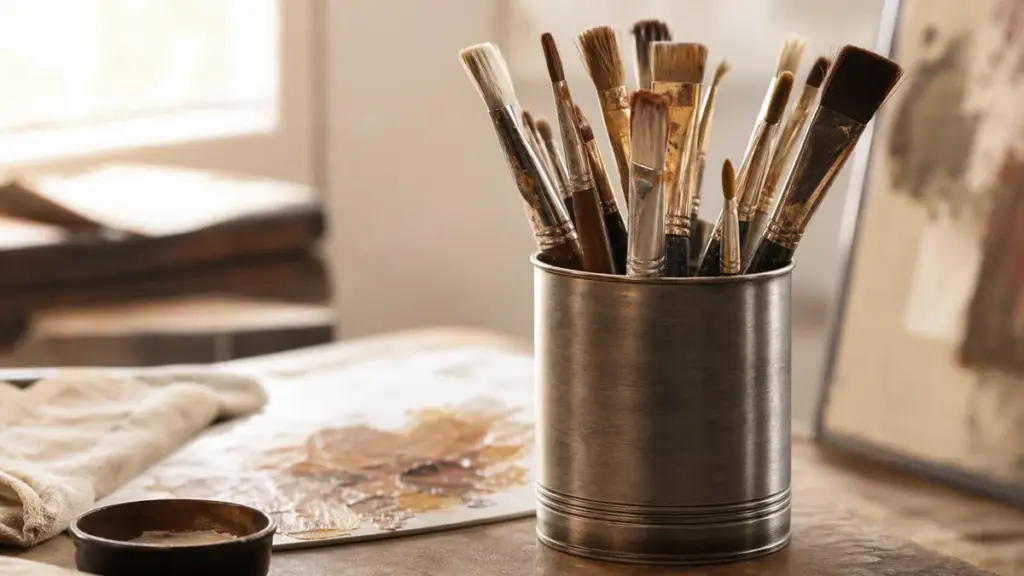
Jasper Johns’s Painted Bronze, 1960, depicts a coffee can holding brushes. MoMA records its medium as oil on bronze and lists it as a promised gift of Marie-Josée and Henry R. Kravis in honour of David Rockefeller.
The material is the crucial detail. This is not simply a discarded container placed in a gallery: the familiar object is represented in bronze and painted. Knowing that changes the viewing question from “why keep this tin?” to “why remake something so ordinary?”
Specify the coffee-can version when searching. Johns also made a different Painted Bronze involving ale cans, so the title alone can lead to the wrong work.
Arman: coffee equipment within a bronze composition
Arman’s Five O’Clock, 1996, provides a later example. The Fondation A.R.M.A.N. catalogue describes its components as a copy of an antique sculpture and a coffee set, in patinated bronze.
Patination is a surface treatment that alters metal’s colour and appearance. Here, the useful comparison is between the recognisable coffee service and the sculptural figure. Consider whether the combination feels ceremonial, disruptive or domestic: those are interpretative possibilities, rather than a documented single meaning.
The foundation record verifies the work’s identity and materials. It does not establish one permanent public collection or a place where readers can reliably see an example.
How to Look at Coffee Art
Use this checklist with a museum image or in a gallery:
- Establish the connection. Does the collection identify coffee, coffee equipment or merely a café?
- Read the exact title. Note translated titles and alternatives, particularly In a Café and L’Absinthe.
- Check the medium. Painted canvas, pasted packaging and painted bronze ask different questions of the viewer.
- Separate observation from interpretation. “A coffee pot stands beside the figure” is an observation; “it symbolises comfort” needs argument or supporting scholarship.
- Record the collection and check display information separately. Ownership, a promised gift and a temporary exhibition are not interchangeable.
Keep visual evidence distinct from narratives supplied by another medium. For the written side of the subject, coffee in literature is the more appropriate next step.
FAQ
Does every brown drink in a painting count as coffee?
No, colour alone is not enough to identify a painted drink. Look first for the collection’s title, catalogue description or curatorial interpretation. If those sources do not identify the contents, describe what is visible, such as a cup, glass or dark liquid. Leaving the drink unidentified is more accurate than assigning it a plausible but unsupported name.
Are paintings made with coffee the same as paintings featuring coffee?
No, coffee as an artistic material is different from coffee as a depicted subject. A picture can show a coffee pot while being made entirely with oil paint, as with Chardin’s example. When researching an individual work, check both the subject description and the medium rather than assuming that a coffee connection tells you what the artist used.
Can I assume these artworks are currently on display?
No, a collection attribution is not a display guarantee. Works may be stored, lent or temporarily unavailable, and a museum record may describe a promised gift rather than an outright acquisition. Check the institution’s current object page before planning a visit, and contact the museum if seeing one particular artwork is essential to your plans.
Where to go next
Read Coffee and the Arts for the wider creative context, then Coffee in Art and Literature to connect visual subjects with written ones. Coffee in Literature turns from objects and compositions to language and narrative, while Coffee in Literature and Film extends that comparison to screen storytelling.
Sources
Collection pages without a publication date are marked “undated”. Artwork dates are not publication dates.
- Carnegie Museum of Art, Glass of Water and Coffeepot, collection record, undated.
https://collection.carnegieart.org/objects/f7fe7406-d3ad-405e-b172-93a8dfe0643e - The Hunterian, University of Glasgow, Gallery 1: Large Print Labels, undated.
- Oskar Reinhart Collection ‘Am Römerholz’, Division and revision: Manet’s Reichshoffen revealed, exhibition account, 2005 to 2006.
https://www.roemerholz.ch/en/division-and-revision-manets-reichshoffen-revealed - The National Gallery, Edouard Manet: Corner of a Café-Concert, collection record, undated.
https://www.nationalgallery.org.uk/paintings/edouard-manet-corner-of-a-cafe-concert - Musée d’Orsay, Dans un café, collection record, undated.
https://www.musee-orsay.fr/en/artworks/dans-un-cafe-1147 - MUNCH, Ved kaffebordet / At the Coffee Table, collection record MM.M.00627, undated.
https://www.munch.no/objekt/MM.M.00627 - Kröller-Müller Museum, Terrace of a Café at Night (Place du Forum), collection record, undated.
https://www.krollermuller.nl/en/collection/vincent-van-gogh-terrace-of-a-caf-at-night-place-du-forum-km-108-565 - Yale University, Yale News, Oscar Sweeting, Vincent van Gogh’s luminous late-night haunt, 2025.
https://news.yale.edu/2025/07/14/vincent-van-goghs-luminous-late-night-haunt - Musée d’Orsay, La Femme à la cafetière, collection record, undated.
https://www.musee-orsay.fr/fr/oeuvres/la-femme-la-cafetiere-1485 - The Museum of Modern Art, Juan Gris: Breakfast (Le Petit déjeuner), collection record, undated; historical exhibition checklist, undated.
https://www.moma.org/collection/works/35572
https://www.moma.org/documents/moma_master-checklist_387278.pdf - Detroit Institute of Arts, Cafe, collection record, undated.
https://dia.org/collection/cafe/51009 - The Museum of Modern Art, Jasper Johns: Painted Bronze, collection record, undated; “Five for Friday: Yes We Can! (or Nice Cans, or It’s in the Can)”, 2015.
https://www.moma.org/collection/works/189521
https://www.moma.org/explore/inside_out/2015/04/24/five-for-friday-yes-we-can-or-nice-cans-or-its-in-the-can/ - Fondation A.R.M.A.N., Five O’Clock, catalogue record ARM 001828, undated.
https://arman-studio.com/RawFiles/001828.html
This piece was researched through museum collection records, institutional interpretation, exhibition documentation and the artist foundation’s catalogue, with visual readings distinguished from documented facts.
Last checked: November 2026