Coffee appears in the arts as a subject, a social ritual and a reason for people to gather. Its most useful cultural story is not simply a list of famous coffee drinkers, but how coffeehouses gave writers, painters and musicians places to meet, exchange criticism and find audiences.
In short
- Separate coffee inside an artwork from the coffeehouse where creative work happened.
- Coffeehouse history connects literary debate, Impressionist circles, Viennese modernism and Beat-era writing, without explaining those movements on its own.
- Painting, literature, film and music use coffee to explore companionship, routine, independence and isolation.
- Design belongs in this story: furniture and interiors shape how people sit, stay and interact.
- Read café legends cautiously. A documented meeting place is not proof that a particular masterpiece was created there.
How coffeehouses supported the arts
A coffeehouse can matter to art without appearing in a finished work. It can provide a meeting room, somewhere to read, a performance venue or a setting for disagreements that sharpen an idea.
That distinction gives coffee and the arts a clearer focus. Rather than treating every painted cup as evidence of a creative movement, ask what the establishment actually enabled: repeated encounters, access to publications, collaboration or contact with an audience. The physical room and the drink have related, but different, histories.
The story also extends beyond European literary cafés. UNESCO’s account of the Turkish meddah, a solo storyteller, identifies coffeehouses among the places where performers entertained and educated audiences. Their repertoire combined stories, songs, imitation and improvisation, including social criticism.
Here, the coffeehouse was not merely somewhere an artist rested between performances. It was a performance space, with the audience helping to shape the occasion. This is a useful corrective to the familiar image of the solitary writer beside a cup.
For the complementary question of what coffee means within individual works, see coffee as an artistic subject.
Four settings where café society mattered
Enlightenment London: conversation and print
In early eighteenth-century London, coffeehouses helped connect conversation with the circulation of printed essays and news. Joseph Addison and Richard Steele’s The Spectator drew on coffeehouse society, while its issues were shared and discussed in those same surroundings.
The Edward Worth Library’s exhibition on their periodicals describes coffeehouses as places where material could be written, distributed and read. The relationship therefore worked both ways: conversation supplied material for publication, and publication supplied material for conversation.
This supports a specific claim about Enlightenment culture, the period associated with arguments about reason, society and public discussion. Coffeehouses helped ideas circulate. It does not establish that drinking coffee produced those ideas, or that every discussion was open-minded.
Impressionist Paris: a circle before a label
The Musée des impressionnismes Giverny identifies the Café Guerbois as a meeting place for the circle around Édouard Manet in the 1860s. Those gathering there included Claude Monet, Pierre-Auguste Renoir and Edgar Degas.
Its significance lies in bringing artists into regular contact. A movement needs more than a shared room, but a meeting place makes sustained argument and mutual recognition possible.
Do not confuse that social role with the subject matter of every café picture. An artist could meet colleagues in one establishment and depict quite different experiences elsewhere. Nor should every drink in a French café scene be assumed to be coffee.
Viennese modernism: the café as a working room
Around 1890, Café Griensteidl became a meeting place for Young Vienna, a literary group whose participants included Hugo von Hofmannsthal, Arthur Schnitzler and Karl Kraus. Vienna’s municipal history describes writers moving between favoured establishments and painters gathering at Café Museum.
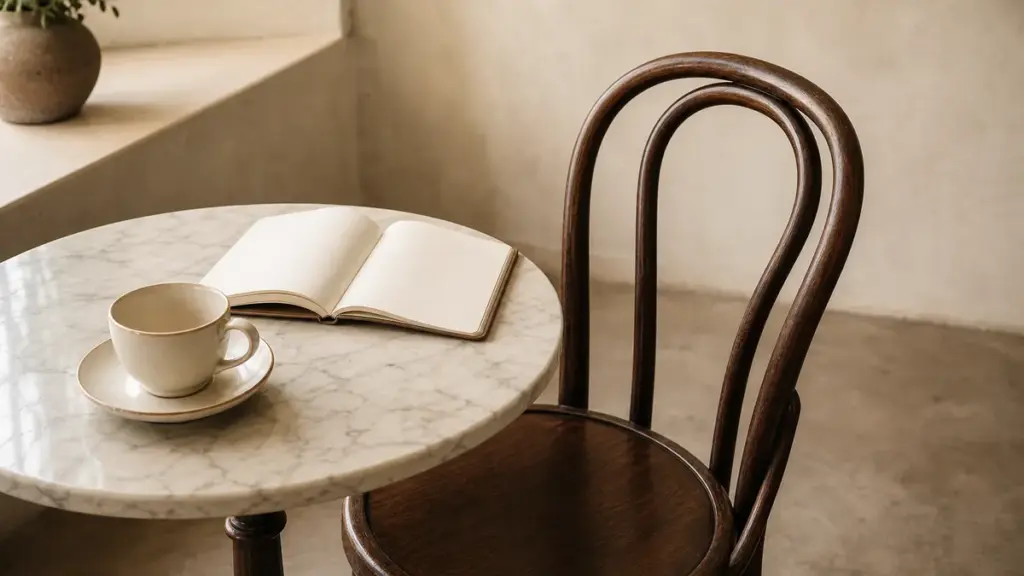
The Austrian Commission for UNESCO identifies newspaper tables, marble-topped tables, alcoves and Thonet chairs among the characteristic features of Viennese coffeehouse culture. These details help explain the attraction: reading, conversation and time spent alone could coexist in one room.
The tradition entered Austria’s national inventory of intangible cultural heritage in 2011. That is a national listing, not inscription on UNESCO’s international Representative List.
Beat-era San Francisco: a neighbourhood network
Caffe Trieste opened in San Francisco’s North Beach in 1956. The city’s historic-preservation assessment records its association with Beat Movement writers and its role as a gathering place for poetry, art and music.
The useful emphasis is on a neighbourhood’s creative network rather than a roll call of celebrities. The Beat Generation, a literary movement associated with challenges to conventional American life, had places where writers could encounter one another outside formal institutions.
Trieste illustrates how a coffeehouse could connect literary activity with music and everyday neighbourhood life. That is a stronger historical claim than the suggestion that espresso itself generated a new literary style.
Painting and literature: the room becomes a subject
Once a café enters a painting or a poem, it becomes a constructed scene rather than a neutral historical record. The artist chooses what to include, where to place the viewer and what to leave unexplained.
Edward Hopper’s Nighthawks (1942) is a useful example. It depicts an all-night diner, not a European coffeehouse, with customers at a counter beneath bright interior lighting. The Art Institute of Chicago discusses the figures’ apparent separation and the absence of a visible entrance.
One possible reading is that a shared public room offers proximity without intimacy. But that is an interpretation of the composition, not proof that the figures feel a particular emotion. For closer attention to visual evidence, continue with coffee in visual art.
Literature can compress a similar tension into an everyday object. In T. S. Eliot’s The Love Song of J. Alfred Prufrock, the speaker describes a life measured in coffee spoons. Read as an image of repetition and hesitation, the spoon becomes more than tableware.
Neither example needs a detailed account of brewing. Their interest lies in how familiar objects and settings make an emotional or social condition visible.
Film and music: coffee gives an encounter its rhythm
Film can turn drinking coffee into an action that structures a scene: someone pours, waits, stirs or takes a sip before answering. When watching, notice whether these gestures support the conversation or interrupt it.
Jim Jarmusch’s Coffee and Cigarettes (2003) brings that possibility to the foreground. Its eleven short films revolve around coffee, cigarettes and encounters between people. Rather than treating the refreshments as incidental scenery, the film makes repeated social rituals part of its organising form.
A useful viewing question is: what changes between the people while the basic arrangement remains familiar? Compare the apparent ease of sharing a table with the awkwardness of maintaining a conversation.
Music offers another connection between the coffeehouse and the work performed there. Johann Sebastian Bach’s Coffee Cantata, BWV 211, was created around 1734 for concerts at Café Zimmermann in Leipzig, according to the Netherlands Bach Society.
Its comic story concerns Liesgen and her father’s attempt to stop her drinking coffee. She ultimately insists on keeping coffee as part of married life. Read as a small domestic drama, it makes personal preference and parental authority matters for musical entertainment.
The distinction matters: a work performed in a coffeehouse need not concern coffee, but this one connects venue and subject.
Design: the objects that make café society possible
Design is not simply decoration added after the cultural activity. A chair, table or interior establishes practical possibilities: where a person can sit, what they can put down and how they face other people.
Michael Thonet’s No. 14 coffeehouse chair, launched in 1859, provides a concrete example. The Design Museum describes its bentwood construction and its assembly from separate components. Steam made the wood flexible enough to form curves before drying into its new shape.
The chair connects the café with industrial design, the development of objects for manufacture and repeated use. Coffee culture belongs not only to paintings of rooms, but also to the making of those rooms.
Look at furniture as carefully as cups. Ask whether a depicted table allows reading or writing, whether seating brings people together, and whether the interior encourages lingering. These are questions to test against the object or image, not assumptions about every café.
Recurring themes, and how to recognise them
Across these examples, several themes offer useful starting points:
- Companionship and separation: sharing a room does not necessarily mean sharing an experience.
- Routine and passing time: small repeated gestures can suggest comfort, constraint or a life slipping by.
- Independence and authority: choosing what to drink can become a dispute about who controls everyday life.
- Public and private life: a café can place intimate behaviour within view of strangers.
These are interpretive possibilities, not a fixed dictionary of symbols. A cup does not always mean hospitality, and a lone customer does not always mean loneliness. Begin with the evidence in the work.
A short timeline
| Date | Verified example | Cultural connection |
|---|---|---|
| 1711 | Addison and Steele’s The Spectator | Coffeehouse conversation and periodical writing |
| Around 1734 | Bach’s Coffee Cantata | Coffeehouse concerts and comic domestic drama |
| 1859 | Launch of Thonet’s No. 14 chair | Coffeehouse furniture and industrial design |
| 1860s | Manet’s circle at Café Guerbois | Artists meeting around shared concerns |
| 1956 | Opening of Caffe Trieste | A gathering place later associated with Beat writers |
A checklist for looking, reading and listening
- Identify the setting. Is it a coffeehouse, diner, home or an unspecified room?
- Establish the action. Is coffee being served, consumed, refused or merely displayed?
- Notice relationships. Who speaks, who listens and who performs the service?
- Separate evidence from interpretation. Record what is visible or stated before deciding what it means.
- Check historical claims separately. A convincing fictional café is not documentation of a real venue.
This approach keeps coffee and the arts connected without making the drink explain everything. For more sustained interpretation of particular works, use the guide to coffee in art and writing.
FAQ
Do I need specialist coffee knowledge to understand these works?
No, close attention to the work is usually more useful than knowing brewing terminology. Begin with the setting, gestures, objects and relationships. Coffee knowledge becomes relevant when a preparation method or serving custom is clearly identified and affects the interpretation. Avoid inferring a precise drink from an indistinct painted cup.
Can a café painting be used as historical evidence?
Yes, but treat it as a selective representation rather than a photograph of everyday life. Compare its details with museum research, contemporary documents and other images. Hopper’s Nighthawks, for example, was inspired by a restaurant, but the Art Institute’s account emphasises its carefully constructed composition rather than a straightforward record of a particular place.
What should I check before repeating a famous café anecdote?
Check whether the evidence establishes a visit, regular attendance or the creation of a particular work. These are different claims. Look for correspondence, manuscripts, archival photographs or a researched institutional account, and identify the source of the story. A venue’s association with an artist does not by itself establish where an artwork was made.
Where to go next
Read Coffee in Art and Literature for closer exploration of coffee as a symbol, ritual and subject within individual works. Continue with Coffee in Paintings and Sculptures to examine visual representations and the evidence behind their interpretation.
Sources
- Edward Worth Library, Making the News: The Spectator and The Guardian in the Early Eighteenth Century, undated online exhibition. Retrieved exhibition.
- UNESCO, Arts of the Meddah, public storytellers, 2008 inscription record. Retrieved heritage record.
- Musée des impressionnismes Giverny, Impressionism, undated online guide. Retrieved museum guide.
- City of Vienna, History of Viennese coffee house culture, undated online history. Retrieved municipal history.
- Austrian Commission for UNESCO, Viennese coffee house culture, 2011 inventory entry. Retrieved national inventory record.
- City and County of San Francisco, Caffe Trieste: Legacy Business Registry application and historic-preservation assessment, 2016. Retrieved assessment.
- Art Institute of Chicago, Nighthawks, collection entry incorporating the Essential Guide, 2013. Retrieved collection entry.
- Poetry Foundation, T. S. Eliot, The Love Song of J. Alfred Prufrock, undated online poem text. Retrieved poem text.
- Criterion Channel, Coffee and Cigarettes, undated catalogue entry for the 2003 film. Retrieved film entry.
- Netherlands Bach Society, Kaffeekantate, BWV 211, 2019 performance resource and commentary. Retrieved music resource.
- Design Museum, Thonet Chair No. 14, undated object guide. Retrieved design guide.
This article was researched through museum collections, library exhibitions, heritage inventories, municipal records and specialist film and music resources; interpretive readings are distinguished from documented history.
Last checked: November 2026